



5086-74-8
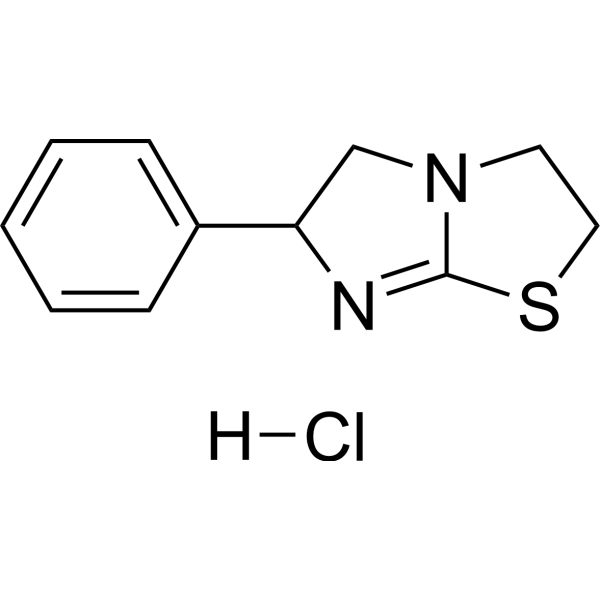
Chemical Structure
Tetramisole hydrochloride
Synonym(s): (±)-Tetramisole hydrochloride; DL-Tetramisole hydrochloride; R-829
- CAS No.: 5086-74-8
- Formula:C11H13ClN2S
- Molecular Weight:240.75
IUPAC Name: 6-phenyl-2,3,5,6-tetrahydroimidazo[2,1-b]thiazole hydrochloride
InChIKey: LAZPBGZRMVRFKY-UHFFFAOYSA-N
SMILES: [H]Cl.C12=NC(C3=CC=CC=C3)CN1CCS2
Biological Activity: Tetramisole hydrochloride is an orally active, selective inward rectifier potassium channel agonist with an EC50 of approximately 30 μM for the Kir2.1 subunit. Tetramisole hydrochloride is also an anti-nematode agent that blocks neuromuscular transmission by non-competitive depolarization. Tetramisole hydrochloride promotes the forward transport of Kir2.1 channels, hyperpolarizes the resting potential (RP), shortens the action potential duration (APD), inhibits intracellular calcium overload and the PKA signaling pathway, and exerts anti-arrhythmic and anti-myocardial remodeling activities. Tetramisole hydrochloride can be used in cardiac electrophysiology research and research related to myocardial ischemia and heart failure[1][2].
| Cat. No. | Nom du produit | Pureté | Description | Pricing | |||||||||||||||||||
|---|---|---|---|---|---|---|---|---|---|---|---|---|---|---|---|---|---|---|---|---|---|---|---|
|
|
Tetramisole hydrochloride | 99.04% | Tetramisole hydrochloride is an orally active, selective inward rectifier potassium channel agonist with an EC50 of approximately 30 μM for the Kir2.1 subunit. Tetramisole hydrochloride is also an anti-nematode agent that blocks neuromuscular transmission by non-competitive depolarization. Tetramisole hydrochloride promotes the forward transport of Kir2.1 channels, hyperpolarizes the resting potential (RP), shortens the action potential duration (APD), inhibits intracellular calcium overload and the PKA signaling pathway, and exerts anti-arrhythmic and anti-myocardial remodeling activities. Tetramisole hydrochloride can be used in cardiac electrophysiology research and research related to myocardial ischemia and heart failure. | ||||||||||||||||||||
|
loading...
/
|
|||||||||||||||||||||||
|
|
Tetramisole hydrochloride (Standard) | ≥98% | Tetramisole hydrochloride (Standard) is the analytical standard of Tetramisole (hydrochloride). This product is intended for research and analytical applications. Tetramisole hydrochloride is an orally active, selective inward rectifier potassium channel agonist with an EC50 of approximately 30 μM for the Kir2.1 subunit. Tetramisole hydrochloride is also an anti-nematode agent that blocks neuromuscular transmission by non-competitive depolarization. Tetramisole hydrochloride promotes the forward transport of Kir2.1 channels, hyperpolarizes the resting potential (RP), shortens the action potential duration (APD), inhibits intracellular calcium overload and the PKA signaling pathway, and exerts anti-arrhythmic and anti-myocardial remodeling activities. Tetramisole hydrochloride can be used in cardiac electrophysiology research and research related to myocardial ischemia and heart failure. | ||||||||||||||||||||
|
loading...
/
|
|||||||||||||||||||||||
-
Similarity Score 1.00
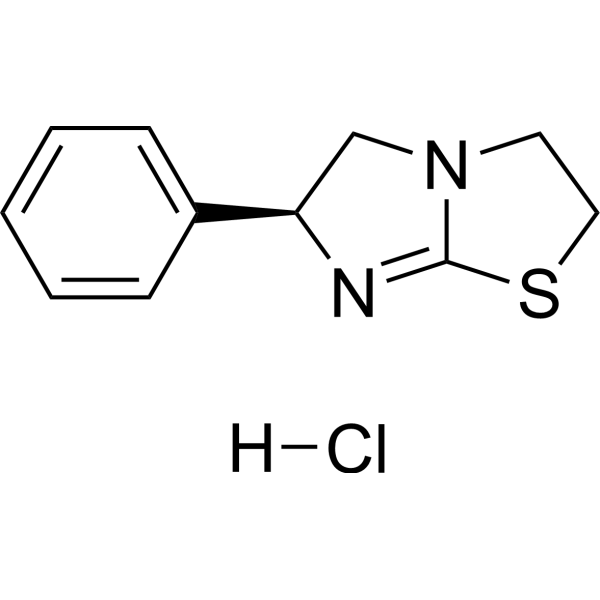 HY-13666Levamisole hydrochloride
-
Similarity Score 0.98
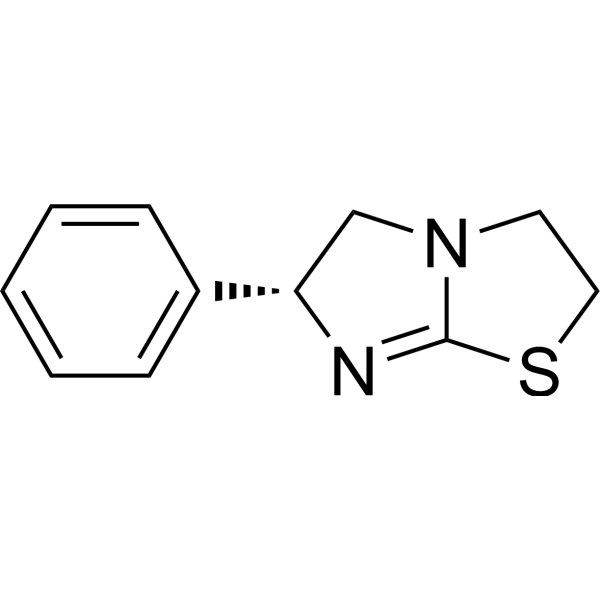 HY-119426Dexamisole
-
Similarity Score 0.98
 HY-A0106RLevamisole (Standard)
-
Similarity Score 0.98
 HY-B1194ATetramisole
-
Similarity Score 0.82
 HY-1839474-Bromolevamisole
-
Similarity Score 0.66
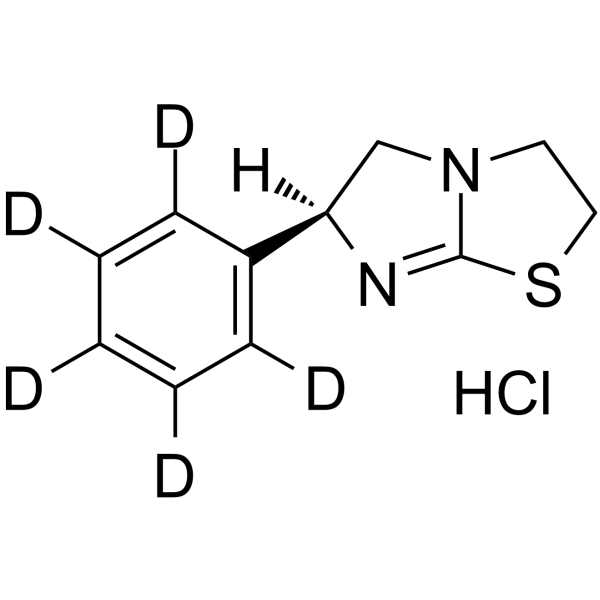 HY-13666SLevamisole-d5 hydrochloride
-
Similarity Score 0.59
 HY-482931Crel-(2R,3R)-2-Phenylpiperidin-3-amine dihydrochloride
-
Similarity Score 0.58
 HY-168824Cypenamine hydrochloride
-
Similarity Score 0.58
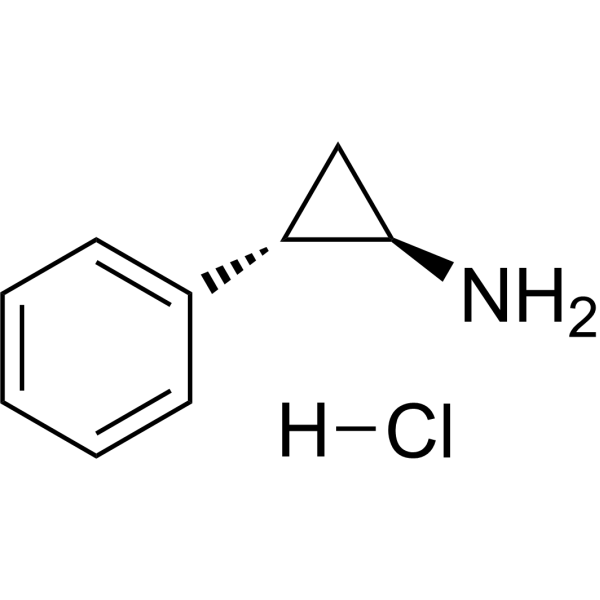 HY-17447AGTranylcypromine hydrochloride (GMP)
-

Explore the MedChemAI to find more analogs


References
- [1]. Liu Q, et al. Tetramisole is a new IK1 channel agonist and exerts IK1 -dependent cardioprotective effects in rats. Pharmacol Res Perspect. 2022 Aug;10(4):e00992. [Content Brief]
- [2]. Nowak LG, et al. Tetramisole and Levamisole Suppress Neuronal Activity Independently from Their Inhibitory Action on Tissue Non-specific Alkaline Phosphatase in Mouse Cortex. Subcell Biochem. 2015;76:239-81. [Content Brief]



