

1. Search Result
Search Result
Results for "

peptide hydrogels

" in MedChemExpress (MCE) Product Catalog:

17

Inhibitors & Agonists

2

Biochemical Assay Reagents

22

Peptides

1

Isotope-Labeled Compounds

Cat. No. Product Name Target Research Area
  • HY-P3159

    Biochemical Assay Reagents Others
    VPM peptide is a dithiol protease-cleavable peptide cross-linker. VPM peptide can be incorporated into the backbone of the PEG-diacrylate (PEG-DA) macromer to form PEG hydrogel .
  • HY-P10294

    Amyloid-β Others
    Oligopeptide P11-4 is an α-peptide that can be self-assembled into β-sheet amyloids with a hydrogel appearance at low pH. Oligopeptide P11-4 can be used in biomimetic mineralization, enamel regeneration and oral care agent .
  • HY-P11328

    Integrin Others
    GFOGER peptide is an artificially synthesized collagen-mimetic sequence. GFOGER peptide acts as a ligand for α2β1, α11β1 and α1β1 integrins, thereby supporting integrin-mediated cell adhesion to collagen. GFOGER peptide triggers signaling pathways mediated by the α2β1 integrin receptor and upregulates osteoblast differentiation. GFOGER peptide accelerates and enhances bone formation at sites of refractory femoral defects. GFOGER peptide can be passively adsorbed onto polymer scaffolds for cell-free/growth factor-free bone formation. GFOGER peptide is used in biomaterials such as hydrogels and 3D bioinks for tissue engineering research including bone formation .
  • HY-P2532

    Integrin Others
    Integrin Binding Peptide is derived by fibronectin. Integrin Binding Peptide can be used for PEG hydrogel preparation .
  • HY-P2263

    Peptides Inflammation/Immunology
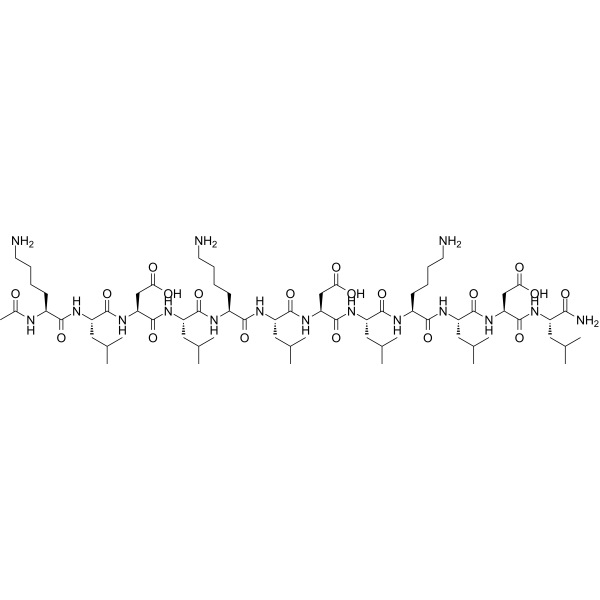
    KLD-12 is a 12-residue self-assembling peptide that is used in tissue-engineering. KLD-12 combined with SDF-1 self-assembled polypeptide enhances chondrogenic differentiation of bone marrow stromal cells (BMSCs). KLD-12 hydrogel can fill full-thickness osteochondral defects in situ and improve cartilage repair .
  • HY-P2632

    RADA16

    Biochemical Assay Reagents Neurological Disease
    RAD16-I (RADA16) is a non-directed self-assembling peptide hydrogel. Under physiological conditions, RAD16-I spontaneously forms a three-dimensional nanofiber network that mimics the extracellular matrix, and possesses excellent properties such as high water content, biocompatibility and degradability. RAD16-I serves as an ideal scaffold for three-dimensional cell culture. RAD16-I not only maintains cell viability and induces self-organization, but also supports cell adhesion, proliferation, differentiation and insulin secretion, effectively stabilizes islet clusters and promotes directed differentiation of the cardiac lineage. RAD16-I can construct a cell-friendly nano-microenvironment for research related to diseases such as myocardial infarction and diabetes .
  • HY-P1771A

    Biochemical Assay Reagents Inflammation/Immunology
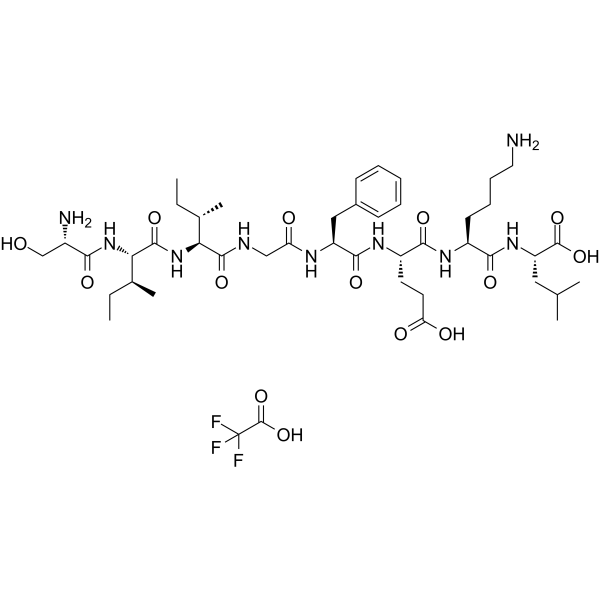
    OVA G4 peptide TFA is a variant of the agonist ovalbumin (OVA) peptide SIINFEKL (257-264). SIINFEKL is routinely used to stimulate ovalbumin-specific T cells and to test new vaccine adjuvants can form a stable hydrogel .
  • HY-P6299

    Peptides Others
    MAX8 is a peptide made up of 20 residues that can fold and self-assemble under the influence of DMEM, forming a mechanically rigid hydrogel, this allows cells to be evenly immersed in the gel when the gelation is triggered in the presence of cells .
  • HY-P10675

    Biochemical Assay Reagents Metabolic Disease
    Peptide K is a self-assembling peptide fiber that can be used to prepare fibrous nanocomposite hydrogels. The fibrous nanocomposite hydrogels have a dynamic network that adapts to cells and enhances cell-matrix and cell-cell interactions, thus significantly promoting the mechanotransduction, metabolic energy, and osteogenesis of encapsulated stem cells .
  • HY-P10699

    Biochemical Assay Reagents Others
    MAX1 is a self-assembling peptide used to prepare hydrogels .
  • HY-P1771

    Biochemical Assay Reagents Inflammation/Immunology
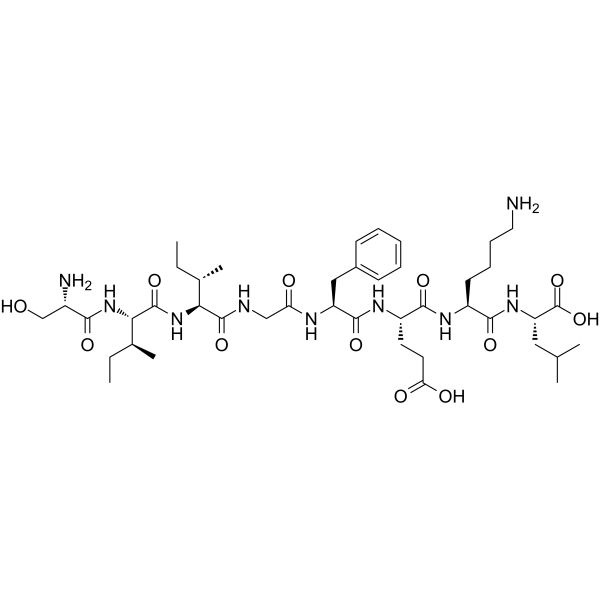
    OVA G4 peptide is a variant of the agonist ovalbumin (OVA) peptide SIINFEKL (257-264). SIINFEKL is routinely used to stimulate ovalbumin-specific T cells and to test new vaccine adjuvants can form a stable hydrogel .
  • HY-P10715

    Peptides Inflammation/Immunology Cancer
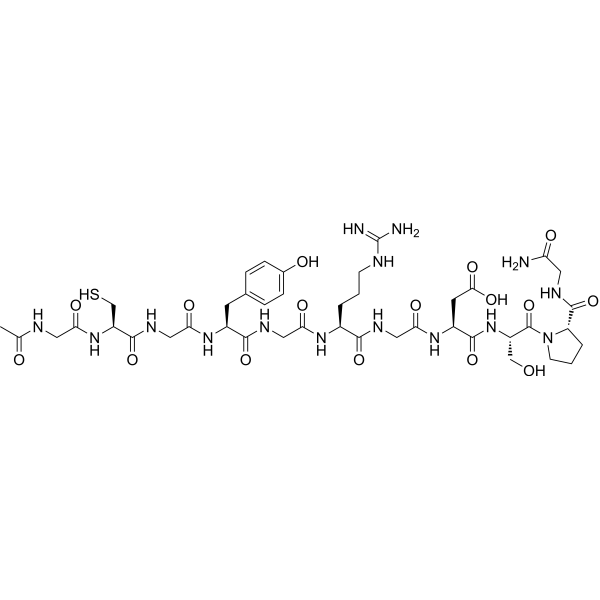
    Fmoc-KCRGDK is a self-assembling peptide that can be used to prepare hydrogels and assist in drug delivery for immune checkpoint inhibitors. Fmoc-KCRGDK can be applied in cancer immunotherapy research .
  • HY-P11066

    Peptides Others
    RAD-FHR peptide is a self-assembling peptide. RAD-FHR peptide significantly enhances migration, proliferation and growth factor-secretion ability in human adipose stem cells (hASCs). RAD-FHR peptide can be used for synthesis of nanofiber hydrogel for stem cell behaviors research in biomimetic 3D systems .
  • HY-P3159A

    Biochemical Assay Reagents Others
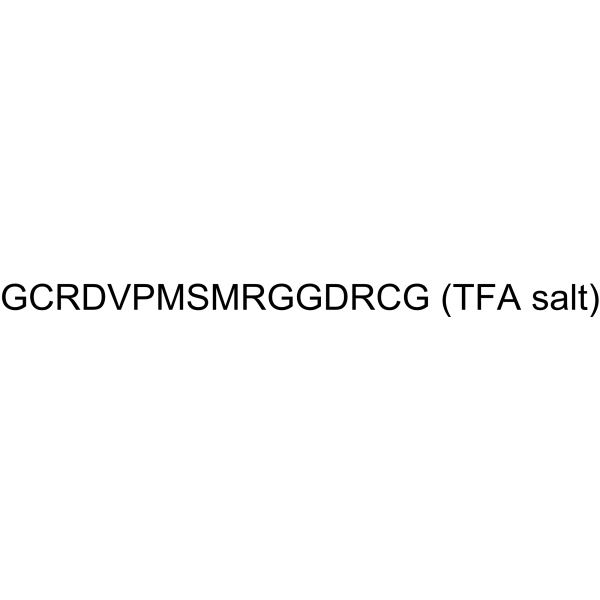
    VPM peptide TFA is a dithiol protease-cleavable peptide cross-linker. VPM peptide TFA can be incorporated into the backbone of the PEG-diacrylate (PEG-DA) macromer to form PEG hydrogel .
  • HY-P10678

    Biochemical Assay Reagents Others
    d-KYFIL is a peptide-based biomaterial that can be used for stereocomplexation and can be used to study the regulation of supramolecular assembly of hydrogel biomaterials .
  • HY-P10661

    Biochemical Assay Reagents Others
    L-KYFIL is a pentapeptide that is amorphous on its own. When mixed with D-KYFIL, it transforms from fibrous hydrogels into plate-like networks, resulting in changes in mechanical properties and forming a crystalline state. The mixture can protect L-KYFIL from proteolytic degradation. L-KYFIL can be used to study stereocomplexation behavior of peptide sequences and in the development of biomaterials .
  • HY-P2263A

    Peptides Inflammation/Immunology
    KLD-12 TFA is the TFA salt form of KLD-12 (HY-P2263). KLD-12 TFA is a self a 12-residue self-assembling peptide that is used in tissue-engineering. KLD-12 TFA combined with SDF-1 self-assembled polypeptide enhances chondrogenic differentiation of bone marrow stromal cells (BMSCs). KLD-12 TFA hydrogel can fill full-thickness osteochondral defects in situ and improve cartilage repair .
  • HY-P11063

    Peptides Cancer
    AcfffGk is a short peptide with the ability to self-assemble into helical nanofibers, forming non-covalently cross-linked hydrogels that serve as scaffolds for 3D cell culture .
  • HY-P11065

    Peptides Others
    RAD-SKP peptide is a self-assembling peptide. RAD-SKP peptide with decellularized cartilage matrix (DCM) can be used for synthesis of nanofiber hydrogel. RAD-SKP peptide can be used for cartilage repair research .
  • HY-P11754

    Peptides Others
    YIGSRC is a laminin-mimetic peptide. YIGSRC supports endothelial cell adhesion and tube formation. YIGSRC contains a cysteine residue for chemical modification to hydrogels via thiol-ene reaction. YIGSRC can be chemically modified onto hydrogels to improve in vitro vascularization .
  • HY-P11641

    MMP Inflammation/Immunology
    GCRRGPLGLSLGKRRCG is an MMP13-specific substrate peptide cleaved by MMP13. GCRRGPLGLSLGKRRCG contributes to an MMP13-responsive hydrogel microsphere system that achieves intelligent and controllable drug release in osteoarthritis (OA), decelerates disease progression, and promotes articular cartilage repair. GCRRGPLGLSLGKRRCG can be used for the research of osteoarthritis .
  • HY-P2632C

    Biochemical Assay Reagents Neurological Disease
    RAD16-I, free acid TFA is a derivative of RADA16 (HY-P2632), with no Ac and NH2 modifications at both ends, and it has the same function as RADA16. RAD16-I, free acid TFA is a non-directed self-assembling peptide hydrogel. Under physiological conditions, RAD16-I, free acid TFA spontaneously forms a three-dimensional nanofiber network that mimics the extracellular matrix, and possesses excellent properties such as high water content, biocompatibility and degradability. RAD16-I, free acid TFA serves as an ideal scaffold for three-dimensional cell culture. RAD16-I, free acid TFA not only maintains cell viability and induces self-organization, but also supports cell adhesion, proliferation, differentiation and insulin secretion, effectively stabilizes islet clusters and promotes directed differentiation of the cardiac lineage. RAD16-I, free acid TFA can construct a cell-friendly nano-microenvironment for research related to diseases such as myocardial infarction and diabetes .

Inquiry Online

Your information is safe with us. * Required Fields.

Salutation


Country or Region *

Applicant Name *


Organization Name *

Department *


Email Address *


Product Name *

Cat. No.


Requested quantity *

Phone Number *


Remarks

Inquiry Online

Inquiry Information

Product Name:
Cat. No.:
Quantity:
MCE Japan Authorized Agent:

