



TCRS-417
Based on 1 publication(s) in Google Scholar
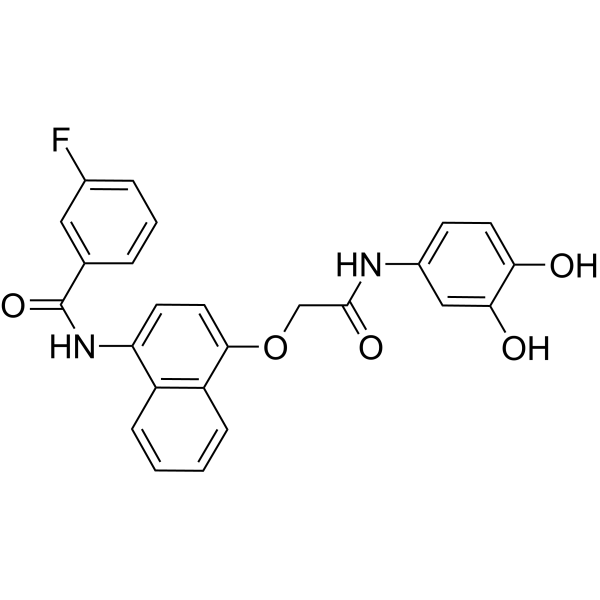
TCRS-417 (T417) is a small-molecular inhibitor for PBX1. TCRS-417 can directly block PBX1-binding to DNA (IC50 = 6.58 μM), and affects PBX1 transcription. TCRS-417 is able to hammer out the stemness traits of Carboplatin (HY-17393)-resistant (CR) cells to revert to a differentiated status through tacking PBX1 signaling cascade. TCRS-417 significantly suppresses self-renewal and proliferation of cancer cells expressing high levels of PBX1. TCRS-417 can decrease the mRNA levels of FOXM1, NEK2, and E2F2 in cancer cell lines. TCRS-417 is selectively toxic against chr1q-amp myeloma and solid tumor cells.
Nur für Forschungszwecke. Wir verkaufen nicht an Patienten.
- Reinheit : 99.13%
- CAS. Nr.: 2032123-28-5
- Formel: C25H19FN2O5
- Molecular Weight:446.43
-
Speicherung:Powder -20°C, 3 years , 4°C, 2 years ; In solvent -80°C, 6 months , -20°C, 1 month

To place orders, for customer services and technical support, please contact: MedChemExpress USA
Tel: 609-228-6898 E-mail: [email protected] [email protected]


-
 Biologische Aktivität
-
Chemical Information
-
Lösungsmittel & Löslichkeit
- Protokoll
- Reinheit & Dokumentation
- Verweise
-
 Help & FAQs


Publications Citing Use of MedChemExpress (MCE) TCRS-417
MoreAlle DNA/RNA Synthesis Isoform-spezifische Produkte anzeigen
More

Biologische Aktivität
Beschreibung
In Vitro
TCRS-417 (Compound T417) (20 μM, 48 h) results in significant depletion of the G2/M phase, together with G0/1 phase arrest, upon T417 treatment in 4 myeloma (MM.1S, U266, NCU.MM1, OPM2), 2 breast cancer (MCF-7, LTED), 2 ovarian cancer (OVCAR3, A2780), 2 lung cancer (A549, H69AR), and 1 brain cancer (SNB-75) cell lines[3].
TCRS-417 (20 μM, 16-20 h) significantly decreases the mRNA levels of FOXM1, NEK2, and E2F2 in almost all 11 cell lines[3].
TCRS-417 (0.625-80 μM) decreases the PBX1 binding to the DNA in a dose-dependent manner[4].
TCRS-417 (0-10 μM) attenuates the spherogenic capacity and re-directs stem cell-like cells back to a more differentiated state in OVCAR3-CR and SKOV3-CR cell lines[4].
MedChemExpress (MCE) has not independently confirmed the accuracy of these methods. They are for reference only. Further protocols information, click here.
In Vivo
TCRS-417 (5 mg/kg/injection, intratumoral, 3 doses per week over a course of 3 weeks) reduces MEOX1 and BCL6 gene expression in a dose-dependent manner[4].
TCRS-417 (5 mg/kg/injection, s.c., 3 doses per week over a course of 3 weeks) significantly delays tumor growth and reduced the end point tumor weight of A2780 xenografts when combined with Carboplatin (HY-17393) in immunocompromised nu/nu mice[4].
MedChemExpress (MCE) has not independently confirmed the accuracy of these methods. They are for reference only.


Chemical Information
-
CAS. Nr. 2032123-28-5
-
Appearance Solid
-
Molecular Weight 446.43
-
Formel C25H19FN2O5
-
SMILES
O=C(C1=CC(F)=CC=C1)NC2=CC=C(C3=C2C=CC=C3)OCC(NC4=CC=C(C(O)=C4)O)=O
-
Synonyms
T417
-
Versand
Room temperature in continental US; may vary elsewhere.
-
Speicherung
Powder -20°C 3 years 4°C 2 years In solvent -80°C 6 months -20°C 1 month


Publications (1)
-
Journal Impact Factor
-
Most Recent
-
Science
2025 Nov 6;390(6773):eads7152. PMID: 41197002


Lösungsmittel & Löslichkeit
In Vitro:
DMSO : 100 mg/mL (224.00 mM; ultrasonic and warming and heat to 60°C; Hygroscopic DMSO has a significant impact on the solubility of product, please use newly opened DMSO)
Please refer to the solubility information to select the appropriate solvent. Once prepared, please aliquot and store the solution to prevent product inactivation from repeated freeze-thaw cycles.
Storage method and period of stock solution: -80°C, 6 months; -20°C, 1 month. When stored at -80°C, please use it within 6 months. When stored at -20°C, please use it within 1 month.
Please refer to the solubility information to select the appropriate solvent. Once prepared, please aliquot and store the solution to prevent product inactivation from repeated freeze-thaw cycles.
Storage method and period of stock solution: -80°C, 6 months; -20°C, 1 month. When stored at -80°C, please use it within 6 months. When stored at -20°C, please use it within 1 month.
Konzentration (Stammlösung) × Volumen (Stammlösung) = Konzentration (Ziellösung) × Volumen (Ziellösung)

Protokoll
-
RNA extraction experimental
By lysing cells, releasing RNA, and removing impurities such as proteins and DNA, high-purity RNA products are finally obtained. The commonly used traditional method is the guanidine isothiocyanate/phenol/chloroform method (Trizol), which is suitable for a variety of animal materials including animal tissues, microorganisms, cultured cells, etc., and most plant materials.
-
hPSC maintenance and expansion
This protocol maintains and expands human pluripotent stem cells under feeder-free, chemically defined conditions using E8 medium and vitronectin-coated culture surfaces; the readout is sustained adherent colony growth with undifferentiated morphology and retained pluripotency-marker expression during serial passaging. E8-based hPSC culture relies on defined soluble factors and matrix-dependent adhesion rather than feeder cells; vitronectin supports hPSC attachment through integrin-mediated interactions, and EDTA passaging dissociates colonies as small aggregates without enzymatic digestion, centrifugation, or routine ROCK-inhibitor treatment.
-
Cell Viability Determination by MTT Colorimetric Assay
The following protocol uses the MTT colorimetric assay as a classic literature-established method for assessing cell viability/metabolic activity in cultured mammalian cells. MTT[3-(4,5-dimethylthiazol-2-yl)-2,5-diphenyltetrazolium bromide] is reduced by metabolically active cells to a colored formazan product; the amount of formazan is quantified spectrophotometrically and provides an indirect measure of metabolically active viable cells. Importantly, MTT reduction reflects cellular oxidoreductase/metabolic activity rather than an absolute direct count of living cells, so changes in cellular metabolism can alter the signal independently of cell number.


Reinheit & Dokumentation
-
Data Sheet (276 KB)
-
SDS (254 KB)
- English - EN (254 KB)
- Français - FR (254 KB)
- Deutsch - DE (254 KB)
- Norwegian - NO (254 KB)
- Español - ES (254 KB)
- Swedish - SV (254 KB)
- Italian - IT (254 KB)
- Korean - KR (254 KB)
- Portuguese - PT (254 KB)
-
Handling Instructions (2659 KB)
Verweise
[1]. Small molecule compounds targeting pbx1 transcriptional complex.WO2016172437.
[3]. Trasanidis, N., et al., (2022). Systems medicine dissection of chr1q-amp reveals a novel PBX1-FOXM1 axis for targeted therapy in multiple myeloma. Blood, 139(13), 1939–1953. [Content Brief]
[4]. Shen, Y. A., et al., (2021). Development of small molecule inhibitors targeting PBX1 transcription signaling as a novel cancer therapeutic strategy. iScience, 24(11), 103297. [Content Brief]


Complete Stock Solution Preparation Table
Please refer to the solubility information to select the appropriate solvent. Once prepared, please aliquot and store the solution to prevent product inactivation from repeated freeze-thaw cycles.
Storage method and period of stock solution: -80°C, 6 months; -20°C, 1 month. When stored at -80°C, please use it within 6 months. When stored at -20°C, please use it within 1 month.
| Optional Solvent | Concentration Solvent Mass | 1 mg | 5 mg | 10 mg | 25 mg |
|---|---|---|---|---|---|
| DMSO | 1 mM | 2.2400 mL | 11.2000 mL | 22.3999 mL | 55.9998 mL |
| 5 mM | 0.4480 mL | 2.2400 mL | 4.4800 mL | 11.2000 mL | |
| 10 mM | 0.2240 mL | 1.1200 mL | 2.2400 mL | 5.6000 mL | |
| 15 mM | 0.1493 mL | 0.7467 mL | 1.4933 mL | 3.7333 mL | |
| 20 mM | 0.1120 mL | 0.5600 mL | 1.1200 mL | 2.8000 mL | |
| 25 mM | 0.0896 mL | 0.4480 mL | 0.8960 mL | 2.2400 mL | |
| 30 mM | 0.0747 mL | 0.3733 mL | 0.7467 mL | 1.8667 mL | |
| 40 mM | 0.0560 mL | 0.2800 mL | 0.5600 mL | 1.4000 mL | |
| 50 mM | 0.0448 mL | 0.2240 mL | 0.4480 mL | 1.1200 mL | |
| 60 mM | 0.0373 mL | 0.1867 mL | 0.3733 mL | 0.9333 mL | |
| 80 mM | 0.0280 mL | 0.1400 mL | 0.2800 mL | 0.7000 mL | |
| 100 mM | 0.0224 mL | 0.1120 mL | 0.2240 mL | 0.5600 mL |


TCRS-417 Related Classifications
HY-153916 Related Classifications
 Powered by Bioz