



UNC9512
Based on 1 publication(s) in Google Scholar
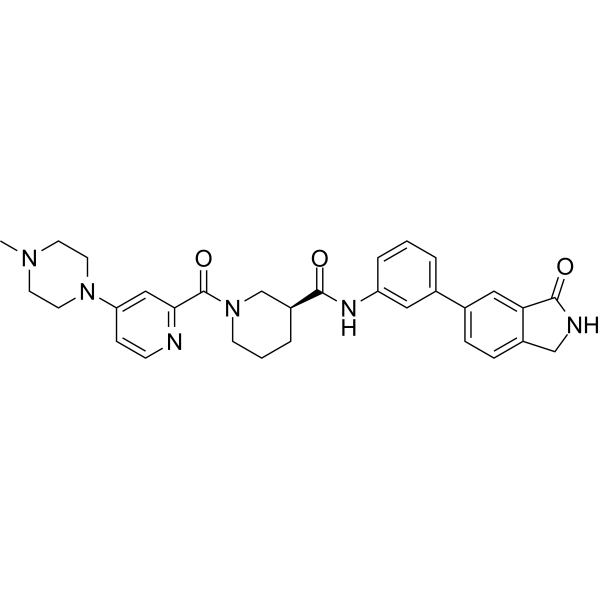
UNC9512 is a selective 53BP1 inhibitor with an IC50 of 0.46 μM, and a Kd values of 0.17 μM. UNC9512 binds 53BP1 and its tandem Tudor domain, disrupts histone H4 interaction, and inhibits 53BP1 activity. UNC9512 can be used as a probe for DNA damage repair and Gene editing.
연구목적의 판매만을 진행합니다. 환자를 대상으로 한 판매는 하지 않습니다.
- Purity : 98.90%
- CAS No.: 3032393-24-8
- 화학식: C31H34N6O3
- 분자량:538.64
-
보관:Powder -20°C, 3 years , 4°C, 2 years ; In solvent -80°C, 6 months , -20°C, 1 month

To place orders, for customer services and technical support, please contact: MedChemExpress USA
Tel: 609-228-6898 E-mail: [email protected] [email protected]


-
 Biological Activity
-
Chemical Information
-
용액&용해도
- Protocol
- 순도&문서
- References
-
 Help & FAQs


Publications Citing Use of MedChemExpress (MCE) UNC9512
MoreAll DNA/RNA Synthesis Isoforms
More

Biological Activity
제품 설명
In Vitro
UNC9512 binds to modified 53BP1 (mutated to match zebrafish 53BP1 key amino acids) with a Kd of approximately 3 μM[1].
UNC9512 (up to 100 μM; 1 h) is highly selective for the 53BP1 tandem Tudor domain, with no measurable binding to SETDB1 TTD, UHRF1 TTD, PHF19 Tudor-PHD, KDM7B JmjC-PHD, CBX2 CD, CDYL2 CD, or MPP8 CD at concentrations up to 100 μM[2].
UNC9512 (0-200 μM; overnight) shows minimal toxicity to HEK293T, U2OS[2].
UNC9512 (0-100 μM; 1 h pre-incubation + 2 h post-IR incubation) dose-dependently reduces 53BP1-dependent foci formation in ionizing radiation-treated U2OS cells, achieving a ~3-fold reduction at 50 μM[2].
MedChemExpress (MCE) has not independently confirmed the accuracy of these methods. They are for reference only.
In Vivo
UNC9512 (60 μM; microinjection; single dose at 1-cell stage) increase mean Ki rate of CRISPR editing of kcnh6a in TL/Ekk zebrafish[1].
UNC9512 (60 μM; microinjection; single dose at 1-cell stage) increase mean Ki rate and maintains 100% Ki efficiency of CRISPR editing of sox10 in TL/Ekk zebrafish[1].
UNC9512 (60 μM; microinjection; single dose at 4-8 cell stage) produces reductions in background indels, NHEJ, and MMEJ for CRISPR editing of sox10 in TL/Ekk zebrafish[1].
MedChemExpress (MCE) has not independently confirmed the accuracy of these methods. They are for reference only.
-
Animal Model:Casper zebrafish[1]
-
Dosage:60 μM
-
Administration:microinjection; single dose at 1-cell stage
-
Result:Increased the mean near WT pigmentation KI rate 1.62-fold.
Produced a significant difference in proportions of larvae across pigmentation rescue groups compared to SS6 alone.
Resulted in 14% KI rate and 4.3% near WT pigmentation KI rate.
-
Animal Model:TL/Ekk zebrafish[1]
-
Dosage:60 μM
-
Administration:microinjection; single dose at 1-cell stage
-
Result:Increased the mean KI rate 1.54-fold (from 1.71% with SS2 alone to 2.63%), though this was not statistically significant.
Produced a non-significant trend towards a higher mean KI-score, lower mean background indels, and higher mean PGE/indel ratio.
Identified 7 PGE positive larvae among 484 injected embryos.
Caused a non-significant reduction in the median percentage of NHEJ-associated indels (≤4 bp) targeting kcnh6a.\nIncreased the mean KI rate 1.19-fold (from 84.33% with SS3 alone to 93.75%), with 100% KI across all experiments.
Produced non-significant changes in mean KI-score (11.82 vs 14.45 for SS3 alone), mean background indels, and mean PGE/indel ratio.
Identified 15 PGE positive larvae among 18 sampled larvae.
Caused a non-significant reduction in the median percentage of NHEJ-associated indels (≤4 bp) targeting sox10.
-
Animal Model:TL/Ekk zebrafish[1]
-
Dosage:60 μM
-
Administration:microinjection; single dose at 4-8 cell stage
-
Result:Resulted in no significant change in KI rate compared to SS3 alone at the 1-cell stage, with a mean KI rate of 83.33%.
Produced a non-significant reduction in mean background indels, a non-significant reduction in mean NHEJ-associated indels, and a non-significant reduction in mean MMEJ-associated indels.
Achieved a mean KI-score of 11.25 and mean PGE/indel ratio of 0.28.


Chemical Information
-
CAS No. 3032393-24-8
-
Appearance Solid
-
분자량 538.64
-
화학식 C31H34N6O3
-
Color White to off-white
-
SMILES
O=C(NC1=CC(C2=CC=C(C3=C2)CNC3=O)=CC=C1)[C@H]4CCCN(C4)C(C5=NC=CC(N6CCN(CC6)C)=C5)=O
-
선적
Room temperature in continental US; may vary elsewhere.
-
보관
Powder -20°C 3 years 4°C 2 years In solvent -80°C 6 months -20°C 1 month


Publications (1)
-
Journal Impact Factor
-
Most Recent


용액&용해도
In Vitro:
DMSO : 100 mg/mL (185.65 mM; Need ultrasonic; Hygroscopic DMSO has a significant impact on the solubility of product, please use newly opened DMSO)
Please refer to the solubility information to select the appropriate solvent. Once prepared, please aliquot and store the solution to prevent product inactivation from repeated freeze-thaw cycles.
Storage method and period of stock solution: -80°C, 6 months; -20°C, 1 month. When stored at -80°C, please use it within 6 months. When stored at -20°C, please use it within 1 month.
Please refer to the solubility information to select the appropriate solvent. Once prepared, please aliquot and store the solution to prevent product inactivation from repeated freeze-thaw cycles.
Storage method and period of stock solution: -80°C, 6 months; -20°C, 1 month. When stored at -80°C, please use it within 6 months. When stored at -20°C, please use it within 1 month.
Concentration (start) × Volume (start) = Concentration (final) × Volume (final)
In Vivo:
Select the appropriate dissolution method based on your experimental animal and administration route.
- For the following dissolution methods, please ensure to first prepare a clear stock solution using an In Vitro approach and then sequentially add co-solvents:
- To ensure reliable experimental results, the clarified stock solution can be appropriately stored based on storage conditions. As for the working solution for In Vivo experiments, it is recommended to prepare freshly and use it on the same day.
- The percentages shown for the solvents indicate their volumetric ratio in the final prepared solution. If precipitation or phase separation occurs during preparation, heat and/or sonication can be used to aid dissolution.
Add each solvent one by one: 10% DMSO 40% PEG300 5% Tween-80 45% Saline
Solubility: ≥ 2.5 mg/mL (4.64 mM); Clear solution
This protocol yields a clear solution of ≥ 2.5 mg/mL (saturation unknown).
Taking 1 mL working solution as an example, add 100 μL DMSO stock solution (25.0 mg/mL) to 400 μL PEG300, and mix evenly; then add 50 μL Tween-80 and mix evenly; then add 450 μL Saline to adjust the volume to 1 mL.
Preparation of Saline: Dissolve 0.9 g sodium chloride in ddH₂O and dilute to 100 mL to obtain a clear Saline solution.
Add each solvent one by one: 10% DMSO 90% (20% SBE-β-CD in Saline)
Solubility: 2.5 mg/mL (4.64 mM); Clear solution; Need ultrasonic
This protocol yields a clear solution of 2.5 mg/mL.
Taking 1 mL working solution as an example, add 100 μL DMSO stock solution (25.0 mg/mL) to 900 μL 20% SBE-β-CD in Saline, and mix evenly.
Preparation of 20% SBE-β-CD in Saline (4°C, storage for one week): 2 g SBE-β-CD powder is dissolved in 10 mL Saline, completely dissolve until clear.
In Vivo Dissolution Calculator
Please enter the basic information of animal experiments:
-
-
-
-
Recommended: Prepare an additional quantity of animals to account for potential losses during experiments.
Please enter your animal formula composition:
-
%DMSO +
Recommended: Keep the proportion of DMSO in working solution below 2% if your animal is weak.
-
%+
-
+%Tween-80 + +
-
%Saline +
The co-solvents required include: DMSO, . All of co-solvents are available by MedChemExpress (MCE). , Tween 80. All of co-solvents are available by MedChemExpress (MCE).
Working solution concentration: 0.22 mg/mL
Method for preparing stock solution: mg drug dissolved in μL DMSO. Stock solution concentration: mg/mL.
1. Take μL DMSO stock solution;
2. Add μL .
μL , mix evenly;
3. Then add μL Tween 80, mix evenly;
4. Then add μL
Please ensure that the stock solution in the first step is dissolved to a clear state, and add co-solvents in sequence. You can use ultrasonic heating (ultrasonic cleaner, recommended frequency 20-40 kHz), vortexing, etc. to assist dissolution.


순도&문서
-
Data Sheet (276 KB)
-
SDS (251 KB)
- English - EN (251 KB)
- Français - FR (251 KB)
- Deutsch - DE (251 KB)
- Norwegian - NO (251 KB)
- Español - ES (251 KB)
- Swedish - SV (251 KB)
- Italian - IT (251 KB)
- Korean - KR (251 KB)
- Portuguese - PT (251 KB)
-
Handling Instructions (2659 KB)
References


Complete Stock Solution Preparation Table
Please refer to the solubility information to select the appropriate solvent. Once prepared, please aliquot and store the solution to prevent product inactivation from repeated freeze-thaw cycles.
Storage method and period of stock solution: -80°C, 6 months; -20°C, 1 month. When stored at -80°C, please use it within 6 months. When stored at -20°C, please use it within 1 month.
| Optional Solvent | Concentration Solvent Mass | 1 mg | 5 mg | 10 mg | 25 mg |
|---|---|---|---|---|---|
| DMSO | 1 mM | 1.8565 mL | 9.2826 mL | 18.5653 mL | 46.4132 mL |
| 5 mM | 0.3713 mL | 1.8565 mL | 3.7131 mL | 9.2826 mL | |
| 10 mM | 0.1857 mL | 0.9283 mL | 1.8565 mL | 4.6413 mL | |
| 15 mM | 0.1238 mL | 0.6188 mL | 1.2377 mL | 3.0942 mL | |
| 20 mM | 0.0928 mL | 0.4641 mL | 0.9283 mL | 2.3207 mL | |
| 25 mM | 0.0743 mL | 0.3713 mL | 0.7426 mL | 1.8565 mL | |
| 30 mM | 0.0619 mL | 0.3094 mL | 0.6188 mL | 1.5471 mL | |
| 40 mM | 0.0464 mL | 0.2321 mL | 0.4641 mL | 1.1603 mL | |
| 50 mM | 0.0371 mL | 0.1857 mL | 0.3713 mL | 0.9283 mL | |
| 60 mM | 0.0309 mL | 0.1547 mL | 0.3094 mL | 0.7736 mL | |
| 80 mM | 0.0232 mL | 0.1160 mL | 0.2321 mL | 0.5802 mL | |
| 100 mM | 0.0186 mL | 0.0928 mL | 0.1857 mL | 0.4641 mL |


UNC9512 Related Classifications
HY-156257 Related Classifications
 Powered by Bioz