



INY-03-041

Based on 1 publication(s) in Google Scholar
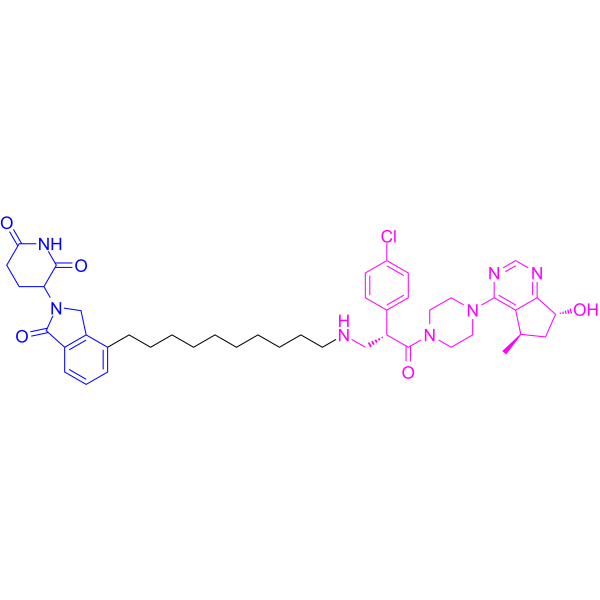
INY-03-041 is a potent, highly selective and PROTAC-based pan-AKT degrader consisting of the ATP-competitive AKT inhibitor Ipatasertib (HY-15186) conjugated to Lenalidomide (HY-A0003, Cereblon ligand). INY-03-041 inhibits AKT1, AKT2 and AKT3 with IC50s of 2.0, 6.8 and 3.5 nM, respectively.
(Pink: Akt ligand (HY-130988); Blue: Cereblon ligand (HY-43722); Black: linker (HY-130985)).
For research use only. We do not sell to patients.
- Purity: 99.74%
- CAS No.: 2503017-97-6
- Formula: C44H56ClN7O5
- Molecular Weight:798.41
-
Storage:
-20°C, sealed storage, away from moisture
* In solvent : -80°C, 6 months; -20°C, 1 month (sealed storage, away from moisture)


-
 Biological Activity
-
Chemical Information
-
Solvent & Solubility
- Purity & Documentation
- References
-
 Help & FAQs



Publications Citing Use of MedChemExpress (MCE) INY-03-041
MoreAll PROTACs Isoforms
More

Biological Activity
|
Akt1 2.0 nM (IC50) |
Akt3 3.5 nM (IC50) |
Akt2 6.8 nM (IC50) |
Cereblon |
INY-03-041 (10-1000 nM; 0-24 hours) induces potent degradation of all three AKT isoforms in MDA-MB-468 cells[1].
INY-03-041 exhibits potent in vitro inhibition of S6K1 (IC50 =37.3 nM) and PKG1 (IC50 = 33.2 nM)[1].
INY-03-041 displays enhanced anti-proliferative effects compared with Ipatasertib (HY-15186) in MDA-MB-468 and HCC1937 cells[1].
INY-03-041 (250 nM, 12 h) promotes sustained AKT degradation and inhibition of downstream signaling effects for up to 96 h, even after compound washout[1].
MedChemExpress (MCE) has not independently confirmed the accuracy of these methods. They are for reference only.
-
Cell Line:MDA-MB-468 cells
-
Concentration:10 nM, 50 nM, 100 nM, 250 nM, 500 nM, 1000 nM
-
Incubation Time:2 hours, 4 hours, 6 hours, 8 hours, 10 hours, 12 hours, 24 hours
-
Result:Induced potent degradation of all three AKT isoforms in a dose-dependent manner after a 12-h treatment, with maximal degradation observed between 100 and 250 nM. At concentrations of 500 nM and greater, AKT degradation is diminished. Treatment with 250 nM of INY-03-041 over time reveals partial degradation of all AKT isoforms within 4 h and progressive loss of AKT abundance out to 24 h.


Chemical Information
-
CAS No. 2503017-97-6
-
Appearance Solid
-
Molecular Weight 798.41
-
Formula C44H56ClN7O5
-
Color White to off-white
-
SMILES
O=C(C(N(CC1=C2C=CC=C1CCCCCCCCCCNC[C@H](C3=CC=C(Cl)C=C3)C(N4CCN(C5=C([C@H](C)C[C@H]6O)C6=NC=N5)CC4)=O)C2=O)CC7)NC7=O
-
Shipping
Room temperature in continental US; may vary elsewhere.
-
Storage
-20°C, sealed storage, away from moisture
* In solvent : -80°C, 6 months; -20°C, 1 month (sealed storage, away from moisture)


Publications (1)
-
Journal Impact Factor
-
Most Recent
-
ACS Omega
Dynamic Detection of the E3-PROTAC-Target Protein Ternary Complex In Vitro and In Vivo via Bimolecular Fluorescence Complementation. [Abstract]2024 Dec 3;9(50):49739-49748. PMID: 39713624


Solvent & Solubility
DMSO : ≥ 100 mg/mL (125.25 mM; Hygroscopic DMSO has a significant impact on the solubility of product, please use newly opened DMSO)
* "≥" means soluble, but saturation unknown.
Please refer to the solubility information to select the appropriate solvent. Once prepared, please aliquot and store the solution to prevent product inactivation from repeated freeze-thaw cycles.
Storage method and period of stock solution: -80°C, 6 months; -20°C, 1 month (sealed storage, away from moisture). When stored at -80°C, please use it within 6 months. When stored at -20°C, please use it within 1 month.
Please refer to the solubility information to select the appropriate solvent. Once prepared, please aliquot and store the solution to prevent product inactivation from repeated freeze-thaw cycles.
Storage method and period of stock solution: -80°C, 6 months; -20°C, 1 month (sealed storage, away from moisture). When stored at -80°C, please use it within 6 months. When stored at -20°C, please use it within 1 month.
Concentration (start) × Volume (start) = Concentration (final) × Volume (final)
Select the appropriate dissolution method based on your experimental animal and administration route.
- For the following dissolution methods, please ensure to first prepare a clear stock solution using an In Vitro approach and then sequentially add co-solvents:
- To ensure reliable experimental results, the clarified stock solution can be appropriately stored based on storage conditions. As for the working solution for In Vivo experiments, it is recommended to prepare freshly and use it on the same day.
- The percentages shown for the solvents indicate their volumetric ratio in the final prepared solution. If precipitation or phase separation occurs during preparation, heat and/or sonication can be used to aid dissolution.
Add each solvent one by one: 10% DMSO 40% PEG300 5% Tween-80 45% Saline
Solubility: ≥ 5.75 mg/mL (7.20 mM); Clear solution
This protocol yields a clear solution of ≥ 5.75 mg/mL (saturation unknown).
Taking 1 mL working solution as an example, add 100 μL DMSO stock solution (57.5 mg/mL) to 400 μL PEG300, and mix evenly; then add 50 μL Tween-80 and mix evenly; then add 450 μL Saline to adjust the volume to 1 mL.
Preparation of Saline: Dissolve 0.9 g sodium chloride in ddH₂O and dilute to 100 mL to obtain a clear Saline solution.
Please enter the basic information of animal experiments:
-
-
-
-
Recommended: Prepare an additional quantity of animals to account for potential losses during experiments.
Please enter your animal formula composition:
-
%DMSO +
Recommended: Keep the proportion of DMSO in working solution below 2% if your animal is weak.
-
%+
-
+%Tween-80 + +
-
%Saline +
The co-solvents required include: DMSO, . All of co-solvents are available by MedChemExpress (MCE). , Tween 80. All of co-solvents are available by MedChemExpress (MCE).
Working solution concentration: 0.22 mg/mL
Method for preparing stock solution: mg drug dissolved in μL DMSO. Stock solution concentration: mg/mL. * In solvent : -80°C, 6 months; -20°C, 1 month (sealed storage, away from moisture)
1. Take μL DMSO stock solution;
2. Add μL .
μL , mix evenly;
3. Then add μL Tween 80, mix evenly;
4. Then add μL
Please ensure that the stock solution in the first step is dissolved to a clear state, and add co-solvents in sequence. You can use ultrasonic heating (ultrasonic cleaner, recommended frequency 20-40 kHz), vortexing, etc. to assist dissolution.


Purity & Documentation
-
Data Sheet (272 KB)
-
SDS (252 KB)
- English - EN (252 KB)
- Français - FR (252 KB)
- Deutsch - DE (252 KB)
- Norwegian - NO (252 KB)
- Español - ES (252 KB)
- Swedish - SV (252 KB)
- Italian - IT (252 KB)
- Portuguese - PT (252 KB)
-
Handling Instructions (2659 KB)
References
[1]. You I, et al. Discovery of an AKT Degrader with Prolonged Inhibition of Downstream Signaling. Cell Chem Biol. 2020 Jan 16;27(1):66-73.e7. [Content Brief]
[2]. Maira SM, et al. Identification and characterization of NVP-BKM120, an orally available pan-class I PI3-kinase inhibitor. Mol Cancer Ther. 2012 Feb;11(2):317-28. [Content Brief]


Complete Stock Solution Preparation Table
Please refer to the solubility information to select the appropriate solvent. Once prepared, please aliquot and store the solution to prevent product inactivation from repeated freeze-thaw cycles.
Storage method and period of stock solution: -80°C, 6 months; -20°C, 1 month (sealed storage, away from moisture). When stored at -80°C, please use it within 6 months. When stored at -20°C, please use it within 1 month.
| Optional Solvent | Concentration Solvent Mass | 1 mg | 5 mg | 10 mg | 25 mg |
|---|---|---|---|---|---|
| DMSO | 1 mM | 1.2525 mL | 6.2624 mL | 12.5249 mL | 31.3122 mL |
| 5 mM | 0.2505 mL | 1.2525 mL | 2.5050 mL | 6.2624 mL | |
| 10 mM | 0.1252 mL | 0.6262 mL | 1.2525 mL | 3.1312 mL | |
| 15 mM | 0.0835 mL | 0.4175 mL | 0.8350 mL | 2.0875 mL | |
| 20 mM | 0.0626 mL | 0.3131 mL | 0.6262 mL | 1.5656 mL | |
| 25 mM | 0.0501 mL | 0.2505 mL | 0.5010 mL | 1.2525 mL | |
| 30 mM | 0.0417 mL | 0.2087 mL | 0.4175 mL | 1.0437 mL | |
| 40 mM | 0.0313 mL | 0.1566 mL | 0.3131 mL | 0.7828 mL | |
| 50 mM | 0.0250 mL | 0.1252 mL | 0.2505 mL | 0.6262 mL | |
| 60 mM | 0.0209 mL | 0.1044 mL | 0.2087 mL | 0.5219 mL | |
| 80 mM | 0.0157 mL | 0.0783 mL | 0.1566 mL | 0.3914 mL | |
| 100 mM | 0.0125 mL | 0.0626 mL | 0.1252 mL | 0.3131 mL |


 Powered by Bioz