



VK-28

Based on 1 Customer Validation
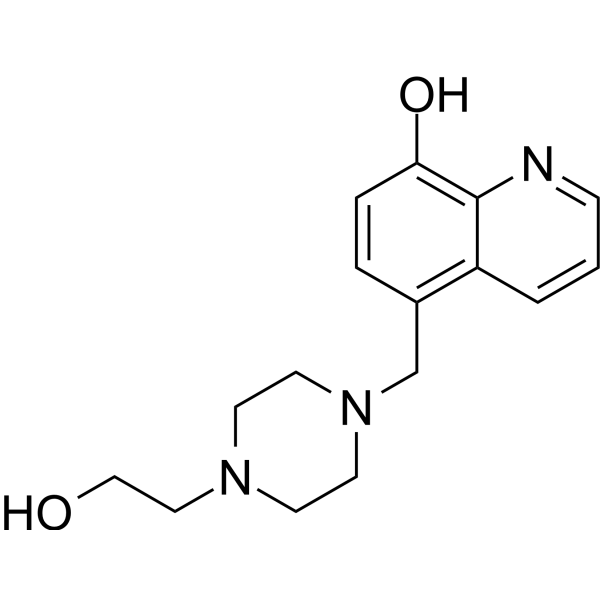
VK-28 is a blood-brain barrier-permeable iron chelator. VK-28 inhibits mitochondrial membrane lipid peroxidation and the iron-dependent generation of reactive hydroxyl radicals. VK-28 exhibits neuroprotective activity and protects rats against 6-OHDA-induced striatal dopaminergic damage. VK-28 can be used in studies related to Parkinson's disease.
For research use only. We do not sell to patients.
- Purity : 97.17%
- CAS No.: 312611-92-0
- Formula: C16H21N3O2
- Molecular Weight:287.36
-
Storage:Powder -20°C, 3 years ; In solvent -80°C, 6 months , -20°C, 1 month

To place orders, for customer services and technical support, please contact: MedChemExpress USA
Tel: 609-228-6898 E-mail: [email protected] [email protected]


-
 Biological Activity
-
Chemical Information
- Protocols
- Purity & Documentation
- References
-
 Help & FAQs


All Dopamine Receptor Isoforms
More

Biological Activity
Description
In Vitro
VK-28 (10-7-10-3 M; 90 min) potently inhibits basal lipid peroxidation and iron-induced lipid peroxidation in mitochondrial membrane homogenates from rat cerebral cortex, with an IC50 of 12.7 µM[1].
VK-28 (1-10 μM; 24 h) exhibits neuroprotective activity by reducing serum deprivation-induced PC12 cell death[2].
MedChemExpress (MCE) has not independently confirmed the accuracy of these methods. They are for reference only. Further protocols information, click here.
-
Cell Line:PC12 cells
-
Concentration:1 μM, 10 μM
-
Incubation Time:24 h
-
Result:Rescued PC12 cells from serum-free induced death, resulting in ~1000% of control OD at 1 μM and ~900% of control OD at 10 μM.
Reduced cell death compared to untreated serum-free cells.
Showed neuroprotective activity comparable to rasagiline.
In Vivo
MedChemExpress (MCE) has not independently confirmed the accuracy of these methods. They are for reference only.
-
Animal Model:Sprague-Dawley (male, 230-270 g, 8-10 per group, intracerebroventricular 6-hydroxydopamine-induced striatal dopaminergic lesion)[1]
-
Dosage:1 µg
-
Administration:i.c.v.; single dose (30 minutes before 6-OHDA)
-
Result:Prevented the 78% reduction in striatal dopamine (DA), 73% reduction in dihydroxyphenylacetic acid (DOPAC), and 59% reduction in homovanilic acid (HVA) caused by 6-OHDA alone.
Reduced the 6-OHDA-induced increase in striatal dopamine turnover ratio (DOPAC+HVA/DA) to near baseline levels.
Left striatal serotonin (5-HT), 5-hydroxyindolacetic acid (5-HIAA), and norepinephrine (NE) concentrations unaffected.


Chemical Information
-
CAS No. 312611-92-0
-
Appearance Solid
-
Molecular Weight 287.36
-
Formula C16H21N3O2
-
Color White to off-white
-
SMILES
OCCN1CCN(CC1)CC2=C3C=CC=NC3=C(C=C2)O
-
Shipping
Room temperature in continental US; may vary elsewhere.
-
Storage
Powder -20°C 3 years In solvent -80°C 6 months -20°C 1 month

Protocols
-
Human pluripotent stem cell midbrain dopaminergic neuron differentiation
Human pluripotent stem cells are directed toward midbrain dopaminergic neurons by first inducing a neural floor-plate-like progenitor state, then patterning cells with ventralizing SHH signaling and midbrain/WNT-FGF cues, and finally maturing progenitors into neurons expressing dopaminergic markers such as TH, NURR1/NR4A2, PITX3, DAT/SLC6A3, VMAT2/SLC18A2, GIRK2/KCNJ6, FOXA2, LMX1A, and EN1. The main readouts are loss of pluripotency, acquisition of FOXA2+/LMX1A+ midbrain floor-plate progenitors, emergence of βIII-tubulin+/MAP2+ neurons, and production of TH+ dopaminergic neurons with molecular, dopamine-release, and electrophysiological features of midbrain dopaminergic identity.
-
Ferroptosis Solutions
Ferroptosis is an iron-dependent, non-apoptotic form of regulated cell death characterized by lethal lipid peroxidation and sensitivity to suppression by iron chelators or lipophilic radical-trapping antioxidants. The core pathway links cystine uptake through system Xc−, glutathione availability, GPX4-dependent detoxification of phospholipid hydroperoxides, iron-dependent oxidative reactions, and polyunsaturated-phospholipid metabolism into a cell-death program that is biochemically and morphologically distinct from apoptosis, necrosis, and autophagy. The ferroptosis pathway is experimentally linked to phenotype through chemical and genetic perturbation. Erastin induces ferroptosis by inhibiting cystine uptake through system Xc− and weakening antioxidant defenses, while GPX4 inhibition or depletion causes lipid peroxide accumulation and ferroptotic cancer-cell death. ACSL4 and oxidizable arachidonoyl- or adrenoyl-containing phosphatidylethanolamines shape ferroptosis sensitivity by con


Purity & Documentation
-
Data Sheet (272 KB)
-
SDS (393 KB)
- English - EN (393 KB)
- Français - FR (393 KB)
- Deutsch - DE (393 KB)
- Norwegian - NO (393 KB)
- Español - ES (393 KB)
- Swedish - SV (393 KB)
- Italian - IT (393 KB)
- Korean - KR (393 KB)
- Portuguese - PT (393 KB)
-
Handling Instructions (2659 KB)
References
[1]. Shachar DB, et al. Neuroprotection by a novel brain permeable iron chelator, VK-28, against 6-hydroxydopamine lession in rats. Neuropharmacology. 2004;46(2):254-263. [Content Brief]
[2]. Youdim MB, et al. Bifunctional drug derivatives of MAO-B inhibitor rasagiline and iron chelator VK-28 as a more effective approach to treatment of brain ageing and ageing neurodegenerative diseases. Mech Ageing Dev. 2005;126(2):317-326. [Content Brief]

Calculators
Concentration (start) × Volume (start) = Concentration (final) × Volume (final)


VK-28 Related Classifications
HY-W686216 Related Classifications
 Powered by Bioz
Keywords