



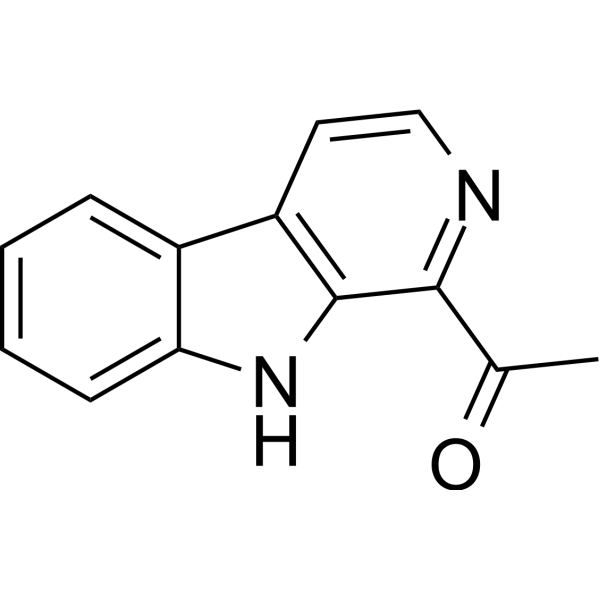
1-Acetyl-β-carboline

Based on 1 Customer Validation
1-Acetyl-β-carboline is a metabolite of Streptomyces kasugaensis and antibacterial agent. 1-Acetyl-β-carboline increases tyrosinase activity, reduces ERK phosphorylation. 1-Acetyl-β-carboline exhibits antibacterial activity against methicillin-resistant Staphylococcus aureus (MRSA) strains with MICs ranging from 128 to 256 ug/mL. 1-Acetyl-β-carboline increases the melanin.
For research use only. We do not sell to patients.
- Purity : 97.04%
- CAS No.: 50892-83-6
- Formula: C13H10N2O
- Molecular Weight:210.23
-
Storage:Powder -20°C, 3 years , 4°C, 2 years ; In solvent -80°C, 6 months , -20°C, 1 month

To place orders, for customer services and technical support, please contact: MedChemExpress USA
Tel: 609-228-6898 E-mail: [email protected] [email protected]


-
 Biological Activity
-
Chemical Information
-
Solvent & Solubility
- Protocols
- Purity & Documentation
- References
-
 Help & FAQs


All Endogenous Metabolite Isoforms
More

Biological Activity
Description
|
Microbial Metabolite |
Cellular Effect
|
Cell Line

|
Type | Value | Description | References |
|---|---|---|---|---|
| A549 | GI50 |
>40 μM
Compound: 41
|
Cytotoxicity activity against human A549 cells assessed as growth inhibition at 10 ug/ml after 72 hrs sulforhodamine B assay
Cytotoxicity activity against human A549 cells assessed as growth inhibition at 10 ug/ml after 72 hrs sulforhodamine B assay
|
[PMID: 21316977] |
| A549 | IC50 |
>50 μM
Compound: 7
|
Cytotoxicity against human A549 cells after 48 hrs by MTT assay
Cytotoxicity against human A549 cells after 48 hrs by MTT assay
|
[PMID: 21977916] |
| DU-145 | GI50 |
>40 μM
Compound: 41
|
Cytotoxicity activity against human DU145 cells assessed as growth inhibition at 10 ug/ml after 72 hrs sulforhodamine B assay
Cytotoxicity activity against human DU145 cells assessed as growth inhibition at 10 ug/ml after 72 hrs sulforhodamine B assay
|
[PMID: 21316977] |
| DU-145 | IC50 |
>50 μM
Compound: 7
|
Cytotoxicity against human DU145 cells after 48 hrs by MTT assay
Cytotoxicity against human DU145 cells after 48 hrs by MTT assay
|
[PMID: 21977916] |
| HeLa | IC50 |
>50 μM
Compound: 7
|
Cytotoxicity against human HeLa cells after 48 hrs by MTT assay
Cytotoxicity against human HeLa cells after 48 hrs by MTT assay
|
[PMID: 21977916] |
| HT-22 | IC50 |
>100 μM
Compound: 31
|
Cytotoxicity against mouse HT-22 cells assessed as reduction in cell viability incubated for 48 hrs by MTS assay
Cytotoxicity against mouse HT-22 cells assessed as reduction in cell viability incubated for 48 hrs by MTS assay
|
[PMID: 36876904] |
| KB | GI50 |
>40 μM
Compound: 41
|
Cytotoxicity activity against human KB cells assessed as growth inhibition at 10 ug/ml after 72 hrs sulforhodamine B assay
Cytotoxicity activity against human KB cells assessed as growth inhibition at 10 ug/ml after 72 hrs sulforhodamine B assay
|
[PMID: 21316977] |
| MCF7 | IC50 |
>50 μM
Compound: 7
|
Cytotoxicity against human MCF7 cells after 48 hrs by MTT assay
Cytotoxicity against human MCF7 cells after 48 hrs by MTT assay
|
[PMID: 21977916] |
| MDA-MB-231 | IC50 |
>50 μM
Compound: 7
|
Cytotoxicity against human MDA-MB-231 cells after 48 hrs by MTT assay
Cytotoxicity against human MDA-MB-231 cells after 48 hrs by MTT assay
|
[PMID: 21977916] |
| NCI-H460 | IC50 |
>50 μM
Compound: 7
|
Cytotoxicity against human NCI-H460 cells after 48 hrs by MTT assay
Cytotoxicity against human NCI-H460 cells after 48 hrs by MTT assay
|
[PMID: 21977916] |
| Neutrophil | IC50 |
>30 μM
Compound: 41
|
Antiinflammatory activity against human neutrophil assessed as inhibition of N-formyl-l-methionyl phenylalanine/cytochalasin B-induced elastase release
Antiinflammatory activity against human neutrophil assessed as inhibition of N-formyl-l-methionyl phenylalanine/cytochalasin B-induced elastase release
|
[PMID: 21316977] |
| Neutrophil | IC50 |
5.03 μM
Compound: 41
|
Antiinflammatory activity against human neutrophil assessed as inhibition of N-formyl-l-methionyl phenylalanine/cytochalasin B-induced superoxide anion generation by spectrophotometry
Antiinflammatory activity against human neutrophil assessed as inhibition of N-formyl-l-methionyl phenylalanine/cytochalasin B-induced superoxide anion generation by spectrophotometry
|
[PMID: 21316977] |
| SMMC-7721 | IC50 |
>50 μM
Compound: 7
|
Cytotoxicity against human SMMC7721 cells after 48 hrs by MTT assay
Cytotoxicity against human SMMC7721 cells after 48 hrs by MTT assay
|
[PMID: 21977916] |
| SW1990 | IC50 |
>50 μM
Compound: 7
|
Cytotoxicity against human SW1990 cells after 48 hrs by MTT assay
Cytotoxicity against human SW1990 cells after 48 hrs by MTT assay
|
[PMID: 21977916] |
In Vitro
1-Acetyl-β-carboline (32-64 μg/mL) exhibits synergistic antimicrobial activity against MRSA strains when used in combination with β-lactam antibiotics[2].
1-Acetyl-β-carboline shows antibacterial activity against MRSA strains tested with MICs ranging from 128 to 256 ug/mL[2].
1-Acetyl-β-carboline (12.5-50 μM; 72 h) increases the melanin content and the tyrosinase activity in B16F10 melanoma cells[3].
MedChemExpress (MCE) has not independently confirmed the accuracy of these methods. They are for reference only. Further protocols information, click here.
-
Cell Line:B16F10 melanoma cells
-
Concentration:12.5, 25, 50 μM
-
Incubation Time:24 h
-
Result:Significantly increased the expression levels of melanogenic enzymes (tyrosinase, TRP-1, TRP-2) and MITF at 50 μM.
Reduced ERK phosphorylation by 20.79% at 12.5 μM and 25.63% at 25 μM.


Chemical Information
-
CAS No. 50892-83-6
-
Appearance Solid
-
Molecular Weight 210.23
-
Formula C13H10N2O
-
Color Light yellow to yellow
-
SMILES
CC(C1=NC=CC2=C1NC3=CC=CC=C32)=O
-
Structure Classification
-
Initial Source
Nonomuraea endophytica
-
Shipping
Room temperature in continental US; may vary elsewhere.
-
Storage
Powder -20°C 3 years 4°C 2 years In solvent -80°C 6 months -20°C 1 month


Solvent & Solubility
In Vitro:
DMSO : 50 mg/mL (237.83 mM; Need ultrasonic; Hygroscopic DMSO has a significant impact on the solubility of product, please use newly opened DMSO)
Please refer to the solubility information to select the appropriate solvent. Once prepared, please aliquot and store the solution to prevent product inactivation from repeated freeze-thaw cycles.
Storage method and period of stock solution: -80°C, 6 months; -20°C, 1 month. When stored at -80°C, please use it within 6 months. When stored at -20°C, please use it within 1 month.
Please refer to the solubility information to select the appropriate solvent. Once prepared, please aliquot and store the solution to prevent product inactivation from repeated freeze-thaw cycles.
Storage method and period of stock solution: -80°C, 6 months; -20°C, 1 month. When stored at -80°C, please use it within 6 months. When stored at -20°C, please use it within 1 month.
Concentration (start) × Volume (start) = Concentration (final) × Volume (final)

Protocols
-
Kinase activity and phosphorylation assays
Kinase activity assays measure the ability of kinases to transfer phosphate groups from ATP to specific substrates, while phosphorylation assays detect the presence and levels of phosphorylated proteins. Common methods include radiolabeled ATP incorporation (e. g. ,), ADP release detection via bioluminescence (e. g. ,[3]), enzyme-linked immunosorbent assays (ELISA) for phospho-specific epitopes (e. g. ,[6]), and microtiter-based formats for high-throughput screening (e. g. ,[8]). The ADP-Glo assay quantifies kinase activity by measuring ADP produced during phosphorylation using a luciferase-based system. Radiometric assays involve autoradiography or scintillation counting after incorporation of 32P-labeled ATP into substrate proteins. ELISA-based approaches rely on phospho-specific antibodies to detect activated kinases in cell lysates or purified samples.
-
Research Protocol for Infectious Diseases
Infectious-disease experiments test how pathogens interact with host barriers, innate immune receptors, inflammatory signaling, pathogen replication, and tissue injury; pattern-recognition receptors such as TLRs, RIG-I-like receptors, NOD-like receptors, and inflammasomes detect microbial molecules and activate NF-κB, interferon, and cytokine responses. The central hypothesis is that infection severity reflects the balance between pathogen burden and host response: protective inflammation restricts pathogen growth, whereas excessive or mislocalized inflammation contributes to tissue damage and disease phenotype. Unresolved questions include which host pathways are protective versus pathogenic, why some infection models fail to translate to human disease, and which combined readouts best predict clinically relevant infection outcomes.
-
Western Blot
Western blotting (WB) is a commonly used experimental method in molecular biology, biochemistry, and immunogenetics for identifying and quantifying target proteins. It combines gel electrophoresis with immunoassay, enabling researchers to analyze protein expression, post-translational modifications, and molecular weight.
-
Protocol for Kinase activity and phosphorylation assays
Kinase activity assays measure transfer of phosphate from ATP to a protein or peptide substrate, generating phosphorylated substrate, ADP, or incorporated radiolabeled phosphate as the readout; phosphorylation assays measure site-specific phosphorylation in cells or tissues as a proxy for kinase-pathway activation, inhibition, or substrate regulation. Phosphorylation can be detected by phospho-specific Western blot, immunoprecipitation kinase assay, phospho-immunofluorescence, phospho-flow cytometry, luminescent ADP detection, radiolabeled ATP incorporation, or reporter-based pathway assays, and these readouts can be applied to cancer cells, primary neurons, mouse tumors, organoids, inflammatory macrophages, ferroptosis studies, and mitophagy studies when the kinase target is biologically relevant.
-
Bacterial live/dead nucleic-acid viability staining
The LIVE/DEAD bacterial viability staining method is based on differential permeability of nucleic-acid-binding fluorescent dyes, most commonly SYTO 9 and propidium iodide (PI), which enables discrimination of bacterial populations with intact versus compromised cytoplasmic membranes. SYTO 9 penetrates both intact and damaged bacterial membranes and binds nucleic acids to produce green fluorescence, whereas propidium iodide penetrates only cells with compromised membranes and fluoresces red while also reducing SYTO 9 signal through competitive binding and fluorescence interactions. The resulting fluorescence pattern is interpreted as a proxy for membrane integrity, which is widely used as an indicator of bacterial viability in microscopy, flow cytometry, and spectroscopic platforms. However, mechanistic studies show that SYTO 9 and PI interactions involve displacement and fluorescence resonance energy transfer effects, which can influence signal interpretation depending on dye ratios a


Purity & Documentation
-
Data Sheet (279 KB)
-
SDS (393 KB)
- English - EN (393 KB)
- Français - FR (393 KB)
- Deutsch - DE (393 KB)
- Norwegian - NO (393 KB)
- Español - ES (393 KB)
- Swedish - SV (393 KB)
- Italian - IT (393 KB)
- Korean - KR (393 KB)
- Portuguese - PT (393 KB)
-
Handling Instructions (2659 KB)
References


Complete Stock Solution Preparation Table
Please refer to the solubility information to select the appropriate solvent. Once prepared, please aliquot and store the solution to prevent product inactivation from repeated freeze-thaw cycles.
Storage method and period of stock solution: -80°C, 6 months; -20°C, 1 month. When stored at -80°C, please use it within 6 months. When stored at -20°C, please use it within 1 month.
| Optional Solvent | Concentration Solvent Mass | 1 mg | 5 mg | 10 mg | 25 mg |
|---|---|---|---|---|---|
| DMSO | 1 mM | 4.7567 mL | 23.7835 mL | 47.5670 mL | 118.9174 mL |
| 5 mM | 0.9513 mL | 4.7567 mL | 9.5134 mL | 23.7835 mL | |
| 10 mM | 0.4757 mL | 2.3783 mL | 4.7567 mL | 11.8917 mL | |
| 15 mM | 0.3171 mL | 1.5856 mL | 3.1711 mL | 7.9278 mL | |
| 20 mM | 0.2378 mL | 1.1892 mL | 2.3783 mL | 5.9459 mL | |
| 25 mM | 0.1903 mL | 0.9513 mL | 1.9027 mL | 4.7567 mL | |
| 30 mM | 0.1586 mL | 0.7928 mL | 1.5856 mL | 3.9639 mL | |
| 40 mM | 0.1189 mL | 0.5946 mL | 1.1892 mL | 2.9729 mL | |
| 50 mM | 0.0951 mL | 0.4757 mL | 0.9513 mL | 2.3783 mL | |
| 60 mM | 0.0793 mL | 0.3964 mL | 0.7928 mL | 1.9820 mL | |
| 80 mM | 0.0595 mL | 0.2973 mL | 0.5946 mL | 1.4865 mL | |
| 100 mM | 0.0476 mL | 0.2378 mL | 0.4757 mL | 1.1892 mL |


1-Acetyl-β-carboline Related Classifications
HY-W060074 Related Classifications
 Powered by Bioz