



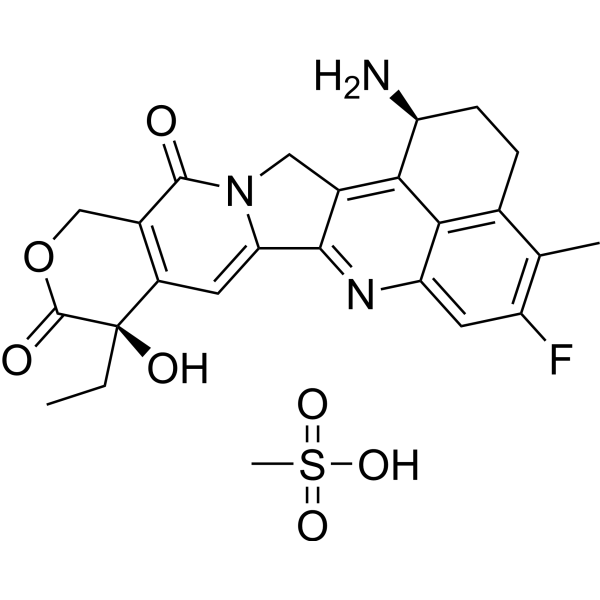
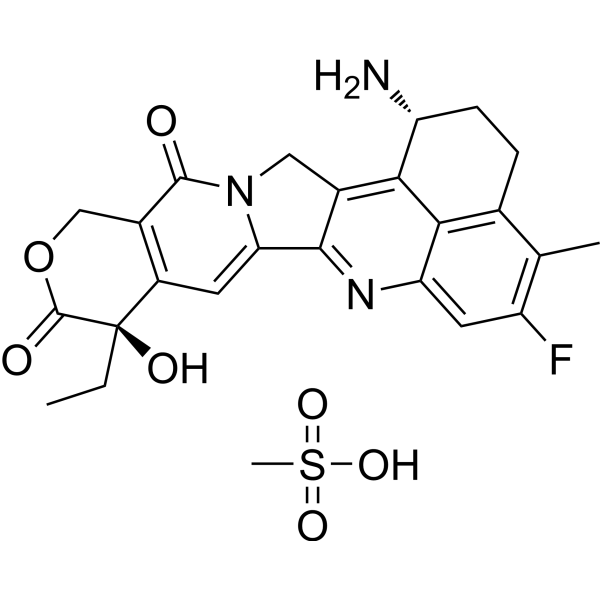
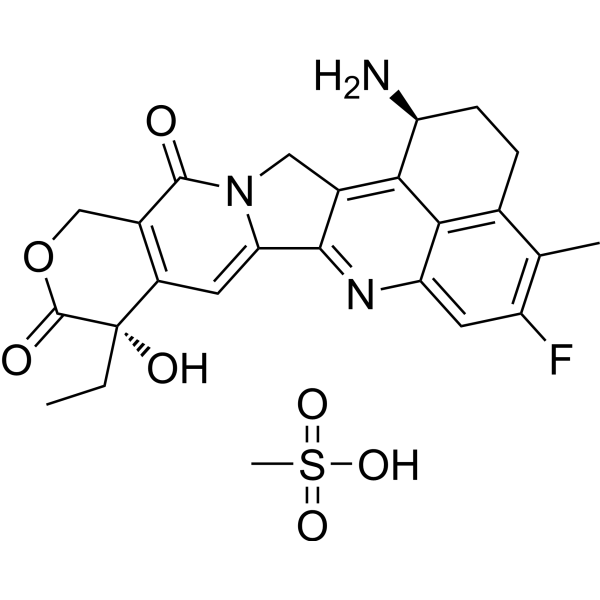
(1S,9R)-Exatecan mesylate

Based on 1 Customer Validation
(1S,9R)-Exatecan mesylate ((1S,9R)-DX8951f) is a non-prodrug camptothecin derivative and a topoisomerase I inhibitor (IC50=0.975 μg/mL in mice and 0.82 μg/mL in humans). (1S,9R)-Exatecan mesylate blocks enzyme activity and induces apoptosis by stabilizing the enzyme-DNA cleavable complex. (1S,9R)-Exatecan mesylate not only effectively inhibits the proliferation of various malignant tumor cells and tumor growth, but also circumvents P-glycoprotein-mediated multidrug resistance. (1S,9R)-Exatecan mesylate is widely used in preclinical studies of various cancers such as pancreatic cancer, lung cancer, breast cancer, and leukemia.
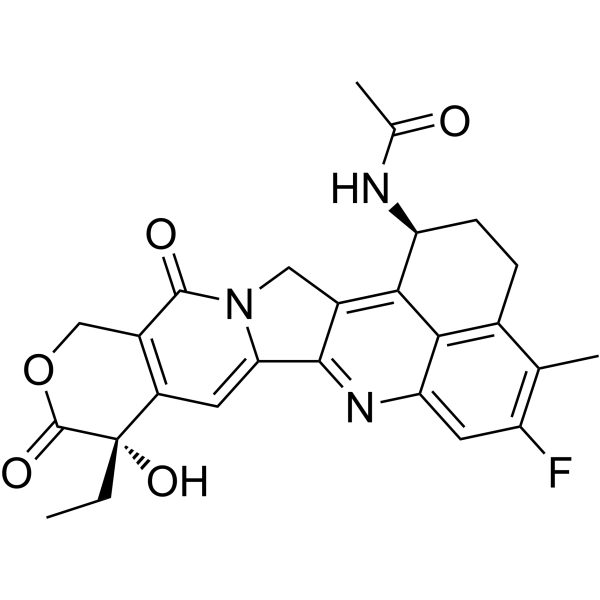
The chiral isomer of (1S,9R)-Exatecan mesylate is (1R,9R)-Exatecan mesylate (HY-13631J).
For research use only. We do not sell to patients.
- Purity: 99.11%
- CAS No.: 2938875-54-6
- Formula: C25H26FN3O7S
- Molecular Weight:531.55
-
Storage:
4°C, sealed storage, away from moisture and light
* In solvent : -80°C, 6 months; -20°C, 1 month (sealed storage, away from moisture and light)

To place orders, for customer services and technical support, please contact: MedChemExpress USA
Tel: 609-228-6898 E-mail: [email protected] [email protected]


-
 Biological Activity
-
Chemical Information
-
Solvent & Solubility
- Purity & Documentation
- References
-
 Help & FAQs


All Topoisomerase Isoforms
More

Biological Activity
Description
The chiral isomer of (1S,9R)-Exatecan mesylate is (1R,9R)-Exatecan mesylate (HY-13631J).
IC50 & Target
|
Camptothecins |
In Vitro
(1S,9R)-Exatecan (mesylate) (48 h exposure; additional 5 days culture post-exposure) and its hydrochloride form (DX-8951a) potently inhibit the growth of SUIT-2, KP-1N, SUIT-2/CPT-11, and KP-1N/CPT-11 human pancreatic carcinoma cells in vitro with IC50 values ranging from 0.079 to 0.69 ng/mL, and show lower cross-resistance in CPT-11-resistant cell lines compared to other camptothecin analogs[1].
(1S,9R)-Exatecan (mesylate) (0.16-10 μg/mL; 10 min at 37°C) (tested as DX-8951a) inhibits topoisomerase I activity from SUIT-2 human pancreatic carcinoma cells with an IC50 of 0.82 μg/mL, showing 2.8-fold stronger inhibition than SN-38[1].
(1S,9R)-Exatecan (mesylate) (0.8-500 ng/mL; 24 h) (tested as DX-8951a) dose-dependently induces DNA fragmentation, a marker of apoptosis, in SUIT-2 human pancreatic carcinoma cells, with 60% fragmentation observed at 20 ng/mL after 24 h of incubation, and is more potent than SN-38[1].
(1S,9R)-Exatecan (mesylate) (0.05 μg/mL; 24 h) (tested as DX-8951a) induces morphological features of apoptotic cell death, including chromatin condensation, nuclear fragmentation, and cytoplasmic vacuolation, in SUIT-2 human pancreatic carcinoma cells after 24 h of incubation[1].
(1S,9R)-Exatecan (mesylate) (Doses yielding GI50 values; 3 days post-drug addition) potently inhibits the proliferation of 31 human cancer cell lines and mouse leukemia P388 cells, with an overall mean GI50 of 2.09 ng/mL, and shows greater potency than comparison compounds[2].
(1S,9R)-Exatecan (mesylate) (Doses yielding IC50 values) potently inhibits P388 cell-derived topoisomerase I activity with an IC50 of 0.975 μg/mL, and is more potent than comparison compounds[2].
(1S,9R)-Exatecan (mesylate) (Doses yielding GI50 values; 3 days post-drug addition) retains potent cytotoxic activity against P-glycoprotein-overexpressing PC-6/VCR cells, overcoming P-glycoprotein-mediated multidrug resistance[2].
MedChemExpress (MCE) has not independently confirmed the accuracy of these methods. They are for reference only.
-
Cell Line:SUIT-2
-
Concentration:0.8-500 ng/mL
-
Incubation Time:24 h
-
Result:Induced DNA fragmentation in a dose-dependent manner.
Caused approximately 60% DNA fragmentation at 20 ng/mL.
Achieved equivalent fragmentation at a 5-times lower concentration than SN-38.
-
Cell Line:31 human cancer cell lines (breast, colon, stomach, lung, ovarian, leukemia) and mouse leukemia P388 cells
-
Concentration:Doses yielding GI50 values
-
Incubation Time:3 days post-drug addition
-
Result:Exhibited strong antiproliferative activity with mean GI50 values of 2.02 ng/mL against breast cancer cell lines, 2.92 ng/mL against colon cancer cell lines, 1.53 ng/mL against stomach cancer cell lines, 0.877 ng/mL against lung cancer cell lines, and 4.33 ng/mL against other cell lines including ovarian cancer, human leukemia, and mouse leukemia.
Achieved an overall mean GI50 value of 2.09 ng/mL across all 32 cell lines.
-
Cell Line:Human non-small cell lung cancer PC-6 cells and its P-glycoprotein-overexpressing variant PC-6/VCR cells
-
Concentration:Doses yielding GI50 values; 5 μg/mL verapamil (co-treatment with PC-6/VCR cells)
-
Incubation Time:3 days post-drug addition
-
Result:Achieved GI50 values of 0.0896 ng/mL for PC-6 cells and 0.0690 ng/mL for PC-6/VCR cells (without verapamil, first set), with a degree of resistance of 0.8.
Achieved GI50 values of 0.179 ng/mL for PC-6 cells and 0.182 ng/mL for PC-6/VCR cells (without verapamil, second set), with a degree of resistance of 1.0.
Reduced the GI50 value of PC-6/VCR cells to 0.156 ng/mL (with 5 μg/mL verapamil), with a VR (+)/VR (−) ratio of 0.86.
In Vivo
(1S,9R)-Exatecan (mesylate) (3.125-18.75 mg/kg; i.v.; every 4 days; 4 doses) produces statistically significant tumor growth inhibition of 72% against CPT-11-resistant SUIT-2/CPT-11 pancreatic cancer xenografts in nude mice at its maximum tolerable dose, with transient body weight loss and no toxicity-related mortality[1].
(1S,9R)-Exatecan (mesylate) (2.5-10 mg/kg; i.v.; every 5 days; 4 doses) produces dose-dependent, statistically significant inhibition of liver metastasis from SUIT-2 pancreatic cancer in nude mice, with 78% liver tumor score inhibition and 3/7 tumor-free mice at the highest tested dose, and no significant body weight loss[1].
(1S,9R)-Exatecan (mesylate) (3.325-50 mg/kg; i.v.; three doses at 4-day intervals) exhibits dose-dependent, potent antitumor activity against human gastric adenocarcinoma SC-6 xenografts in nude mice, with a maximal tumor growth inhibition by weight of 92% at a total i.v. dose of 50 mg/kg (three doses at 4-day intervals) without causing toxic deaths[2].
MedChemExpress (MCE) has not independently confirmed the accuracy of these methods. They are for reference only.
-
Animal Model:BALB/c-nu/nu (male, 6 weeks old)[1]
-
Dosage:3.125 mg/kg (total 12.5 mg/kg); 6.25 mg/kg (total 25 mg/kg); 12.5 mg/kg (total 50 mg/kg); 18.75 mg/kg (total 75 mg/kg)
-
Administration:i.v.; every 4 days; 4 doses
-
Result:Produced tumor growth inhibition (IR) rates of 68%, 78%, 68%, and 79%, respectively.
Resulted in mean tumor weights of 0.235±0.057 g, 0.164±0.053 g, 0.236±0.100 g, and 0.154±0.027 g, respectively.
Caused no body weight loss in any treated group, and no mice died of toxicity.\nAt total dose of 75 mg/kg, produced a tumor growth inhibition (IR) rate of 72% with a mean tumor weight of 0.250±0.061 g; caused maximum body weight loss of 14.6% on day 31.
At total doses of 50 mg/kg, 25 mg/kg, and 12.5 mg/kg, resulted in IR rates of 33%, 13%, and 20% with mean tumor weights of 0.595±0.130 g, 0.776±0.157 g, and 0.712±0.065 g, respectively; caused maximum body weight loss of 6.1% (day 21), 8.7% (day 15), and 3.2% (day 15), respectively.
Caused no mice to die of toxicity in any treated group.
-
Animal Model:BALB/c-nu/nu (male, 6 weeks old)[1]
-
Dosage:2.5 mg/kg (total 10 mg/kg); 5 mg/kg (total 20 mg/kg); 10 mg/kg (total 40 mg/kg)
-
Administration:i.v.; every 5 days; 4 doses
-
Result:At total dose of 40 mg/kg, produced a liver tumor growth score inhibition rate of 78%, with a mean liver tumor score of 0.7±0.9, mean liver weight of 1.594±0.154 g, and 3/7 mice with no visible liver tumor nodules; found 2/7 mice with visible spleen tumor nodules, and 0/7 mice with ascites, with 3/7 mice being tumor-free.
At total dose of 20 mg/kg, resulted in a liver tumor growth score inhibition rate of 69%, with a mean liver tumor score of 1.0±0.6, mean liver weight of 1.594±0.163 g, 5/6 mice with liver tumor nodules, 2/6 mice with spleen tumor nodules, 0/6 mice with ascites, and 1/6 mice tumor-free.
At total dose of 10 mg/kg, resulted in a liver tumor growth score inhibition rate of 28%, with a mean liver tumor score of 2.3±1.1, mean liver weight of 1.780±0.197 g, 6/6 mice with liver tumor nodules, 3/6 mice with spleen tumor nodules, 2/6 mice with ascites (mean volume 0.1±0.1 mL, 97% inhibition), and 0/6 mice tumor-free.
Caused no significant body weight loss.
-
Animal Model:BALB/c-nu/nu (male, 5 or 6 weeks old, human gastric adenocarcinoma SC-6 cells transplanted s.c.)[2]
-
Dosage:3.325 mg/kg; 6.25 mg/kg; 12.5 mg/kg; 25 mg/kg; 50 mg/kg
-
Administration:i.v.; three doses at 4-day intervals
-
Result:Achieved 54% maximal tumor growth inhibition by volume (day 12) and 43% tumor growth inhibition by weight at total dose 3.325 mg/kg, with 3.8% maximal body weight reduction (day 6) and 0 toxic deaths.
Achieved 72% maximal tumor growth inhibition by volume (day 14) and 58% statistically significant tumor growth inhibition by weight at total dose 6.25 mg/kg, with 2.6% maximal body weight reduction (day 6) and 0 toxic deaths.
Achieved 82% maximal tumor growth inhibition by volume (day 17) and 73% statistically significant tumor growth inhibition by weight at total dose 12.5 mg/kg, with 5.9% maximal body weight reduction (day 6) and 0 toxic deaths.
Achieved 95% maximal tumor growth inhibition by volume (day 17) and 90% statistically significant tumor growth inhibition by weight at total dose 25 mg/kg, with 7.0% maximal body weight reduction (day 6) and 0 toxic deaths.
Achieved 96% maximal tumor growth inhibition by volume (day 17) and 92% statistically significant tumor growth inhibition by weight at total dose 50 mg/kg, with 12.5% maximal body weight reduction (day 12) and 0 toxic deaths.


Chemical Information
-
CAS No. 2938875-54-6
-
Appearance Solid
-
Molecular Weight 531.55
-
Formula C25H26FN3O7S
-
Color White to yellow
-
SMILES
O=S(C)(O)=O.O=C1[C@@](O)(CC)C2=C(CO1)C(N3CC4=C5C6=C(CC[C@@H]5N)C(C)=C(F)C=C6N=C4C3=C2)=O
-
Synonyms
(1S,9R)-DX8951f
-
Shipping
Room temperature in continental US; may vary elsewhere.
-
Storage
4°C, sealed storage, away from moisture and light
* In solvent : -80°C, 6 months; -20°C, 1 month (sealed storage, away from moisture and light)


Solvent & Solubility
In Vitro:
DMSO : 50 mg/mL (94.06 mM; Need ultrasonic; Hygroscopic DMSO has a significant impact on the solubility of product, please use newly opened DMSO)
Please refer to the solubility information to select the appropriate solvent. Once prepared, please aliquot and store the solution to prevent product inactivation from repeated freeze-thaw cycles.
Storage method and period of stock solution: -80°C, 6 months; -20°C, 1 month (sealed storage, away from moisture and light). When stored at -80°C, please use it within 6 months. When stored at -20°C, please use it within 1 month.
Please refer to the solubility information to select the appropriate solvent. Once prepared, please aliquot and store the solution to prevent product inactivation from repeated freeze-thaw cycles.
Storage method and period of stock solution: -80°C, 6 months; -20°C, 1 month (sealed storage, away from moisture and light). When stored at -80°C, please use it within 6 months. When stored at -20°C, please use it within 1 month.
Concentration (start) × Volume (start) = Concentration (final) × Volume (final)


Purity & Documentation
-
Data Sheet (292 KB)
-
SDS (396 KB)
- English - EN (396 KB)
- Français - FR (396 KB)
- Deutsch - DE (396 KB)
- Norwegian - NO (396 KB)
- Español - ES (396 KB)
- Swedish - SV (396 KB)
- Italian - IT (396 KB)
- Korean - KR (396 KB)
- Portuguese - PT (396 KB)
-
Handling Instructions (2659 KB)
References
[1]. Takiguchi S, et al. Antitumor effect of DX-8951, a novel camptothecin analog, on human pancreatic tumor cells and their CPT-11-resistant variants cultured in vitro and xenografted into nude mice. Jpn J Cancer Res. 1997;88(8):760-769. [Content Brief]
[2]. Mitsui I, et al. A new water-soluble camptothecin derivative, DX-8951f, exhibits potent antitumor activity against human tumors in vitro and in vivo. Jpn J Cancer Res. 1995;86(8):776-782. [Content Brief]


Complete Stock Solution Preparation Table
Please refer to the solubility information to select the appropriate solvent. Once prepared, please aliquot and store the solution to prevent product inactivation from repeated freeze-thaw cycles.
Storage method and period of stock solution: -80°C, 6 months; -20°C, 1 month (sealed storage, away from moisture and light). When stored at -80°C, please use it within 6 months. When stored at -20°C, please use it within 1 month.
| Optional Solvent | Concentration Solvent Mass | 1 mg | 5 mg | 10 mg | 25 mg |
|---|---|---|---|---|---|
| DMSO | 1 mM | 1.8813 mL | 9.4065 mL | 18.8129 mL | 47.0323 mL |
| 5 mM | 0.3763 mL | 1.8813 mL | 3.7626 mL | 9.4065 mL | |
| 10 mM | 0.1881 mL | 0.9406 mL | 1.8813 mL | 4.7032 mL | |
| 15 mM | 0.1254 mL | 0.6271 mL | 1.2542 mL | 3.1355 mL | |
| 20 mM | 0.0941 mL | 0.4703 mL | 0.9406 mL | 2.3516 mL | |
| 25 mM | 0.0753 mL | 0.3763 mL | 0.7525 mL | 1.8813 mL | |
| 30 mM | 0.0627 mL | 0.3135 mL | 0.6271 mL | 1.5677 mL | |
| 40 mM | 0.0470 mL | 0.2352 mL | 0.4703 mL | 1.1758 mL | |
| 50 mM | 0.0376 mL | 0.1881 mL | 0.3763 mL | 0.9406 mL | |
| 60 mM | 0.0314 mL | 0.1568 mL | 0.3135 mL | 0.7839 mL | |
| 80 mM | 0.0235 mL | 0.1176 mL | 0.2352 mL | 0.5879 mL |


(1S,9R)-Exatecan mesylate Related Classifications
HY-13631I Related Classifications
 Powered by Bioz