



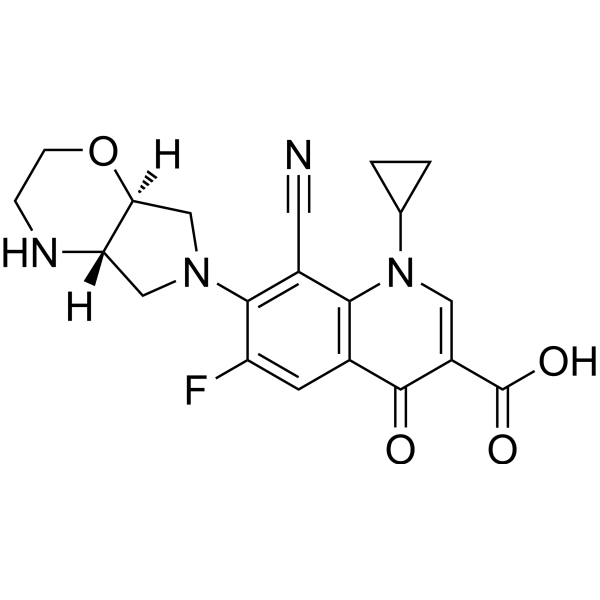
Finafloxacin
Based on 1 publication(s) in Google Scholar
Finafloxacin is an orally active fourth-generation fluoroquinolone broad-spectrum antibiotic. Finafloxacin exhibits stronger antibacterial activity in acidic pH environments and is not easily affected by bacterial multidrug efflux transporters. Finafloxacin is effective against a variety of extracellular pathogenic bacteria, and can also accumulate in macrophages, showing excellent antibacterial activity against intracellular Staphylococcus aureus, Listeria monocytogenes, Legionella pneumophila, Burkholderia pseudomallei, and other pathogens. Finafloxacin has been approved by the U.S. FDA for research on acute otitis externa mediated by Pseudomonas aeruginosa. Finafloxacin is also used in studies related to diseases such as melioidosis, inhalational tularemia, and inhalational plague.
Nos produits utilisent uniquement pour la recherche. Nous ne vendons pas aux patients.
- Pureté : 98.75%
- CAS No.: 209342-40-5
- Formule: C20H19FN4O4
- Masse moléculaire:398.39
-
Stockage:Powder -20°C, 3 years , 4°C, 2 years ; In solvent -80°C, 2 years , -20°C, 1 year

To place orders, for customer services and technical support, please contact: MedChemExpress USA
Tel: 609-228-6898 E-mail: [email protected] [email protected]


-
 Activité biologique
-
Chemical Information
-
Solvant et solubilité
- Protocole
- Pureté et documentation
- Références
-
 Help & FAQs


Publications Citing Use of MedChemExpress (MCE) Finafloxacin
MoreVoir tous les produits spécifiques à Isoform Antibiotic
More

Activité biologique
Description
IC50 & Target
|
Quinolone |
In Vitro
Finafloxacin (24 h; 48 h) inhibits growth of extracellular MSSA, CA-MRSA, HA-MRSA, VISA, L. monocytogenes, and L. pneumophila with MICs ranging from 0.01 mg/L (against L. pneumophila) to 16 mg/L (against a ciprofloxacin-resistant HA-MRSA isolate), and shows reduced susceptibility to NorA and Lde efflux mechanisms compared to ciprofloxacin[1].
Finafloxacin is bactericidal against intracellular L. monocytogenes in human THP-1 macrophages at neutral pH, but is less potent than ciprofloxacin[1].
MedChemExpress (MCE) has not independently confirmed the accuracy of these methods. They are for reference only.
In Vivo
Finafloxacin (23.1 mg/kg; p.o.; every 8 h; 3-7 days) provides 100% survival when administered starting 24 h post inhalational Y. pestis challenge, and 80% to 100% survival when administered starting 38 h postchallenge[3].
MedChemExpress (MCE) has not independently confirmed the accuracy of these methods. They are for reference only.
-
Animal Model:BALB/c (female, 8 to 10 weeks old, inhalational challenge with Francisella tularensis SCHU S4)[3]
-
Dosage:23.1 mg/kg
-
Administration:p.o.; every 8 h; 3 days; 7 days
-
Result:Provided 100% survival when treatment initiated at 24 h postchallenge, with 90% of mice showing no clinical signs of disease, no detectable bacteria in organs, and no histopathological changes typical of infection.
Increased time to death significantly compared to ciprofloxacin when treatment initiated at 72 h postchallenge for 3 days, with mice resolving clinical signs by day 7, relapsing by day 11, and succumbing by day 16.
Provided 50% survival when treatment initiated at 72 h postchallenge for 7 days, with all surviving mice having no detectable bacteria in organs and no histopathological changes typical of infection.
Caused less weight loss than ciprofloxacin in the 3-day 72 h postchallenge regimen, with differences identifiable at days 9 to 10 postchallenge.


Chemical Information
-
CAS No. 209342-40-5
-
Appearance Solid
-
Masse moléculaire 398.39
-
Formule C20H19FN4O4
-
Color Light yellow to yellow
-
SMILES
O=C(C1=CN(C2CC2)C3=C(C=C(F)C(N4C[C@]5([H])OCCN[C@@]5([H])C4)=C3C#N)C1=O)O
-
Livraison
Room temperature in continental US; may vary elsewhere.
-
Stockage
Powder -20°C 3 years 4°C 2 years In solvent -80°C 2 years -20°C 1 year


Publications (1)
-
Journal Impact Factor
-
Most Recent
-
Microb Pathog
Antibiotic discovery against Piscirickettsia salmonis using a combined in silico and in vitro approach. [Abstract]2023 Jul:180:106122. PMID: 37094756


Solvant et solubilité
In Vitro:
DMSO : 6.4 mg/mL (16.06 mM; Need ultrasonic and warming; Hygroscopic DMSO has a significant impact on the solubility of product, please use newly opened DMSO)
Please refer to the solubility information to select the appropriate solvent. Once prepared, please aliquot and store the solution to prevent product inactivation from repeated freeze-thaw cycles.
Storage method and period of stock solution: -80°C, 2 years; -20°C, 1 year. When stored at -80°C, please use it within 2 years. When stored at -20°C, please use it within 1 year.
Please refer to the solubility information to select the appropriate solvent. Once prepared, please aliquot and store the solution to prevent product inactivation from repeated freeze-thaw cycles.
Storage method and period of stock solution: -80°C, 2 years; -20°C, 1 year. When stored at -80°C, please use it within 2 years. When stored at -20°C, please use it within 1 year.
Concentration (start) × Volume (start) = Concentration (final) × Volume (final)


Pureté et documentation
-
Fiche technique (286 KB)
-
SDS (393 KB)
- English - EN (393 KB)
- Français - FR (393 KB)
- Deutsch - DE (393 KB)
- Norwegian - NO (393 KB)
- Español - ES (393 KB)
- Swedish - SV (393 KB)
- Italian - IT (393 KB)
- Korean - KR (393 KB)
- Portuguese - PT (393 KB)
-
Instruction de manipulation (2659 KB)
Références


Complete Stock Solution Preparation Table
Please refer to the solubility information to select the appropriate solvent. Once prepared, please aliquot and store the solution to prevent product inactivation from repeated freeze-thaw cycles.
Storage method and period of stock solution: -80°C, 2 years; -20°C, 1 year. When stored at -80°C, please use it within 2 years. When stored at -20°C, please use it within 1 year.
| Optional Solvent | Concentration Solvent Mass | 1 mg | 5 mg | 10 mg | 25 mg |
|---|---|---|---|---|---|
| DMSO | 1 mM | 2.5101 mL | 12.5505 mL | 25.1010 mL | 62.7526 mL |
| 5 mM | 0.5020 mL | 2.5101 mL | 5.0202 mL | 12.5505 mL | |
| 10 mM | 0.2510 mL | 1.2551 mL | 2.5101 mL | 6.2753 mL | |
| 15 mM | 0.1673 mL | 0.8367 mL | 1.6734 mL | 4.1835 mL |


Finafloxacin Related Classifications
HY-13451 Related Classifications
 Powered by Bioz