



Mizolastine

Based on 1 Customer Validation
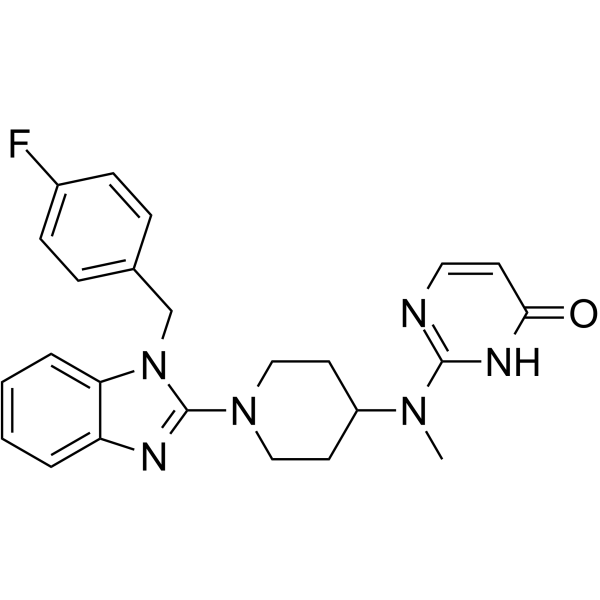
Mizolastine is an orally active, high affinity and specific peripheral histamine H1 receptor antagonist (second generation antihistamine). Mizolastine effectively inhibits mRNA expression of VEGF165, VEGF120, TNF-α and KC. Mizolastine can be used in studies of allergic rhinitis and chronic idiopathic urticarial.
Nos produits utilisent uniquement pour la recherche. Nous ne vendons pas aux patients.
- Pureté : 99.74%
- CAS No.: 108612-45-9
- Formule: C24H25FN6O
- Masse moléculaire:432.49
-
Stockage:Powder -20°C, 3 years , 4°C, 2 years ; In solvent -80°C, 2 years , -20°C, 1 year

To place orders, for customer services and technical support, please contact: MedChemExpress USA
Tel: 609-228-6898 E-mail: [email protected] [email protected]


-
 Activité biologique
-
Chemical Information
-
Solvant et solubilité
- Protocole
- Pureté et documentation
- Références
-
 Help & FAQs


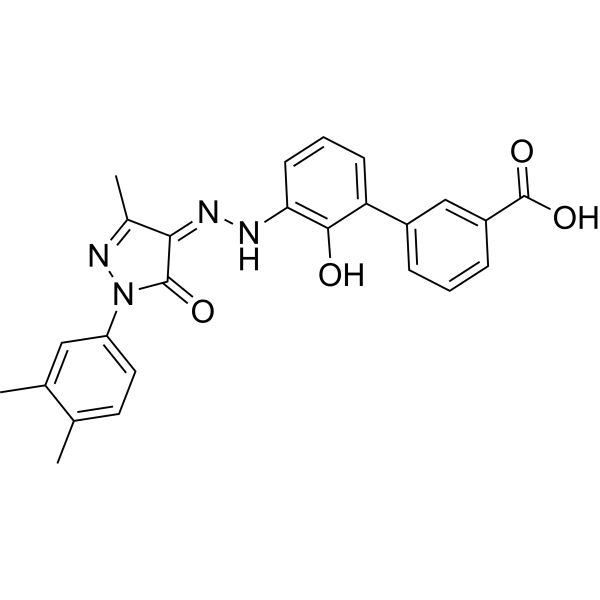
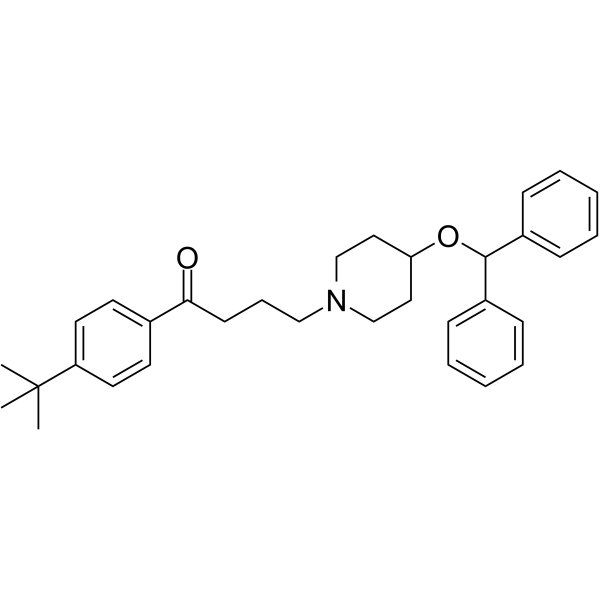


Voir tous les produits spécifiques à Isoform Histamine Receptor
More

Activité biologique
Description
Cellular Effect
|
Cell Line

|
Type | Value | Description | References |
|---|---|---|---|---|
| HEK293 | IC50 |
441 nM
Compound: mizolastine
|
Inhibition of human ERG channel expressed in HEK293 cells by patch clamp assay
Inhibition of human ERG channel expressed in HEK293 cells by patch clamp assay
|
[PMID: 19553115] |
In Vitro
Mizolastine (1-10000 nM; 0.5-6 h) shows inhibitory effects on VEGF, KC and TNF-α release in mast cells[1].
Mizolastine (0.1 µM; 4 h) significantly reduces VEGF165, VEGF120, TNF-α and KC mRNA expression in mast cells[1].
MedChemExpress (MCE) has not independently confirmed the accuracy of these methods. They are for reference only.
-
Cell Line:Mast cells (from Kunming mice)
-
Concentration:1-10000 nM
-
Incubation Time:0.5-6 h
-
Result:Markedly inhibited release of KC, VEGF and TNF-α in a time- and dose- dependent manner.
-
Cell Line:Mast cells (from Kunming mice)
-
Concentration:0.1 µM
-
Incubation Time:4 h
-
Result:Led to a significant reduction of induced VEGF165, VEGF120, TNF-α and KC mRNA synthesis.
In Vivo
MedChemExpress (MCE) has not independently confirmed the accuracy of these methods. They are for reference only.
-
Animal Model:Male Sprague-Dawley rats (specific-pathogen-free; 234-254 g; 7 to 8-week-old; rat paw edema model)[2].
-
Dosage:0.3 mg/kg
-
Administration:Oral gavage; single daily for 7 days.
-
Result:Significantly reduced paw edema by 21% at 1 h, and by 14‑18% between 2 and 4 h.
Inhibited inflammatory cell infiltration and significantly reduced levels of LTB4.
Suppressed expression of 5‑LOX, cPLA2, FLAP and LTB4r mRNA.


Chemical Information
-
CAS No. 108612-45-9
-
Appearance Solid
-
Masse moléculaire 432.49
-
Formule C24H25FN6O
-
Color White to off-white
-
SMILES
O=C1NC(N(C2CCN(C3=NC4=CC=CC=C4N3CC5=CC=C(F)C=C5)CC2)C)=NC=C1
-
Livraison
Room temperature in continental US; may vary elsewhere.
-
Stockage
Powder -20°C 3 years 4°C 2 years In solvent -80°C 2 years -20°C 1 year


Solvant et solubilité
In Vitro:
DMSO : 25 mg/mL (57.80 mM; Need ultrasonic; Hygroscopic DMSO has a significant impact on the solubility of product, please use newly opened DMSO)
H2O : < 0.1 mg/mL (insoluble)
Please refer to the solubility information to select the appropriate solvent. Once prepared, please aliquot and store the solution to prevent product inactivation from repeated freeze-thaw cycles.
Storage method and period of stock solution: -80°C, 2 years; -20°C, 1 year. When stored at -80°C, please use it within 2 years. When stored at -20°C, please use it within 1 year.
Please refer to the solubility information to select the appropriate solvent. Once prepared, please aliquot and store the solution to prevent product inactivation from repeated freeze-thaw cycles.
Storage method and period of stock solution: -80°C, 2 years; -20°C, 1 year. When stored at -80°C, please use it within 2 years. When stored at -20°C, please use it within 1 year.
Concentration (start) × Volume (start) = Concentration (final) × Volume (final)
In Vivo:
Select the appropriate dissolution method based on your experimental animal and administration route.
- For the following dissolution methods, please ensure to first prepare a clear stock solution using an In Vitro approach and then sequentially add co-solvents:
- To ensure reliable experimental results, the clarified stock solution can be appropriately stored based on storage conditions. As for the working solution for In Vivo experiments, it is recommended to prepare freshly and use it on the same day.
- The percentages shown for the solvents indicate their volumetric ratio in the final prepared solution. If precipitation or phase separation occurs during preparation, heat and/or sonication can be used to aid dissolution.
Add each solvent one by one: 10% DMSO 40% PEG300 5% Tween-80 45% Saline
Solubility: ≥ 2.5 mg/mL (5.78 mM); Clear solution
This protocol yields a clear solution of ≥ 2.5 mg/mL (saturation unknown).
Taking 1 mL working solution as an example, add 100 μL DMSO stock solution (25.0 mg/mL) to 400 μL PEG300, and mix evenly; then add 50 μL Tween-80 and mix evenly; then add 450 μL Saline to adjust the volume to 1 mL.
Preparation of Saline: Dissolve 0.9 g sodium chloride in ddH₂O and dilute to 100 mL to obtain a clear Saline solution.
Add each solvent one by one: 10% DMSO 90% (20% SBE-β-CD in Saline)
Solubility: ≥ 2.5 mg/mL (5.78 mM); Clear solution
This protocol yields a clear solution of ≥ 2.5 mg/mL (saturation unknown).
Taking 1 mL working solution as an example, add 100 μL DMSO stock solution (25.0 mg/mL) to 900 μL 20% SBE-β-CD in Saline, and mix evenly.
Preparation of 20% SBE-β-CD in Saline (4°C, storage for one week): 2 g SBE-β-CD powder is dissolved in 10 mL Saline, completely dissolve until clear.
In Vivo Dissolution Calculator
Please enter the basic information of animal experiments:
-
-
-
-
Recommended: Prepare an additional quantity of animals to account for potential losses during experiments.
Please enter your animal formula composition:
-
%DMSO +
Recommended: Keep the proportion of DMSO in working solution below 2% if your animal is weak.
-
%+
-
+%Tween-80 + +
-
%Saline +
The co-solvents required include: DMSO, . All of co-solvents are available by MedChemExpress (MCE). , Tween 80. All of co-solvents are available by MedChemExpress (MCE).
Working solution concentration: 0.22 mg/mL
Method for preparing stock solution: mg drug dissolved in μL DMSO. Stock solution concentration: mg/mL.
1. Take μL DMSO stock solution;
2. Add μL .
μL , mix evenly;
3. Then add μL Tween 80, mix evenly;
4. Then add μL
Please ensure that the stock solution in the first step is dissolved to a clear state, and add co-solvents in sequence. You can use ultrasonic heating (ultrasonic cleaner, recommended frequency 20-40 kHz), vortexing, etc. to assist dissolution.


Pureté et documentation
-
Fiche technique (277 KB)
-
SDS (393 KB)
- English - EN (393 KB)
- Français - FR (393 KB)
- Deutsch - DE (393 KB)
- Norwegian - NO (393 KB)
- Español - ES (393 KB)
- Swedish - SV (393 KB)
- Italian - IT (393 KB)
- Korean - KR (393 KB)
- Portuguese - PT (393 KB)
-
Instruction de manipulation (2659 KB)
Références
[1]. Xia Q, et al. The effect of mizolastine on expression of vascular endothelial cell growth factor, tumour necrosis factor-alpha and keratinocyte-derived chemokine in murine mast cells, compared with dexamethasone and loratadine. Clin Exp Dermatol. 2005 Mar [Content Brief]
[2]. Ren X, et al. The anti-inflammatory effects of Yunnan Baiyao are involved in regulation of the phospholipase A2/arachidonic acid metabolites pathways in acute inflammation rat model. Mol Med Rep. 2017 Oct;16(4):4045-4053. [Content Brief]
[3]. Prakash A, et al. Mizolastine: a review of its use in allergic rhinitis and chronic idiopathic urticaria. BioDrugs. 1998 Jul;10(1):41-63. [Content Brief]


Complete Stock Solution Preparation Table
Please refer to the solubility information to select the appropriate solvent. Once prepared, please aliquot and store the solution to prevent product inactivation from repeated freeze-thaw cycles.
Storage method and period of stock solution: -80°C, 2 years; -20°C, 1 year. When stored at -80°C, please use it within 2 years. When stored at -20°C, please use it within 1 year.
| Optional Solvent | Concentration Solvent Mass | 1 mg | 5 mg | 10 mg | 25 mg |
|---|---|---|---|---|---|
| DMSO | 1 mM | 2.3122 mL | 11.5610 mL | 23.1219 mL | 57.8048 mL |
| 5 mM | 0.4624 mL | 2.3122 mL | 4.6244 mL | 11.5610 mL | |
| 10 mM | 0.2312 mL | 1.1561 mL | 2.3122 mL | 5.7805 mL | |
| 15 mM | 0.1541 mL | 0.7707 mL | 1.5415 mL | 3.8537 mL | |
| 20 mM | 0.1156 mL | 0.5780 mL | 1.1561 mL | 2.8902 mL | |
| 25 mM | 0.0925 mL | 0.4624 mL | 0.9249 mL | 2.3122 mL | |
| 30 mM | 0.0771 mL | 0.3854 mL | 0.7707 mL | 1.9268 mL | |
| 40 mM | 0.0578 mL | 0.2890 mL | 0.5780 mL | 1.4451 mL | |
| 50 mM | 0.0462 mL | 0.2312 mL | 0.4624 mL | 1.1561 mL |


Mizolastine Related Classifications
HY-B0164 Related Classifications
 Powered by Bioz