



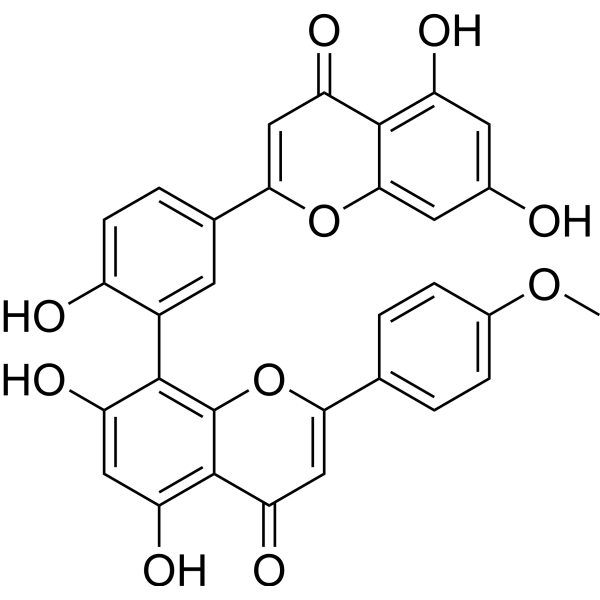
Podocarpusflavone A

Based on 1 Customer Validation
Podocarpusflavone A is a biflavonoid present in the leaves of Podocarpus henkelii, with anti-tumor, topoisomerase I inhibitory, antibacterial and antifungal activities. Podocarpusflavone A exhibits antibacterial activity against Enterococcus faecalis and Pseudomonas aeruginosa. Podocarpusflavone A shows weak activity against fungal pathogens. Podocarpusflavone A targets topoisomerase I and induces cell cycle arrest and apoptosis in MCF-7 cells. Podocarpusflavone A can be used for studies on cancer, bacterial and fungal infections.
For research use only. We do not sell to patients.
- Purity : 99.62%
- CAS No.: 22136-74-9
- Formula: C31H20O10
- Molecular Weight:552.48
-
Storage:
4°C, protect from light
* In solvent : -80°C, 6 months; -20°C, 1 month (protect from light)

To place orders, for customer services and technical support, please contact: MedChemExpress USA
Tel: 609-228-6898 E-mail: [email protected] [email protected]


-
 Biological Activity
-
Chemical Information
-
Solvent & Solubility
- Protocols
- Purity & Documentation
- References
-
 Help & FAQs


All Topoisomerase Isoforms
More

Biological Activity
Description
IC50 & Target
[2]|
Topoisomerase I 65.98 μg/mL (IC50) |
Cellular Effect
|
Cell Line

|
Type | Value | Description | References |
|---|---|---|---|---|
| A549 | IC50 |
1.6 μg/mL
Compound: 2
|
Cytotoxicity against A549 cells
Cytotoxicity against A549 cells
|
[PMID: 17027271] |
| B16 | IC50 |
1.6 μg/mL
Compound: 2
|
Cytotoxicity against B16 cells
Cytotoxicity against B16 cells
|
[PMID: 17027271] |
| Bel-7402 | IC50 |
1.6 μg/mL
Compound: 2
|
Cytotoxicity against BEL-7402 cells
Cytotoxicity against BEL-7402 cells
|
[PMID: 17027271] |
| BGC-823 | IC50 |
1.6 μg/mL
Compound: 2
|
Cytotoxicity against BGC823 cells
Cytotoxicity against BGC823 cells
|
[PMID: 17027271] |
| BHK-21 | IC50 |
0.75 μM
Compound: 12
|
Cytotoxicity against hamster BHK-21 cells assessed as reduction in cell viability incubated for 24 hrs by Celltiter assay
Cytotoxicity against hamster BHK-21 cells assessed as reduction in cell viability incubated for 24 hrs by Celltiter assay
|
[PMID: 34274831] |
| DU-145 | IC50 |
1.6 μg/mL
Compound: 2
|
Cytotoxicity against DU145 cells
Cytotoxicity against DU145 cells
|
[PMID: 17027271] |
| HT-29 | IC50 |
1.6 μg/mL
Compound: 2
|
Cytotoxicity against HT29 cells
Cytotoxicity against HT29 cells
|
[PMID: 17027271] |
| HT-29 | IC50 |
7.9 μM
Compound: Podocarpusflavone A
|
Antiproliferative activity against human HT-29 cells assessed as decrease in cell viability after 24 hrs by CCK8 assay
Antiproliferative activity against human HT-29 cells assessed as decrease in cell viability after 24 hrs by CCK8 assay
|
[PMID: 30108705] |
| L6 | IC50 |
0.75 μM
Compound: 12
|
Cytotoxicity against African green monkey COS-7 cells assessed as reduction in cell viability incubated for 24 hrs by Celltiter assay
Cytotoxicity against African green monkey COS-7 cells assessed as reduction in cell viability incubated for 24 hrs by Celltiter assay
|
[PMID: 34274831] |
| MCF7 | IC50 |
1.6 μg/mL
Compound: 2
|
Cytotoxicity against MCF7 cells
Cytotoxicity against MCF7 cells
|
[PMID: 17027271] |
| MCF7 | IC50 |
35.1 μM
Compound: 5
|
Cytotoxicity against human MCF7 cells measured after 24 hrs by MTT assay
Cytotoxicity against human MCF7 cells measured after 24 hrs by MTT assay
|
[PMID: 34875389] |
| MDA-MB-231 | IC50 |
1.6 μg/mL
Compound: 2
|
Cytotoxicity against MDA-MB-231 cells
Cytotoxicity against MDA-MB-231 cells
|
[PMID: 17027271] |
| PC-3 | GI50 |
>100 μM
Compound: 17
|
Growth inhibition of human PC3 cells by colorimetric MTT assay
Growth inhibition of human PC3 cells by colorimetric MTT assay
|
[PMID: 25736997] |
| SGC-7901 | IC50 |
1.6 μg/mL
Compound: 2
|
Cytotoxicity against SGC7901 cells
Cytotoxicity against SGC7901 cells
|
[PMID: 17027271] |
In Vitro
Podocarpusflavone A (PFA) (Serial two-fold dilutions from an initial 1 mg/mL; 12-24 h) shows broad-spectrum bactericidal activity against Enterococcus faecalis and Pseudomonas aeruginosa (MIC = 60 μg/mL), with weaker activity against Staphylococcus aureus (MIC = 130 μg/mL) and Escherichia coli (MIC = 250 μg/mL)[1].
Podocarpusflavone A (Serial two-fold dilutions from an initial 1 mg/mL; 24-48 h) exhibits weak antifungal activity against Candida albicans and Aspergillus fumigatus (MIC = 250 μg/mL) and Cryptococcus neoformans (MIC = 130 μg/mL) at 24 h and 48 h incubation[1].
Podocarpusflavone A (CC50 threshold of 1000 μg/mL; MIC values as measured in antibacterial and antifungal assays) has favorable selective antimicrobial activity (SI > 15) against Enterococcus faecalis and Pseudomonas aeruginosa, with lower selectivity against other tested bacterial and fungal pathogens[1].
Podocarpusflavone A (PF) (1-40 µM; 72 h) shows potent antiproliferative activity against KB, MCF-7, DLD and HEp-2 tumor cell lines with ED50 values of 4.67 µg/mL, 15.17 µg/mL, 4.95 µg/mL and 10.87 µg/mL[2].
Podocarpusflavone A (20-40 µg/mL; 24 h) induces cell cycle arrest at sub-G1/S phase and triggers apoptosis in MCF-7 cells[2].
Podocarpusflavone A shows moderate Topoisomerase I inhibitory activity with an IC50 value of 65.98 µg/mL[2].
MedChemExpress (MCE) has not independently confirmed the accuracy of these methods. They are for reference only.
-
Cell Line:MCF-7 cells
-
Concentration:20, 40 µg/mL
-
Incubation Time:24 h
-
Result:Induced cell cycle arrest at sub-G1/S phase in MCF-7 cells.
-
Cell Line:MCF-7 cells
-
Concentration:20, 40 µg/mL
-
Incubation Time:24 h
-
Result:Induced apoptosis in MCF-7 cells.
- Research Protocol for Infectious Diseases
- Detection of Apoptosis
- TUNEL staining for apoptotic DNA fragmentation
- Flow cytometric DNA-content cell-cycle staining
- Annexin V plus membrane-impermeant dye apoptosis staining
- BrdU Incorporation Assay
- Apoptosis Solutions
- Protocol for Cell Cycle
- Bacterial live/dead nucleic-acid viability staining


Chemical Information
-
CAS No. 22136-74-9
-
Appearance Solid
-
Molecular Weight 552.48
-
Formula C31H20O10
-
Color Light yellow to green yellow
-
SMILES
O=C1C=C(C2=CC=C(OC)C=C2)OC3=C(C4=CC(C5=CC(C6=C(O)C=C(O)C=C6O5)=O)=CC=C4O)C(O)=CC(O)=C13
-
Structure Classification
-
Initial Source
-
Shipping
Room temperature in continental US; may vary elsewhere.
-
Storage
4°C, protect from light
* In solvent : -80°C, 6 months; -20°C, 1 month (protect from light)


Solvent & Solubility
In Vitro:
DMSO : 50 mg/mL (90.50 mM; Need ultrasonic; Hygroscopic DMSO has a significant impact on the solubility of product, please use newly opened DMSO)
Please refer to the solubility information to select the appropriate solvent. Once prepared, please aliquot and store the solution to prevent product inactivation from repeated freeze-thaw cycles.
Storage method and period of stock solution: -80°C, 6 months; -20°C, 1 month (protect from light). When stored at -80°C, please use it within 6 months. When stored at -20°C, please use it within 1 month.
Please refer to the solubility information to select the appropriate solvent. Once prepared, please aliquot and store the solution to prevent product inactivation from repeated freeze-thaw cycles.
Storage method and period of stock solution: -80°C, 6 months; -20°C, 1 month (protect from light). When stored at -80°C, please use it within 6 months. When stored at -20°C, please use it within 1 month.
Concentration (start) × Volume (start) = Concentration (final) × Volume (final)
In Vivo:
Select the appropriate dissolution method based on your experimental animal and administration route.
- For the following dissolution methods, please ensure to first prepare a clear stock solution using an In Vitro approach and then sequentially add co-solvents:
- To ensure reliable experimental results, the clarified stock solution can be appropriately stored based on storage conditions. As for the working solution for In Vivo experiments, it is recommended to prepare freshly and use it on the same day.
- The percentages shown for the solvents indicate their volumetric ratio in the final prepared solution. If precipitation or phase separation occurs during preparation, heat and/or sonication can be used to aid dissolution.
Add each solvent one by one: 10% DMSO 40% PEG300 5% Tween-80 45% Saline
Solubility: ≥ 1.25 mg/mL (2.26 mM); Clear solution
This protocol yields a clear solution of ≥ 1.25 mg/mL (saturation unknown).
Taking 1 mL working solution as an example, add 100 μL DMSO stock solution (12.5 mg/mL) to 400 μL PEG300, and mix evenly; then add 50 μL Tween-80 and mix evenly; then add 450 μL Saline to adjust the volume to 1 mL.
Preparation of Saline: Dissolve 0.9 g sodium chloride in ddH₂O and dilute to 100 mL to obtain a clear Saline solution.
In Vivo Dissolution Calculator
Please enter the basic information of animal experiments:
-
-
-
-
Recommended: Prepare an additional quantity of animals to account for potential losses during experiments.
Please enter your animal formula composition:
-
%DMSO +
Recommended: Keep the proportion of DMSO in working solution below 2% if your animal is weak.
-
%+
-
+%Tween-80 + +
-
%Saline +
The co-solvents required include: DMSO, . All of co-solvents are available by MedChemExpress (MCE). , Tween 80. All of co-solvents are available by MedChemExpress (MCE).
Working solution concentration: 0.22 mg/mL
Method for preparing stock solution: mg drug dissolved in μL DMSO. Stock solution concentration: mg/mL. * In solvent : -80°C, 6 months; -20°C, 1 month (protect from light)
1. Take μL DMSO stock solution;
2. Add μL .
μL , mix evenly;
3. Then add μL Tween 80, mix evenly;
4. Then add μL
Please ensure that the stock solution in the first step is dissolved to a clear state, and add co-solvents in sequence. You can use ultrasonic heating (ultrasonic cleaner, recommended frequency 20-40 kHz), vortexing, etc. to assist dissolution.


Purity & Documentation
-
Data Sheet (294 KB)
-
SDS (393 KB)
- English - EN (393 KB)
- Français - FR (393 KB)
- Deutsch - DE (393 KB)
- Norwegian - NO (393 KB)
- Español - ES (393 KB)
- Swedish - SV (393 KB)
- Italian - IT (393 KB)
- Korean - KR (393 KB)
- Portuguese - PT (393 KB)
-
Handling Instructions (2659 KB)
References
[1]. Bagla VP, et al. Antimicrobial activity, toxicity and selectivity index of two biflavonoids and a flavone isolated from Podocarpus henkelii (Podocarpaceae) leaves. BMC Complement Altern Med. 2014;14:383. Published 2014 Oct 8. [Content Brief]
[2]. Yeh PH, et al. Naturally Occurring Cytotoxic [3′→8″]-Biflavonoids from Podocarpus nakaii. Journal of Traditional and Complementary Medicine. 2011;2(3):220-226. [Content Brief]


Complete Stock Solution Preparation Table
Please refer to the solubility information to select the appropriate solvent. Once prepared, please aliquot and store the solution to prevent product inactivation from repeated freeze-thaw cycles.
Storage method and period of stock solution: -80°C, 6 months; -20°C, 1 month (protect from light). When stored at -80°C, please use it within 6 months. When stored at -20°C, please use it within 1 month.
| Optional Solvent | Concentration Solvent Mass | 1 mg | 5 mg | 10 mg | 25 mg |
|---|---|---|---|---|---|
| DMSO | 1 mM | 1.8100 mL | 9.0501 mL | 18.1002 mL | 45.2505 mL |
| 5 mM | 0.3620 mL | 1.8100 mL | 3.6200 mL | 9.0501 mL | |
| 10 mM | 0.1810 mL | 0.9050 mL | 1.8100 mL | 4.5251 mL | |
| 15 mM | 0.1207 mL | 0.6033 mL | 1.2067 mL | 3.0167 mL | |
| 20 mM | 0.0905 mL | 0.4525 mL | 0.9050 mL | 2.2625 mL | |
| 25 mM | 0.0724 mL | 0.3620 mL | 0.7240 mL | 1.8100 mL | |
| 30 mM | 0.0603 mL | 0.3017 mL | 0.6033 mL | 1.5084 mL | |
| 40 mM | 0.0453 mL | 0.2263 mL | 0.4525 mL | 1.1313 mL | |
| 50 mM | 0.0362 mL | 0.1810 mL | 0.3620 mL | 0.9050 mL | |
| 60 mM | 0.0302 mL | 0.1508 mL | 0.3017 mL | 0.7542 mL | |
| 80 mM | 0.0226 mL | 0.1131 mL | 0.2263 mL | 0.5656 mL |


Podocarpusflavone A Related Classifications
HY-N2198 Related Classifications
 Powered by Bioz