



BUBR1
BUBR1 is an essential spindle assembly checkpoint protein that prevents premature anaphase onset and supports chromosome alignment and kinetochore-microtubule attachment[1]. Mechanistically, BUBR1 inhibits APC/C^Cdc20 through its N-terminal Cdc20-binding KEN-box region, allowing cyclin B accumulation before mitotic entry[2]. At kinetochores, BUBR1 links mitotic checkpoint signaling with chromosome-spindle attachment control and regulates CENP-A/Aurora kinase-associated attachment stability[3]. In human cells, BUBR1/BUB3 exists in functionally distinct kinetochore pools: a Bub1-dependent pool supports chromosome alignment, whereas KNL1-MELT binding strengthens checkpoint-complex incorporation[4]. Compared with Bub1, Bub1 is required for kinetochore localization of BUBR1, CENP-E, CENP-F, and Mad2, while BUBR1 is not required for kinetochore localization of Bub1 in human somatic cells[5]. In disease models, reduced BUBR1 causes progressive aneuploidy, senescence, infertility, and progeroid phenotypes in mice, whereas sustained high-level BUBR1 expression preserves genomic integrity and reduces tumorigenesis[6][7]. For experimental applications, bubristatin acts as a selective BUBR1 kinase antagonist and helps dissect BUBR1-CENP-E control of end-on microtubule capture[8].
References:
- [1]. Bloom CR, et al. Physiological relevance of post-translational regulation of the spindle assembly checkpoint protein BubR1. Cell Biosci. 2021 Apr 23;11(1):76. [Content Brief]
- [2]. Malureanu LA, et al. BubR1 N terminus acts as a soluble inhibitor of cyclin B degradation by APC/C(Cdc20) in interphase. Dev Cell. 2009 Jan;16(1):118-31. [Content Brief]
- [3]. Lampson MA, et al. The human mitotic checkpoint protein BubR1 regulates chromosome-spindle attachments. Nat Cell Biol. 2005 Jan;7(1):93-8. [Content Brief]
- [4]. Zhang G, et al. Two functionally distinct kinetochore pools of BubR1 ensure accurate chromosome segregation. Nat Commun. 2016 Jul 26;7:12256. [Content Brief]
- [5]. Johnson VL, et al. Bub1 is required for kinetochore localization of BubR1, Cenp-E, Cenp-F and Mad2, and chromosome congression. J Cell Sci. 2004 Mar 15;117(Pt 8):1577-89. [Content Brief]
- [6]. Baker DJ, et al. BubR1 insufficiency causes early onset of aging-associated phenotypes and infertility in mice. Nat Genet. 2004 Jul;36(7):744-9. [Content Brief]
- [7]. Baker DJ, et al. Increased expression of BubR1 protects against aneuploidy and cancer and extends healthy lifespan. Nat Cell Biol. 2013 Jan;15(1):96-102. [Content Brief]
- [8]. Huang Y, et al. BubR1 phosphorylates CENP-E as a switch enabling the transition from lateral association to end-on capture of spindle microtubules. Cell Res. 2019 Jul;29(7):562-578. [Content Brief]
All Product Categories
-
BUBR1 Related Products (1)
Related Products (1)

-
Indibulin
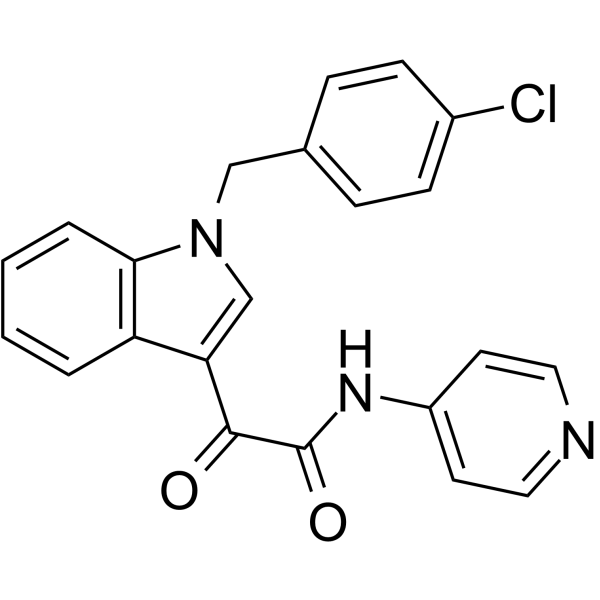 0 ImagesSynonyms: ZIO 301; D 24851Indibulin (ZIO 301), an orally applicable inhibitor of tubulin assembly, shows potent anticancer activity with a minimal neurotoxicity. Indibulin reduces inter-kinetochoric tension, produces aberrant spindles, activates mitotic checkpoint proteins Mad2 and BubR1, and induces mitotic arrest and apoptosis.



