



Fluorescent Dye
Fluorescence is a phenomenon of photoluminescence in luminescence. When an atom is irradiated by light, some electrons around the nucleus jump from their original orbitals to higher energy orbitals under the influence of light energy, i.e., from the ground state to the first or second excited single-line state, etc. Due to the instability of the first or second excited singlet state, the electron returns from the excited singlet state to the ground state accompanied by released energy, resulting in fluorescence.
Fluorescent dyes can be covalently bound or physically adsorbed in the structure of the substance. The fluorescence properties allow for the characterization, localization and quantitative analysis of the labeled object. Fluorescent dyes have shown great potential for the detection of proteins, nucleic acids, cells, and immunoassays, attributed to the advantages in non-radioactive contamination, simple experimental operation and easy observation.
Fluorescent dyes have penetrated many fields such as pharmacology, physiology, environmental science, and information science, as well as functional studies of proteins and drug screening.
All Product Categories
-
Fluorescent Dye Related Products (4851)
Related Products (4851)

-
Antibodies (4)
-
Mito-CS1
 0 ImagesCat. No.: HY-D3602CAS No.: 2558211-88-2Mito-CS1 is a fluorescent probe for imaging and reversible detection of the exchangeable mitochondrial Cu+ pool in living cells. Mito-CS1 combines a Cu+-responsive fluorescent platform with a mitochondria-targeted triphenylphosphonium group, which localizes the probe to mitochondria via a proton gradient. Mito-CS1 contains a thioether-rich receptor for the selective recognition and binding of Cu+, triggering a fluorescence turn-on response by inhibiting photoinduced electron transfer. The apo-form of Mito-CS1 has excitation/emission wavelengths of 555/569 nm, while those of Mito-CS1 after binding to Cu+ are 550/558 nm.
-
FAM labled Tadnersen sodium
 0 ImagesCat. No.: HY-132581HFAM labled Tadnersen sodiumis a FAM labled Tadnersen sodium.
-
2,4,6-Trimethylphenol (Standard)
 0 Images2,4,6-Trimethylphenol (Standard) is the analytical standard of 2,4,6-Trimethylphenol. This product is intended for research and analytical applications. 2,4,6-Trimethylphenol is a probe compound shown to react mainly with organic matter (3DOM*). 2,4,6-Trimethylphenol is rapidly oxidized by singlet oxygen in aqueous solution[1][2].
-
Sulfo-Cy5-TCO
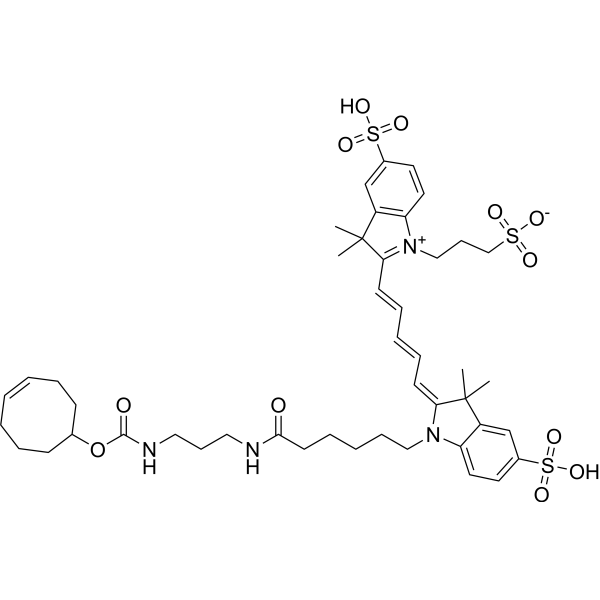 0 ImagesCat. No.: HY-151759CAS No.: 2129525-69-3Sulfo-Cy5-TCO is a water-soluble sulfonated Cy5 fluorescent reagent containing trans-cyclooctene (TCO). Sulfo-Cy5-TCO undergoes an inverse electron demand Diels‑Alder reaction with tetrazine-labeled fixed breast cancer cells to achieve cell labeling. Sulfo-Cy5-TCO is used for fluorescent labeling and imaging of biological samples such as proteins and cells.
-
Ulex Europaeus Agglutinin I (Fluorescein)
 0 ImagesCat. No.: HY-NP0145Synonyms: UEA I (Fluorescein)Ulex Europaeus Agglutinin I (UEA I) Fluorescein is a plant lectin that can be used as a probe to specifically bind biomolecules (such as polysaccharides, peptides, etc.).Ulex Europaeus Agglutinin I (UEA I) Fluorescein is a biological material or organic compound that can be used in life science research.

-
Fluoro azasterol
 0 ImagesCat. No.: HY-N15872CAS No.: 2758497-01-5Fluoro azasterol is a class of azasterols. Azasterols are a group of compounds that have uses as anti-parasitic, antifungal, and anti-toxoplasma agents.
-
Ulex Europaeus Agglutinin I-AF350
 0 ImagesCat. No.: HY-NP090BSynonyms: UEA I-AF350Ulex Europaeus Agglutinin I-AF350 (UEA I-AF350) is an AF350-labeled glehnia littoralis lectin I (UEA-I). Ulex Europaeus Agglutinin I exhibits specificity for cell surface glycoconjugates containing α-L-fucosylate. Ulex Europaeus Agglutinin I-AF350 can be used for vascular endothelial labeling, glycan imaging, and tissue staining studies (Ex/Em = 346/445 nm).
-
Lucifer yellow CH ammonium
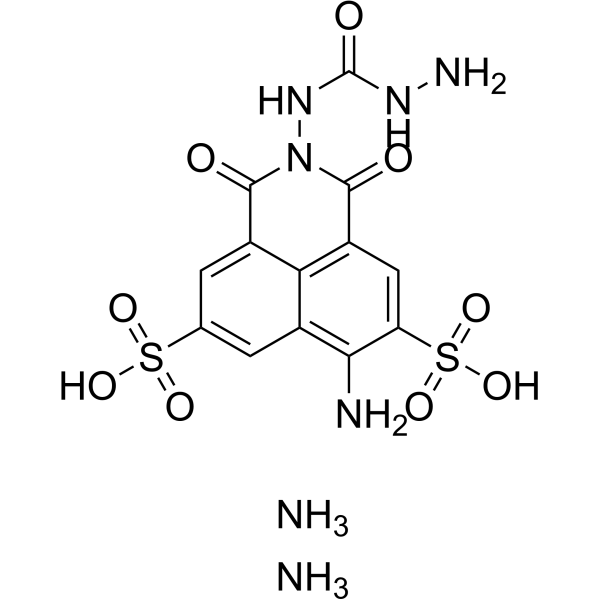 0 ImagesCat. No.: HY-D1754CAS No.: 188904-20-3Synonyms: LYCH ammoniumLucifer yellow CH (LYC) ammonium is a thiol-reactive fluorescent polar tracer.
-
CBG-549-QSY7
 0 ImagesCat. No.: HY-D2924CBG-549-QSY7 is a Dylight 549-labeled SNAP tag fluorescent probe (Ex/Em: 546 nm/580 nm), specially designed for non-washable fluorescence imaging applications. CBG-549-QSY7 employs an intramolecular FRET quenching mechanism: intramolecular fluorescence quenching occurs before binding to the SNAP tag, and upon binding, the quenching group is cleaved, releasing fluorescence. The background fluorescence of CBG-549-QSY7 is extremely low, and clear cell membrane images can be obtained after 5 minutes of incubation.

-
FAM labled Mongersen sodium
 0 ImagesCat. No.: HY-145721DFAM labled Mongersen sodiumis a FAM labled Mongersen sodium.
-
pH-Ap-1
 0 ImagesCat. No.: HY-D3109CAS No.: 148043-22-5pH-Ap-1 is a fluorescent probe used for ratiometric monitoring of pH fluctuations during autophagy in living cells, and it can detect intracellular pH changes in the autophagy process. For fluorescence detection of pH-Ap-1, its excitation wavelength is 475 nm, with an emission wavelength of 538 nm under alkaline conditions and 645 nm under acidic conditions. For intracellular imaging, excitation is performed at 488 nm: the emission light ranging from 500-550 nm is collected via the green channel corresponding to 538 nm, while the emission light ranging from 625-750 nm is collected via the red channel corresponding to 645 nm. pH-Ap-1 exhibits excellent photostability and chemical stability.
-
FAM labled Beclanorsen sodium
 0 ImagesCat. No.: HY-177618CFAM labled Beclanorsen sodiumis a FAM labled Beclanorsen sodium.
-
Lyso-OC
 0 ImagesCat. No.: HY-D3087CAS No.: 1966158-27-9Lyso-OC is a two-photon fluorescent probe that enables real-time monitoring of autophagy through ultrasensitive detection of lysosomal polarity changes. Lyso-OC possesses a coumarin (HY-N0709) solvatochromic group and a morpholine lysosome-targeting group, allowing selective lysosomal localization in living cells. Lyso-OC emits strong fluorescence in low-polarity lysosomes, whereas in high-polarity autolysosomes formed during autophagy, its fluorescence intensity decreases and the emission peak shifts by approximately 30 nm. For two-photon detection, the excitation/emission wavelengths of Lyso-OC are 760/490-550 nm, and its one-photon excitation wavelength is 375 nm. Lyso-OC can be used in cancer-related research.
-
Rhod-2 triammonium
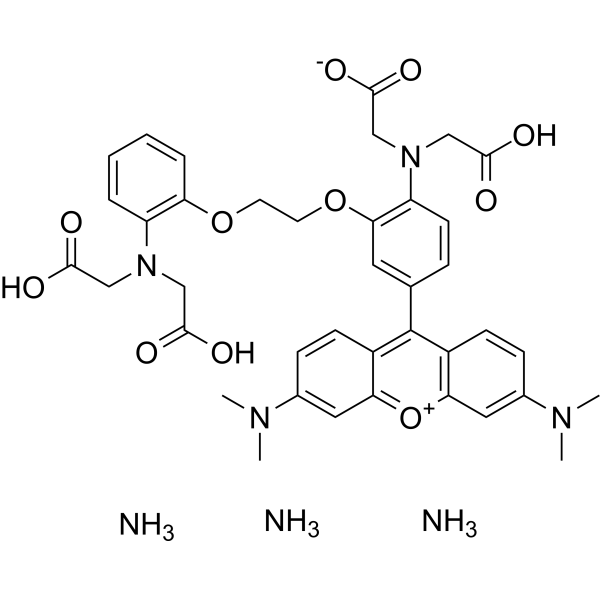 0 ImagesCat. No.: HY-W127781CAS No.: 129787-65-1Rhod-2 triammonium is a cell impermeant, red fluorescent calcium indicator. Rhod-2 triammonium exhibits a significant shift in fluorescence intensity upon calcium binding (ex max=549 nm; calcium-free v. ex/em max=552/581 nm; calcium-bound). Unlike the UV-excitable indicators Fura-2 and Indo-1 (HY-D0121), there is no accompanying spectral shift.
-
ER Flipper-TR 28
 0 ImagesCat. No.: HY-D2320CAS No.: 2334078-37-2ER Flipper-TR 28 is a flipper probe with a small molecule fluorophore that can image membrane tension in the endoplasmic reticulum (ER). ER Flipper-TR 28 bears a pentafluorophenyl group and also reacts with protein thiolate on the ER surface facing the cytoplasm.
-
Cy3 labled Onvuzosiran sodium
 0 ImagesCat. No.: HY-177652DCy3 labled Onvuzosiran sodium is a Cy3 labled Onvuzosiran sodium.
-
BTP9-Neu5Ac
 0 ImagesCat. No.: HY-D2982CAS No.: 1978301-38-0BTP9-Neu5Ac is a fluorescent imaging probe specifically designed for detecting the neuraminidase (NA) sialidase activity of influenza viruses. BTP9-Neu5Ac can visualize the intracellular Golgi localization of the viral NA activity. BTP9-Neu5Ac can be used for precise and temporal monitoring of the key enzyme activities during the viral life cycle.
-
RB-PEG5000-Mal
 0 ImagesCat. No.: HY-D2885ESynonyms: Rhodamine B-PEG5000-MalRB-PEG5000-Mal (Rhodamine B-PEG5000-Mal) is a fluorescent dye composed of Rhodamine B (HY-Y0016), PEG and Maleimide (HY-W007324) (Mal). RB-PEG5000-Mal can be used for fluorescent labeling and imaging (Ex/Em=546/610 nm).




