



Tivozanib
Based on 12 publication(s) in Google Scholar
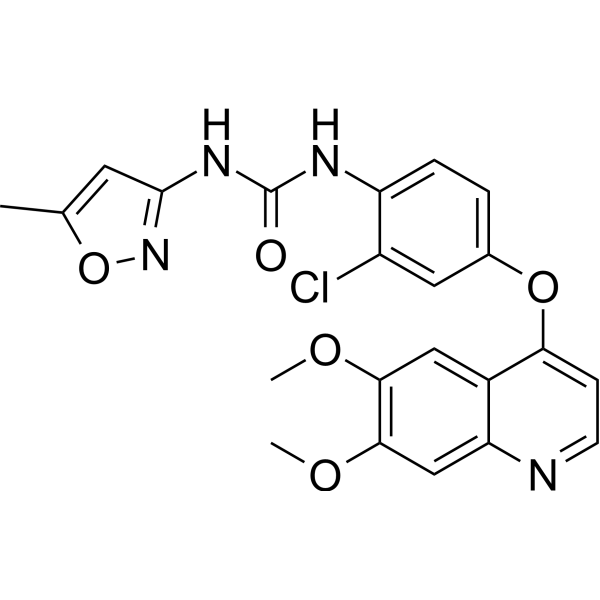
Tivozanib (AV-951; KRN951) is a selective, orally active inhibitor for vascular endothelial growth factor receptor (VEGFR)-1, 2 3, with IC50s of 30, 6.5 and 15 nM, respectively. Tivozanib exhibits antitumor efficacy.
商品は「研究用試薬」です。人や動物の医療用・臨床診断用・食品用の製品ではありません。
研究用途以外に使用した場合、当社は一切の責任を負いかねます。
- 純度 : 99.80%
- CAS 番号: 475108-18-0
- 分子式: C22H19ClN4O5
- 分子量:454.86
-
保管条件:Powder -20°C, 3 years , 4°C, 2 years ; In solvent -80°C, 2 years , -20°C, 1 year

To place orders, for customer services and technical support, please contact: MedChemExpress USA
Tel: 609-228-6898 E-mail: [email protected] [email protected]


-
 生物活性
生物活性
-
化学情報
-
溶剤 & 溶解度
- プロトコル
- 純度とドキュメンテーション
- 参考文献
-
 Help & FAQs


-
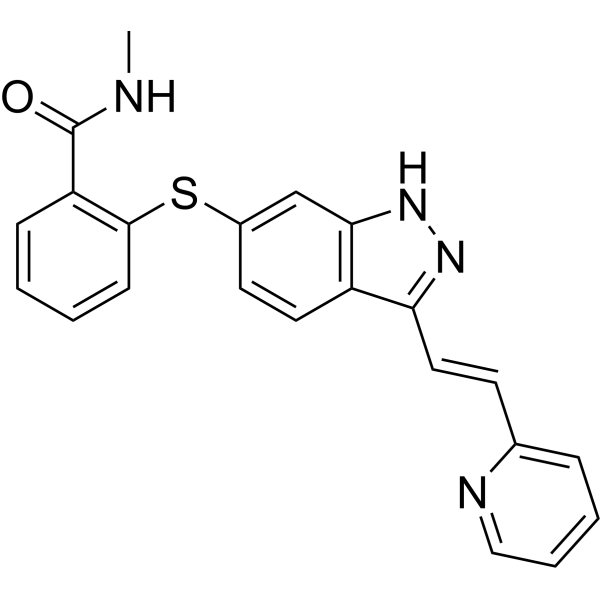
HY-10065
AxitinibTyrosine Kinase Inhibitor -
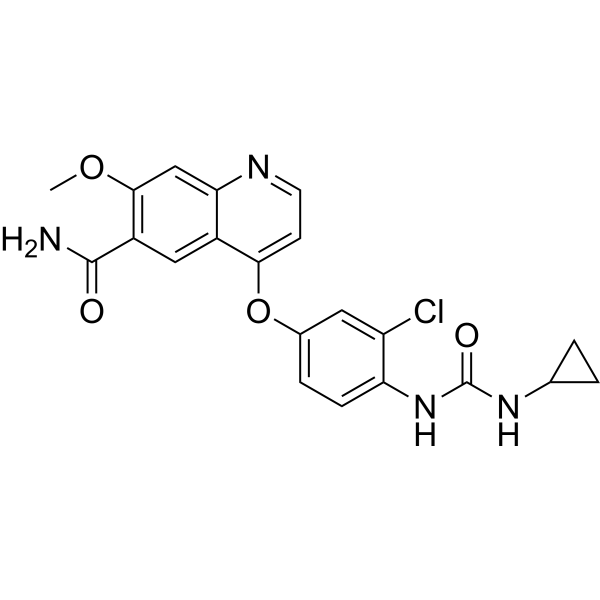
HY-10981
LenvatinibVEGFR/FGFR Inhibitor -
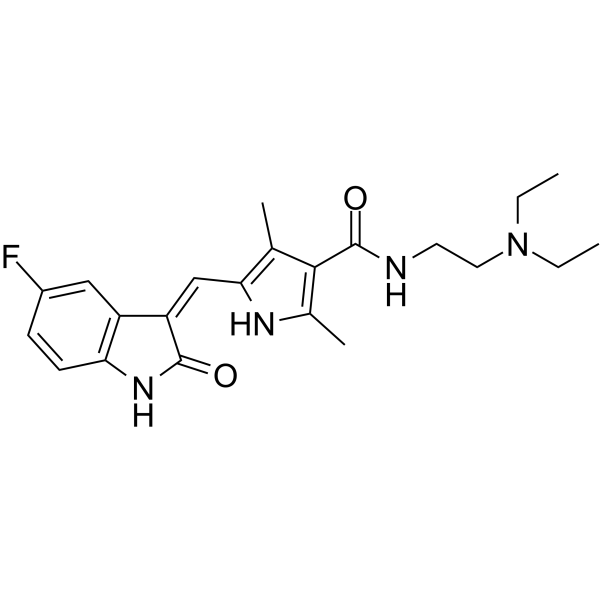
HY-10255A
SunitinibMulti-targeted RTK Inhibitor -
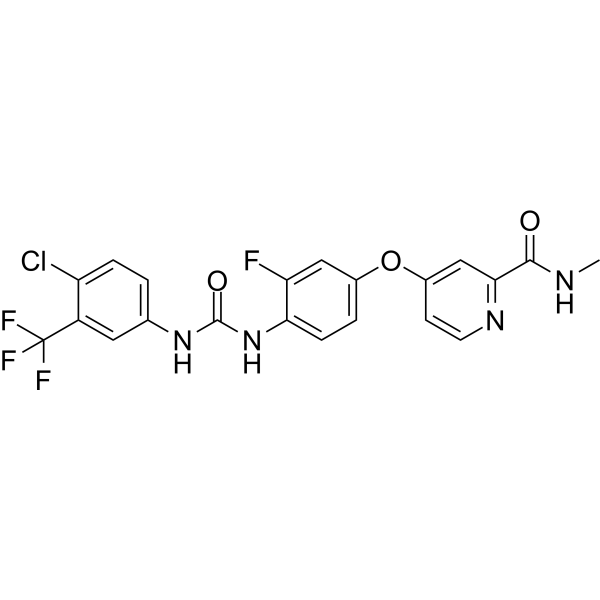
HY-10331
RegorafenibMulti-kinase Inhibitor -
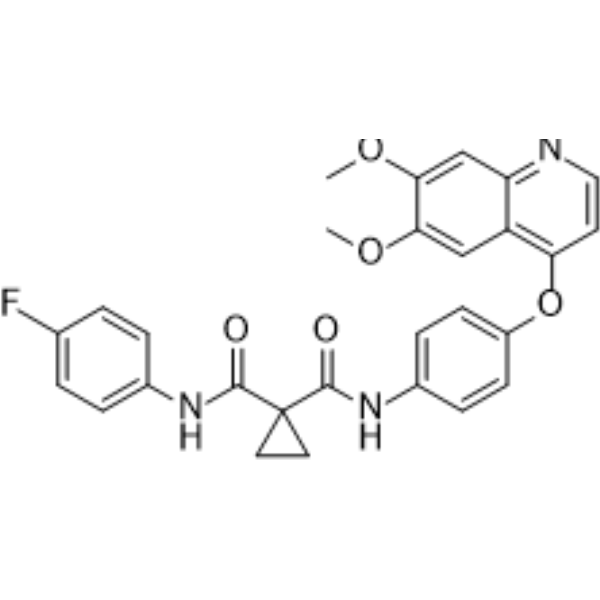
HY-13016
CabozantinibVEGFR2/MET Inhibitor -
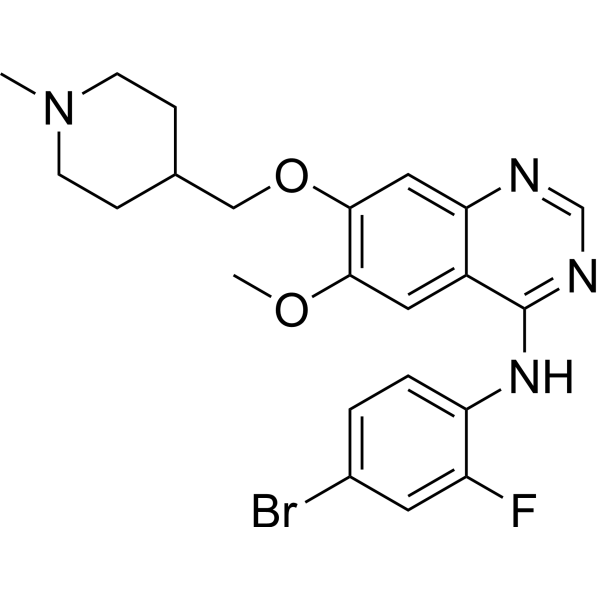
HY-10260
VandetanibVEGFR2/3 Inhibitor -
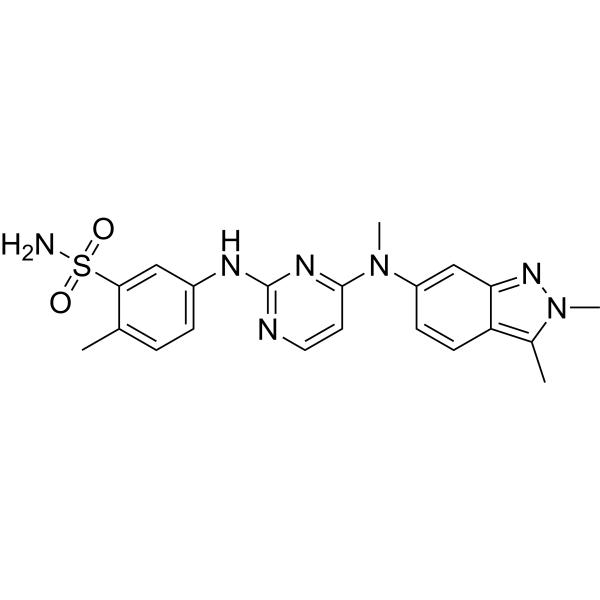
HY-10208
PazopanibVEGFR Inhibitor -
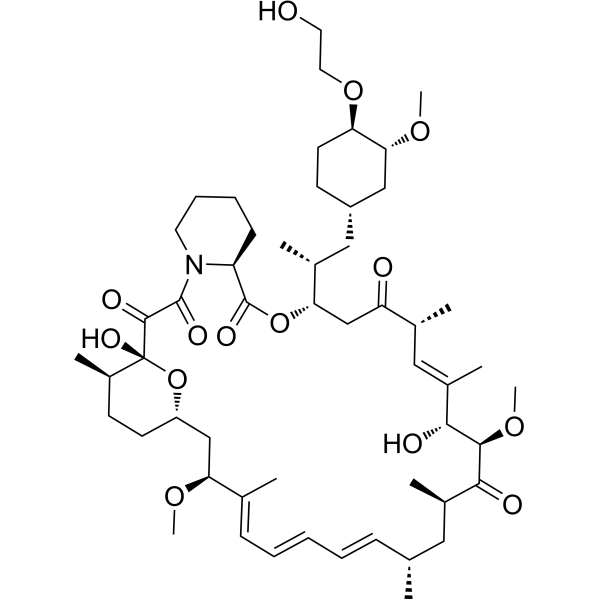
HY-10218
EverolimusmTORC Inhibitor -
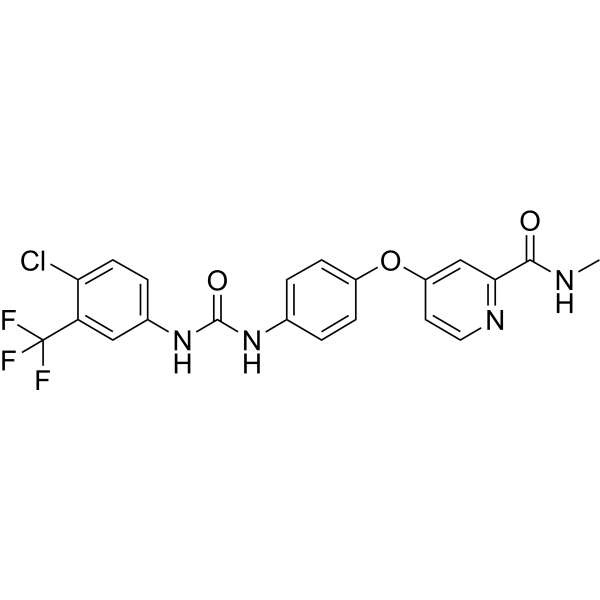
HY-10201
SorafenibMultikinase Inhibitor -
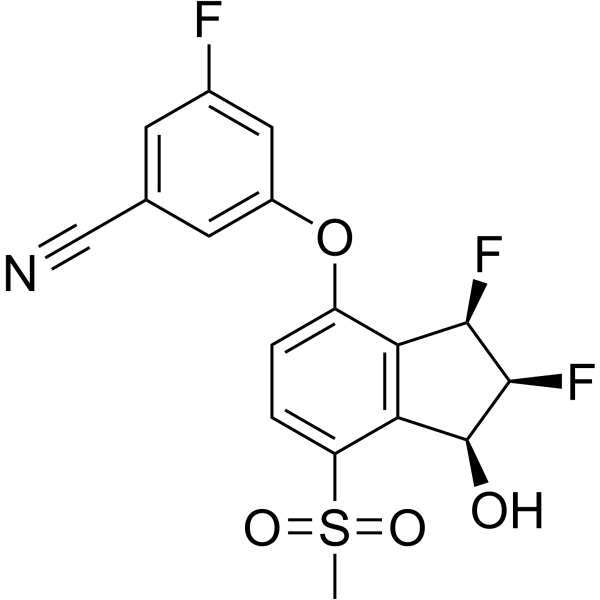
HY-125840
BelzutifanHIF-2α Inhibitor -
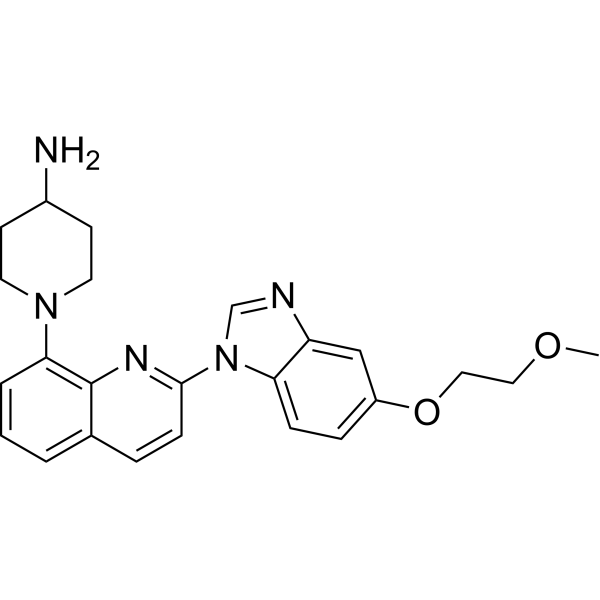
HY-12050
CP-673451PDGFR Inhibitor
MedChemExpress(MCE)の使用を引用している文献 Tivozanib
More- Cancer Commun (Lond). 2026 Sep 11:46:0048.
- Sci Transl Med. 2018 Jul 18;10(450):eaaq1093. [Abstract]
- Angiogenesis. 2025 Feb 3;28(2):13. [Abstract]
- Cell Mol Gastroenterol Hepatol. 2025;19(5):101454. [Abstract]
- Cancer Cell Int. 2021 Jun 5;21(1):291. [Abstract]
- Pharmaceuticals (Basel). 2023 Feb 14;16(2):295. [Abstract]
- Mol Divers. 2026 Sep 19.
- PLoS One. 2024 Nov 1;19(11):e0308647. [Abstract]
- Res Sq. 2026 May 20.
- SSRN. 2026 May 20.
- Technical University of Munich. 24.01.2018.
- Patent. US20170349880A1.
 Customer Validation & Images

-
WB
-
WB
-
In Vivo Efficacy Study
-
Histological Imaging/Staining
-
WB
VEGFR アイソフォーム固有の製品をすべて表示
More

生物活性
製品説明
IC50 & Target
[1]|
VEGFR2 6.5 nM (IC50) |
VEGFR3 15 nM (IC50) |
VEGFR1 30 nM (IC50) |
Cellular Effect
|
Cell Line

|
Type | Value | Description | References |
|---|---|---|---|---|
| A549 | IC50 |
0.62 μM
Compound: Tivozanib
|
Antiproliferative activity against human A549 cells assessed as inhibition of cell growth incubated for 48 hrs by CCK-8 assay
Antiproliferative activity against human A549 cells assessed as inhibition of cell growth incubated for 48 hrs by CCK-8 assay
|
[PMID: 37453330] |
| B16-F10 | IC50 |
18.8 μM
Compound: 10
|
Cytotoxicity against mouse B16-F10 cells assessed as reduction in cell viability incubated for 48 hrs by MTT assay
Cytotoxicity against mouse B16-F10 cells assessed as reduction in cell viability incubated for 48 hrs by MTT assay
|
[PMID: 38870832] |
| HUVEC | IC50 |
>300 nM
Compound: Chemical probe: KRN951
|
Antiproliferative activity against bFGF-induced human HUVEC cells assessed as cell viability incubated for 72 hrs by WST-1 assay
Antiproliferative activity against bFGF-induced human HUVEC cells assessed as cell viability incubated for 72 hrs by WST-1 assay
|
[PMID: 16982756] |
| HUVEC | IC50 |
0.67 nM
Compound: Chemical probe: KRN951
|
Antiproliferative activity against VEGF-induced human HUVEC cells assessed as cell viability incubated for 72 hrs by WST-1 assay
Antiproliferative activity against VEGF-induced human HUVEC cells assessed as cell viability incubated for 72 hrs by WST-1 assay
|
[PMID: 16982756] |
| Macrophage | IC50 |
226.75 μM
Compound: Tivozanib
|
Cytotoxicity against human Primary macrophage cells assessed as inhibition of cell growth incubated for 48 hrs by CCK-8 assay
Cytotoxicity against human Primary macrophage cells assessed as inhibition of cell growth incubated for 48 hrs by CCK-8 assay
|
[PMID: 37453330] |
| MCF7 | IC50 |
0.38 μM
Compound: Tivozanib
|
Antiproliferative activity against human MCF7 cells
Antiproliferative activity against human MCF7 cells
|
[PMID: 24583357] |
| MCF7 | IC50 |
0.38 μM
Compound: Tivozanib
|
Antiproliferative activity against human MCF7 cells assessed as inhibition of cell growth incubated for 48 hrs by CCK-8 assay
Antiproliferative activity against human MCF7 cells assessed as inhibition of cell growth incubated for 48 hrs by CCK-8 assay
|
[PMID: 37453330] |
| NCI-H460 | IC50 |
0.39 μM
Compound: Tivozanib
|
Antiproliferative activity against human NCI-H460 cells assessed as inhibition of cell growth incubated for 48 hrs by CCK-8 assay
Antiproliferative activity against human NCI-H460 cells assessed as inhibition of cell growth incubated for 48 hrs by CCK-8 assay
|
[PMID: 37453330] |
体外実験
Tivozanib inhibits the phosphorylation of VEGFR-1, VEGFR-2, and VEGFR-3, with IC50s of 0.16-0.24 nM[1].
Tivozanib (0-100 nM, 24 h) inhibits VEGF-induced proliferation of HUVECs with IC50 of 0.67 nM, and migration of HUVECs in dose-dependent manner[1].
Tivozanib (0-300 nM, 1 h) selectively inhibits the VEGF-stimulated phosphorylation of MAPKs in endothelial cells ligand-dependently, with IC50s of 0.13 and 0.18 nM for ERK1 and ERK2, respectively[1].
MedChemExpress (MCE) has not independently confirmed the accuracy of these methods. They are for reference only.
-
Cell Line:HUVECs
-
Concentration:0-300 nM
-
Incubation Time:1 h
-
Result:Inhibited VEGR-dependent phosphorylation of ERK1 and ERK2.
-
Cell Line:HUVECs
-
Concentration:0-100 nM
-
Incubation Time:24 h
-
Result:Inhibited proliferation.
-
Cell Line:HUVECs
-
Concentration:0-100 nM
-
Incubation Time:22 h
-
Result:Inhibited migration.
体内実験
Tivozanib (0.2-1 mg/kg, po for 21 days) reversibly suppresses vascular permeability and angiogenesis in Calu-6 tumor bearing rats model[1].
Tivozanib (5 mg/kg, po, single dose) reveals a AUCinf of 44.5 μg·h/mL, Cmax of 2823 ng/mL in athymic mice model[1].
MedChemExpress (MCE) has not independently confirmed the accuracy of these methods. They are for reference only.
-
Animal Model:Calu-6 tumor bearing athymic mice model[1]
-
Dosage:0.04-1 mg/kg/day
-
Administration:p.o., for 14-21 days
-
Result:Inhibited tumor growth, angiogenesis and vascular permeability.
臨床実験
| NCT Number | Sponsor | Condition | Start Date |
Phase
|
|---|---|---|---|---|
| NCT01329991 | Plexxikon| | 2011-05 | PHASE1 |


化学情報
-
CAS 番号 475108-18-0
-
性状 Solid
-
分子量 454.86
-
分子式 C22H19ClN4O5
-
Color Off-white to light brown
-
SMILES
O=C(NC1=CC=C(C=C1Cl)OC2=CC=NC3=CC(OC)=C(C=C23)OC)NC4=NOC(C)=C4
-
別名
チボザニブ; AV-951; KRN951
-
輸送条件
Room temperature in continental US; may vary elsewhere.
-
保管条件
Powder -20°C 3 years 4°C 2 years In solvent -80°C 2 years -20°C 1 year


Publications (12)
-
Journal Impact Factor
-
Most Recent
-
-
Sci Transl Med
PP2A inhibition is a druggable MEK inhibitor resistance mechanism in KRAS-mutant lung cancer cells. [Abstract]2018 Jul 18;10(450):eaaq1093. PMID: 30021885 -
Angiogenesis
Clioquinol inhibits angiogenesis by promoting VEGFR2 degradation and synergizes with AKT inhibition to suppress triple-negative breast cancer vascularization. [Abstract]2025 Feb 3;28(2):13. PMID: 39899169
Tivozanib purchased from MedChemExpress. Usage Cited in: Angiogenesis. 2025 Feb 3;28(2):13. [Abstract]
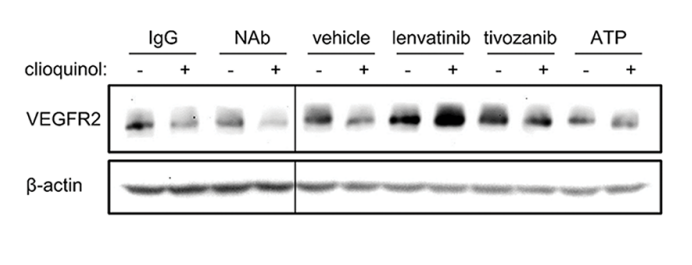
Western blots showing VEGFR2 and β-actin expression in HUVECs that were pre-treated with 4 µg/mL IgG, 4 µg/mL anti-VEGFR2 NAb, 0.1% DMSO (vehicle), 100 nM Lenvatinib, 250 nM Tivozanib, or 1 mM ATP for 2 h and then exposed to 0.1% DMSO or 10 µM Clioquinol for another 4 h.
Tivozanib purchased from MedChemExpress. Usage Cited in: Angiogenesis. 2025 Feb 3;28(2):13. [Abstract]
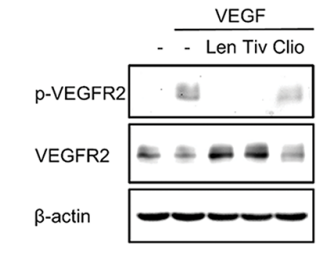
Western blots showing p-VEGFR2, VEGFR2, and β-actin expression in HUVECs that were treated with 0.1% DMSO, 100 nM Lenvatinib, 250 nM Tivozanib or 10 µM Clioquinol for 1 h and then stimulated with 25 ng/mL VEGF for 7 min.
-
Cell Mol Gastroenterol Hepatol
Sorafenib Promotes Treg Cell Differentiation To Compromise Its Efficacy via VEGFR/AKT/Foxo1 Signaling in Hepatocellular Carcinoma. [Abstract]2025;19(5):101454. PMID: 39743020 -
Cancer Cell Int
Construction of a prognostic model with histone modification-related genes and identification of potential drugs in pancreatic cancer. [Abstract]2021 Jun 5;21(1):291. PMID: 34090418 -
Pharmaceuticals (Basel)
Mechanism Underlying Triple VEGFR Inhibitor Tivozanib-Induced Hypertension in Mice Model. [Abstract]2023 Feb 14;16(2):295. PMID: 37259438
Tivozanib purchased from MedChemExpress. Usage Cited in: Pharmaceuticals (Basel). 2023 Feb 14;16(2):295. [Abstract]
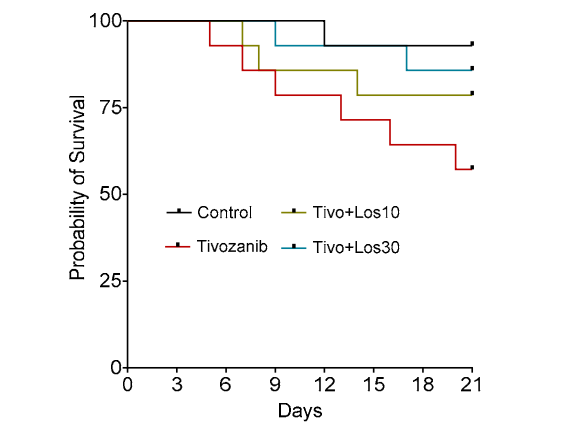
Effect of tivozanib and losartan on survival rate, body weight, urine flow and urine protein levels. Mice either daily received tivozanib (1 mg/kg), Tivozanib plus Losartan (10 mg/kg; Tivo + Los10), Tivozanib plus Losartan (30 mg/kg; Tivo + Los30) or vehicle control.Probability of survival.
Tivozanib purchased from MedChemExpress. Usage Cited in: Pharmaceuticals (Basel). 2023 Feb 14;16(2):295. [Abstract]
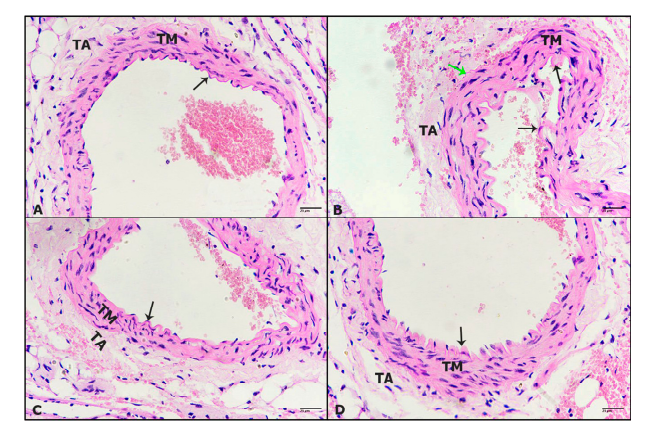
Effect of tivozanib and losartan on histology of heart and kidney. Mice either daily received Tivozanib (1 mg/kg), Tivozanib plus losartan (10 mg/kg; Tivo + Los10), Tivozanib plus losartan (30 mg/kg; Tivo + Los30) or vehicle control. Photomicrographs of mice aorta.
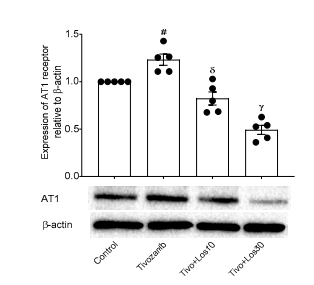
Tivozanib purchased from MedChemExpress. Usage Cited in: Pharmaceuticals (Basel). 2023 Feb 14;16(2):295. [Abstract]
Mice either daily received Tivozanib (1 mg/kg), Tivozanib plus losartan (10 mg/kg; Tivo + Los10), Tivozanib plus losartan (30 mg/kg; Tivo + Los30) or vehicle control. Protein expression of angiotensin-II type 1 (AT1) receptor in the aorta.
-
-
PLoS One
A novel small molecule screening assay using normal human chondrocytes toward osteoarthritis drug discovery. [Abstract]2024 Nov 1;19(11):e0308647. PMID: 39485774 -
-
-
-


溶剤 & 溶解度
体外:
DMSO : 25 mg/mL (54.96 mM; Need ultrasonic; Hygroscopic DMSO has a significant impact on the solubility of product, please use newly opened DMSO)
Please refer to the solubility information to select the appropriate solvent. Once prepared, please aliquot and store the solution to prevent product inactivation from repeated freeze-thaw cycles.
Storage method and period of stock solution: -80°C, 2 years; -20°C, 1 year. When stored at -80°C, please use it within 2 years. When stored at -20°C, please use it within 1 year.
Please refer to the solubility information to select the appropriate solvent. Once prepared, please aliquot and store the solution to prevent product inactivation from repeated freeze-thaw cycles.
Storage method and period of stock solution: -80°C, 2 years; -20°C, 1 year. When stored at -80°C, please use it within 2 years. When stored at -20°C, please use it within 1 year.
濃度 (開始) × 体積 (開始) = 濃度 (終了) × 体積 (終了)
体内:
Select the appropriate dissolution method based on your experimental animal and administration route.
- For the following dissolution methods, please ensure to first prepare a clear stock solution using an In Vitro approach and then sequentially add co-solvents:
- To ensure reliable experimental results, the clarified stock solution can be appropriately stored based on storage conditions. As for the working solution for In Vivo experiments, it is recommended to prepare freshly and use it on the same day.
- The percentages shown for the solvents indicate their volumetric ratio in the final prepared solution. If precipitation or phase separation occurs during preparation, heat and/or sonication can be used to aid dissolution.
Add each solvent one by one: 10% DMSO 40% PEG300 5% Tween-80 45% Saline
Solubility: ≥ 2.5 mg/mL (5.50 mM); Clear solution
This protocol yields a clear solution of ≥ 2.5 mg/mL (saturation unknown).
Taking 1 mL working solution as an example, add 100 μL DMSO stock solution (25.0 mg/mL) to 400 μL PEG300, and mix evenly; then add 50 μL Tween-80 and mix evenly; then add 450 μL Saline to adjust the volume to 1 mL.
Preparation of Saline: Dissolve 0.9 g sodium chloride in ddH₂O and dilute to 100 mL to obtain a clear Saline solution.
Add each solvent one by one: 10% DMSO 90% (20% SBE-β-CD in Saline)
Solubility: ≥ 2.5 mg/mL (5.50 mM); Clear solution
This protocol yields a clear solution of ≥ 2.5 mg/mL (saturation unknown).
Taking 1 mL working solution as an example, add 100 μL DMSO stock solution (25.0 mg/mL) to 900 μL 20% SBE-β-CD in Saline, and mix evenly.
Preparation of 20% SBE-β-CD in Saline (4°C, storage for one week): 2 g SBE-β-CD powder is dissolved in 10 mL Saline, completely dissolve until clear.
In Vivo Dissolution Calculator
Please enter the basic information of animal experiments:
-
-
-
-
Recommended: Prepare an additional quantity of animals to account for potential losses during experiments.
Please enter your animal formula composition:
-
%DMSO +
Recommended: Keep the proportion of DMSO in working solution below 2% if your animal is weak.
-
%+
-
+%Tween-80 + +
-
%Saline +
The co-solvents required include: DMSO, . All of co-solvents are available by MedChemExpress (MCE). , Tween 80. All of co-solvents are available by MedChemExpress (MCE).
Working solution concentration: 0.22 mg/mL
Method for preparing stock solution: mg drug dissolved in μL DMSO. Stock solution concentration: mg/mL.
1. Take μL DMSO stock solution;
2. Add μL .
μL , mix evenly;
3. Then add μL Tween 80, mix evenly;
4. Then add μL
Please ensure that the stock solution in the first step is dissolved to a clear state, and add co-solvents in sequence. You can use ultrasonic heating (ultrasonic cleaner, recommended frequency 20-40 kHz), vortexing, etc. to assist dissolution.


純度とドキュメンテーション
-
データシート (282 KB)
-
SDS (393 KB)
- English - EN (393 KB)
- Français - FR (393 KB)
- Deutsch - DE (393 KB)
- Norwegian - NO (393 KB)
- Español - ES (393 KB)
- Swedish - SV (393 KB)
- Italian - IT (393 KB)
- Korean - KR (393 KB)
- Portuguese - PT (393 KB)
-
取扱説明書 (2659 KB)
参考文献


Complete Stock Solution Preparation Table
Please refer to the solubility information to select the appropriate solvent. Once prepared, please aliquot and store the solution to prevent product inactivation from repeated freeze-thaw cycles.
Storage method and period of stock solution: -80°C, 2 years; -20°C, 1 year. When stored at -80°C, please use it within 2 years. When stored at -20°C, please use it within 1 year.
| Optional Solvent | Concentration Solvent Mass | 1 mg | 5 mg | 10 mg | 25 mg |
|---|---|---|---|---|---|
| DMSO | 1 mM | 2.1985 mL | 10.9924 mL | 21.9848 mL | 54.9620 mL |
| 5 mM | 0.4397 mL | 2.1985 mL | 4.3970 mL | 10.9924 mL | |
| 10 mM | 0.2198 mL | 1.0992 mL | 2.1985 mL | 5.4962 mL | |
| 15 mM | 0.1466 mL | 0.7328 mL | 1.4657 mL | 3.6641 mL | |
| 20 mM | 0.1099 mL | 0.5496 mL | 1.0992 mL | 2.7481 mL | |
| 25 mM | 0.0879 mL | 0.4397 mL | 0.8794 mL | 2.1985 mL | |
| 30 mM | 0.0733 mL | 0.3664 mL | 0.7328 mL | 1.8321 mL | |
| 40 mM | 0.0550 mL | 0.2748 mL | 0.5496 mL | 1.3740 mL | |
| 50 mM | 0.0440 mL | 0.2198 mL | 0.4397 mL | 1.0992 mL |


Tivozanib 関連分類
HY-10977 関連分類
 Powered by Bioz