



Anti-Mouse/Rat/Rabbit TNF alpha Antibody (TN3-19.12)

Based on 1 Customer Validation
Anti-Mouse TNF alpha Antibody (TN3-19.12) is an anti-mouse TNF alpha IgG antibody inhibitor derived from host Armenian Hamster. Anti-Mouse TNF alpha Antibody (TN3-19.12) neutralizes cytotoxic activity in supernatants obtained from LNC-8 cells. Anti-Mouse TNF alpha Antibody (TN3-19.12) reduces the symptoms and severity of EAE (experimental allergic encephalomyelitis) in LNC-8 cells xenograft mice models. Anti-Mouse TNF alpha Antibody (TN3-19.12) prevents diabetes in NOD mice. Anti-Mouse TNF alpha Antibody (TN3-19.12) shows apparent radiosensitizing effect in CD2F1 mice.
For research use only. We do not sell to patients.
- Purity: 99.24%
- Molecular Weight:150 kDa
-
Storage:
Please store the product under the recommended conditions in the Certificate of Analysis.

To place orders, for customer services and technical support, please contact: MedChemExpress USA
Tel: 609-228-6898 E-mail: [email protected] [email protected]


-
 Biological Activity
-
Chemical Information
- Purity & Documentation
- References
-
 Help & FAQs




Biological Activity
Armenian Hamster IgG
Mouse
TNF alpha
Anti-Mouse TNF alpha Antibody (TN3-19.12) (850 ng, 1 h) neutralizes cytotoxic activity in supernatants obtained from LNC-8 cells[1].
MedChemExpress (MCE) has not independently confirmed the accuracy of these methods. They are for reference only.
Anti-Mouse TNF alpha Antibody (TN3-19.12) (0.3-1 mg, i.p., a single dose) reduces the symptoms and severity of EAE (experimental allergic encephalomyelitis) in LNC-8 cells xenograft mice models[1].
Anti-Mouse TNF alpha Antibody (TN3-19.12) (20 μg/g or 100 μg/injection, i.p., every other day for 21-24 days) prevents diabetes in NOD mice (0-4 weeks)[2].
Anti-Mouse TNF alpha Antibody (TN3-19.12) (50-100 μg, i.p., a single dose) reduces survival of irradiated CD2F1 mice[3].
Anti-Mouse TNF alpha Antibody (TN3-19.12) (200 μg, i.p., 20 h before LPS (HY-D1056)) reduces LPS-induced radioprotection in CD2F1 mice[3].
MedChemExpress (MCE) has not independently confirmed the accuracy of these methods. They are for reference only.
-
Animal Model:Mice injected with LNC-8 cells intraperitoneally[1]
-
Dosage:0.3 mg
-
Administration:Intraperitoneal injection
-
Result:Resulted in a dramatic reduction in the symptoms and severity of EAE (experimental allergic encephalomyelitis).
Alleviated meningeal infiltration.
-
Animal Model:Mice injected with LNC-8 cells intravenously[1]
-
Dosage:1 mg
-
Administration:Intraperitoneal injection
-
Result:Reduced the symptoms and severity of EAE.
Reduced the incidence of disease from 89% in the PBS to 20%.
-
Animal Model:Newborn female NOD mice[2]
-
Dosage:20 μg/g
-
Administration:Intraperitoneally every other day for 24 days
-
Result:None of mice developed diabetes even after 30 week of age.
Had no significant effect on mouse development and growth, or mortality.
Had no dramatic influence on the development of lymphoid tissues.
Did not potentiate the ability to respond to GAD67, GAD65, CPH, peripherin, and HSP60 at 10 week of age.
Enhanced responses to HEL and OVA.
Inhibited insulitis (only 27% of mice developed a low or moderate degree of insulitis compared to PBS-treated of 100%).
-
Animal Model:2-week-old female NOD mice[2]
-
Dosage:20 μg/g
-
Administration:Intraperitoneally every other day for 3 weeks
-
Result:None of mice developed diabetes even after 34 week of age.
-
Animal Model:4-week-old female NOD mice[2]
-
Dosage:100 μg/injection
-
Administration:Intraperitoneally every other day for 3 weeks
-
Result:Partly prevented disease (about 50%).
-
Animal Model:Irradiated CD2F1 mice (male, 8-10 week) [3]
-
Dosage:100 μg 20 h before irradiation or at 50 μg 1 h after irradiation
-
Administration:Intraperitoneal injection
-
Result:Reduced survival of irradiated CD2F1 mice.
Unconjugated
The product can be reconstituted/diluted with sterile PBS or saline.
in vivo TNFα neutralization; Flow cytometry
-
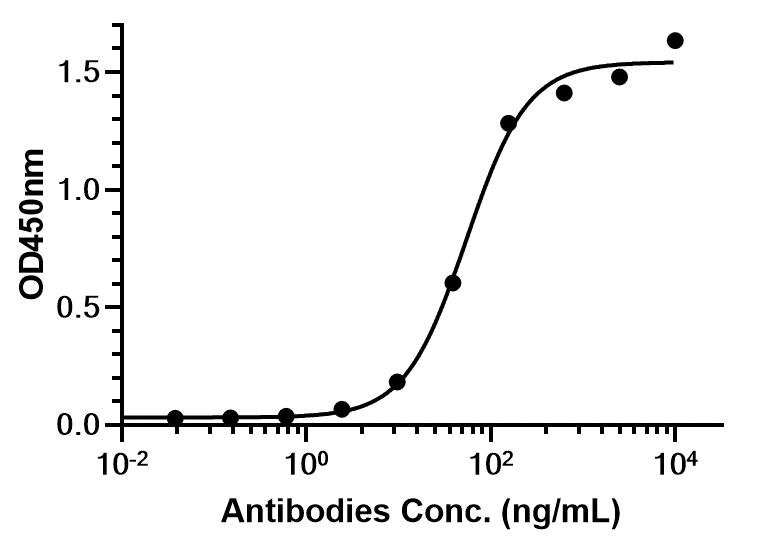 Immobilized TNF-alpha/TNFSF2 Protein, Mouse (His, HY-P7417) can bind Anti-Mouse/Rat/Rabbit TNF alpha Antibody (TN3-19.12). The EC50 for this effect is 54.46 ng/mL.
 -
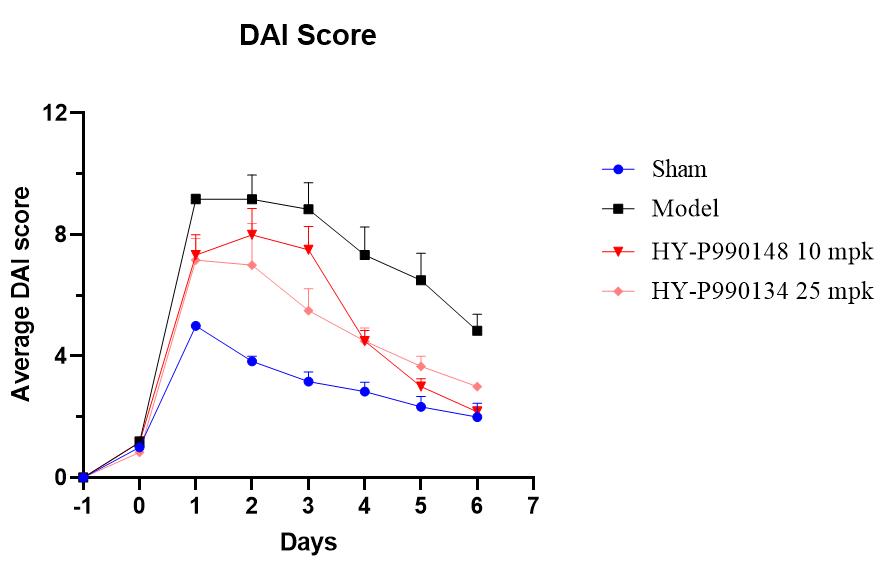 Clinical disease scores of mice with active intestinal inflammation and upon Anti-Mouse/Rat/Rabbit TNF alpha Antibody (TN3-19.12, HY-P99148) remission in colitis.
 -
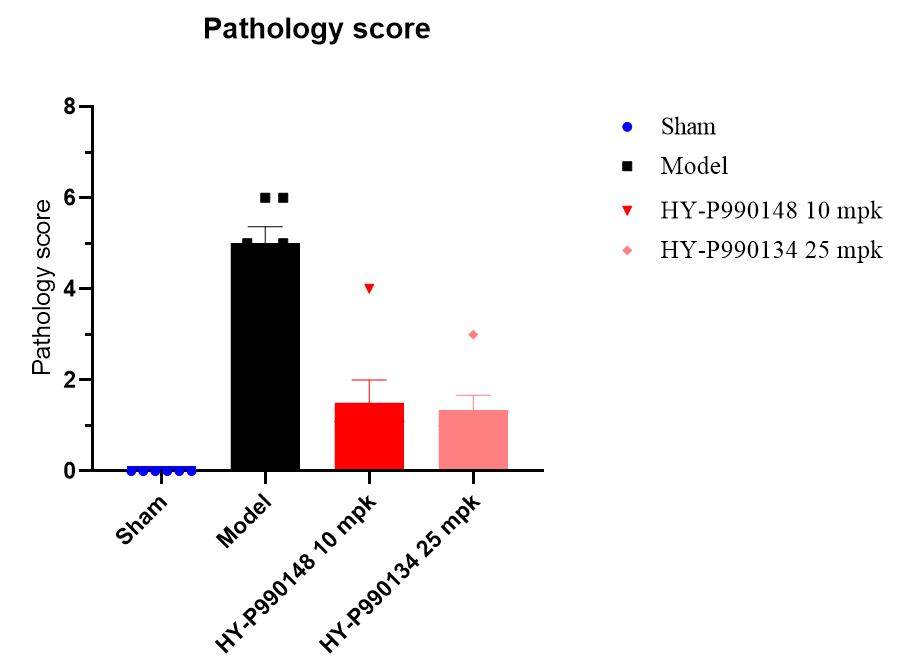 Histopathological scores of naive mice, mice with active disease, or Anti-Mouse/Rat/Rabbit TNF alpha Antibody (TN3-19.12, HY-P99148) in colitis.


Chemical Information
-
Appearance Liquid
-
Molecular Weight 150 kDa
-
Color Colorless to light yellow
-
SMILES
[Anti-Mouse/Rat/Rabbit TNF alpha Antibody (TN3-19.12)]
-
Shipping
Shipping with dry ice.
-
Formulation
Please refer to the lot-specific COA for specific buffer information.
-
Storage
Please store the product under the recommended conditions in the Certificate of Analysis.


Purity & Documentation
-
Data Sheet (265 KB)
-
SDS (251 KB)
- English - EN (251 KB)
- Français - FR (251 KB)
- Deutsch - DE (251 KB)
- Norwegian - NO (251 KB)
- Español - ES (251 KB)
- Swedish - SV (251 KB)
- Italian - IT (251 KB)
- Korean - KR (251 KB)
- Portuguese - PT (251 KB)
-
Inhibitory Antibodies User Guide (603 KB)
References
[1]. Ruddle NH, et al. An antibody to lymphotoxin and tumor necrosis factor prevents transfer of experimental allergic encephalomyelitis. J Exp Med. 1990 Oct 1;172(4):1193-200. [Content Brief]
[2]. Yang XD, et al. Effect of tumor necrosis factor alpha on insulin-dependent diabetes mellitus in NOD mice. I. The early development of autoimmunity and the diabetogenic process. J Exp Med. 1994 Sep 1;180(3):995-1004. [Content Brief]
[3]. Neta R, et al. Role of cytokines (interleukin 1, tumor necrosis factor, and transforming growth factor beta) in natural and lipopolysaccharide-enhanced radioresistance. J Exp Med. 1991 May 1;173(5):1177-82. [Content Brief]

Calculators
Concentration (start) × Volume (start) = Concentration (final) × Volume (final)


Anti-Mouse/Rat/Rabbit TNF alpha Antibody (TN3-19.12) Related Classifications
HY-P99148 Related Classifications
 Powered by Bioz