



Vitamin B12
Based on 4 publication(s) in Google Scholar
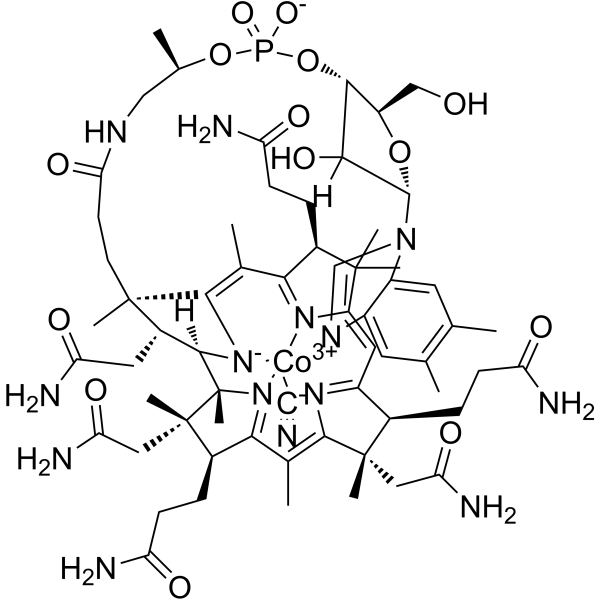
Vitamin B12 is a vitamin that can pass through the blood-brain barrier. Vitamin B12 plays a key role in the normal functioning of the brain and nervous system, and for the formation of blood. Vitamin B12 is beneficial for many inflammatory diseases and also provides protection in oxidative-stress-associated pathologies.
Nur für Forschungszwecke. Wir verkaufen nicht an Patienten.
- Reinheit: 99.99%
- CAS. Nr.: 68-19-9
- Formel: C63H88CoN14O14P
- Molecular Weight:1355.37
-
Speicherung:
4°C, protect from light
* In solvent : -80°C, 1 year; -20°C, 6 months (protect from light)

To place orders, for customer services and technical support, please contact: MedChemExpress USA
Tel: 609-228-6898 E-mail: [email protected] [email protected]


-
 Biologische Aktivität
-
Chemical Information
-
Lösungsmittel & Löslichkeit
- Reinheit & Dokumentation
- Verweise
-
 Help & FAQs
-

Anti-Infection Compound Library
HY-L002
-
Immunology/Inflammation Compound Library
HY-L007
-
Metabolism/Protease Compound Library
HY-L012
-
Natural Product Library
HY-L021
-
FDA-Approved Drug Library
HY-L022
-
Anti-Cancer Compound Library
HY-L025
-
CNS-Penetrant Compound Library
HY-L028
-
Human Endogenous Metabolite Compound Library
HY-L030
-
Drug Repurposing Compound Library
HY-L035
-
NMPA-Approved Drug Library
HY-L053
-
Medicine Food Homology Compound Library
HY-L055
-
Orally Active Compound Library
HY-L061
-
Traditional Chinese Medicine Active Compound Library
HY-L065
-
FDA Approved & Pharmacopeial Drug Library
HY-L066
-
Gut Microbial Metabolite Library
HY-L078
-
Microbial Metabolite Library
HY-L084
-
Food Additive Library
HY-L093
-
Food-Sourced Compound Library
HY-L094
-
Inactive Ingredient Library
HY-L096
-
Rare Diseases Drug Library
HY-L102
-
Pediatric Drug Library
HY-L104
-
Anti-Cancer Natural Product Library
HY-L107
-
Anti-inflammatory Traditional Chinese Medicine Active Compound Library
HY-L114
-
FDA-Approved Anticancer Drug Library
HY-L122
-
Human Metabolite Library
HY-L123
-
Off-patent Drug Library
HY-L141
-
Animal-Sourced Natural Product Library
HY-L157
-
FDA-Approved Traditional Chinese Medicine Active Compound Library
HY-L163
-
Multi-Target Compound Library
HY-L176
-
Bioactive Compound Library Max
HY-L181
-
Natural Product Library Plus
HY-L021P
-
Drug Repurposing Compound Library Plus
HY-L035P
-
FDA-Approved Drug Library Plus
HY-L022P
-
FDA-Approved Drug Library Mini
HY-L022M
-
Natural Product and Natural Product-Like Compound Library
HY-L021M
-
Bioactive Compound Library
HY-L001
-
Miao Ethnicity Medicine Compound Library
HY-L190
-
Tibetan Medicine Compound Library
HY-L191
-
Dietary Supplement Library
HY-L192
-
PBCRBS Traditional Chinese Medicine Compound Library
HY-L193
-
Vitamin Compound Library
HY-L197
-
High-Throughput Bioactive Compound Library
HY-L205
-
High-Throughput Natural Product Library
HY-L206
-
Mass Spectrometry Human Endogenous Metabolite Library
HY-L207
-
Ancient Chinese Classical Formulas Traditional Chinese Medicine Active Compound Library
HY-L209
-
Mass Spectrometry Human Metabolite Library
HY-L215
-
Cosmetic Ingredient Compound Library
HY-L221
-
Diarrhea-Related Traditional Chinese Medicine Active Compound Library
HY-L224
-
Mongolian Medicine Compound Library
HY-L238
-
Natural Product Diversity Scaffold Library
HY-L245
-
Tonifying Traditional Chinese Medicine Monomer Compound Library
HY-L246
-
Mass Spectrometry Natural Product Library
HY-L262


Publications Citing Use of MedChemExpress (MCE) Vitamin B12
MoreAlle Endogenous Metabolite Isoform-spezifische Produkte anzeigen
More

Biologische Aktivität
|
Human Endogenous Metabolite |
Microbial Metabolite |
Vitamin B12 is one of the eight B vitamins. It is normally involved in the metabolism of every cell of the human body, especially affecting DNA synthesis and regulation, but also fatty acid synthesis (especially odd chain fatty acids) and energy production. However, many (though not all) of the effects of functions of B12 can be replaced by sufficient quantities of folic acid (vitamin B9), since B12 is used to regenerate folate in the body. Most vitamin B12 deficiency symptoms are actually folate deficiency symptoms, since they include all the effects of pernicious anemia and megaloblastosis, which are due to poor synthesis of DNA when the body does not have a proper supply of folic acid for the production of thymine due to methyl trapping. When sufficient folic acid is available, all known B12 related deficiency syndromes normalize, save those narrowly connected with the vitamin B12-dependent enzymes Methylmalonyl Coenzyme A mutase, and 5-methyltetrahydrofolate-homocysteine methyltransferase (MTR), also known as methionine synthase; and the buildup of their respective substrates (methylmalonic acid, MMA) and homocysteine.Coenzyme B12's reactive C-Co bond participates in three main types of enzyme-catalyzed reactions[1][2].
MedChemExpress (MCE) has not independently confirmed the accuracy of these methods. They are for reference only.
| NCT Number | Sponsor | Condition | Start Date |
Phase

|
|---|---|---|---|---|
| NCT01329991 | Plexxikon| | 2011-05 | PHASE1 |


Chemical Information
-
CAS. Nr. 68-19-9
-
Appearance Solid
-
Molecular Weight 1355.37
-
Formel C63H88CoN14O14P
-
Color Brown to reddish brown
-
SMILES
N#[C-][Co+3]([N-]1[C@@]([C@@H]2CC(N)=O)([H])[C@]3([C@](C)4CC(N)=O)C)([N](C([C@](C)5CC(N)=O)=C6C)=C7[C@H]5CCC(N)=O)([N](C(C(C)8C)=C7)=C([C@H]8CCC(N)=O)C(C)=C1[C@@]2(CCC(NC[C@H]9C)=O)C)([N](C%10=C%11)=CN([C@@H](O[C@@H]%12CO)[C@]([C@@H]%12O[P]([O-])(O9)=O)([H])O)C%10=CC(C)=C%11C)[N]3=C6[C@H]4CCC(N)=O
-
Synonyms
Cyanocobalamin
-
Structure Classification
-
Initial Source
-
Versand
Room temperature in continental US; may vary elsewhere.
-
Speicherung
4°C, protect from light
* In solvent : -80°C, 1 year; -20°C, 6 months (protect from light)


Publications (4)
-
Journal Impact Factor
-
Most Recent
-
Nat Commun
2025 Jan 31;16(1):1233. PMID: 39890804 -
-
-
J Biol Chem
Transcobalamin receptor CD320, responsible for vitamin B12 cellular uptake, is present on the cell surface as a homo-oligomer. [Abstract]2026 Jun 22:113286. PMID: 42331108


Lösungsmittel & Löslichkeit
DMSO : 20.83 mg/mL (15.37 mM; ultrasonic and warming and heat to 60°C; Hygroscopic DMSO has a significant impact on the solubility of product, please use newly opened DMSO)
H2O : 6.25 mg/mL (4.61 mM; ultrasonic and warming and heat to 60°C)
Please refer to the solubility information to select the appropriate solvent. Once prepared, please aliquot and store the solution to prevent product inactivation from repeated freeze-thaw cycles.
Storage method and period of stock solution: -80°C, 1 year; -20°C, 6 months (protect from light). When stored at -80°C, please use it within 1 year. When stored at -20°C, please use it within 6 months.
* Note: If you choose water as the stock solution, please dilute it to the working solution, then filter and sterilize it with a 0.22 μm filter before use.
Please refer to the solubility information to select the appropriate solvent. Once prepared, please aliquot and store the solution to prevent product inactivation from repeated freeze-thaw cycles.
Storage method and period of stock solution: -80°C, 1 year; -20°C, 6 months (protect from light). When stored at -80°C, please use it within 1 year. When stored at -20°C, please use it within 6 months.
* Note: If you choose water as the stock solution, please dilute it to the working solution, then filter and sterilize it with a 0.22 μm filter before use.
Konzentration (Stammlösung) × Volumen (Stammlösung) = Konzentration (Ziellösung) × Volumen (Ziellösung)
Select the appropriate dissolution method based on your experimental animal and administration route.
- For the following dissolution methods, please ensure to first prepare a clear stock solution using an In Vitro approach and then sequentially add co-solvents:
- To ensure reliable experimental results, the clarified stock solution can be appropriately stored based on storage conditions. As for the working solution for In Vivo experiments, it is recommended to prepare freshly and use it on the same day.
- The percentages shown for the solvents indicate their volumetric ratio in the final prepared solution. If precipitation or phase separation occurs during preparation, heat and/or sonication can be used to aid dissolution.
Add each solvent one by one: 10% DMSO 40% PEG300 5% Tween-80 45% Saline
Solubility: ≥ 2.5 mg/mL (1.84 mM); Clear solution
This protocol yields a clear solution of ≥ 2.5 mg/mL (saturation unknown).
Taking 1 mL working solution as an example, add 100 μL DMSO stock solution (25.0 mg/mL) to 400 μL PEG300, and mix evenly; then add 50 μL Tween-80 and mix evenly; then add 450 μL Saline to adjust the volume to 1 mL.
Preparation of Saline: Dissolve 0.9 g sodium chloride in ddH₂O and dilute to 100 mL to obtain a clear Saline solution.
Add each solvent one by one: 10% DMSO 90% (20% SBE-β-CD in Saline)
Solubility: ≥ 2.5 mg/mL (1.84 mM); Clear solution
This protocol yields a clear solution of ≥ 2.5 mg/mL (saturation unknown).
Taking 1 mL working solution as an example, add 100 μL DMSO stock solution (25.0 mg/mL) to 900 μL 20% SBE-β-CD in Saline, and mix evenly.
Preparation of 20% SBE-β-CD in Saline (4°C, storage for one week): 2 g SBE-β-CD powder is dissolved in 10 mL Saline, completely dissolve until clear.
For the following dissolution methods, please prepare the working solution directly:
It is recommended to prepare fresh solutions and use them promptly within a short period of time.
The percentages shown for the solvents indicate their volumetric ratio in the final prepared solution. If precipitation or phase separation occurs during preparation, heat and/or sonication can be used to aid dissolution.
Add each solvent one by one: PBS
Solubility: 50 mg/mL (36.89 mM); Clear solution; Need ultrasonic
Please enter the basic information of animal experiments:
-
-
-
-
Recommended: Prepare an additional quantity of animals to account for potential losses during experiments.
Please enter your animal formula composition:
-
%DMSO +
Recommended: Keep the proportion of DMSO in working solution below 2% if your animal is weak.
-
%+
-
+%Tween-80 + +
-
%Saline +
The co-solvents required include: DMSO, . All of co-solvents are available by MedChemExpress (MCE). , Tween 80. All of co-solvents are available by MedChemExpress (MCE).
Working solution concentration: 0.22 mg/mL
Method for preparing stock solution: mg drug dissolved in μL DMSO. Stock solution concentration: mg/mL. * In solvent : -80°C, 1 year; -20°C, 6 months (protect from light)
1. Take μL DMSO stock solution;
2. Add μL .
μL , mix evenly;
3. Then add μL Tween 80, mix evenly;
4. Then add μL
Please ensure that the stock solution in the first step is dissolved to a clear state, and add co-solvents in sequence. You can use ultrasonic heating (ultrasonic cleaner, recommended frequency 20-40 kHz), vortexing, etc. to assist dissolution.


Reinheit & Dokumentation
-
Data Sheet (292 KB)
-
SDS (394 KB)
- English - EN (394 KB)
- Français - FR (394 KB)
- Deutsch - DE (394 KB)
- Norwegian - NO (394 KB)
- Español - ES (394 KB)
- Swedish - SV (394 KB)
- Italian - IT (394 KB)
- Korean - KR (394 KB)
- Portuguese - PT (394 KB)
-
Handling Instructions (2659 KB)
Verweise
[1]. Banerjee, R. et al. The many faces of vitamin B12: catalysis by cobalamin-dependent enzymes. Annu Rev Biochem, 2003. 72: p. 209-47. [Content Brief]
[2]. Lai SC, et al. The transcobalamin receptor knockout mouse: a model for vitamin B12 deficiency in the central nervous system. FASEB J. 2013 Jun;27(6):2468-75. [Content Brief]


Complete Stock Solution Preparation Table
Please refer to the solubility information to select the appropriate solvent. Once prepared, please aliquot and store the solution to prevent product inactivation from repeated freeze-thaw cycles.
Storage method and period of stock solution: -80°C, 1 year; -20°C, 6 months (protect from light). When stored at -80°C, please use it within 1 year. When stored at -20°C, please use it within 6 months.
| Optional Solvent | Concentration Solvent Mass | 1 mg | 5 mg | 10 mg | 25 mg |
|---|---|---|---|---|---|
| H2O / DMSO | 1 mM | 0.7378 mL | 3.6890 mL | 7.3781 mL | 18.4451 mL |
| DMSO | 5 mM | 0.1476 mL | 0.7378 mL | 1.4756 mL | 3.6890 mL |
| 10 mM | 0.0738 mL | 0.3689 mL | 0.7378 mL | 1.8445 mL | |
| 15 mM | 0.0492 mL | 0.2459 mL | 0.4919 mL | 1.2297 mL |
* Note: If you choose water as the stock solution, please dilute it to the working solution, then filter and sterilize it with a 0.22 μm filter before use.


Vitamin B12 Related Classifications
HY-B0315 Related Classifications
 Powered by Bioz