



BAM7
Based on 3 publication(s) in Google Scholar
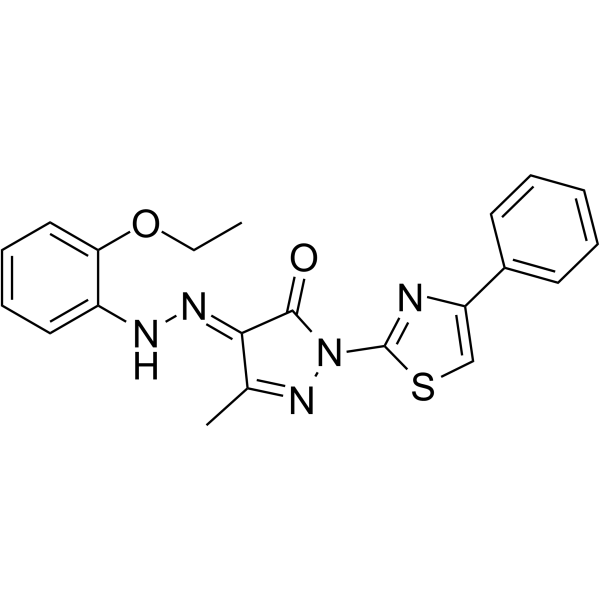
BAM7 is a direct and selective activator of proapoptotic BAX with an IC50 of 3.3 μM.
For research use only. We do not sell to patients.
- Purity : 99.20%
- CAS No.: 331244-89-4
- Formula: C21H19N5O2S
- Molecular Weight:405.47
-
Storage:Powder -20°C, 3 years , 4°C, 2 years ; In solvent -80°C, 2 years , -20°C, 1 year

To place orders, for customer services and technical support, please contact: MedChemExpress USA
Tel: 609-228-6898 E-mail: [email protected] [email protected]


-
 Biological Activity
-
Chemical Information
-
Solvent & Solubility
- Purity & Documentation
- References
-
 Help & FAQs


-
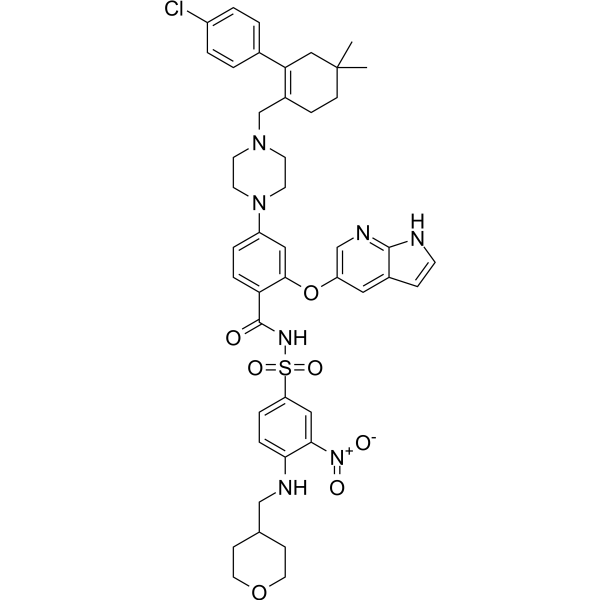
HY-15531
VenetoclaxBCL-2 Inhibitor -
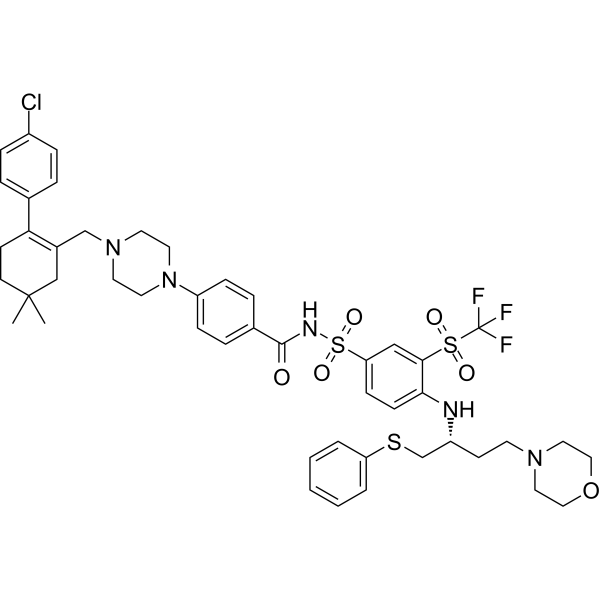
HY-10087
NavitoclaxBcl-2 Inhibitor -
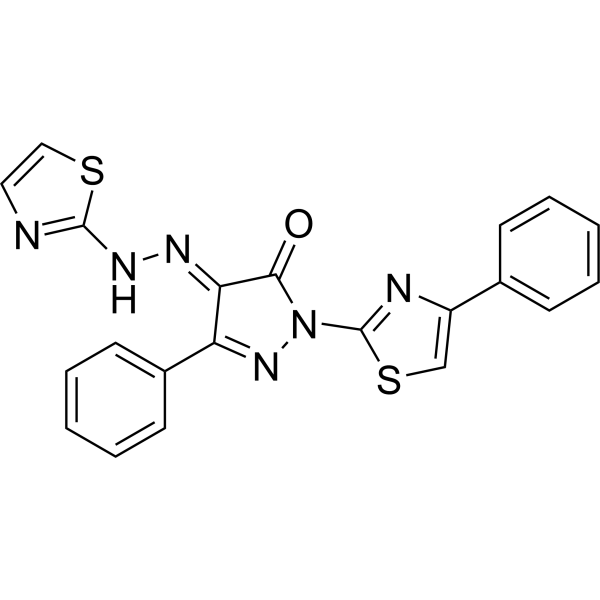
HY-123054
BTSA1BAX Activator -
HY-12020
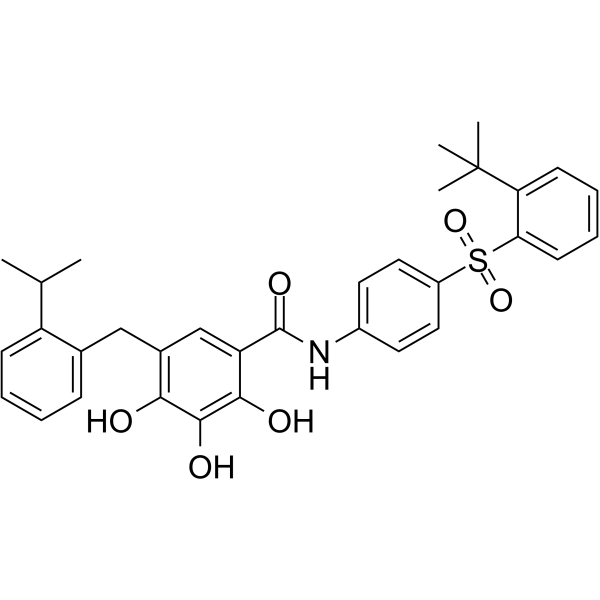
TW-37Bcl-2 Family Inhibitor -
HY-50907
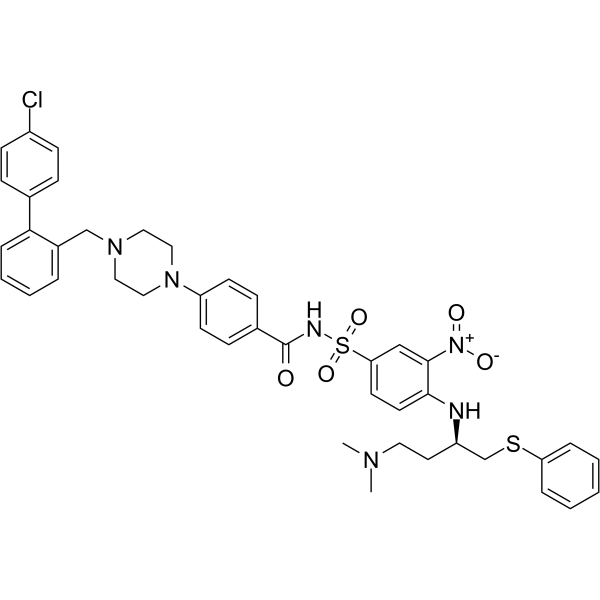
ABT-737Bcl-2 Family Inhibitor/BH3 Mimetic -
HY-103269
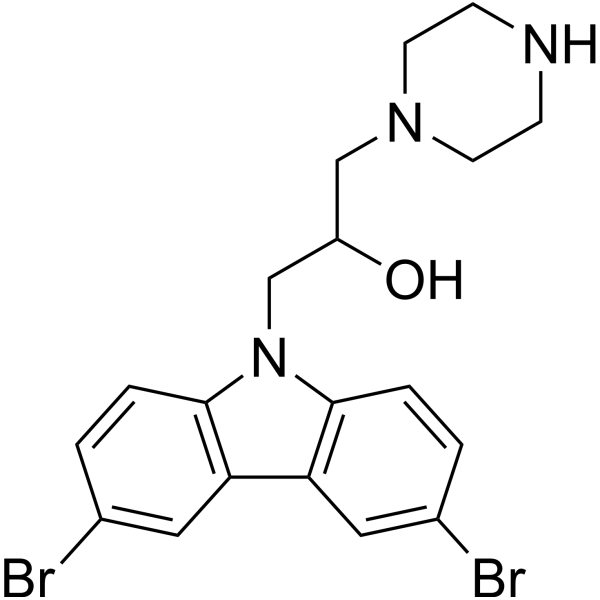
BAI1BAX Inhibitor -

HY-15531R
Venetoclax (Standard)BCL-2 Inhibitor -
HY-100741
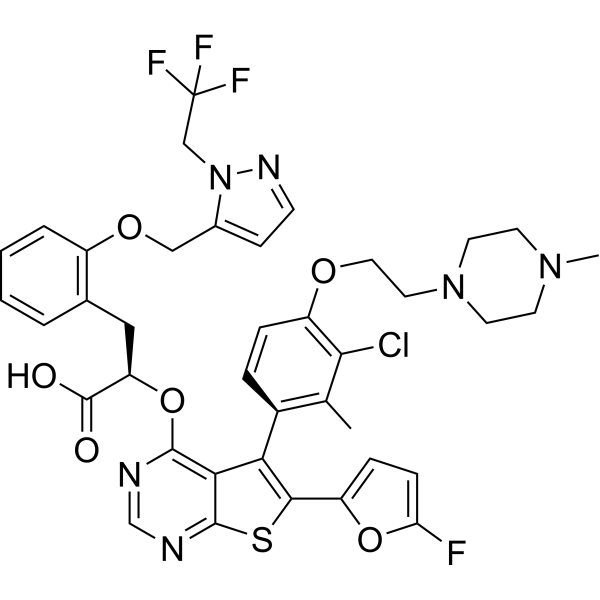
S63845MCL1 Inhibitor -
HY-P0081
Bax inhibitor peptide V5Bcl-2 Family Inhibitor -
HY-10969
Obatoclax MesylateBcl-2 Family Inhibitor
Publications Citing Use of MedChemExpress (MCE) BAM7
More Customer Validation & Images

-
Cell Proliferation/Viability Assay


Biological Activity
Description
IC50 & Target
[1]|
Bax 3.3 μM (IC50) |
Cellular Effect
|
Cell Line

|
Type | Value | Description | References |
|---|---|---|---|---|
| Huh-7 | EC50 |
8.2 μM
Compound: 1
|
Activation of Bax in human HuH7 cells assessed as inhibition of mitochondrial accumulation of fluorescent probe Mitotracker Red after 12 to 72 hrs by spectrophotometric analysis
Activation of Bax in human HuH7 cells assessed as inhibition of mitochondrial accumulation of fluorescent probe Mitotracker Red after 12 to 72 hrs by spectrophotometric analysis
|
[PMID: 25668341] |
| MEF | EC50 |
>50 μM
Compound: 1
|
Induction of apoptosis in Bax/Bak-deficient MEF assessed as appearance of fragmented nuclei and cell membrane blebbing after 24 hrs by DAPI staining
Induction of apoptosis in Bax/Bak-deficient MEF assessed as appearance of fragmented nuclei and cell membrane blebbing after 24 hrs by DAPI staining
|
[PMID: 25668341] |
| MEF | EC50 |
>50 μM
Compound: 1
|
Induction of apoptosis in Bax-deficient MEF assessed as appearance of fragmented nuclei and cell membrane blebbing after 24 hrs by DAPI staining
Induction of apoptosis in Bax-deficient MEF assessed as appearance of fragmented nuclei and cell membrane blebbing after 24 hrs by DAPI staining
|
[PMID: 25668341] |
| MEF | EC50 |
3.2 μM
Compound: 1
|
Induction of apoptosis in Bcl2-deficient MEF assessed as appearance of fragmented nuclei and cell membrane blebbing after 24 hrs by DAPI staining
Induction of apoptosis in Bcl2-deficient MEF assessed as appearance of fragmented nuclei and cell membrane blebbing after 24 hrs by DAPI staining
|
[PMID: 25668341] |
| MEF | EC50 |
3.5 μM
Compound: 1
|
Induction of apoptosis in Bad-deficient MEF assessed as appearance of fragmented nuclei and cell membrane blebbing after 24 hrs by DAPI staining
Induction of apoptosis in Bad-deficient MEF assessed as appearance of fragmented nuclei and cell membrane blebbing after 24 hrs by DAPI staining
|
[PMID: 25668341] |
| MEF | EC50 |
4 μM
Compound: 1
|
Induction of apoptosis in Bid-deficient MEF assessed as appearance of fragmented nuclei and cell membrane blebbing after 24 hrs by DAPI staining
Induction of apoptosis in Bid-deficient MEF assessed as appearance of fragmented nuclei and cell membrane blebbing after 24 hrs by DAPI staining
|
[PMID: 25668341] |
| MEF | EC50 |
6 μM
Compound: 1
|
Induction of apoptosis in Bak-deficient MEF assessed as appearance of fragmented nuclei and cell membrane blebbing after 24 hrs by DAPI staining
Induction of apoptosis in Bak-deficient MEF assessed as appearance of fragmented nuclei and cell membrane blebbing after 24 hrs by DAPI staining
|
[PMID: 25668341] |
| MEF | EC50 |
7.7 μM
Compound: 1
|
Induction of apoptosis in wild-type MEF assessed as appearance of fragmented nuclei and cell membrane blebbing after 24 hrs by DAPI staining
Induction of apoptosis in wild-type MEF assessed as appearance of fragmented nuclei and cell membrane blebbing after 24 hrs by DAPI staining
|
[PMID: 25668341] |
In Vitro
BAM7 is selective for the BH3-binding site on BAX. BAM7 activates BAX and BAX-dependent cell death. Whereas treatment with BAX or BAM7 alone has no effect on the liposomes, the combination of BAM7 and BAX yields dose-responsive liposomal release of entrapped fluorophore. BAM7 dose- and time-responsively impairs the viability of Bak-/- MEFs that exclusively express BAX but has no effect on Bak-/- MEFs that contain BAK but lack BAX. In contrast, standard proapoptotic stimuli such as serum withdrawal, Staurosporine and Etoposide induces an equivalent apoptotic response in Bax-/- and Bak-/- MEFs. As further evidence of BAM7 specificity of action, (i) BAM7 does not affect the viability of Bax-/- Bak-/- MEFs; (ii) ANA-BAM16, which does not bind or activate BAX, has no effect on Bak-/- MEFs; and (iii) BAM7 selectively induces cell death of Bax-/- Bak-/- MEFs reconstituted with wild-type BAX but not BAXK21E , which bears the mutation that abrogates BAM7 binding[1].
MedChemExpress (MCE) has not independently confirmed the accuracy of these methods. They are for reference only. .


Chemical Information
-
CAS No. 331244-89-4
-
Appearance Solid
-
Molecular Weight 405.47
-
Formula C21H19N5O2S
-
Color Pink to red
-
SMILES
CCOC1=CC=CC=C1N/N=C2C(C)=NN(C3=NC(C4=CC=CC=C4)=CS3)C\2=O
-
Shipping
Room temperature in continental US; may vary elsewhere.
-
Storage
Powder -20°C 3 years 4°C 2 years In solvent -80°C 2 years -20°C 1 year


Publications (3)
-
Journal Impact Factor
-
Most Recent
-
Biochem Pharmacol
TIMP1 down-regulation enhances gemcitabine sensitivity and reverses chemoresistance in pancreatic cancer. [Abstract]2021 Jul:189:114085. PMID: 32522594 -
J Nutr
A-Type Cinnamon Procyanidin Oligomers Protect Against 1-Methyl-4-Phenyl-1,2,3,6-Tetrahydropyridine-Induced Neurotoxicity in Mice Through Inhibiting the P38 Mitogen-Activated Protein Kinase/P53/BCL-2 Associated X Protein Signaling Pathway. [Abstract]2020 Jul 1;150(7):1731-1737. PMID: 32386222
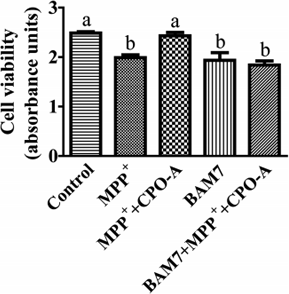
BAM7 purchased from MedChemExpress. Usage Cited in: J Nutr. 2020 Jul 1;150(7):1731-1737. [Abstract]
The cell viability in untreated SH-SY5Y cells or those stimulated with BAM7 and then treated with MPP+ or the combination of MPP+ and CPO-A.
-


Solvent & Solubility
In Vitro:
DMSO : 5 mg/mL (12.33 mM; Need ultrasonic; Hygroscopic DMSO has a significant impact on the solubility of product, please use newly opened DMSO)
Please refer to the solubility information to select the appropriate solvent. Once prepared, please aliquot and store the solution to prevent product inactivation from repeated freeze-thaw cycles.
Storage method and period of stock solution: -80°C, 2 years; -20°C, 1 year. When stored at -80°C, please use it within 2 years. When stored at -20°C, please use it within 1 year.
Please refer to the solubility information to select the appropriate solvent. Once prepared, please aliquot and store the solution to prevent product inactivation from repeated freeze-thaw cycles.
Storage method and period of stock solution: -80°C, 2 years; -20°C, 1 year. When stored at -80°C, please use it within 2 years. When stored at -20°C, please use it within 1 year.
Concentration (start) × Volume (start) = Concentration (final) × Volume (final)
In Vivo:
Select the appropriate dissolution method based on your experimental animal and administration route.
- For the following dissolution methods, please ensure to first prepare a clear stock solution using an In Vitro approach and then sequentially add co-solvents:
- To ensure reliable experimental results, the clarified stock solution can be appropriately stored based on storage conditions. As for the working solution for In Vivo experiments, it is recommended to prepare freshly and use it on the same day.
- The percentages shown for the solvents indicate their volumetric ratio in the final prepared solution. If precipitation or phase separation occurs during preparation, heat and/or sonication can be used to aid dissolution.
In Vivo Dissolution Calculator
Please enter the basic information of animal experiments:
-
-
-
-
Recommended: Prepare an additional quantity of animals to account for potential losses during experiments.
Please enter your animal formula composition:
-
%DMSO +
Recommended: Keep the proportion of DMSO in working solution below 2% if your animal is weak.
-
%+
-
+%Tween-80 + +
-
%Saline +
The co-solvents required include: DMSO, . All of co-solvents are available by MedChemExpress (MCE). , Tween 80. All of co-solvents are available by MedChemExpress (MCE).
Working solution concentration: 0.22 mg/mL
Method for preparing stock solution: mg drug dissolved in μL DMSO. Stock solution concentration: mg/mL.
1. Take μL DMSO stock solution;
2. Add μL .
μL , mix evenly;
3. Then add μL Tween 80, mix evenly;
4. Then add μL
Please ensure that the stock solution in the first step is dissolved to a clear state, and add co-solvents in sequence. You can use ultrasonic heating (ultrasonic cleaner, recommended frequency 20-40 kHz), vortexing, etc. to assist dissolution.


Purity & Documentation
-
Data Sheet (277 KB)
-
SDS (392 KB)
- English - EN (392 KB)
- Français - FR (392 KB)
- Deutsch - DE (392 KB)
- Norwegian - NO (392 KB)
- Español - ES (392 KB)
- Swedish - SV (392 KB)
- Italian - IT (392 KB)
- Korean - KR (392 KB)
- Portuguese - PT (392 KB)
-
Handling Instructions (2659 KB)
References


Complete Stock Solution Preparation Table
Please refer to the solubility information to select the appropriate solvent. Once prepared, please aliquot and store the solution to prevent product inactivation from repeated freeze-thaw cycles.
Storage method and period of stock solution: -80°C, 2 years; -20°C, 1 year. When stored at -80°C, please use it within 2 years. When stored at -20°C, please use it within 1 year.
| Optional Solvent | Concentration Solvent Mass | 1 mg | 5 mg | 10 mg | 25 mg |
|---|---|---|---|---|---|
| DMSO | 1 mM | 2.4663 mL | 12.3314 mL | 24.6627 mL | 61.6568 mL |
| 5 mM | 0.4933 mL | 2.4663 mL | 4.9325 mL | 12.3314 mL | |
| 10 mM | 0.2466 mL | 1.2331 mL | 2.4663 mL | 6.1657 mL |


BAM7 Related Classifications
HY-15341 Related Classifications
 Powered by Bioz