



Bax inhibitor peptide V5
Based on 16 publication(s) in Google Scholar
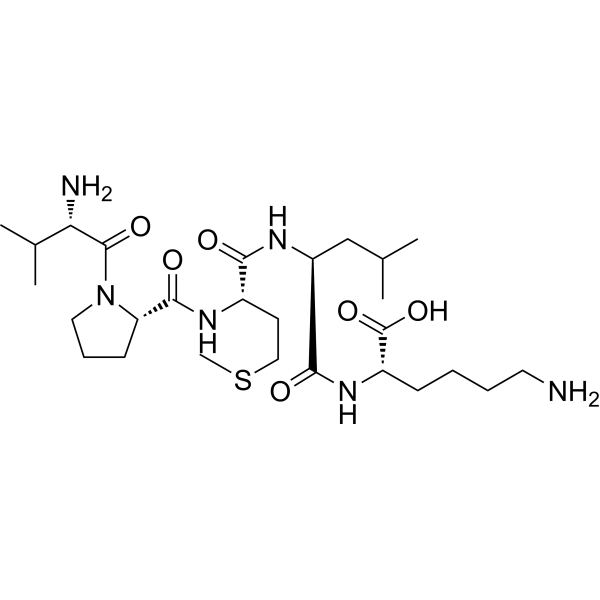
Bax inhibitor peptide V5 (BIP-V5) is a Bax-mediated apoptosis inhibitor, used for cancer treatment.
For research use only. We do not sell to patients.
- Purity : 98.19%
- CAS No.: 579492-81-2
- Formula: C27H50N6O6S
- Molecular Weight:586.79
-
Storage:
Sealed storage, away from moisture.
Powder -80°C, 2 years , -20°C, 1 year* In solvent : -80°C, 6 months; -20°C, 1 month (sealed storage, away from moisture)

To place orders, for customer services and technical support, please contact: MedChemExpress USA
Tel: 609-228-6898 E-mail: [email protected] [email protected]


-
 Biological Activity
-
Chemical Information
-
Solvent & Solubility
- Protocol
- Purity & Documentation
- References
-
 Help & FAQs




Publications Citing Use of MedChemExpress (MCE) Bax inhibitor peptide V5
More- Sci Adv. 2025 Apr 4;11(14):eadr6415. [Abstract]
- Cell Death Dis. 2022 Mar 2;13(3):197. [Abstract]
- Environ Int. 2024 Feb:184:108480. [Abstract]
- Apoptosis. 2022 Feb;27(1-2):149-160. [Abstract]
- Int J Mol Sci. 2023 May 11;24(10):8609. [Abstract]
- Int J Cancer. 2020 Apr 1;146(7):1963-1978. [Abstract]
- Sci Rep. 2017 Jul 3;7(1):4546. [Abstract]
- Fish Shellfish Immunol. 2024 Apr:147:109400. [Abstract]
- Toxicol Appl Pharmacol. 2021 Nov 1:430:115728. [Abstract]
- Toxicol Appl Pharmacol. 2018 Sep 15:355:269-285. [Abstract]
- Front Vet Sci. 2024 Feb 21:11:1331409. [Abstract]
- Am J Cancer Res. 2022 Nov 15;12(11):4930-4953. [Abstract]
- Toxicol Lett. 2020 Apr 1:322:87-97. [Abstract]
- bioRxiv. 2025 May 16.
- Biomed Pharmacother. 2023 Dec 31:169:115893. [Abstract]
- Research Square Preprint. 2022 JuL.
 Customer Validation & Images

-
WB
-
WB
-
IF


Biological Activity
Description
IC50 & Target
[1]|
Bax |
In Vitro
Bax inhibitor peptide V5 (BIP-V5; 0-50 μM) reduces cell death in STF-cMyc cells but not in SW620 or NCI-H23 cells. BIPV5 does not result in any significant effect on cell cycle arrest at the G2/M phase[1]. V5 treatment upregulates expression of anti-apoptotic proteins Bcl-2 and XIAP by more than 3- and 11-fold and downregulates expression of apoptosis-inducing proteins Bax, Bad, and nuclear factor-κB-p65 by 10, 30, and nearly 50%, respectively[2].
MedChemExpress (MCE) has not independently confirmed the accuracy of these methods. They are for reference only.
In Vivo
MedChemExpress (MCE) has not independently confirmed the accuracy of these methods. They are for reference only.


Chemical Information
-
CAS No. 579492-81-2
-
Appearance Solid
-
Molecular Weight 586.79
-
Formula C27H50N6O6S
-
Color White to off-white
-
Synonyms
BIP-V5; BAX Inhibiting Peptide V5
-
Sequence Shortening
VPMLK
-
Shipping
Room temperature in continental US; may vary elsewhere.
-
Storage
Sealed storage, away from moisture
Powder -80°C 2 years -20°C 1 year * In solvent : -80°C, 6 months; -20°C, 1 month (sealed storage, away from moisture)


Publications (16)
-
Journal Impact Factor
-
Most Recent
-
Sci Adv
2025 Apr 4;11(14):eadr6415. PMID: 40184468 -
Cell Death Dis
NEDD4L binds the proteasome and promotes autophagy and bortezomib sensitivity in multiple myeloma. [Abstract]2022 Mar 2;13(3):197. PMID: 35236820 -
Environ Int
1,2-Dichloroethane induces testicular pyroptosis by activating piR-mmu-1019957/IRF7 pathway and the protective effects of melatonin. [Abstract]2024 Feb:184:108480. PMID: 38341879 -
Apoptosis
Excessive hydrogen sulfide causes lung and brain tissue damage by promoting PARP1/Bax and C9 and inhibiting LAMB1. [Abstract]2022 Feb;27(1-2):149-160. PMID: 35119561 -
Int J Mol Sci
Mitochondrial Trafficking of MLKL, Bak/Bax, and Drp1 Is Mediated by RIP1 and ROS which Leads to Decreased Mitochondrial Membrane Integrity during the Hyperglycemic Shift to Necroptosis. [Abstract]2023 May 11;24(10):8609. PMID: 37239951 -
Int J Cancer
The NEDD4-1 E3 ubiquitin ligase: A potential molecular target for bortezomib sensitivity in multiple myeloma. [Abstract]2020 Apr 1;146(7):1963-1978. PMID: 31390487 -
Sci Rep
2017 Jul 3;7(1):4546. PMID: 28674407
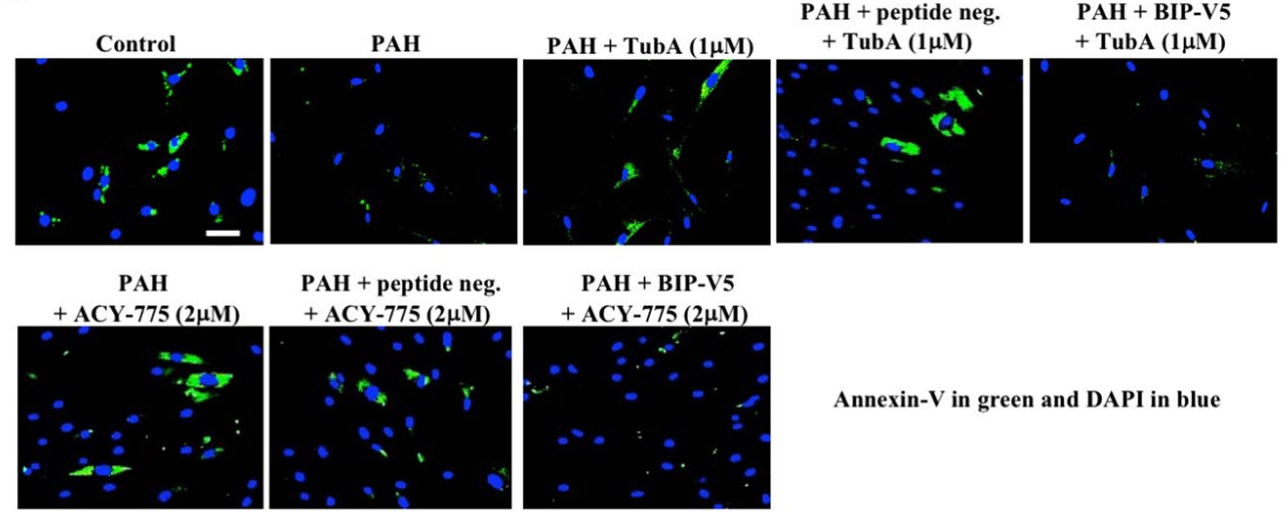
Bax inhibitor peptide V5 purchased from MedChemExpress. Usage Cited in: Sci Rep. 2017 Jul 3;7(1):4546. [Abstract]
Pretreatment with BIP-V5 significantly rescues cells from apoptosis induced by HDAC6 inhibition, whereas no effect is detected with a negative control peptide.
-
Fish Shellfish Immunol
CyHV-2 infection triggers mitochondrial-mediated apoptosis in GiCF cells by upregulating the pro-apoptotic gene ccBAX. [Abstract]2024 Apr:147:109400. PMID: 38253137 -
Toxicol Appl Pharmacol
1,2-Dichloroethane induces apoptosis in the cerebral cortexes of NIH Swiss mice through microRNA-182-5p targeting phospholipase D1 via a mitochondria-dependent pathway. [Abstract]2021 Nov 1:430:115728. PMID: 34560092 -
Toxicol Appl Pharmacol
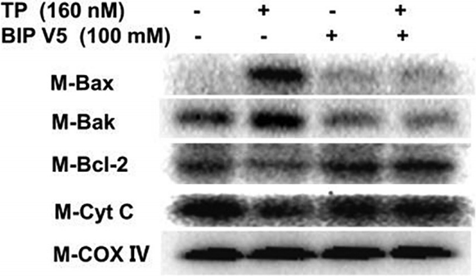
Triptolide induces p53-dependent cardiotoxicity through mitochondrial membrane permeabilization in cardiomyocytes. [Abstract]2018 Sep 15:355:269-285. PMID: 30009776
Bax inhibitor peptide V5 purchased from MedChemExpress. Usage Cited in: Toxicol Appl Pharmacol. 2018 Sep 15:355:269-285. [Abstract]
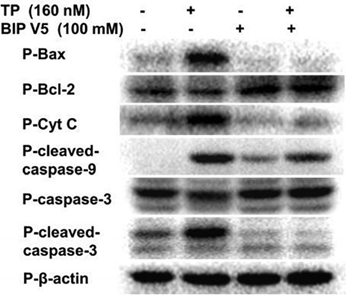
Bax inhibition ameliorates mitochondria dysfunction through modulating translocation and expression of Bax. H9c2 cells are treated with 160 nM TP for 24 h after pretreatment with BIP V5 (100 μM) or vehicle for 1 h. The mitochondrial levels of Bax, Bak, Bcl-2, Cyt C, and COX VI are measured by western blot analysis in H9c2 cells.
Bax inhibitor peptide V5 purchased from MedChemExpress. Usage Cited in: Toxicol Appl Pharmacol. 2018 Sep 15:355:269-285. [Abstract]
Bax inhibition ameliorates mitochondria dysfunction through modulating translocation and expression of Bax. H9c2 cells are treated with 160 nM TP for 24 h after pretreatment with BIP V5 (100 μM) or vehicle for 1 h. The cytoplasmic levels of Bax, Bcl-2, Cyt C, cleaved-caspase-9, cleaved-caspase-3 and β-actin are measured by immunoblot assays in H9c2 cells.
-
Front Vet Sci
Exploration of the protective mechanisms of Icariin against cisplatin-induced renal cell damage in canines. [Abstract]2024 Feb 21:11:1331409. PMID: 38455257 -
Am J Cancer Res
2022 Nov 15;12(11):4930-4953. PMID: 36504899 -
Toxicol Lett
1,2-Dichloroethane induces cerebellum granular cell apoptosis via mitochondrial pathway in vitro and in vivo. [Abstract]2020 Apr 1:322:87-97. PMID: 31935479 -
-
Biomed Pharmacother
Structural identification of an polysaccharide isolated from Epimedium brevicornum and its beneficial effect on promoting osteogenesis in osteoblasts induced by high glucose. [Abstract]2023 Dec 31:169:115893. PMID: 37979377 -


Solvent & Solubility
In Vitro:
DMSO : ≥ 100 mg/mL (170.42 mM; Hygroscopic DMSO has a significant impact on the solubility of product, please use newly opened DMSO)
H2O : 100 mg/mL (170.42 mM; Need ultrasonic)
* "≥" means soluble, but saturation unknown.
Please refer to the solubility information to select the appropriate solvent. Once prepared, please aliquot and store the solution to prevent product inactivation from repeated freeze-thaw cycles.
Storage method and period of stock solution: -80°C, 6 months; -20°C, 1 month (sealed storage, away from moisture). When stored at -80°C, please use it within 6 months. When stored at -20°C, please use it within 1 month.
* Note: If you choose water as the stock solution, please dilute it to the working solution, then filter and sterilize it with a 0.22 μm filter before use.
Please refer to the solubility information to select the appropriate solvent. Once prepared, please aliquot and store the solution to prevent product inactivation from repeated freeze-thaw cycles.
Storage method and period of stock solution: -80°C, 6 months; -20°C, 1 month (sealed storage, away from moisture). When stored at -80°C, please use it within 6 months. When stored at -20°C, please use it within 1 month.
* Note: If you choose water as the stock solution, please dilute it to the working solution, then filter and sterilize it with a 0.22 μm filter before use.
Concentration (start) × Volume (start) = Concentration (final) × Volume (final)
In Vivo:
Select the appropriate dissolution method based on your experimental animal and administration route.
- For the following dissolution methods, please ensure to first prepare a clear stock solution using an In Vitro approach and then sequentially add co-solvents:
- To ensure reliable experimental results, the clarified stock solution can be appropriately stored based on storage conditions. As for the working solution for In Vivo experiments, it is recommended to prepare freshly and use it on the same day.
- The percentages shown for the solvents indicate their volumetric ratio in the final prepared solution. If precipitation or phase separation occurs during preparation, heat and/or sonication can be used to aid dissolution.
Add each solvent one by one: 10% DMSO 40% PEG300 5% Tween-80 45% Saline
Solubility: ≥ 2.5 mg/mL (4.26 mM); Clear solution
This protocol yields a clear solution of ≥ 2.5 mg/mL (saturation unknown).
Taking 1 mL working solution as an example, add 100 μL DMSO stock solution (25.0 mg/mL) to 400 μL PEG300, and mix evenly; then add 50 μL Tween-80 and mix evenly; then add 450 μL Saline to adjust the volume to 1 mL.
Preparation of Saline: Dissolve 0.9 g sodium chloride in ddH₂O and dilute to 100 mL to obtain a clear Saline solution.
Add each solvent one by one: 10% DMSO 90% (20% SBE-β-CD in Saline)
Solubility: ≥ 2.5 mg/mL (4.26 mM); Clear solution
This protocol yields a clear solution of ≥ 2.5 mg/mL (saturation unknown).
Taking 1 mL working solution as an example, add 100 μL DMSO stock solution (25.0 mg/mL) to 900 μL 20% SBE-β-CD in Saline, and mix evenly.
Preparation of 20% SBE-β-CD in Saline (4°C, storage for one week): 2 g SBE-β-CD powder is dissolved in 10 mL Saline, completely dissolve until clear.
For the following dissolution methods, please prepare the working solution directly:
It is recommended to prepare fresh solutions and use them promptly within a short period of time.
The percentages shown for the solvents indicate their volumetric ratio in the final prepared solution. If precipitation or phase separation occurs during preparation, heat and/or sonication can be used to aid dissolution.
Add each solvent one by one: PBS
Solubility: 100 mg/mL (170.42 mM); Clear solution; Need ultrasonic
In Vivo Dissolution Calculator
Please enter the basic information of animal experiments:
-
-
-
-
Recommended: Prepare an additional quantity of animals to account for potential losses during experiments.
Working solution concentration: 0.22 mg/mL
This product has good water solubility, please refer to the measured solubility data in water/PBS/Saline for details.

Protocol
Cell Assay[1]
Cells (2.5×10⁴ cells/mL) are grown in 96-well plates in a final volume of 100 μL/well. After 24 h, cells are incubated with small molecules or vehicle (DMSO) for 48-96 h prior to harvest. 3-(4,5-Dimethylthiazol-2-yl)-2,5-diphenyltetrazolium bromide, a tetrazole (MTT) reagent (0.5 mg/mL), is added to each well during the final 2 h, and absorbance is measured. Cell growth is calculated as the ratio of absorbance obtained upon compound treatment to that obtained with vehicle (DMSO) treatment.
MedChemExpress (MCE) has not independently confirmed the accuracy of these methods. They are for reference only.


Purity & Documentation
-
Data Sheet (276 KB)
-
SDS (394 KB)
- English - EN (394 KB)
- Français - FR (394 KB)
- Deutsch - DE (394 KB)
- Norwegian - NO (394 KB)
- Español - ES (394 KB)
- Swedish - SV (394 KB)
- Italian - IT (394 KB)
- Korean - KR (394 KB)
- Portuguese - PT (394 KB)
-
Handling Instructions (2659 KB)
References
[1]. Jo MJ, et al. Regulation of cancer cell death by a novel compound, C604, in a c-Myc-overexpressing cellular environment. Eur J Pharmacol. 2015 Dec 15;769:257-65. [Content Brief]
[2]. Rivas-Carrillo JD, et al. Cell-permeable pentapeptide V5 inhibits apoptosis and enhances insulin secretion, allowing experimental single-donor islet transplantation in mice. Diabetes. 2007 May;56(5):1259-67. Epub 2007 Feb 7. [Content Brief]


Complete Stock Solution Preparation Table
Please refer to the solubility information to select the appropriate solvent. Once prepared, please aliquot and store the solution to prevent product inactivation from repeated freeze-thaw cycles.
Storage method and period of stock solution: -80°C, 6 months; -20°C, 1 month (sealed storage, away from moisture). When stored at -80°C, please use it within 6 months. When stored at -20°C, please use it within 1 month.
| Optional Solvent | Concentration Solvent Mass | 1 mg | 5 mg | 10 mg | 25 mg |
|---|---|---|---|---|---|
| DMSO / H2O | 1 mM | 1.7042 mL | 8.5209 mL | 17.0419 mL | 42.6047 mL |
| 5 mM | 0.3408 mL | 1.7042 mL | 3.4084 mL | 8.5209 mL | |
| 10 mM | 0.1704 mL | 0.8521 mL | 1.7042 mL | 4.2605 mL | |
| 15 mM | 0.1136 mL | 0.5681 mL | 1.1361 mL | 2.8403 mL | |
| 20 mM | 0.0852 mL | 0.4260 mL | 0.8521 mL | 2.1302 mL | |
| 25 mM | 0.0682 mL | 0.3408 mL | 0.6817 mL | 1.7042 mL | |
| 30 mM | 0.0568 mL | 0.2840 mL | 0.5681 mL | 1.4202 mL | |
| 40 mM | 0.0426 mL | 0.2130 mL | 0.4260 mL | 1.0651 mL | |
| 50 mM | 0.0341 mL | 0.1704 mL | 0.3408 mL | 0.8521 mL | |
| 60 mM | 0.0284 mL | 0.1420 mL | 0.2840 mL | 0.7101 mL | |
| 80 mM | 0.0213 mL | 0.1065 mL | 0.2130 mL | 0.5326 mL | |
| 100 mM | 0.0170 mL | 0.0852 mL | 0.1704 mL | 0.4260 mL |
* Note: If you choose water as the stock solution, please dilute it to the working solution, then filter and sterilize it with a 0.22 μm filter before use.


Bax inhibitor peptide V5 Related Classifications
HY-P0081 Related Classifications
 Powered by Bioz