



Breviscapine
Based on 2 publication(s) in Google Scholar
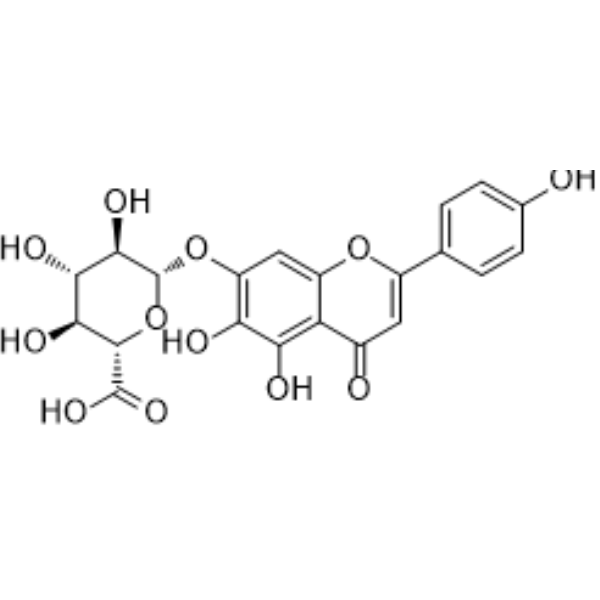
Breviscapine (Breviscapinun) is a flavonoid compound with antioxidant, anti-inflammatory, anti-fibrotic, and neuroprotective activities. Breviscapine ameliorates cerebral ischemia/reperfusion injury and vascular dementia, and inhibits the formation of postoperative abdominal adhesions. The mechanism of action of Breviscapine involves the regulation of oxidative stress, inflammatory cytokines, signaling pathways such as TGF-β/Smad, and cellular calcium overload. Breviscapine is used for research on diseases including cardiovascular and cerebrovascular diseases.
商品は「研究用試薬」です。人や動物の医療用・臨床診断用・食品用の製品ではありません。
研究用途以外に使用した場合、当社は一切の責任を負いかねます。
- 純度 : 99.13%
- CAS 番号: 116122-36-2
-
保管条件:
4°C, protect from light
* In solvent : -80°C, 6 months; -20°C, 1 month (protect from light)


To place orders, for customer services and technical support, please contact: MedChemExpress USA
Tel: 609-228-6898 E-mail: [email protected] [email protected]


-
 生物活性
生物活性
-
化学情報
-
溶剤 & 溶解度
- プロトコル
- 純度とドキュメンテーション
- 参考文献
-
 Help & FAQs


MedChemExpress(MCE)の使用を引用している文献 Breviscapine
More Customer Validation & Images

-
Cell Proliferation/Viability Assay

-
IF

-
Apoptosis Analysis

-
WB

-
Histological Imaging/Staining

Calcium Channel アイソフォーム固有の製品をすべて表示
More

生物活性
製品説明
Cellular Effect
|
Cell Line

|
Type | Value | Description | References |
|---|---|---|---|---|
| A549 | IC50 |
>50 μM
Compound: 1
|
Antiproliferative activity against human A549 cells after 72 hrs by MTT assay
Antiproliferative activity against human A549 cells after 72 hrs by MTT assay
|
[PMID: 30243153] |
| Bel-7402 | IC50 |
>50 μM
Compound: 1
|
Antiproliferative activity against human Bel7402 cells after 72 hrs by MTT assay
Antiproliferative activity against human Bel7402 cells after 72 hrs by MTT assay
|
[PMID: 30243153] |
| HCT-116 | IC50 |
77 μM
Compound: Scutellarin
|
Antiproliferative activity against human HCT116 cells after 72 hrs by MTT assay
Antiproliferative activity against human HCT116 cells after 72 hrs by MTT assay
|
[PMID: 28458133] |
| HepG2 | IC50 |
56.09 μM
Compound: Scutellarin
|
Antiproliferative activity against human HepG2 cells after 72 hrs by MTT assay
Antiproliferative activity against human HepG2 cells after 72 hrs by MTT assay
|
[PMID: 28458133] |
| L02 | IC50 |
>100 μM
Compound: Scutellarin
|
Antiproliferative activity against human LO2 cells after 72 hrs by MTT assay
Antiproliferative activity against human LO2 cells after 72 hrs by MTT assay
|
[PMID: 28458133] |
| L02 | IC50 |
>50 μM
Compound: 1
|
Cytotoxicity against human LO2 cells assessed as decrease in cell viability after 72 hrs by MTT assay
Cytotoxicity against human LO2 cells assessed as decrease in cell viability after 72 hrs by MTT assay
|
[PMID: 30243153] |
| MCF7 | IC50 |
>100 μM
Compound: Scutellarin
|
Antiproliferative activity against human MCF7 cells after 72 hrs by MTT assay
Antiproliferative activity against human MCF7 cells after 72 hrs by MTT assay
|
[PMID: 28458133] |
| MCF7 | IC50 |
>50 μM
Compound: 1
|
Antiproliferative activity against human MCF7 cells after 72 hrs by MTT assay
Antiproliferative activity against human MCF7 cells after 72 hrs by MTT assay
|
[PMID: 30243153] |
| PC-3 | IC50 |
72.9 μM
Compound: Scutellarin
|
Antiproliferative activity against human PC3 cells after 72 hrs by MTT assay
Antiproliferative activity against human PC3 cells after 72 hrs by MTT assay
|
[PMID: 28458133] |
体外実験
Breviscapine (6.25-100 μg/L; 24 h) protects primary cortical neurons against H2O2-induced cytotoxicity[1].
Breviscapine (50 μg/L; 24 h) reduces H2O2-induced intracellular calcium overload in primary cortical neurons[1].
MedChemExpress (MCE) has not independently confirmed the accuracy of these methods. They are for reference only.
体内実験
Breviscapine (10-40 mg/kg; i.p.; 10 days) significantly inhibits the formation of postoperative intra-abdominal adhesions in Wistar rats by suppressing inflammatory responses, upregulating peritoneal fibrinolytic activity, and regulating the TGF-β/Smad signaling pathway[2].
Breviscapine (20-100 mg/kg; i.p.; administration starts 7 days before MCAO and continues until sacrifice) dose-dependently alleviates cerebral ischemia/reperfusion injury in Sprague-Dawley rats. Among all regimens, the 100 mg/kg daily i.p. dose initiated 7 days prior to surgery exerts the optimal efficacy, including reducing cerebral infarct volume by approximately 55%, and significantly improving neurological function, levels of inflammatory markers, oxidative stress status, and apoptotic signaling pathways[3].
MedChemExpress (MCE) has not independently confirmed the accuracy of these methods. They are for reference only.
-
Animal Model:Wistar rats (both sexes, 9-10 weeks old, 200-250 g, cecum scraped + transient ischemia after midline laparotomy)[2]
-
Dosage:10 mg/kg; 20 mg/kg; 40 mg/kg
-
Administration:i.p.; daily; 10 days post-surgery
-
Result:Decreased the levels of IL-18, IL-6, and tumor necrosis factor-a in blood serum and TGF-b1, connective tissue growth factor, PAI-1 in peritoneal
fluid. But the levels of tPA and the ratio of tPA and PAI-1 in peritoneal fluid were increased.
Significantly inhibited the expression of TGF-b1 and increased the level of Smad7 in the rat cecum tissue.
-
Animal Model:Wistar (male, 6 weeks old, 230 ± 10 g, permanent occlusion of bilateral common carotid arteries)[1]
-
Dosage:2 mg/kg
-
Administration:i.p.; once daily; 14 days
-
Result:Improved the performance of learning and memory of VD rats in Morris water maze.
Decreased the level of lipid peroxidation and free radicals, and attenuated the pathological alterations, such as nuclear shrink, cellular edema and irregular arrangement of pyramidal layer in the hippocampal CA 1 area.
臨床実験
| NCT Number | Sponsor | Condition | Start Date |
Phase
|
|---|---|---|---|---|
| NCT01329991 | 2011-05 | PHASE1 |


化学情報
-
CAS 番号 116122-36-2
-
性状 Solid
-
Color Light yellow to yellow
-
SMILES
O=C(C=C(C1=CC=C(O)C=C1)OC2=CC(O[C@@H]([C@@H]([C@@H](O)[C@@H]3O)O)O[C@@H]3C(O)=O)=C4O)C2=C4O.O[C@H]([C@H]([C@@H]([C@@H](C(O)=O)O5)O)O)[C@@H]5OC6=CC(O)=C7C(C=C(C8=CC=C(O)C=C8)OC7=C6)=O
-
別名
Breviscapinun
-
Structure Classification
-
輸送条件
Room temperature in continental US; may vary elsewhere.
-
保管条件
4°C, protect from light
* In solvent : -80°C, 6 months; -20°C, 1 month (protect from light)


Publications (2)
-
Journal Impact Factor
-
Most Recent
-
Int Immunopharmacol
Breviscapine regulates lipid metabolism of microglia via the ADORA1/PPARα/ACOX1 pathway to promote spinal cord injury recovery. [Abstract]2025 Sep 23:162:115145. PMID: 40628044 -
Immunopharmacol Immunotoxicol
Breviscapine inhibits the proliferation and immune escape of diffuse large B-cell lymphoma cells by regulating JAK2/STAT3/PD-L1 pathway. [Abstract]2026 Apr;48(2):213-223. PMID: 41770217
Breviscapine purchased from MedChemExpress. Usage Cited in: Immunopharmacol Immunotoxicol. 2026 Apr;48(2):213-223. [Abstract]
GM12878 cells were exposed to Breviscapine (0, 6.25, 12.5, 25, 50, 100, 200, and 400 μM) for one day. GM12878 cell viability was examined using the Cell Counting Kit-8 (CCK-8) assay.
Breviscapine purchased from MedChemExpress. Usage Cited in: Immunopharmacol Immunotoxicol. 2026 Apr;48(2):213-223. [Abstract]
DLBCL cells (U2932 and OCI-LY3) were exposed to Breviscapine (0, 25, 50, 100 μM) for one day. DLBCL cell apoptosis was assessed with Hoechst staining.
Breviscapine purchased from MedChemExpress. Usage Cited in: Immunopharmacol Immunotoxicol. 2026 Apr;48(2):213-223. [Abstract]
DLBCL cells (U2932 and OCI-LY3) were exposed to Breviscapine (0, 25, 50, 100 μM) for one day. DLBCL cell apoptosis was assessed with flow cytometry.
Breviscapine purchased from MedChemExpress. Usage Cited in: Immunopharmacol Immunotoxicol. 2026 Apr;48(2):213-223. [Abstract]
Western blot analysis of cleaved caspase-3 and caspase-3 protein levels treated with Breviscapine (0, 25, 50, 100 μM).
Breviscapine purchased from MedChemExpress. Usage Cited in: Immunopharmacol Immunotoxicol. 2026 Apr;48(2):213-223. [Abstract]
The pathological changes were assessed using hematoxylin-eosin (HE) staining treated with Breviscapine (40, 80 mg/kg, i.p.).

Breviscapine purchased from MedChemExpress. Usage Cited in: Immunopharmacol Immunotoxicol. 2026 Apr;48(2):213-223. [Abstract]
Comparison of tumor volume and tumor weight in mice at the time points of 0, 4, 8, 12, 16, 20, 24 and 28 days treated with Breviscapine (40, 80 mg/kg, i.p.).


溶剤 & 溶解度
体外:
DMSO : 100 mg/mL (ultrasonic and warming and heat to 60°C; Hygroscopic DMSO has a significant impact on the solubility of product, please use newly opened DMSO)
H2O : < 0.1 mg/mL (insoluble)


純度とドキュメンテーション
-
データシート (284 KB)
-
SDS (252 KB)
- English - EN (252 KB)
- Français - FR (252 KB)
- Deutsch - DE (252 KB)
- Norwegian - NO (252 KB)
- Español - ES (252 KB)
- Swedish - SV (252 KB)
- Italian - IT (252 KB)
- Korean - KR (252 KB)
- Portuguese - PT (252 KB)
-
取扱説明書 (2659 KB)
参考文献
[1]. Xiong Z, et al. Protective effects of breviscapine on ischemic vascular dementia in rats. Biol Pharm Bull. 2006;29(9):1880-1885. [Content Brief]
[2]. Zhang H, et al. Evaluation of breviscapine on prevention of experimentally induced abdominal adhesions in rats. Am J Surg. 2016;211(6):1143-1152. [Content Brief]
[3]. Li Y, et al. Breviscapine Alleviates Cognitive Impairments Induced by Transient Cerebral Ischemia/Reperfusion through Its Anti-Inflammatory and Anti-Oxidant Properties in a Rat Model. ACS Chem Neurosci. 2020;11(24):4489-4498. [Content Brief]

Calculators
濃度 (開始) × 体積 (開始) = 濃度 (終了) × 体積 (終了)


Breviscapine 関連分類
HY-107802 関連分類
 Powered by Bioz