



(R)-Oxybutynin
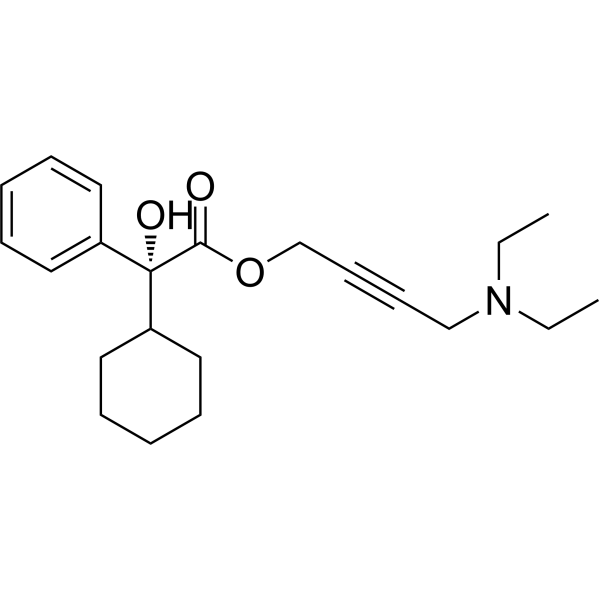
(R)-Oxybutynin (Aroxybutynin) is the racemic isomer of Oxybutynin and an orally active muscarinic receptor antagonist. (R)-Oxybutynin has antispasmodic, antimuscarinic, and anticholinergic activities and competitively antagonizes carbachol-induced contractions. (R)-Oxybutynin can be used to study urinary incontinence caused by neurogenic bladder dysfunction.
Nur für Forschungszwecke. Wir verkaufen nicht an Patienten.
- CAS. Nr.: 119618-21-2
- Formel: C22H31NO3
- Molecular Weight:357.49
-
Speicherung:
Please store the product under the recommended conditions in the Certificate of Analysis.

To place orders, for customer services and technical support, please contact: MedChemExpress USA
Tel: 609-228-6898 E-mail: [email protected] [email protected]


-
 Biologische Aktivität
-
Chemical Information
- Reinheit & Dokumentation
- Verweise
-
 Help & FAQs




Biologische Aktivität
The metabolism of Oxybutynin is stereoselective and it is extensively metabolized primarily by cytochrome P450 3A4 to form NDO. (R)-Oxybutynin has lower plasma concentrations than the other enantiomer[2].
MedChemExpress (MCE) has not independently confirmed the accuracy of these methods. They are for reference only.


Chemical Information
-
CAS. Nr. 119618-21-2
-
Molecular Weight 357.49
-
Formel C22H31NO3
-
SMILES
CCN(CC)CC#CCOC([C@@](C1CCCCC1)(C2=CC=CC=C2)O)=O
-
Synonyms
Aroxybutynin
-
Versand
Room temperature in continental US; may vary elsewhere.
-
Speicherung
Please store the product under the recommended conditions in the Certificate of Analysis.


Reinheit & Dokumentation
Verweise
[1]. Smith ER, et al. Comparison of the antimuscarinic and antispasmodic actions of racemic oxybutynin and desethyloxybutynin and their enantiomers with those of racemic terodiline. Arzneimittelforschung. 1998 Oct;48(10):1012-8. [Content Brief]
[2]. Siddiqui MA, et al. Oxybutynin extended-release: a review of its use in the management of overactive bladder. Drugs. 2004;64(8):885-912. [Content Brief]
[3]. Zobrist RH, et al. Pharmacokinetics of the R- and S-enantiomers of oxybutynin and N-desethyloxybutynin following oral and transdermal administration of the racemate in healthy volunteers. Pharm Res. 2001 Jul;18(7):1029-34. [Content Brief]

Calculators
Konzentration (Stammlösung) × Volumen (Stammlösung) = Konzentration (Ziellösung) × Volumen (Ziellösung)


(R)-Oxybutynin Related Classifications
HY-B0267C Related Classifications
 Powered by Bioz