



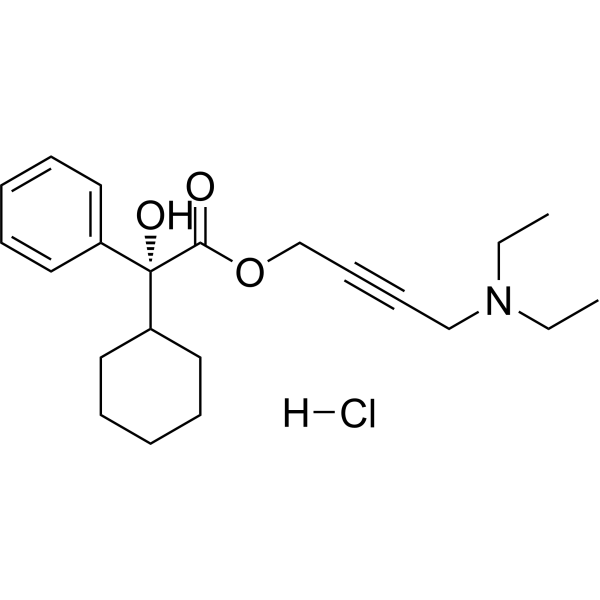
(R)-Oxybutynin hydrochloride

Based on 1 Customer Validation
(R)-Oxybutynin hydrochloride (Aroxybutynin hydrochloride), an enantiomer of Oxybutynin hydrochloride, is an orally active muscarinic receptor antagonist. (R)-Oxybutynin hydrochloride exhibits antispasmodic and anticholinergic activities, and competitively antagonizes carbachol-induced contractions. (R)-Oxybutynin hydrochloride can be used in the research of urinary incontinence caused by neurogenic bladder dysfunction.
For research use only. We do not sell to patients.
- Purity : 98.08%
- CAS No.: 1207344-05-5
- Formula: C22H32ClNO3
- Molecular Weight:393.95
-
Storage:
4°C, sealed storage, away from moisture
* In solvent : -80°C, 6 months; -20°C, 1 month (sealed storage, away from moisture)

To place orders, for customer services and technical support, please contact: MedChemExpress USA
Tel: 609-228-6898 E-mail: [email protected] [email protected]


-
 Biological Activity
-
Chemical Information
-
Solvent & Solubility
- Purity & Documentation
- References
-
 Help & FAQs




Biological Activity
Description
In Vitro
(R)-Oxybutynin (96 h) hydrochloride shows comparable in vitro permeation capacity across heat-separated human cadaver epidermal membranes to its S-enantiomer, with a total mean cumulative permeation amount of 139 μg/cm2[2].
(R)-Oxybutynin hydrochloride is the enantiomer of Oxybutynin (HY-B0267) with higher antimuscarinic activity. It is 12- to 88-fold more potent than the S-enantiomer at M1, M2, and M3 receptor subtypes, and shows a slight preference for M3[4].
MedChemExpress (MCE) has not independently confirmed the accuracy of these methods. They are for reference only.
Clinical Trial
| NCT Number | Sponsor | Condition | Start Date |
Phase

|
|---|---|---|---|---|
| NCT01329991 | Plexxikon| | 2011-05 | PHASE1 |


Chemical Information
-
CAS No. 1207344-05-5
-
Appearance Oil
-
Molecular Weight 393.95
-
Formula C22H32ClNO3
-
Color Off-white to light yellow
-
SMILES
O=C([C@](C1=CC=CC=C1)(C2CCCCC2)O)OCC#CCN(CC)CC.Cl
-
Synonyms
Aroxybutynin hydrochloride
-
Shipping
Room temperature in continental US; may vary elsewhere.
-
Storage
4°C, sealed storage, away from moisture
* In solvent : -80°C, 6 months; -20°C, 1 month (sealed storage, away from moisture)


Solvent & Solubility
In Vitro:
DMSO : 100 mg/mL (253.84 mM; Need ultrasonic; Hygroscopic DMSO has a significant impact on the solubility of product, please use newly opened DMSO)
Please refer to the solubility information to select the appropriate solvent. Once prepared, please aliquot and store the solution to prevent product inactivation from repeated freeze-thaw cycles.
Storage method and period of stock solution: -80°C, 6 months; -20°C, 1 month (sealed storage, away from moisture). When stored at -80°C, please use it within 6 months. When stored at -20°C, please use it within 1 month.
Please refer to the solubility information to select the appropriate solvent. Once prepared, please aliquot and store the solution to prevent product inactivation from repeated freeze-thaw cycles.
Storage method and period of stock solution: -80°C, 6 months; -20°C, 1 month (sealed storage, away from moisture). When stored at -80°C, please use it within 6 months. When stored at -20°C, please use it within 1 month.
Concentration (start) × Volume (start) = Concentration (final) × Volume (final)
In Vivo:
Select the appropriate dissolution method based on your experimental animal and administration route.
- For the following dissolution methods, please ensure to first prepare a clear stock solution using an In Vitro approach and then sequentially add co-solvents:
- To ensure reliable experimental results, the clarified stock solution can be appropriately stored based on storage conditions. As for the working solution for In Vivo experiments, it is recommended to prepare freshly and use it on the same day.
- The percentages shown for the solvents indicate their volumetric ratio in the final prepared solution. If precipitation or phase separation occurs during preparation, heat and/or sonication can be used to aid dissolution.
Add each solvent one by one: 10% DMSO 40% PEG300 5% Tween-80 45% Saline
Solubility: 2.5 mg/mL (6.35 mM); Clear solution; Need ultrasonic
This protocol yields a clear solution of 2.5 mg/mL.
Taking 1 mL working solution as an example, add 100 μL DMSO stock solution (25.0 mg/mL) to 400 μL PEG300, and mix evenly; then add 50 μL Tween-80 and mix evenly; then add 450 μL Saline to adjust the volume to 1 mL.
Preparation of Saline: Dissolve 0.9 g sodium chloride in ddH₂O and dilute to 100 mL to obtain a clear Saline solution.
In Vivo Dissolution Calculator
Please enter the basic information of animal experiments:
-
-
-
-
Recommended: Prepare an additional quantity of animals to account for potential losses during experiments.
Please enter your animal formula composition:
-
%DMSO +
Recommended: Keep the proportion of DMSO in working solution below 2% if your animal is weak.
-
%+
-
+%Tween-80 + +
-
%Saline +
The co-solvents required include: DMSO, . All of co-solvents are available by MedChemExpress (MCE). , Tween 80. All of co-solvents are available by MedChemExpress (MCE).
Working solution concentration: 0.22 mg/mL
Method for preparing stock solution: mg drug dissolved in μL DMSO. Stock solution concentration: mg/mL. * In solvent : -80°C, 6 months; -20°C, 1 month (sealed storage, away from moisture)
1. Take μL DMSO stock solution;
2. Add μL .
μL , mix evenly;
3. Then add μL Tween 80, mix evenly;
4. Then add μL
Please ensure that the stock solution in the first step is dissolved to a clear state, and add co-solvents in sequence. You can use ultrasonic heating (ultrasonic cleaner, recommended frequency 20-40 kHz), vortexing, etc. to assist dissolution.


Purity & Documentation
-
Data Sheet (281 KB)
-
SDS (252 KB)
- English - EN (252 KB)
- Français - FR (252 KB)
- Deutsch - DE (252 KB)
- Norwegian - NO (252 KB)
- Español - ES (252 KB)
- Swedish - SV (252 KB)
- Italian - IT (252 KB)
- Korean - KR (252 KB)
- Portuguese - PT (252 KB)
-
Handling Instructions (2659 KB)
References
[1]. Smith ER, et al. Comparison of the antimuscarinic and antispasmodic actions of racemic oxybutynin and desethyloxybutynin and their enantiomers with those of racemic terodiline. Arzneimittel-Forschung. 1998 Oct;48(10):1012-8. [Content Brief]
[2]. Zobrist RH, et al. Pharmacokinetics of the R- and S-enantiomers of oxybutynin and N-desethyloxybutynin following oral and transdermal administration of the racemate in healthy volunteers. Pharmaceutical research. 2001 Jul;18(7):1029-34. [Content Brief]
[4]. Siddiqui MA, et al. Oxybutynin extended-release: a review of its use in the management of overactive bladder. Drugs. 2004;64(8):885-912. [Content Brief]


Complete Stock Solution Preparation Table
Please refer to the solubility information to select the appropriate solvent. Once prepared, please aliquot and store the solution to prevent product inactivation from repeated freeze-thaw cycles.
Storage method and period of stock solution: -80°C, 6 months; -20°C, 1 month (sealed storage, away from moisture). When stored at -80°C, please use it within 6 months. When stored at -20°C, please use it within 1 month.
| Optional Solvent | Concentration Solvent Mass | 1 mg | 5 mg | 10 mg | 25 mg |
|---|---|---|---|---|---|
| DMSO | 1 mM | 2.5384 mL | 12.6920 mL | 25.3839 mL | 63.4598 mL |
| 5 mM | 0.5077 mL | 2.5384 mL | 5.0768 mL | 12.6920 mL | |
| 10 mM | 0.2538 mL | 1.2692 mL | 2.5384 mL | 6.3460 mL | |
| 15 mM | 0.1692 mL | 0.8461 mL | 1.6923 mL | 4.2307 mL | |
| 20 mM | 0.1269 mL | 0.6346 mL | 1.2692 mL | 3.1730 mL | |
| 25 mM | 0.1015 mL | 0.5077 mL | 1.0154 mL | 2.5384 mL | |
| 30 mM | 0.0846 mL | 0.4231 mL | 0.8461 mL | 2.1153 mL | |
| 40 mM | 0.0635 mL | 0.3173 mL | 0.6346 mL | 1.5865 mL | |
| 50 mM | 0.0508 mL | 0.2538 mL | 0.5077 mL | 1.2692 mL | |
| 60 mM | 0.0423 mL | 0.2115 mL | 0.4231 mL | 1.0577 mL | |
| 80 mM | 0.0317 mL | 0.1586 mL | 0.3173 mL | 0.7932 mL | |
| 100 mM | 0.0254 mL | 0.1269 mL | 0.2538 mL | 0.6346 mL |


(R)-Oxybutynin hydrochloride Related Classifications
HY-B0267B Related Classifications
 Powered by Bioz
Keywords
- (R)-Oxybutynin
- 1207344-05-5
- Aroxybutynin
- mAChR
- M2 muscarinic receptor subtype
- smooth muscle relaxant
- neurogenic detrusor overactivity
- hypoglossal motor nucleus
- urinary incontinence
- muscarinic receptors
- M1 muscarinic receptor subtype
- overactive bladder
- muscarinic receptor antagonist
- obstructive sleep apnea
- Inhibitor
- inhibitor
- inhibit