



PCC0208009
Based on 1 Customer Validation
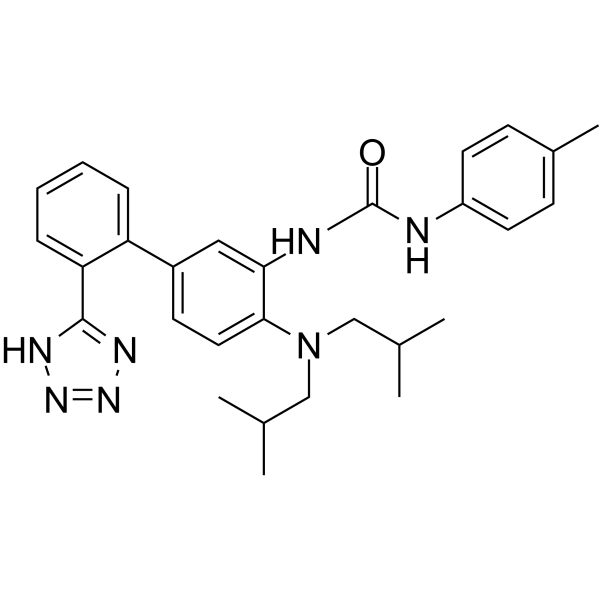
PCC0208009 is a potent IDO inhibitor with an IC50 value of 4.52 nM in HeLa cell. PCC0208009 alleviates neuropathic pain and comorbidities by regulating synaptic plasticity of anterior cingulate cortex (ACC) and amygdala .
For research use only. We do not sell to patients.
- Purity: 98.06%
- CAS No.: 1668565-74-9
- Formula: C29H35N7O
- Molecular Weight:497.63
-
Storage:Powder -20°C, 3 years , 4°C, 2 years ; In solvent -80°C, 2 years , -20°C, 1 year

To place orders, for customer services and technical support, please contact: MedChemExpress USA
Tel: 609-228-6898 E-mail: [email protected] [email protected]


-
 Biological Activity
-
Chemical Information
-
Solvent & Solubility
- Purity & Documentation
- References
-
 Help & FAQs




Biological Activity
|
IDO 4.52 nM (IC50, in HeLa cell) |
PCC0208009 inhibits IDO1 activity in HeLa cells, with an IC50 value of 4.52 nM, but it does not change the enzyme activity in vitro, indicating that it acts as an indirect IDO1 inhibitor[1].
PCC0208009 (0-200 nM; 48 hours) dose-dependently suppresses the IDO protein and mRNA expression induced by IFN-γ [3] .
MedChemExpress (MCE) has not independently confirmed the accuracy of these methods. They are for reference only.
-
Cell Line:HeLa cells
-
Concentration:0, 50, 100, 200 nM
-
Incubation Time:48 hours
-
Result:The IDO protein expression induced by IFN-γ was dose-dependently suppressed by PCC, which showed significant differences at 100 and 200 nM (P < 0.05).
-
Cell Line:HeLa cells
-
Concentration:0, 50, 100, 200 nM
-
Incubation Time:48 hours
-
Result:The IDO mRNA expression induced by IFN-γ was dose-dependently suppressed by PCC, which showed significant differences at all doses compared with the IFN-γ group.
PCC0208009 (oral gavage; once; 12-50 mg/kg) in adult male Sprague Dawley rats (180 g-200 g) is detected at 30, 60 and 90min after administration to evaluate the antinociceptive effects of PCC0208009 on neuropathic pain[1].
MedChemExpress (MCE) has not independently confirmed the accuracy of these methods. They are for reference only.
-
Animal Model:Adult male Sprague Dawley rats (180 g-200 g) [1]
-
Dosage:50 mg/kg
-
Administration:Single oral gavage
-
Result:The highest concentrations of PCC0208009 in plasma and brain were observed at 60 min after administration.
-
Animal Model:Adult male Sprague-Dawley rats bearing spinal nerve ligation (SNL)[1]
-
Dosage:12.5 mg/kg, 25 mg/kg, 50 mg/kg
-
Administration:oral gavage; once
-
Result:Showed the behavioral tests and the timelines.


Chemical Information
-
CAS No. 1668565-74-9
-
Appearance Solid
-
Molecular Weight 497.63
-
Formula C29H35N7O
-
Color White to light yellow
-
SMILES
CC(C)CN(CC(C)C)C1=CC=C(C2=CC=CC=C2C3=NN=NN3)C=C1NC(NC4=CC=C(C)C=C4)=O
-
Shipping
Room temperature in continental US; may vary elsewhere.
-
Storage
Powder -20°C 3 years 4°C 2 years In solvent -80°C 2 years -20°C 1 year


Solvent & Solubility
DMSO : 100 mg/mL (200.95 mM; Need ultrasonic; Hygroscopic DMSO has a significant impact on the solubility of product, please use newly opened DMSO)
Please refer to the solubility information to select the appropriate solvent. Once prepared, please aliquot and store the solution to prevent product inactivation from repeated freeze-thaw cycles.
Storage method and period of stock solution: -80°C, 2 years; -20°C, 1 year. When stored at -80°C, please use it within 2 years. When stored at -20°C, please use it within 1 year.
Please refer to the solubility information to select the appropriate solvent. Once prepared, please aliquot and store the solution to prevent product inactivation from repeated freeze-thaw cycles.
Storage method and period of stock solution: -80°C, 2 years; -20°C, 1 year. When stored at -80°C, please use it within 2 years. When stored at -20°C, please use it within 1 year.
Concentration (start) × Volume (start) = Concentration (final) × Volume (final)
Select the appropriate dissolution method based on your experimental animal and administration route.
- For the following dissolution methods, please ensure to first prepare a clear stock solution using an In Vitro approach and then sequentially add co-solvents:
- To ensure reliable experimental results, the clarified stock solution can be appropriately stored based on storage conditions. As for the working solution for In Vivo experiments, it is recommended to prepare freshly and use it on the same day.
- The percentages shown for the solvents indicate their volumetric ratio in the final prepared solution. If precipitation or phase separation occurs during preparation, heat and/or sonication can be used to aid dissolution.
Add each solvent one by one: 10% DMSO 40% PEG300 5% Tween-80 45% Saline
Solubility: 2.5 mg/mL (5.02 mM); Suspended solution; Need ultrasonic
This protocol yields a suspended solution of 2.5 mg/mL. Suspended solution can be used for oral and intraperitoneal injection.
Taking 1 mL working solution as an example, add 100 μL DMSO stock solution (25.0 mg/mL) to 400 μL PEG300, and mix evenly; then add 50 μL Tween-80 and mix evenly; then add 450 μL Saline to adjust the volume to 1 mL.
Preparation of Saline: Dissolve 0.9 g sodium chloride in ddH₂O and dilute to 100 mL to obtain a clear Saline solution.
Please enter the basic information of animal experiments:
-
-
-
-
Recommended: Prepare an additional quantity of animals to account for potential losses during experiments.
Please enter your animal formula composition:
-
%DMSO +
Recommended: Keep the proportion of DMSO in working solution below 2% if your animal is weak.
-
%+
-
+%Tween-80 + +
-
%Saline +
The co-solvents required include: DMSO, . All of co-solvents are available by MedChemExpress (MCE). , Tween 80. All of co-solvents are available by MedChemExpress (MCE).
Working solution concentration: 0.22 mg/mL
Method for preparing stock solution: mg drug dissolved in μL DMSO. Stock solution concentration: mg/mL.
1. Take μL DMSO stock solution;
2. Add μL .
μL , mix evenly;
3. Then add μL Tween 80, mix evenly;
4. Then add μL
Please ensure that the stock solution in the first step is dissolved to a clear state, and add co-solvents in sequence. You can use ultrasonic heating (ultrasonic cleaner, recommended frequency 20-40 kHz), vortexing, etc. to assist dissolution.


Purity & Documentation
-
Data Sheet (279 KB)
-
SDS (254 KB)
- English - EN (254 KB)
- Français - FR (254 KB)
- Deutsch - DE (254 KB)
- Norwegian - NO (254 KB)
- Español - ES (254 KB)
- Swedish - SV (254 KB)
- Italian - IT (254 KB)
- Korean - KR (254 KB)
- Portuguese - PT (254 KB)
-
Handling Instructions (2659 KB)
References
[1]. Yu Wang, et al. PCC0208009, an indirect IDO1 inhibitor, alleviates neuropathic pain and co-morbidities by regulating synaptic plasticity of ACC and amygdala. Biochem Pharmacol. 2020 Jul;177:113926. [Content Brief]
[2]. David K Williams, et al. Development of a series of novel o-phenylenediamine-based indoleamine 2,3-dioxygenase 1 (IDO1) inhibitors. Bioorg Med Chem Lett. 2018 Feb 15;28(4):732-736. [Content Brief]
[3]. Shanyue Sun, et al. PCC0208009 enhances the anti-tumor effects of temozolomide through direct inhibition and transcriptional regulation of indoleamine 2,3-dioxygenase in glioma models. Int J Immunopathol Pharmacol. Jan-Dec 2018;32:2058738418787991. [Content Brief]


Complete Stock Solution Preparation Table
Please refer to the solubility information to select the appropriate solvent. Once prepared, please aliquot and store the solution to prevent product inactivation from repeated freeze-thaw cycles.
Storage method and period of stock solution: -80°C, 2 years; -20°C, 1 year. When stored at -80°C, please use it within 2 years. When stored at -20°C, please use it within 1 year.
| Optional Solvent | Concentration Solvent Mass | 1 mg | 5 mg | 10 mg | 25 mg |
|---|---|---|---|---|---|
| DMSO | 1 mM | 2.0095 mL | 10.0476 mL | 20.0953 mL | 50.2381 mL |
| 5 mM | 0.4019 mL | 2.0095 mL | 4.0191 mL | 10.0476 mL | |
| 10 mM | 0.2010 mL | 1.0048 mL | 2.0095 mL | 5.0238 mL | |
| 15 mM | 0.1340 mL | 0.6698 mL | 1.3397 mL | 3.3492 mL | |
| 20 mM | 0.1005 mL | 0.5024 mL | 1.0048 mL | 2.5119 mL | |
| 25 mM | 0.0804 mL | 0.4019 mL | 0.8038 mL | 2.0095 mL | |
| 30 mM | 0.0670 mL | 0.3349 mL | 0.6698 mL | 1.6746 mL | |
| 40 mM | 0.0502 mL | 0.2512 mL | 0.5024 mL | 1.2560 mL | |
| 50 mM | 0.0402 mL | 0.2010 mL | 0.4019 mL | 1.0048 mL | |
| 60 mM | 0.0335 mL | 0.1675 mL | 0.3349 mL | 0.8373 mL | |
| 80 mM | 0.0251 mL | 0.1256 mL | 0.2512 mL | 0.6280 mL | |
| 100 mM | 0.0201 mL | 0.1005 mL | 0.2010 mL | 0.5024 mL |


PCC0208009 Related Classifications
HY-100771 Related Classifications
 Powered by Bioz