



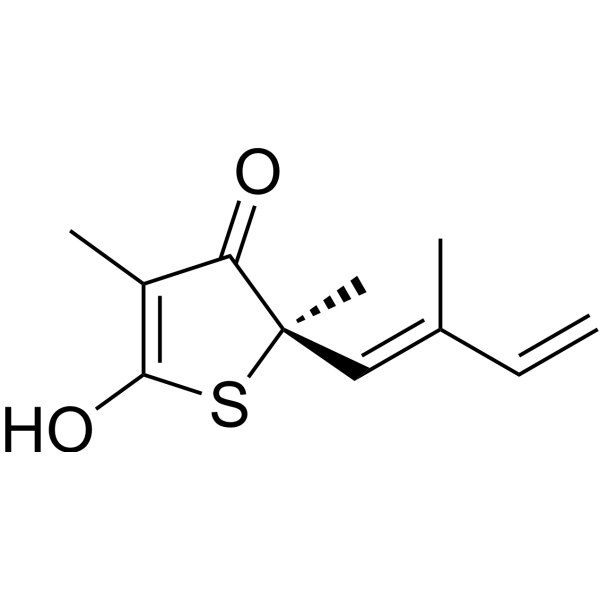
Thiolactomycin

Based on 1 Customer Validation
Thiolactomycin is an orally active bacterial type II fatty acid synthase (FAS-II) inhibitor with antibacterial and antimalarial activities. Thiolactomycin specifically targets KasA/KasB in mycobacteria and FabB/FabF in bacteria, thereby inhibiting the biosynthesis of fatty acids and mycolic acids. Thiolactomycin can be used in studies related to tuberculosis, systemic bacterial infections, and experimental pyelonephritis.
Nos produits utilisent uniquement pour la recherche. Nous ne vendons pas aux patients.
- Pureté : 96.65%
- CAS No.: 82079-32-1
- Formule: C11H14O2S
- Masse moléculaire:210.29
-
Stockage:Powder -20°C, 3 years ; In solvent -80°C, 6 months , -20°C, 1 month

To place orders, for customer services and technical support, please contact: MedChemExpress USA
Tel: 609-228-6898 E-mail: [email protected] [email protected]


-
 Activité biologique
-
Chemical Information
- Protocole
- Pureté et documentation
- Références
-
 Help & FAQs


Voir tous les produits spécifiques à Isoform Antibiotic
More

Activité biologique
Description
Cellular Effect
|
Cell Line

|
Type | Value | Description | References |
|---|---|---|---|---|
| HepG2 | IC50 |
>80 μg/mL
Compound: 1, TLM, thiolactomycin
|
Inhibition of type1 FAS in HepG2 cells
Inhibition of type1 FAS in HepG2 cells
|
[PMID: 17507223] |
| HepG2 | IC50 |
>80 ng/mL
Compound: 1, TLM
|
Inhibition of fatty acid synthase type 1 in human HepG2 cells assessed as [1-14C]acetate incorporation into cellular fatty acid
Inhibition of fatty acid synthase type 1 in human HepG2 cells assessed as [1-14C]acetate incorporation into cellular fatty acid
|
[PMID: 18805004] |
| HepG2 | IC50 |
>380 μM
Compound: 14a-(5R)
|
Inhibition of FASN in human HepG2 cells
Inhibition of FASN in human HepG2 cells
|
[PMID: 21726077] |
| MCF7 | IC50 |
>80 μg/mL
Compound: {5R}-TLM
|
Inhibitory concentration against MCF-7 breast cancer cells in XTT assay (non radioactive assay)
Inhibitory concentration against MCF-7 breast cancer cells in XTT assay (non radioactive assay)
|
[PMID: 15715465] |
In Vitro
Thiolactomycin (56-240 μM; 21 days) inhibits growth of Mycobacterium tuberculosis H37Rv with an MIC50 of 56 μM, MIC90 of 125 μM, and MIC99 of 240 μM[1].
Thiolactomycin (200 μM; 1 h) inhibits mycolic acid biosynthesis in Mycobacterium smegmatis cell wall fractions by 54% at a concentration of 200 μM[1].
Thiolactomycin (200 μM-1.0 mM) inhibits type II fatty acid synthase activity in Mycobacterium smegmatis cytosolic extracts by 59% at 200 μM and 69% at 1.0 mM[1].
TlnCACP(apo)-Cy, TlnDA-PCP(holo), and TlnA (10 μM, 10 μM, 2 μM; 4 h) are necessary and sufficient to convert 7-CoA to thiolactomycin, while TlnDTE does not participate in thiolactomycin biosynthesis[2].
TlnA (2 μM; 2 h) catalyzes the conversion of the unstable thiocarboxylate intermediate 9 to thiolactomycin, with 6 acting as a spontaneous byproduct of 9, not a substrate for TlnA[2].
TlnCACP-Cy (10 μM; 2 h) mediates sulfur transfer from L-Cys to the polyketide intermediate via a condensation and heterocyclization-dependent mechanism, requiring catalytic residues D140 and D394, but not N352, to generate the thiocarboxylate intermediate 9[2].
Thiolactomycin inhibits growth of Pseudomonas aeruginosa J-272 with an MIC of 800 μg/mL and Pseudomonas aeruginosa M-57740 with an MIC of 1.56 μg/mL in heart infusion medium[3].
Thiolactomycin (24 h) exhibits broad-spectrum aerobic antibacterial activity, with particularly potent activity against Salmonella enteritidis T-1 (MIC 6.25-12.5 μg/mL), Serratia marcescens FU-111 (MIC 50-100 μg/mL), and Pseudomonas aeruginosa GMB-75 (MIC 6.25 μg/mL) on NA and ANTI-3 agars[3].
Thiolactomycin (40 h) exhibits potent activity against Bacteroides fragilis strains (MIC 3.12-12.5 μg/mL) and Fusobacterium necroforum S-45 (MIC 3.25 μg/mL) under anaerobic conditions on Gam agar medium[3].
Thiolactomycin (25-200 μg/mL) shows moderate in vitro antibacterial activity against S. marcescens 101, S. marcescens 92, S. marcescens 5, K. pneumoniae 3K25, K. pneumoniae 15C, and E. coli 11 with MIC values ranging from 25 to 200 μg/mL[4].
MedChemExpress (MCE) has not independently confirmed the accuracy of these methods. They are for reference only.
In Vivo
Thiolactomycin (≤0.05-12.8 mg/mouse; s.c., p.o.; single dose, two doses at 1 and 3 hours post-challenge) exhibits dose-dependent protective efficacy against multiple bacterial systemic infections in mice, with ED50 values ranging from ≤1.50 to 12.8 mg/mouse, and greater efficacy than carbenicillin against several S. marcescens and K. pneumoniae strains[4].
Thiolactomycin (0.5-2 mg/mouse; s.c.; 4 doses at 5, 7, 12, 24 hours post-challenge) reduces kidney bacterial counts and abscess formation in mice with experimental pyelonephritis, with significant efficacy at doses of 0.5 to 2 mg/mouse delivered subcutaneously four times post-challenge[4].
Thiolactomycin (2.83-3.25 mg/mouse; s.c.; two doses at 1 and 3 hours post-challenge) is twice as effective as carbenicillin against S. marcescens systemic infection in cyclophosphamide-induced immunocompromised mice (ED50 3.25 mg/mouse) and equally effective as carbenicillin in hydrocortisone-induced immunocompromised mice (ED50 2.83 mg/mouse)[4].
MedChemExpress (MCE) has not independently confirmed the accuracy of these methods. They are for reference only.
-
Animal Model:ddY (male)[3]
-
Dosage:455 mg/kg (i.v.); 520 mg/kg (i.p.); 1689 mg/kg (p.o.)
-
Administration:i.v.; single dose; i.p.; single dose; p.o.; single dose
-
Result:Determined median lethal dose (LD50) as 455 mg/kg via intravenous injection.
Determined median lethal dose (LD50) as 520 mg/kg via intraperitoneal injection.
Determined median lethal dose (LD50) as 1689 mg/kg via oral administration.
Observed no delayed toxicity during 14 days of observation after intravenous injection.
-
Animal Model:ddY (SPF, female, 5 weeks old, 21~25 g, transurethral S. marcescens 101 challenge with 4-hour urethral occlusion); ddY (SPF, female, 5 weeks old, 22~24 g, transurethral K. pneumoniae 3K25 challenge with 4-hour urethral occlusion)[4]
-
Dosage:0.5 mg/mouse; 1 mg/mouse; 2 mg/mouse
-
Administration:s.c.; 4 doses at 5, 7, 12, 24 hours post-challenge
-
Result:Reduced kidney bacterial counts to 2.2×10⁶ cells/g (p<0.01) in S. marcescens 101-infected mice at 0.5 mg/mouse.
Reduced kidney bacterial counts to 1.0×10⁵ cells/g (p<0.001) in S. marcescens 101-infected mice at 1 mg/mouse, with significant suppression of abscess formation compared to controls.
Reduced kidney bacterial counts to 9.5×10⁵ cells/g (p<0.05) in K. pneumoniae 3K25-infected mice at 1 mg/mouse, with reduced abscess formation compared to controls.
Reduced kidney bacterial counts to 4.8×10⁵ cells/g (p<0.05) in K. pneumoniae 3K25-infected mice at 2 mg/mouse, with reduced abscess formation compared to controls.
Was more effective than ampicillin against both pathogens and comparable to ceftezole against K. pneumoniae 3K25.


Chemical Information
-
CAS No. 82079-32-1
-
Appearance Solid
-
Masse moléculaire 210.29
-
Formule C11H14O2S
-
Color White to light yellow
-
SMILES
C=C/C(C)=C/[C@@]1(C(O)=C(C(S1)=O)C)C
-
Livraison
Room temperature in continental US; may vary elsewhere.
-
Stockage
Powder -20°C 3 years In solvent -80°C 6 months -20°C 1 month


Pureté et documentation
-
Fiche technique (292 KB)
-
SDS (393 KB)
- English - EN (393 KB)
- Français - FR (393 KB)
- Deutsch - DE (393 KB)
- Norwegian - NO (393 KB)
- Español - ES (393 KB)
- Swedish - SV (393 KB)
- Italian - IT (393 KB)
- Korean - KR (393 KB)
- Portuguese - PT (393 KB)
-
Instruction de manipulation (2659 KB)
Références
[1]. Douglas JD, et al. Analogues of thiolactomycin: potential drugs with enhanced anti-mycobacterial activity. Microbiology (Reading). 2002;148(Pt 10):3101-3109. [Content Brief]
[2]. Guo J, et al. Deciphering the Thiolactonization Mechanism in Thiolactomycin Biosynthesis. J Am Chem Soc. 2025;147(26):22368-22386. [Content Brief]

Calculators
Concentration (start) × Volume (start) = Concentration (final) × Volume (final)


Thiolactomycin Related Classifications
HY-122394 Related Classifications
 Powered by Bioz