



Tylvalosin tartrate
Based on 2 publication(s) in Google Scholar
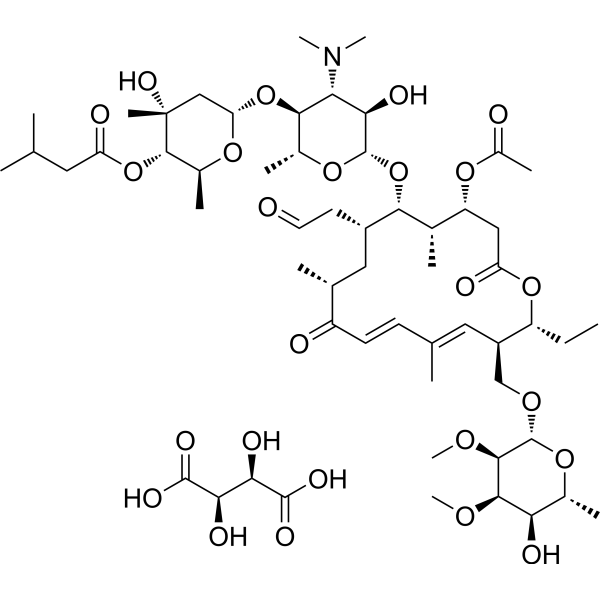
Tylvalosin (Acetylisovaleryltylosin) tartrate is an orally active, broad-spectrum macrolide antibiotic with antimicrobial activity. Tylvalosin tartrate is an antiviral agent useful in studying PRRSV infection. Tylvalosin tartrate induces apoptosis. Tylvalosin tartrate also has anti-inflammatory activity, relieves oxidative stress, and alleviates acute lung injury by inhibiting NF-κB activation.
Nos produits utilisent uniquement pour la recherche. Nous ne vendons pas aux patients.
- Pureté: 96.03%
- CAS No.: 63428-13-7
- Formule: C57H93NO25
- Masse moléculaire:1192.34
-
Stockage:
-20°C, stored under nitrogen
* In solvent : -80°C, 6 months; -20°C, 1 month (stored under nitrogen)


-
 Activité biologique
-
Chemical Information
-
Solvant et solubilité
- Pureté et documentation
- Références
-
 Help & FAQs



Publications Citing Use of MedChemExpress (MCE) Tylvalosin tartrate
MoreVoir tous les produits spécifiques à Isoform Antibiotic
More

Activité biologique
|
Macrolide |
Tylvalosin tartrate (10 μg/mL; 0.5, 1 h) increases caspase-3 cleavage in porcine neutrophils, leading to DNA fragmentation during apoptosis [4].
Tylvalosin tartrate (0.1-10 μg/mL; 0.5 h) Promote endocytosis of porcine neutrophils by macrophages without changing phagocytosis [4].
MedChemExpress (MCE) has not independently confirmed the accuracy of these methods. They are for reference only.
-
Cell Line:Porcine neutrophils
-
Concentration:0.1, 1.0, or 10 µg/mL
-
Incubation Time:0.5, 1 h
-
Result:Resulted induction of concentration- and time-dependent apoptosis in porcine monocyte-derived macrophages.
MedChemExpress (MCE) has not independently confirmed the accuracy of these methods. They are for reference only.
-
Animal Model:PRRSV-free commercial breed piglets[5]
-
Dosage:800 mg/kg Aivlosin (20% Tylvalosin Tartrate Premix)
-
Administration:po; 7-14 days
-
Result:Attenuated the increase in total white blood cells induced by immunization at day one post-immunization (DPI) and induced an increase in monocyte counts after seven DPI.
Attenuate the reduction in the percentage of CD8+ T cells induced by PRRSV-inactivated vaccine immunization at seven DPI.


Chemical Information
-
CAS No. 63428-13-7
-
Appearance Solid
-
Masse moléculaire 1192.34
-
Formule C57H93NO25
-
Color White to light yellow
-
SMILES
OC([C@H](O)[C@@H](O)C(O)=O)=O.O[C@@H]1[C@@H](C)O[C@@H](OC[C@H]([C@@H](CC)OC(C[C@@H](OC(C)=O)[C@H](C)[C@@H](O[C@@H]2O[C@H](C)[C@@H](O[C@@H]3O[C@@H](C)[C@H](OC(CC(C)C)=O)[C@@](O)(C)C3)[C@H](N(C)C)[C@H]2O)[C@@H](CC=O)C[C@H]4C)=O)/C=C(C)/C=C/C4=O)[C@H](OC)[C@@H]1OC
-
Synonyms
Acetylisovaleryltylosin tartrate
-
Livraison
Room temperature in continental US; may vary elsewhere.
-
Stockage
-20°C, stored under nitrogen
* In solvent : -80°C, 6 months; -20°C, 1 month (stored under nitrogen)


Publications (2)
-
Journal Impact Factor
-
Most Recent
-
Int J Biol Macromol
De novo design mini-binder proteins targeting the capsid-forming domain of type 2 PRRSV nucleocapsid protein to inhibit PRRSV replication in vitro. [Abstract]2025 Aug 26;323(Pt 2):147118. PMID: 40865823 -
Rapid Commun Mass Spectrom
2025;39(20):e10103. PMID: 40589310


Solvant et solubilité
DMSO : 100 mg/mL (83.87 mM; Need ultrasonic; Hygroscopic DMSO has a significant impact on the solubility of product, please use newly opened DMSO)
Please refer to the solubility information to select the appropriate solvent. Once prepared, please aliquot and store the solution to prevent product inactivation from repeated freeze-thaw cycles.
Storage method and period of stock solution: -80°C, 6 months; -20°C, 1 month (stored under nitrogen). When stored at -80°C, please use it within 6 months. When stored at -20°C, please use it within 1 month.
Please refer to the solubility information to select the appropriate solvent. Once prepared, please aliquot and store the solution to prevent product inactivation from repeated freeze-thaw cycles.
Storage method and period of stock solution: -80°C, 6 months; -20°C, 1 month (stored under nitrogen). When stored at -80°C, please use it within 6 months. When stored at -20°C, please use it within 1 month.
Concentration (start) × Volume (start) = Concentration (final) × Volume (final)
Select the appropriate dissolution method based on your experimental animal and administration route.
- For the following dissolution methods, please ensure to first prepare a clear stock solution using an In Vitro approach and then sequentially add co-solvents:
- To ensure reliable experimental results, the clarified stock solution can be appropriately stored based on storage conditions. As for the working solution for In Vivo experiments, it is recommended to prepare freshly and use it on the same day.
- The percentages shown for the solvents indicate their volumetric ratio in the final prepared solution. If precipitation or phase separation occurs during preparation, heat and/or sonication can be used to aid dissolution.
Add each solvent one by one: 10% DMSO 40% PEG300 5% Tween-80 45% Saline
Solubility: ≥ 5 mg/mL (4.19 mM); Clear solution
This protocol yields a clear solution of ≥ 5 mg/mL (saturation unknown).
Taking 1 mL working solution as an example, add 100 μL DMSO stock solution (50.0 mg/mL) to 400 μL PEG300, and mix evenly; then add 50 μL Tween-80 and mix evenly; then add 450 μL Saline to adjust the volume to 1 mL.
Preparation of Saline: Dissolve 0.9 g sodium chloride in ddH₂O and dilute to 100 mL to obtain a clear Saline solution.
Please enter the basic information of animal experiments:
-
-
-
-
Recommended: Prepare an additional quantity of animals to account for potential losses during experiments.
Please enter your animal formula composition:
-
%DMSO +
Recommended: Keep the proportion of DMSO in working solution below 2% if your animal is weak.
-
%+
-
+%Tween-80 + +
-
%Saline +
The co-solvents required include: DMSO, . All of co-solvents are available by MedChemExpress (MCE). , Tween 80. All of co-solvents are available by MedChemExpress (MCE).
Working solution concentration: 0.22 mg/mL
Method for preparing stock solution: mg drug dissolved in μL DMSO. Stock solution concentration: mg/mL. * In solvent : -80°C, 6 months; -20°C, 1 month (stored under nitrogen)
1. Take μL DMSO stock solution;
2. Add μL .
μL , mix evenly;
3. Then add μL Tween 80, mix evenly;
4. Then add μL
Please ensure that the stock solution in the first step is dissolved to a clear state, and add co-solvents in sequence. You can use ultrasonic heating (ultrasonic cleaner, recommended frequency 20-40 kHz), vortexing, etc. to assist dissolution.


Pureté et documentation
-
Fiche technique (285 KB)
-
SDS (393 KB)
- English - EN (393 KB)
- Français - FR (393 KB)
- Deutsch - DE (393 KB)
- Norwegian - NO (393 KB)
- Español - ES (393 KB)
- Swedish - SV (393 KB)
- Italian - IT (393 KB)
- Portuguese - PT (393 KB)
-
Instruction de manipulation (2659 KB)
Références
[1]. Albert Philip Adrian Mockett, et al. Use of tylvalosin as antiviral agent. Patent. WO2008007104.
[2]. Zhao Z, et al. Tylvalosin exhibits anti-inflammatory property and attenuates acute lung injury in different models possibly through suppression of NF-κB activation. Biochem Pharmacol. 2014 Jul 1;90(1):73-87. [Content Brief]
[3]. Zhang Q, et al. Tylvalosin Tartrate Improves the Health Status of Swine Herds during Immunization with Porcine Reproductive and Respiratory Syndrome Virus-Inactivated Vaccine. Vet Sci. 2022 Dec 25;10(1):12. [Content Brief]
[4]. Moges R, et al. Anti-Inflammatory Benefits of Antibiotics: Tylvalosin Induces Apoptosis of Porcine Neutrophils and Macrophages, Promotes Efferocytosis, and Inhibits Pro-Inflammatory CXCL-8, IL1α, and LTB4 Production, While Inducing the Release of Pro-Resolving Lipoxin A4 and Resolvin D1. Front Vet Sci. 2018 Apr 11;5:57. [Content Brief]


Complete Stock Solution Preparation Table
Please refer to the solubility information to select the appropriate solvent. Once prepared, please aliquot and store the solution to prevent product inactivation from repeated freeze-thaw cycles.
Storage method and period of stock solution: -80°C, 6 months; -20°C, 1 month (stored under nitrogen). When stored at -80°C, please use it within 6 months. When stored at -20°C, please use it within 1 month.
| Optional Solvent | Concentration Solvent Mass | 1 mg | 5 mg | 10 mg | 25 mg |
|---|---|---|---|---|---|
| DMSO | 1 mM | 0.8387 mL | 4.1934 mL | 8.3869 mL | 20.9672 mL |
| 5 mM | 0.1677 mL | 0.8387 mL | 1.6774 mL | 4.1934 mL | |
| 10 mM | 0.0839 mL | 0.4193 mL | 0.8387 mL | 2.0967 mL | |
| 15 mM | 0.0559 mL | 0.2796 mL | 0.5591 mL | 1.3978 mL | |
| 20 mM | 0.0419 mL | 0.2097 mL | 0.4193 mL | 1.0484 mL | |
| 25 mM | 0.0335 mL | 0.1677 mL | 0.3355 mL | 0.8387 mL | |
| 30 mM | 0.0280 mL | 0.1398 mL | 0.2796 mL | 0.6989 mL | |
| 40 mM | 0.0210 mL | 0.1048 mL | 0.2097 mL | 0.5242 mL | |
| 50 mM | 0.0168 mL | 0.0839 mL | 0.1677 mL | 0.4193 mL | |
| 60 mM | 0.0140 mL | 0.0699 mL | 0.1398 mL | 0.3495 mL | |
| 80 mM | 0.0105 mL | 0.0524 mL | 0.1048 mL | 0.2621 mL |


 Powered by Bioz