



Crisdesalazine

Based on 1 Customer Validation
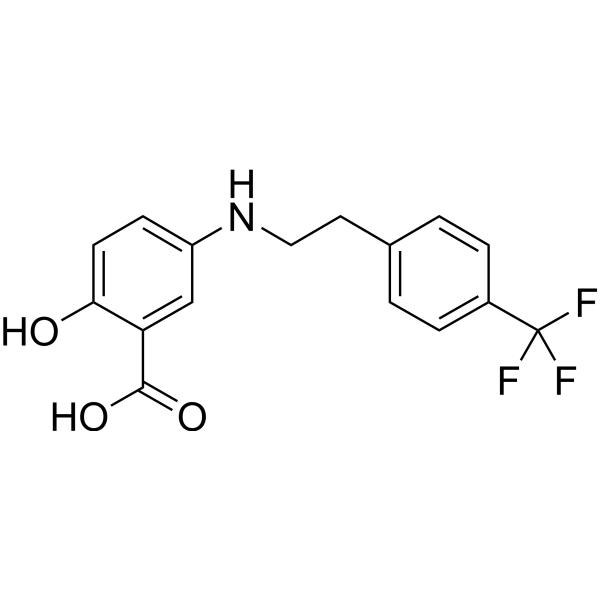
Crisdesalazine (AAD-2004) is a microsomal prostaglandin E2 synthase-1 (mPGES-1) inhibitor. Crisdesalazine acts as a potent free radical scavenger that directly neutralizes reactive oxygen species (ROS) including hydrogen peroxide, exerting neuroprotective effects against apoptosis and axonal damage. Crisdesalazine inhibits PGE2 production, mediates inflammatory responses, and promotes the conversion of macrophages from the pro-inflammatory M1 phenotype to the anti-inflammatory M2 phenotype. Crisdesalazine is applicable to neuroprotection research in multiple sclerosis and spinal cord injury.
For research use only. We do not sell to patients.
- Purity : 98.92%
- CAS No.: 927685-43-6
- Formula: C16H14F3NO3
- Molecular Weight:325.28
-
Storage:Powder -20°C, 3 years , 4°C, 2 years ; In solvent -80°C, 6 months , -20°C, 1 month

To place orders, for customer services and technical support, please contact: MedChemExpress USA
Tel: 609-228-6898 E-mail: [email protected] [email protected]


-
 Biological Activity
-
Chemical Information
-
Solvent & Solubility
- Protocols
- Purity & Documentation
- References
-
 Help & FAQs




Biological Activity
Description
In Vitro
Crisdesalazine (0.2-50 μM; 24 h) is non-cytotoxic to murine RAW 264.7 macrophages at concentrations up to 50 μM and to human SH-SY5Y neuroblastoma cells at concentrations up to 10 μM, with reduced viability only at 50 μM in SH-SY5Y cells[1].
Crisdesalazine (0.2-5 μM; 24 h post-LPS stimulation) promotes the transition of LPS-stimulated murine RAW 264.7 macrophages from the pro-inflammatory M1 to the anti-inflammatory M2 phenotype by reducing pro-inflammatory marker and cytokine expression and increasing anti-inflammatory marker expression[1].
Crisdesalazine (0.2-5 μM; 24 h during co-culture) reduces neuroinflammation and neuronal necrosis in human SH-SY5Y cells co-cultured with LPS-stimulated murine RAW 264.7 macrophages by suppressing pro-inflammatory cytokine expression and decreasing necrotic cell populations[1].
Crisdesalazine (1 mM) reduces H2O2 levels in primary mouse spinal cord astrocytes, attenuates astrocytic reactivity, and exerts neuroprotective effects against apoptosis and axonal injury in primary mouse cortical neurons co-cultured with OGD/R-challenged astrocytes[2].
MedChemExpress (MCE) has not independently confirmed the accuracy of these methods. They are for reference only.
-
Cell Line:human neuroblastoma SH-SY5Y cells, murine macrophage RAW 264.7 cells
-
Concentration:0.2, 1, 5, 10, 50 μM
-
Incubation Time:24 h
-
Result:Significantly reduced SH-SY5Y cell viability only at the 50 μM concentration.
Did not affect RAW 264.7 cell viability at any tested concentration.
-
Cell Line:LPS-stimulated murine RAW 264.7 macrophages
-
Concentration:0.2, 1, 5 μM; 10 μM (excluded from subsequent experiments)
-
Incubation Time:24 h post-LPS stimulation
-
Result:Significantly reduced mRNA expression of M1 pro-inflammatory marker iNOS and pro-inflammatory cytokines IL-1β and IL-6 compared to LPS-stimulated untreated cells at 0.2, 1, and 5 μM.
Showed no significant effect on IL-6 expression at 10 μM.
Significantly increased CD206 (M2 anti-inflammatory marker) expression in treated groups compared to LPS-stimulated untreated groups via immunofluorescence staining.
-
Cell Line:co-culture system of LPS-stimulated murine RAW 264.7 macrophages and human neuroblastoma SH-SY5Y cells
-
Concentration:0.2, 1, 5 μM
-
Incubation Time:24 h during co-culture
-
Result:Significantly reduced mRNA expression of pro-inflammatory cytokines IL-1β, IL-6, and TNF-α in SH-SY5Y cells co-cultured with LPS-stimulated RAW 264.7 cells, with marked reductions seen at 0.2 and 5 μM.
Significantly reduced neuronal necrosis in all treated groups compared to untreated co-culture groups, with the greatest reduction observed at 0.2 μM.
In Vivo
Crisdesalazine (3.3 mg/kg; i.p.; daily; 14 days) reduces spinal cord H2O2 levels, inhibits glial scar formation and astrocyte proliferation, promotes neuronal and axonal regeneration, and improves motor function in a mouse model of spinal cord injury[2].
MedChemExpress (MCE) has not independently confirmed the accuracy of these methods. They are for reference only.
-
Animal Model:C57BL/6 (6-week-old female; EAE induced by MOG35-55 immunization with complete Freund’s adjuvant plus pertussis toxin)[1]
-
Dosage:3.3 mg/kg
-
Administration:i.p.; once daily; 7 days
-
Result:Significantly reduced EAE clinical symptom severity from day 11 to day 23 post-induction.
Decreased mononuclear cell infiltration and demyelination in the spinal cord.
Increased spinal cord expression of M2 anti-inflammatory marker CD206 and regulatory T cell marker Foxp3.
Decreased spinal cord expression of M1 pro-inflammatory marker iNOS and pro-inflammatory cytokines TNF-α, IFN-γ, IL-1β, and IL-6.
Increased percentage of CD4+CD25+Foxp3+ Treg cells in splenocytes.
Increased CD206 expression in splenocytes.
Decreased iNOS, TNF-α, and IFN-γ expression in splenocytes.
Reduced IL-6 secretion in splenocytes to levels similar to naïve mice.
Caused no drug-related adverse effects.
-
Animal Model:C57BL/6J (6-8 weeks old, 19-20 g, SPF grade, spinal cord injury induced via weight-drop contusion at T10 level)[2]
-
Dosage:3.3 mg/kg
-
Administration:i.p.; daily; 14 days
-
Result:Significantly reduced spinal cord H2O2 concentration compared to vehicle-treated SCI mice.
Significantly improved BMS scores and hindlimb stride length at 21 days post-injury compared to vehicle-treated SCI mice.
Mitigated SCI-induced reduction in motor neuron number and preserved spinal cord tissue structure, with smaller lesion cavities compared to vehicle-treated SCI mice.
Significantly downregulated mean fluorescence intensity of GFAP and vimentin (markers of glial scar formation) compared to vehicle-treated SCI mice.
Significantly downregulated vimentin protein expression measured via western blot compared to vehicle-treated SCI mice.
Significantly reduced mean fluorescence intensity of Ki67+/GFAP+ and PH3+/GFAP+ (markers of astrocyte proliferation) compared to vehicle-treated SCI mice.
Significantly increased mean fluorescence intensity of Neun+ and MAP2+ (markers of neuronal regeneration) compared to vehicle-treated SCI mice.
Significantly increased mean fluorescence intensity of GAP43+ and NF+ (markers of axonal regeneration) compared to vehicle-treated SCI mice.


Chemical Information
-
CAS No. 927685-43-6
-
Appearance Solid
-
Molecular Weight 325.28
-
Formula C16H14F3NO3
-
Color White to off-white
-
SMILES
OC(C1=CC(NCCC2=CC=C(C(F)(F)F)C=C2)=CC=C1O)=O
-
Synonyms
AAD-2004
-
Shipping
Room temperature in continental US; may vary elsewhere.
-
Storage
Powder -20°C 3 years 4°C 2 years In solvent -80°C 6 months -20°C 1 month


Solvent & Solubility
In Vitro:
DMSO : 50 mg/mL (153.71 mM; Need ultrasonic; Hygroscopic DMSO has a significant impact on the solubility of product, please use newly opened DMSO)
Please refer to the solubility information to select the appropriate solvent. Once prepared, please aliquot and store the solution to prevent product inactivation from repeated freeze-thaw cycles.
Storage method and period of stock solution: -80°C, 6 months; -20°C, 1 month. When stored at -80°C, please use it within 6 months. When stored at -20°C, please use it within 1 month.
Please refer to the solubility information to select the appropriate solvent. Once prepared, please aliquot and store the solution to prevent product inactivation from repeated freeze-thaw cycles.
Storage method and period of stock solution: -80°C, 6 months; -20°C, 1 month. When stored at -80°C, please use it within 6 months. When stored at -20°C, please use it within 1 month.
Concentration (start) × Volume (start) = Concentration (final) × Volume (final)


Purity & Documentation
-
Data Sheet (281 KB)
-
SDS (394 KB)
- English - EN (394 KB)
- Français - FR (394 KB)
- Deutsch - DE (394 KB)
- Norwegian - NO (394 KB)
- Español - ES (394 KB)
- Swedish - SV (394 KB)
- Italian - IT (394 KB)
- Korean - KR (394 KB)
- Portuguese - PT (394 KB)
-
Handling Instructions (2659 KB)
References
[1]. Park SM, et al. Crisdesalazine alleviates inflammation in an experimental autoimmune encephalomyelitis multiple sclerosis mouse model by regulating the immune system. BMC Neurosci. 2025;26(1):1. Published 2025 Jan 3. [Content Brief]
[2]. Mi X, et al. AAD-2004 through clearing H2O2 reduces astrocyte proliferation and promotes neural regeneration after spinal cord injury. Sci Rep. 2025;16(1):3371. Published 2025 Dec 26. [Content Brief]


Complete Stock Solution Preparation Table
Please refer to the solubility information to select the appropriate solvent. Once prepared, please aliquot and store the solution to prevent product inactivation from repeated freeze-thaw cycles.
Storage method and period of stock solution: -80°C, 6 months; -20°C, 1 month. When stored at -80°C, please use it within 6 months. When stored at -20°C, please use it within 1 month.
| Optional Solvent | Concentration Solvent Mass | 1 mg | 5 mg | 10 mg | 25 mg |
|---|---|---|---|---|---|
| DMSO | 1 mM | 3.0743 mL | 15.3714 mL | 30.7427 mL | 76.8569 mL |
| 5 mM | 0.6149 mL | 3.0743 mL | 6.1485 mL | 15.3714 mL | |
| 10 mM | 0.3074 mL | 1.5371 mL | 3.0743 mL | 7.6857 mL | |
| 15 mM | 0.2050 mL | 1.0248 mL | 2.0495 mL | 5.1238 mL | |
| 20 mM | 0.1537 mL | 0.7686 mL | 1.5371 mL | 3.8428 mL | |
| 25 mM | 0.1230 mL | 0.6149 mL | 1.2297 mL | 3.0743 mL | |
| 30 mM | 0.1025 mL | 0.5124 mL | 1.0248 mL | 2.5619 mL | |
| 40 mM | 0.0769 mL | 0.3843 mL | 0.7686 mL | 1.9214 mL | |
| 50 mM | 0.0615 mL | 0.3074 mL | 0.6149 mL | 1.5371 mL | |
| 60 mM | 0.0512 mL | 0.2562 mL | 0.5124 mL | 1.2809 mL | |
| 80 mM | 0.0384 mL | 0.1921 mL | 0.3843 mL | 0.9607 mL | |
| 100 mM | 0.0307 mL | 0.1537 mL | 0.3074 mL | 0.7686 mL |


Crisdesalazine Related Classifications
HY-105005 Related Classifications
 Powered by Bioz
Keywords
- Crisdesalazine
- 927685-43-6
- AAD-2004
- AAD2004
- AAD 2004
- Prostaglandin Receptor
- Free Radical Scavengers
- PGE synthase
- Reactive Oxygen Species (ROS)
- Apoptosis
- primary cortical cells
- M2
- hydrogen peroxide
- spinal cord demyelination
- microsomal prostaglandin E2 synthase-1
- amyotrophic lateral sclerosis mouse models
- M1
- macrophage
- astrocyte
- prostaglandin E2
- Inhibitor
- inhibitor
- inhibit