



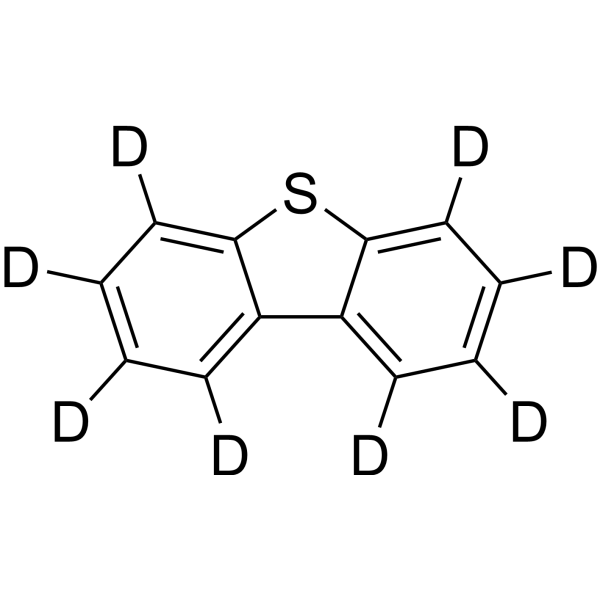
Dibenzothiophene-d8

Based on 1 Customer Validation
Dibenzothiophene-d8 is the deuterium labeled Dibenzothiophene (HY-B0973). Dibenzothiophene is an orally active and a noncompetitive CYP1A inhibitor. Dibenzothiophene inhibits CYP1A-mediated EROD activity with Km of 0.592 μM. Dibenzothiophene interacts with the AHR pathway. Dibenzothiophene enhances the embryotoxicity of β-naphthoflavone (HY-114740). Dibenzothiophene shows acute toxicity in mice. Dibenzothiophene is mainly used for the study of the mechanism of developmental toxicity in organisms.
For research use only. We do not sell to patients.
- Purity : 99.3%
- CAS No.: 33262-29-2
- Formula: C12D8S
- Molecular Weight:192.31
-
Storage:
4°C, protect from light
* In solvent : -80°C, 6 months; -20°C, 1 month (protect from light)

To place orders, for customer services and technical support, please contact: MedChemExpress USA
Tel: 609-228-6898 E-mail: [email protected] [email protected]


-
 Biological Activity
-
Chemical Information
-
Solvent & Solubility
- Protocols
- Purity & Documentation
- References
-
 Help & FAQs




Biological Activity
Description
In Vitro
Stable heavy isotopes of hydrogen, carbon, and other elements have been incorporated into drug molecules, largely as tracers for quantitation during the drug development process. Deuteration has gained attention because of its potential to affect the pharmacokinetic and metabolic profiles of drugs[1].
MedChemExpress (MCE) has not independently confirmed the accuracy of these methods. They are for reference only.
Application
1. This compound can be used as a tracer
2. This compound can be used as an internal standard for quantitative analysis by NMR, GC-MS, or LC-MS.


Chemical Information
-
CAS No. 33262-29-2
-
Unlabeled CAS 132-65-0
-
Appearance Solid
-
Molecular Weight 192.31
-
Formula C12D8S
-
SMILES
[2H]C1=C2C3=C([2H])C([2H])=C([2H])C([2H])=C3SC2=C([2H])C([2H])=C1[2H]
-
Shipping
Room temperature in continental US; may vary elsewhere.
-
Storage
4°C, protect from light
* In solvent : -80°C, 6 months; -20°C, 1 month (protect from light)


Solvent & Solubility
In Vitro:
DMSO : 100 mg/mL (519.99 mM; Need ultrasonic; Hygroscopic DMSO has a significant impact on the solubility of product, please use newly opened DMSO)
Please refer to the solubility information to select the appropriate solvent. Once prepared, please aliquot and store the solution to prevent product inactivation from repeated freeze-thaw cycles.
Storage method and period of stock solution: -80°C, 6 months; -20°C, 1 month (protect from light). When stored at -80°C, please use it within 6 months. When stored at -20°C, please use it within 1 month.
Please refer to the solubility information to select the appropriate solvent. Once prepared, please aliquot and store the solution to prevent product inactivation from repeated freeze-thaw cycles.
Storage method and period of stock solution: -80°C, 6 months; -20°C, 1 month (protect from light). When stored at -80°C, please use it within 6 months. When stored at -20°C, please use it within 1 month.
Concentration (start) × Volume (start) = Concentration (final) × Volume (final)


Purity & Documentation
-
Data Sheet (277 KB)
-
SDS (393 KB)
- English - EN (393 KB)
- Français - FR (393 KB)
- Deutsch - DE (393 KB)
- Norwegian - NO (393 KB)
- Español - ES (393 KB)
- Swedish - SV (393 KB)
- Italian - IT (393 KB)
- Korean - KR (393 KB)
- Portuguese - PT (393 KB)
-
Handling Instructions (2659 KB)
References


Complete Stock Solution Preparation Table
Please refer to the solubility information to select the appropriate solvent. Once prepared, please aliquot and store the solution to prevent product inactivation from repeated freeze-thaw cycles.
Storage method and period of stock solution: -80°C, 6 months; -20°C, 1 month (protect from light). When stored at -80°C, please use it within 6 months. When stored at -20°C, please use it within 1 month.
| Optional Solvent | Concentration Solvent Mass | 1 mg | 5 mg | 10 mg | 25 mg |
|---|---|---|---|---|---|
| DMSO | 1 mM | 5.1999 mL | 25.9997 mL | 51.9994 mL | 129.9984 mL |
| 5 mM | 1.0400 mL | 5.1999 mL | 10.3999 mL | 25.9997 mL | |
| 10 mM | 0.5200 mL | 2.6000 mL | 5.1999 mL | 12.9998 mL | |
| 15 mM | 0.3467 mL | 1.7333 mL | 3.4666 mL | 8.6666 mL | |
| 20 mM | 0.2600 mL | 1.3000 mL | 2.6000 mL | 6.4999 mL | |
| 25 mM | 0.2080 mL | 1.0400 mL | 2.0800 mL | 5.1999 mL | |
| 30 mM | 0.1733 mL | 0.8667 mL | 1.7333 mL | 4.3333 mL | |
| 40 mM | 0.1300 mL | 0.6500 mL | 1.3000 mL | 3.2500 mL | |
| 50 mM | 0.1040 mL | 0.5200 mL | 1.0400 mL | 2.6000 mL | |
| 60 mM | 0.0867 mL | 0.4333 mL | 0.8667 mL | 2.1666 mL | |
| 80 mM | 0.0650 mL | 0.3250 mL | 0.6500 mL | 1.6250 mL | |
| 100 mM | 0.0520 mL | 0.2600 mL | 0.5200 mL | 1.3000 mL |


Dibenzothiophene-d8 Related Classifications
HY-B0973S Related Classifications
 Powered by Bioz