



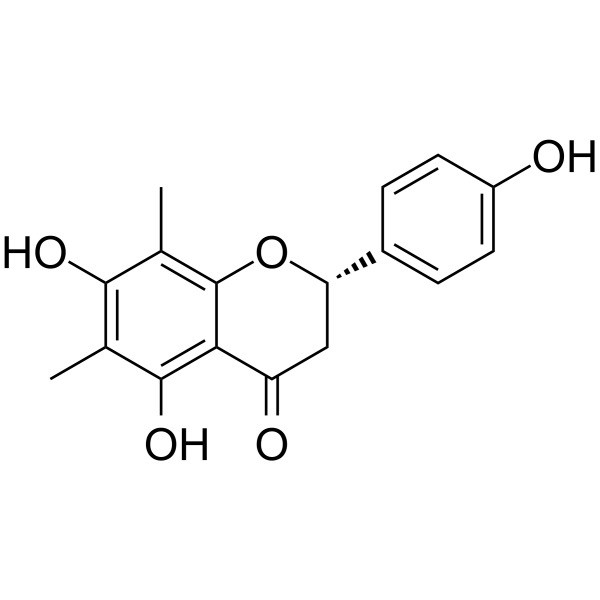
Farrerol
Based on 7 publication(s) in Google Scholar
Farrerol is a bioactive constituent of Rhododendron, with broad activities such as anti-oxidative, anti-inflammatory, anti-tumor, neuroprotective and hepatoprotective effects.
Nur für Forschungszwecke. Wir verkaufen nicht an Patienten.
- Reinheit : 99.98%
- CAS. Nr.: 24211-30-1
- Formel: C17H16O5
- Molecular Weight:300.31
-
Speicherung:
4°C, protect from light
* In solvent : -80°C, 6 months; -20°C, 1 month (protect from light)

To place orders, for customer services and technical support, please contact: MedChemExpress USA
Tel: 609-228-6898 E-mail: [email protected] [email protected]


-
 Biologische Aktivität
-
Chemical Information
-
Lösungsmittel & Löslichkeit
- Protokoll
- Reinheit & Dokumentation
- Verweise
-
 Help & FAQs


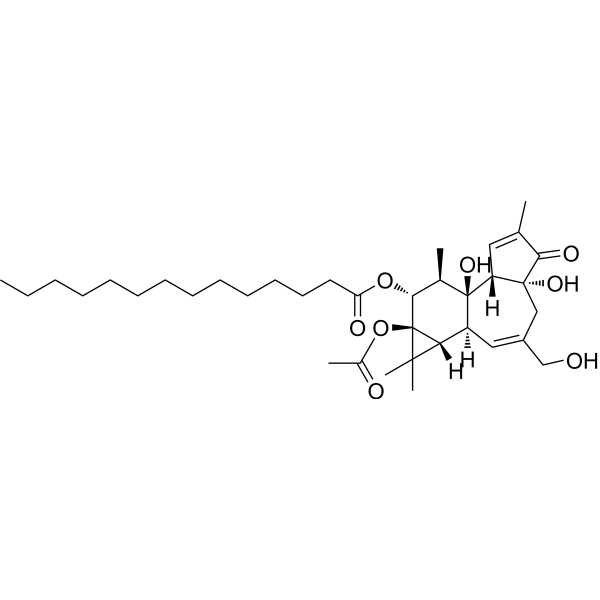
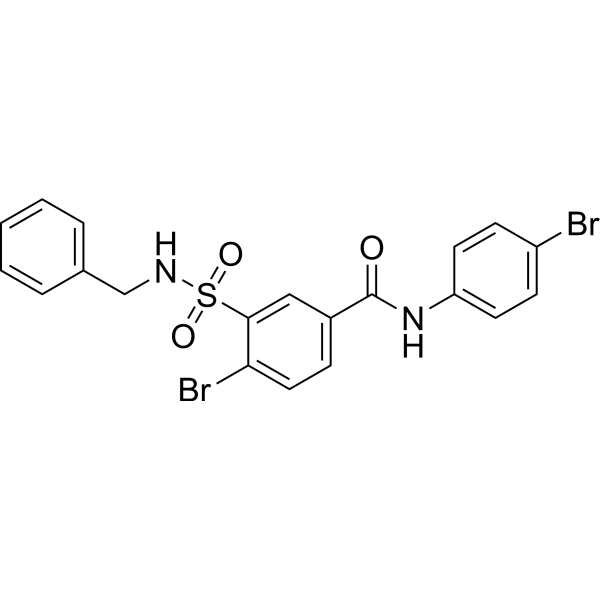

Publications Citing Use of MedChemExpress (MCE) Farrerol
More- Nat Commun. 2025 Jul 15;16(1):6502. [Abstract]
- Food Chem. 2025 Dec 30:497:146992. [Abstract]
- Food Chem. 2025 Oct 15:489:144992. [Abstract]
- Antioxidants (Basel). 2021 May 27;10(6):863. [Abstract]
- Ind Crops Prod. 2025 Dec 11;239:122458.
- Int J Mol Sci. 2026 Feb 5;27(3):1576. [Abstract]
- J Cell Mol Med. 2024 Sep;28(18):e70096. [Abstract]
 Customer Validation & Images

-
WB

-
Cell Imaging/Staining


Biologische Aktivität
Beschreibung
In Vitro
Farrerol observably reduces the production of inflammatory mediators including IL-1β, IL-6, TNF-α, COX-2, and iNOS in LPS-induced RAW264.7 cells via suppressing AKT, ERK1/2, JNK1/2, and NF-κB p65 phosphorylation[1].
Farrerol attenuates β-amyloid-induced oxidative stress and inflammation through Nrf2/Keap1 pathway in a microglia cell line[2].
Farrerol inhibits angiogenesis through Akt/mTOR, Erk and Jak2/Stat3 signal pathway[3].
Farrerol overcomes the invasiveness of lung squamous cell carcinoma cells by regulating the expression of inducers of epithelial mesenchymal transition[4].
Farrerol ameliorates acetaminophen-induced hepatotoxicity via activation of Nrf2 and autophagy[6].
MedChemExpress (MCE) has not independently confirmed the accuracy of these methods. They are for reference only.
In Vivo
MedChemExpress (MCE) has not independently confirmed the accuracy of these methods. They are for reference only.


Chemical Information
-
CAS. Nr. 24211-30-1
-
Appearance Solid
-
Molecular Weight 300.31
-
Formel C17H16O5
-
Color White to light yellow
-
SMILES
O=C1C[C@@H](C2=CC=C(O)C=C2)OC3=C(C)C(O)=C(C)C(O)=C13
-
Synonyms
(-)-Farrerol
-
Structure Classification
-
Initial Source
-
Versand
Room temperature in continental US; may vary elsewhere.
-
Speicherung
4°C, protect from light
* In solvent : -80°C, 6 months; -20°C, 1 month (protect from light)


Publications (7)
-
Journal Impact Factor
-
Most Recent
-
Nat Commun
2025 Jul 15;16(1):6502. PMID: 40664653 -
Food Chem
Effects of sun drying combined with baking processes on the flavor quality of Chongqing Tuocha raw tea. [Abstract]2025 Dec 30:497:146992. PMID: 41285060 -
Food Chem
Flavonoid-mediated metabolic underpinning quality variation in red bud-sport pear mutants. [Abstract]2025 Oct 15:489:144992. PMID: 40466530 -
Antioxidants (Basel)
Sagan Dalya Tea, a New "Old" Probable Adaptogenic Drug: Metabolic Characterization and Bioactivity Potentials of Rhododendron adamsii Leaves. [Abstract]2021 May 27;10(6):863. PMID: 34072186 -
-
Int J Mol Sci
Dual Targeting of HIF-1α and DLL4 by Isoxanthohumol Potentiates Immune Checkpoint Blockade. [Abstract]2026 Feb 5;27(3):1576. PMID: 41683994 -
J Cell Mol Med
Farrerol alleviates insulin resistance and hepatic steatosis of metabolic associated fatty liver disease by targeting PTPN1. [Abstract]2024 Sep;28(18):e70096. PMID: 39289804
Farrerol purchased from MedChemExpress. Usage Cited in: J Cell Mol Med. 2024 Sep;28(18):e70096. [Abstract]
Effects of Farrerol (40 mg/kg) on glucose tolerance and insulin sensitivity. The expression of phosphorylated insulin receptor (p-INSR), insulin receptor (INSR), and GAPDH was analyzed by Western blotting.
Farrerol purchased from MedChemExpress. Usage Cited in: J Cell Mol Med. 2024 Sep;28(18):e70096. [Abstract]
Farrerol (20 μM; 24 h) reduced lipid accumulation in PAOA-treated HepG2 cells. Representative Oil Red O staining image of HepG2 cells.


Lösungsmittel & Löslichkeit
In Vitro:
DMSO : 175 mg/mL (582.73 mM; Need ultrasonic; Hygroscopic DMSO has a significant impact on the solubility of product, please use newly opened DMSO)
Please refer to the solubility information to select the appropriate solvent. Once prepared, please aliquot and store the solution to prevent product inactivation from repeated freeze-thaw cycles.
Storage method and period of stock solution: -80°C, 6 months; -20°C, 1 month (protect from light). When stored at -80°C, please use it within 6 months. When stored at -20°C, please use it within 1 month.
Please refer to the solubility information to select the appropriate solvent. Once prepared, please aliquot and store the solution to prevent product inactivation from repeated freeze-thaw cycles.
Storage method and period of stock solution: -80°C, 6 months; -20°C, 1 month (protect from light). When stored at -80°C, please use it within 6 months. When stored at -20°C, please use it within 1 month.
Konzentration (Stammlösung) × Volumen (Stammlösung) = Konzentration (Ziellösung) × Volumen (Ziellösung)
In Vivo:
Select the appropriate dissolution method based on your experimental animal and administration route.
- For the following dissolution methods, please ensure to first prepare a clear stock solution using an In Vitro approach and then sequentially add co-solvents:
- To ensure reliable experimental results, the clarified stock solution can be appropriately stored based on storage conditions. As for the working solution for In Vivo experiments, it is recommended to prepare freshly and use it on the same day.
- The percentages shown for the solvents indicate their volumetric ratio in the final prepared solution. If precipitation or phase separation occurs during preparation, heat and/or sonication can be used to aid dissolution.
Add each solvent one by one: 10% DMSO 40% PEG300 5% Tween-80 45% Saline
Solubility: ≥ 2.08 mg/mL (6.93 mM); Clear solution
This protocol yields a clear solution of ≥ 2.08 mg/mL (saturation unknown).
Taking 1 mL working solution as an example, add 100 μL DMSO stock solution (20.8 mg/mL) to 400 μL PEG300, and mix evenly; then add 50 μL Tween-80 and mix evenly; then add 450 μL Saline to adjust the volume to 1 mL.
Preparation of Saline: Dissolve 0.9 g sodium chloride in ddH₂O and dilute to 100 mL to obtain a clear Saline solution.
Add each solvent one by one: 10% DMSO 90% (20% SBE-β-CD in Saline)
Solubility: ≥ 2.08 mg/mL (6.93 mM); Clear solution
This protocol yields a clear solution of ≥ 2.08 mg/mL (saturation unknown).
Taking 1 mL working solution as an example, add 100 μL DMSO stock solution (20.8 mg/mL) to 900 μL 20% SBE-β-CD in Saline, and mix evenly.
Preparation of 20% SBE-β-CD in Saline (4°C, storage for one week): 2 g SBE-β-CD powder is dissolved in 10 mL Saline, completely dissolve until clear.
In Vivo Dissolution Calculator
Please enter the basic information of animal experiments:
-
-
-
-
Recommended: Prepare an additional quantity of animals to account for potential losses during experiments.
Please enter your animal formula composition:
-
%DMSO +
Recommended: Keep the proportion of DMSO in working solution below 2% if your animal is weak.
-
%+
-
+%Tween-80 + +
-
%Saline +
The co-solvents required include: DMSO, . All of co-solvents are available by MedChemExpress (MCE). , Tween 80. All of co-solvents are available by MedChemExpress (MCE).
Working solution concentration: 0.22 mg/mL
Method for preparing stock solution: mg drug dissolved in μL DMSO. Stock solution concentration: mg/mL. * In solvent : -80°C, 6 months; -20°C, 1 month (protect from light)
1. Take μL DMSO stock solution;
2. Add μL .
μL , mix evenly;
3. Then add μL Tween 80, mix evenly;
4. Then add μL
Please ensure that the stock solution in the first step is dissolved to a clear state, and add co-solvents in sequence. You can use ultrasonic heating (ultrasonic cleaner, recommended frequency 20-40 kHz), vortexing, etc. to assist dissolution.


Reinheit & Dokumentation
-
Data Sheet (276 KB)
-
SDS (396 KB)
- English - EN (396 KB)
- Français - FR (396 KB)
- Deutsch - DE (396 KB)
- Norwegian - NO (396 KB)
- Español - ES (396 KB)
- Swedish - SV (396 KB)
- Italian - IT (396 KB)
- Korean - KR (396 KB)
- Portuguese - PT (396 KB)
-
Handling Instructions (2659 KB)
Verweise
[1]. Ran X, et al. Farrerol Ameliorates TNBS-Induced Colonic Inflammation by Inhibiting ERK1/2, JNK1/2, and NF-κB Signaling Pathway. Int J Mol Sci. 2018 Jul 13;19(7). [Content Brief]
[2]. Cui B, et al. Farrerol attenuates β-amyloid-induced oxidative stress and inflammation through Nrf2/Keap1 pathway in a microglia cell line. Biomed Pharmacother. 2019 Jan;109:112-119. [Content Brief]
[3]. Dai F, et al. Farrerol inhibited angiogenesis through Akt/mTOR, Erk and Jak2/Stat3 signal pathway. Phytomedicine. 2016 Jun 15;23(7):686-93. [Content Brief]
[4]. Li B, et al. Farrerol overcomes the invasiveness of lung squamous cell carcinoma cells by regulating the expression of inducers of epithelial mesenchymal transition. Microb Pathog. 2019 Jun;131:277. [Content Brief]
[5]. Li Y, et al. Farrerol protects dopaminergic neurons in a rat model of lipopolysaccharide-induced Parkinson's disease by suppressing the activation of the AKT and NF-κB signaling pathways. Int Immunopharmacol. 2019 Oct;75:105739. [Content Brief]
[6]. Wang L, et al. Farrerol Ameliorates APAP-induced Hepatotoxicity via Activation of Nrf2 and Autophagy. Int J Biol Sci. 2019 Jan 29;15(4):788-799. [Content Brief]
[7]. Chen L, Yan T, Huang D, et al. Stereoselectivity of In Vivo Processes and Bioactivity of Farrerol Enantiomers. Molecules. 2025;30(9):2038. [Content Brief]


Complete Stock Solution Preparation Table
Please refer to the solubility information to select the appropriate solvent. Once prepared, please aliquot and store the solution to prevent product inactivation from repeated freeze-thaw cycles.
Storage method and period of stock solution: -80°C, 6 months; -20°C, 1 month (protect from light). When stored at -80°C, please use it within 6 months. When stored at -20°C, please use it within 1 month.
| Optional Solvent | Concentration Solvent Mass | 1 mg | 5 mg | 10 mg | 25 mg |
|---|---|---|---|---|---|
| DMSO | 1 mM | 3.3299 mL | 16.6495 mL | 33.2989 mL | 83.2473 mL |
| 5 mM | 0.6660 mL | 3.3299 mL | 6.6598 mL | 16.6495 mL | |
| 10 mM | 0.3330 mL | 1.6649 mL | 3.3299 mL | 8.3247 mL | |
| 15 mM | 0.2220 mL | 1.1100 mL | 2.2199 mL | 5.5498 mL | |
| 20 mM | 0.1665 mL | 0.8325 mL | 1.6649 mL | 4.1624 mL | |
| 25 mM | 0.1332 mL | 0.6660 mL | 1.3320 mL | 3.3299 mL | |
| 30 mM | 0.1110 mL | 0.5550 mL | 1.1100 mL | 2.7749 mL | |
| 40 mM | 0.0832 mL | 0.4162 mL | 0.8325 mL | 2.0812 mL | |
| 50 mM | 0.0666 mL | 0.3330 mL | 0.6660 mL | 1.6649 mL | |
| 60 mM | 0.0555 mL | 0.2775 mL | 0.5550 mL | 1.3875 mL | |
| 80 mM | 0.0416 mL | 0.2081 mL | 0.4162 mL | 1.0406 mL | |
| 100 mM | 0.0333 mL | 0.1665 mL | 0.3330 mL | 0.8325 mL |


Farrerol Related Classifications
HY-N0344 Related Classifications
 Powered by Bioz