



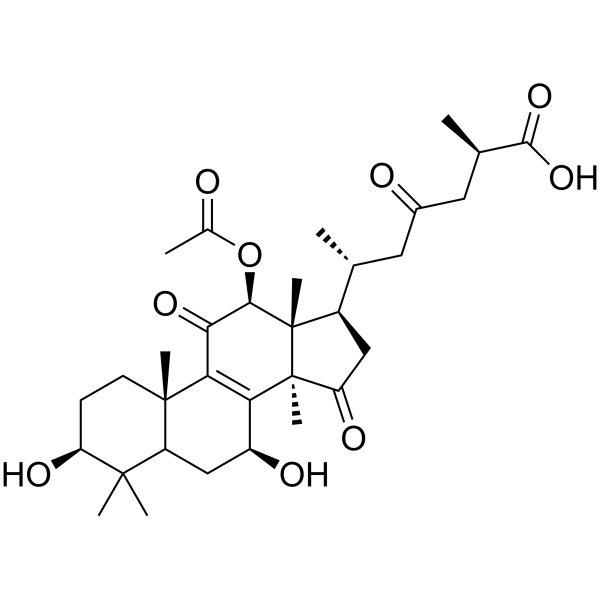
Ganoderic acid K
Ganoderic acid K is a triterpenoid compound. Ganoderic acid K can be isolated from Ganoderma lucidum. Ganoderic acid K inhibits ACE activity with an IC50 of 2.6×10⁻⁵ M. Ganoderic acid K exhibits direct, high-affinity binding to recombinant MD2 protein, with a Kd value of 0.47 μM. It potently inhibits LPS-induced release of TNF-α and IL-6. It reduces cerebral infarction volume and ameliorates neurological dysfunction in mice with ischemic stroke in the tMCAO model. Ganoderic acid K can be used in studies related to hypertension and ischemic stroke.
Nur für Forschungszwecke. Wir verkaufen nicht an Patienten.
- CAS. Nr.: 104700-95-0
- Formel: C32H46O9
- Molecular Weight:574.70
-
Speicherung:
Please store the product under the recommended conditions in the Certificate of Analysis.

To place orders, for customer services and technical support, please contact: MedChemExpress USA
Tel: 609-228-6898 E-mail: [email protected] [email protected]


-
 Biologische Aktivität
-
Chemical Information
- Protokoll
- Reinheit & Dokumentation
- Verweise
-
 Help & FAQs




Biologische Aktivität
Beschreibung
IC50 & Target
[1]|
IL-6 |
In Vitro
Ganoderic acid K inhibits the activity of purified porcine kidney angiotensin-converting enzyme, with an IC50 value of 2.6×10⁻⁵ M[1].
Ganoderic acid K (25 μM; 1 h pretreatment) potently inhibits LPS-induced release of TNF-α and IL-6 in BV-2 mouse microglia, with inhibition rates of over 50% for both cytokines[2].
Ganoderic acid K (0.19-50 μM) exhibits direct, high-affinity binding to recombinant MD2 protein, with a Kd value of 0.47 μM[2].
MedChemExpress (MCE) has not independently confirmed the accuracy of these methods. They are for reference only.
-
Cell Line:BV-2 murine microglial cells
-
Concentration:12.5, 25, 50, 100 μM
-
Incubation Time:24 h
-
Result:Showed no cytotoxicity to BV-2 cells at all tested concentrations.
-
Cell Line:LPS-stimulated BV-2 murine microglial cells
-
Concentration:25 μM (pretreatment); 10 ng/mL LPS
-
Incubation Time:1 h (pretreatment); 12 h (LPS incubation)
-
Result:Significantly inhibited LPS-induced TNF-α and IL-6 release by more than 50% each.
Demonstrated the most pronounced inhibitory effect among the eight tested ganoderic acid monomers.
In Vivo
MedChemExpress (MCE) has not independently confirmed the accuracy of these methods. They are for reference only.
-
Animal Model:C57BL/6J (8-week-old male, 23 g)[2]
-
Dosage:20 mg/kg
-
Administration:Not specified
-
Result:Significantly reduced cerebral infarct volume compared to vehicle-treated tMCAO mice.
Exhibited significantly lower neurological deficit scores relative to vehicle-treated tMCAO controls.


Chemical Information
-
CAS. Nr. 104700-95-0
-
Molecular Weight 574.70
-
Formel C32H46O9
-
SMILES
C[C@@H]([C@H]1CC([C@]2(C)[C@]1(C)[C@H](OC(C)=O)C(C3=C2[C@@H](O)CC4[C@]3(C)CC[C@H](O)C4(C)C)=O)=O)CC(C[C@H](C(O)=O)C)=O
-
Initial Source
Ganoderma lucidum
-
Versand
Room temperature in continental US; may vary elsewhere.
-
Speicherung
Please store the product under the recommended conditions in the Certificate of Analysis.


Reinheit & Dokumentation
Verweise
[1]. Morigiwa A, et al. Angiotensin converting enzyme-inhibitory triterpenes from Ganoderma lucidum. Chem Pharm Bull (Tokyo). 1986 Jul;34(7):3025-8. [Content Brief]
[2]. Ma A, et al. Ganoderic Acids Alleviate Neuroinflammation by Targeting Myeloid Differentiation Factor 2 for Ischemic Stroke Therapy. Exploration (Beijing). 2026;6(1):20240147. Published 2026 Feb 18. [Content Brief]

Calculators
Konzentration (Stammlösung) × Volumen (Stammlösung) = Konzentration (Ziellösung) × Volumen (Ziellösung)


Ganoderic acid K Related Classifications
HY-113898 Related Classifications
 Powered by Bioz
Keywords