



Alvespimycin
Based on 16 publication(s) in Google Scholar
Alvespimycin (17-DMAG) is a potent inhibitor of Hsp90, binding to Hsp90 with an EC50 of 62 nM.
For research use only. We do not sell to patients.
- Purity: 99.52%
- CAS No.: 467214-20-6
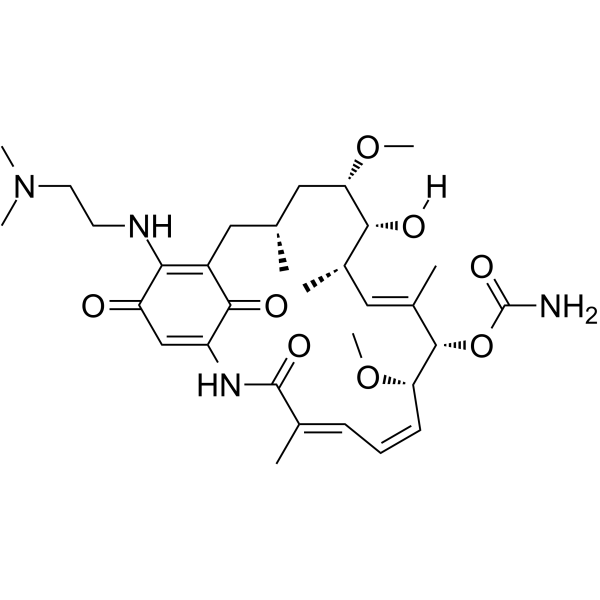
- Formula: C32H48N4O8
- Molecular Weight:616.75
-
Storage:Powder -20°C, 3 years , 4°C, 2 years ; In solvent -80°C, 6 months , -20°C, 1 month


-
 Biological Activity
-
Chemical Information
-
Solvent & Solubility
- Protocol
- Purity & Documentation
- References
-
 Help & FAQs
-


Cell Cycle/DNA Damage Compound Library
HY-L004
-
Metabolism/Protease Compound Library
HY-L012
-
Anti-Cancer Compound Library
HY-L025
-
Anti-Aging Compound Library
HY-L034
-
Covalent Screening Library
HY-L036
-
Endoplasmic Reticulum Stress Compound Library
HY-L054
-
Pyroptosis Compound Library
HY-L059
-
Cytoskeleton Compound Library
HY-L060
-
Anti-Blood Cancer Compound Library
HY-L079
-
Anti-Prostate Cancer Compound Library
HY-L124
-
Metabolic Enzyme Compound Library
HY-L146
-
Highly Selective Inhibitors Library
HY-L158
-
Extracellular Vesicles (EVs) Compound Library
HY-L168
-
Anti-Hematopathy Compound Library
HY-L171
-
Multi-Target Compound Library
HY-L176
-
Bioactive Compound Library Max
HY-L181
-
Covalent Screening Library Plus
HY-L036P
-
Bioactive Compound Library
HY-L001
-
High-Throughput Bioactive Compound Library
HY-L205
-
RNA Binding Bioactive Compound Library
HY-L248


Publications Citing Use of MedChemExpress (MCE) Alvespimycin
More- Nat Commun. 2021 Jul 22;12(1):4457. [Abstract]
- Adv Sci (Weinh). 2025 Jul 29:e01977. [Abstract]
- Theranostics. 2020 Jul 9;10(18):8415-8429. [Abstract]
- Pharmacol Res. 2020 Jan;151:104512. [Abstract]
- Cell Death Dis. 2022 Jan 21;13(1):73. [Abstract]
- NPJ Precis Oncol. 2023 May 18;7(1):44. [Abstract]
- Br J Pharmacol. 2021 Nov;178(22):4485-4500. [Abstract]
- Drug Deliv Transl Res. 2025 Oct 29. [Abstract]
- ACS Biomater Sci Eng. 2021 Nov 8;7(11):5154-5164. [Abstract]
- Front Pharmacol. 2022 Jan 14:12:724192. [Abstract]
- Sci Rep. 2021 May 26;11(1):11057. [Abstract]
- Biochim Biophys Acta Mol Cell Res. 2024 Apr;1871(4):119703. [Abstract]
- Exp Ther Med. 2022 Apr;23(4):273. [Abstract]
- Authorea. April 10, 2021.
- bioRxiv. 2021 Jan 27.
- Friedrich-Alexander University Erlangen-Nuremberg. 2016 Sep 14.
 Customer Validation & Images

-
WB
-
WB


Biological Activity
|
HSP90 62 nM (EC50) |
GRP94 65 nM (EC50) |
|
Cell Line

|
Type | Value | Description | References |
|---|---|---|---|---|
| A2058 | EC50 |
7.9 nM
Compound: 17-DMAG
|
Inhibition of Hsp90 in human A2058 cells
Inhibition of Hsp90 in human A2058 cells
|
[PMID: 18929486] |
| A2058 | IC50 |
2.1 nM
Compound: 17-DMAG
|
Cytotoxicity against human A2058 cells by MTT assay
Cytotoxicity against human A2058 cells by MTT assay
|
[PMID: 18929486] |
| A2058 | IC50 |
24.3 nM
Compound: 17-DMAG
|
Inhibition of Hsp90 in human A2058 cells assessed as Akt degradation
Inhibition of Hsp90 in human A2058 cells assessed as Akt degradation
|
[PMID: 18929486] |
| A549 | IC50 |
68 nM
Compound: 1e, 17-DMAG
|
Cytotoxicity against human A549 cells after 72 hrs by celltiter-glo assay
Cytotoxicity against human A549 cells after 72 hrs by celltiter-glo assay
|
[PMID: 19405528] |
| AGS | IC50 |
0.0036 μM
Compound: page 2621, table 2 footnote
|
Inhibition of hypoxia-induced HIF1 activation in human AGS cells by reporter gene assay
Inhibition of hypoxia-induced HIF1 activation in human AGS cells by reporter gene assay
|
[PMID: 18359631] |
| AGS | IC50 |
0.036 μM
Compound: 17-DMAG
|
Inhibition of HIF1 activation in human AGS cells assessed as inhibition of hypoxia-induced luciferase expression after 16 hrs by reporter assay
Inhibition of HIF1 activation in human AGS cells assessed as inhibition of hypoxia-induced luciferase expression after 16 hrs by reporter assay
|
[PMID: 17583950] |
| AGS | IC50 |
16 μM
Compound: 17-DMAG
|
Viability of human AGS cells under normoxic conditions after 24 hrs by MTT assay
Viability of human AGS cells under normoxic conditions after 24 hrs by MTT assay
|
[PMID: 17583950] |
| AGS | IC50 |
16 μM
Compound: page 2621, table 2 footnote
|
Cytotoxicity against human AGS cells by MTT assay
Cytotoxicity against human AGS cells by MTT assay
|
[PMID: 18359631] |
| BT-549 | IC50 |
17.1 μM
Compound: 47; 17-DMAG
|
Anticancer activity against human BT-549 cells assessed as cell growth inhibition incubated for 72 hrs by CCK-8 assay
Anticancer activity against human BT-549 cells assessed as cell growth inhibition incubated for 72 hrs by CCK-8 assay
|
[PMID: 33650861] |
| CCRF-CEM | IC50 |
2500 nM
Compound: 1e, 17-DMAG
|
Cytotoxicity against human paclitaxel-resistant CCRF-CEM cells after 72 hrs by celltiter-96 aqueous one solution assay
Cytotoxicity against human paclitaxel-resistant CCRF-CEM cells after 72 hrs by celltiter-96 aqueous one solution assay
|
[PMID: 19405528] |
| CCRF-CEM | IC50 |
540 nM
Compound: 1e, 17-DMAG
|
Cytotoxicity against human CCRF-CEM cells after 72 hrs by celltiter-96 aqueous one solution assay
Cytotoxicity against human CCRF-CEM cells after 72 hrs by celltiter-96 aqueous one solution assay
|
[PMID: 19405528] |
| HCT-116 | IC50 |
0.05 μM
Compound: 36, 17-DMAG
|
Cytotoxicity against human HCT116 cells by Alamar blue assay
Cytotoxicity against human HCT116 cells by Alamar blue assay
|
[PMID: 20662534] |
| HCT-116 | IC50 |
0.78 μM
Compound: 17-DMAG
|
Antiproliferative activity against human HCT116 cells assessed as inhibition of cell viability after 48 hrs by MTT assay
Antiproliferative activity against human HCT116 cells assessed as inhibition of cell viability after 48 hrs by MTT assay
|
[PMID: 24582477] |
| HCT-116 | IC50 |
1.21 μM
Compound: 17-DMAG
|
Antiproliferative activity against human HCT116 cells after 48 hrs by MTT assay
Antiproliferative activity against human HCT116 cells after 48 hrs by MTT assay
|
[PMID: 24763261] |
| HCT-116 | IC50 |
57 nM
Compound: alvespimycin, 17-DMAG
|
Cytotoxicity against human HCT116 cells after 72 hrs
Cytotoxicity against human HCT116 cells after 72 hrs
|
[PMID: 19231864] |
| HeLa | IC50 |
0.15 μM
Compound: page 2621, table 2 footnote
|
Inhibition of TNF-alpha-induced NF-kappaB activation in human HeLa cells
Inhibition of TNF-alpha-induced NF-kappaB activation in human HeLa cells
|
[PMID: 18359631] |
| HeLa | IC50 |
2.06 μM
Compound: page 2621, table 2 footnote
|
Cytotoxicity against human HeLa cells by MTT assay
Cytotoxicity against human HeLa cells by MTT assay
|
[PMID: 18359631] |
| Hep 3B2 | IC50 |
>30 μM
Compound: 17-DMAG
|
Inhibition of hypoxia-induced HIF1 activation in human Hep3B cells by pGL3-HRE-luciferase reporter gene assay
Inhibition of hypoxia-induced HIF1 activation in human Hep3B cells by pGL3-HRE-luciferase reporter gene assay
|
[PMID: 19072214] |
| Hep 3B2 | IC50 |
>50 μM
Compound: 17-DMAG
|
Viability of human Hep3B cells under normoxic conditions after 24 hrs by MTT assay
Viability of human Hep3B cells under normoxic conditions after 24 hrs by MTT assay
|
[PMID: 17583950] |
| Hep 3B2 | IC50 |
0.057 μM
Compound: 17-DMAG
|
Inhibition of hypoxia-induced HIF1alpha protein accumulation in human Hep3B cells treated for 30 mins measured after 12 hrs by Western blot analysis
Inhibition of hypoxia-induced HIF1alpha protein accumulation in human Hep3B cells treated for 30 mins measured after 12 hrs by Western blot analysis
|
[PMID: 20469887] |
| Hep 3B2 | IC50 |
0.061 μM
Compound: 17-DMAG
|
Inhibition of HIF1 activation in human Hep3B cells assessed as inhibition of hypoxia-induced luciferase expression after 16 hrs by reporter assay
Inhibition of HIF1 activation in human Hep3B cells assessed as inhibition of hypoxia-induced luciferase expression after 16 hrs by reporter assay
|
[PMID: 17583950] |
| Hep 3B2 | IC50 |
0.079 μM
Compound: 17-DMAG
|
Inhibition of hypoxia-induced VEGF protein secretion in human Hep3B cells after 16 hrs by ELISA
Inhibition of hypoxia-induced VEGF protein secretion in human Hep3B cells after 16 hrs by ELISA
|
[PMID: 20469887] |
| Hep 3B2 | IC50 |
57.2 nM
Compound: 17-DMAG
|
Inhibition of hypoxia-induced HIF1alpha protein accumulation in human Hep3B cells treated for 30 mins measured after 12 hrs by Western blot analysis
Inhibition of hypoxia-induced HIF1alpha protein accumulation in human Hep3B cells treated for 30 mins measured after 12 hrs by Western blot analysis
|
[PMID: 19072214] |
| Hep 3B2 | IC50 |
79.5 nM
Compound: 17-DMAG
|
Inhibition of hypoxia-induced VEGF protein secretion in human Hep3B cells after 16 hrs by ELISA
Inhibition of hypoxia-induced VEGF protein secretion in human Hep3B cells after 16 hrs by ELISA
|
[PMID: 19072214] |
| Hs-578T | IC50 |
8.4 nM
Compound: 47; 17-DMAG
|
Anticancer activity against human Hs-578T cells assessed as cell growth inhibition incubated for 72 hrs by CCK-8 assay
Anticancer activity against human Hs-578T cells assessed as cell growth inhibition incubated for 72 hrs by CCK-8 assay
|
[PMID: 33650861] |
| Huh-7 | EC50 |
1.2 nM
Compound: 17-DMAG
|
Antiviral activity against Hepatitis C virus genotype 1b Con1 infected in human HuH7 cells assessed as GAPDH RNA or 18S rRNA level after 3 days by qRT-PCR analysis
Antiviral activity against Hepatitis C virus genotype 1b Con1 infected in human HuH7 cells assessed as GAPDH RNA or 18S rRNA level after 3 days by qRT-PCR analysis
|
[PMID: 18936191] |
| Huh-7 | EC50 |
3.1 nM
Compound: 17-DMAG
|
Antiviral activity against Hepatitis C virus genotype 1b Con1 infected in human HuH7 cells assessed as GAPDH RNA or 18S rRNA level after 3 days selected with 40 nM HCV-796 and 800 nM boceprevir by qRT-PCR analysis
Antiviral activity against Hepatitis C virus genotype 1b Con1 infected in human HuH7 cells assessed as GAPDH RNA or 18S rRNA level after 3 days selected with 40 nM HCV-796 and 800 nM boceprevir by qRT-PCR analysis
|
[PMID: 18936191] |
| MCF7 | IC50 |
0.39 μM
Compound: 17-DMAG
|
Antiproliferative activity against human MCF7 cells assessed as inhibition of cell viability after 48 hrs by MTT assay
Antiproliferative activity against human MCF7 cells assessed as inhibition of cell viability after 48 hrs by MTT assay
|
[PMID: 24582477] |
| MCF7 | IC50 |
0.5 μM
Compound: 17-DMAG
|
Anti-cancer activity against human MCF7 cells assessed as inhibition of cell viability incubated for 72 hrs by MTS assay
Anti-cancer activity against human MCF7 cells assessed as inhibition of cell viability incubated for 72 hrs by MTS assay
|
[PMID: 39042910] |
| MCF7 | IC50 |
0.8 μM
Compound: 17-DMAG
|
Antiproliferative activity against human MCF7 cells after 48 hrs by MTT assay
Antiproliferative activity against human MCF7 cells after 48 hrs by MTT assay
|
[PMID: 24763261] |
| MCF7 | IC50 |
230 nM
Compound: 1e, 17-DMAG
|
Cytotoxicity against human MCF7 cells after 72 hrs by celltiter-glo assay
Cytotoxicity against human MCF7 cells after 72 hrs by celltiter-glo assay
|
[PMID: 19405528] |
| MCF7 | IC50 |
71 nM
Compound: alvespimycin, 17-DMAG
|
Cytotoxicity against human MCF7 cells after 72 hrs
Cytotoxicity against human MCF7 cells after 72 hrs
|
[PMID: 19231864] |
| MCF7 | IC50 |
862 nM
Compound: alvespimycin, 17-DMAG
|
Cytotoxicity against human MCF7 cells after 72 hrs in presence of NQO1 inhibitor dicoumarol
Cytotoxicity against human MCF7 cells after 72 hrs in presence of NQO1 inhibitor dicoumarol
|
[PMID: 19231864] |
| MDA-MB-231 | IC50 |
17.6 nM
Compound: 17-DMAG
|
Inhibition of Hsp90 in human MDA-MB-231 cells assessed as Akt degradation
Inhibition of Hsp90 in human MDA-MB-231 cells assessed as Akt degradation
|
[PMID: 18929486] |
| MDA-MB-231 | IC50 |
4.5 nM
Compound: 17-DMAG
|
Inhibition of Hsp90 in human MDA-MB-231 cells assessed as her2 degradation
Inhibition of Hsp90 in human MDA-MB-231 cells assessed as her2 degradation
|
[PMID: 18929486] |
| MDA-MB-231 | IC50 |
45.7 μM
Compound: 47; 17-DMAG
|
Anticancer activity against human MDA-MB-231 cells assessed as cell growth inhibition incubated for 72 hrs by CCK-8 assay
Anticancer activity against human MDA-MB-231 cells assessed as cell growth inhibition incubated for 72 hrs by CCK-8 assay
|
[PMID: 33650861] |
| MDA-MB-231 | IC50 |
5.8 nM
Compound: 17-DMAG
|
Cytotoxicity against human MDA-MB-231 cells by MTT assay
Cytotoxicity against human MDA-MB-231 cells by MTT assay
|
[PMID: 18929486] |
| MDA-MB-468 | IC50 |
1600 nM
Compound: alvespimycin, 17-DMAG
|
Cytotoxicity against NQ01-deficient human MDA468 cells after 72 hrs
Cytotoxicity against NQ01-deficient human MDA468 cells after 72 hrs
|
[PMID: 19231864] |
| NCI-H1299 | IC50 |
0.1 μM
Compound: 1c, DMAG
|
Inhibition of human HSP90 in human NCI-H1299 cells assessed as Akt degradation after 24 hrs by luminex assay
Inhibition of human HSP90 in human NCI-H1299 cells assessed as Akt degradation after 24 hrs by luminex assay
|
[PMID: 21438541] |
| NCI-H596 | IC50 |
1100 nM
Compound: alvespimycin, 17-DMAG
|
Cytotoxicity against NQ01-deficient human NCI-H596 cells after 72 hrs
Cytotoxicity against NQ01-deficient human NCI-H596 cells after 72 hrs
|
[PMID: 19231864] |
| NCI-N87 | EC50 |
62 nM
Compound: 17-DMAG
|
Antitumor activity against human NCI-N87 cells assessed as reduction in cell growth
Antitumor activity against human NCI-N87 cells assessed as reduction in cell growth
|
[PMID: 38232464] |
| PC-9 | IC50 |
0.01 μM
Compound: 3; 17-DMAG
|
Cytotoxicity against HGF-induced erlotinib-resistant human PC9 cells assessed as inhibition of cell growth after 72 hrs by MTT assay
Cytotoxicity against HGF-induced erlotinib-resistant human PC9 cells assessed as inhibition of cell growth after 72 hrs by MTT assay
|
[PMID: 26844689] |
| SK-BR-3 | EC50 |
4 nM
Compound: 4b, 17-DMAG
|
Upregulation of Hsp70 in SKBR3 cells
Upregulation of Hsp70 in SKBR3 cells
|
[PMID: 16854066] |
| SK-BR-3 | EC50 |
8 nM
Compound: 4b, 17-DMAG
|
Degradation of Her2 in SKBR3 cells
Degradation of Her2 in SKBR3 cells
|
[PMID: 16854066] |
| SK-BR-3 | GI50 |
29 nM
Compound: 4b, 17-DMAG
|
Inhibition of human SKBR3 cell growth
Inhibition of human SKBR3 cell growth
|
[PMID: 16854066] |
| SK-BR-3 | IC50 |
1.34 μM
Compound: 17-DMAG
|
Antiproliferative activity against human SKBR3 cells assessed as inhibition of cell viability after 48 hrs by MTT assay
Antiproliferative activity against human SKBR3 cells assessed as inhibition of cell viability after 48 hrs by MTT assay
|
[PMID: 24582477] |
| SK-BR-3 | IC50 |
230 nM
Compound: alvespimycin, 17-DMAG
|
Cytotoxicity against human SKBR3 cells after 72 hrs in presence of NQO1 inhibitor dicoumarol
Cytotoxicity against human SKBR3 cells after 72 hrs in presence of NQO1 inhibitor dicoumarol
|
[PMID: 19231864] |
| SK-BR-3 | IC50 |
24 nM
Compound: 1e, 17-DMAG
|
Cytotoxicity against human SKBR3 cells after 72 hrs by celltiter-glo assay
Cytotoxicity against human SKBR3 cells after 72 hrs by celltiter-glo assay
|
[PMID: 19405528] |
| SK-BR-3 | IC50 |
24 nM
Compound: 1
|
Cytotoxicity against SKBr3 cells
Cytotoxicity against SKBr3 cells
|
[PMID: 16165354] |
| SK-BR-3 | IC50 |
24 nM
Compound: 3, 17-DMAG
|
Binding affinity to Hsp90 in human SKBR3 cells
Binding affinity to Hsp90 in human SKBR3 cells
|
[PMID: 19017562] |
| SK-BR-3 | IC50 |
3.11 μM
Compound: 17-DMAG
|
Antiproliferative activity against human SKBR3 cells after 48 hrs by MTT assay
Antiproliferative activity against human SKBR3 cells after 48 hrs by MTT assay
|
[PMID: 24763261] |
| SK-BR-3 | IC50 |
58 nM
Compound: alvespimycin, 17-DMAG
|
Cytotoxicity against human SKBR3 cells after 72 hrs
Cytotoxicity against human SKBR3 cells after 72 hrs
|
[PMID: 19231864] |
| SK-OV-3 | EC50 |
14 nM
Compound: 4b, 17-DMAG
|
Upregulation of Hsp70 in SKOV3 cells
Upregulation of Hsp70 in SKOV3 cells
|
[PMID: 16854066] |
| SK-OV-3 | EC50 |
46 nM
Compound: 4b, 17-DMAG
|
Degradation of Her2 in SKOV3 cells
Degradation of Her2 in SKOV3 cells
|
[PMID: 16854066] |
| SK-OV-3 | GI50 |
32 nM
Compound: 4b, 17-DMAG
|
Inhibition of human SKOV3 cell growth
Inhibition of human SKOV3 cell growth
|
[PMID: 16854066] |
| SK-OV-3 | IC50 |
122 nM
Compound: alvespimycin, 17-DMAG
|
Cytotoxicity against human SKOV3 cells after 72 hrs
Cytotoxicity against human SKOV3 cells after 72 hrs
|
[PMID: 19231864] |
| SK-OV-3 | IC50 |
220 nM
Compound: 1e, 17-DMAG
|
Cytotoxicity against human SKOV3 cells after 72 hrs by celltiter-glo assay
Cytotoxicity against human SKOV3 cells after 72 hrs by celltiter-glo assay
|
[PMID: 19405528] |
Alvespimycin (17-DMAG) inhibits the growth of the human cancer cell lines SKBR3 and SKOV3, which overexpress Hsp90 client protein Her2, and causes down-regulation of Her2 as well as induction of Hsp70 consistent with Hsp90 inhibition, for Her2 degradation with EC50 of 8 nM and 46 nM in SKBR3 and SKOV3 cells, respectively; for Hsp70 induction with EC50 of 4 nM and 14 nM in SKBR3 and SKOV3 cells, respectively[1].
Compared with the vehicle control, Alvespimycin (17-DMAG) dose-dependent apoptosis (P<0.001 averaged across 24- and 48-hour time points) at concentrations of 50 nM to 500 nM, which represent pharmacologically attainable doses. Similar to many other agents, Alvespimycin (17-DMAG) also demonstrates time-dependent apoptosis (P <0.001, averaged across all doses) in chronic lymphocytic leukemia (CLL) cells with extended exposure from 24 to 48 hours. In addition,Alvespimycin (17-DMAG) is much more potent after 24 and 48 hours of treatment than 17-AAG[2].
MedChemExpress (MCE) has not independently confirmed the accuracy of these methods. They are for reference only.
MedChemExpress (MCE) has not independently confirmed the accuracy of these methods. They are for reference only.


Chemical Information
-
CAS No. 467214-20-6
-
Appearance Solid
-
Molecular Weight 616.75
-
Formula C32H48N4O8
-
Color Pale purple to purple
-
SMILES
C/C1=C\C=C/[C@@H]([C@H](/C(C)=C/[C@@H]([C@H]([C@H](C[C@@H](CC(C(C(NC1=O)=CC2=O)=O)=C2NCCN(C)C)C)OC)O[H])C)OC(N)=O)OC
-
Synonyms
17-DMAG; KOS-1022; NSC 707545
-
Shipping
Room temperature in continental US; may vary elsewhere.
-
Storage
Powder -20°C 3 years 4°C 2 years In solvent -80°C 6 months -20°C 1 month


Publications (16)
-
Journal Impact Factor
-
Most Recent
-
Nat Commun
2021 Jul 22;12(1):4457. PMID: 34294701 -
Adv Sci (Weinh)
2025 Jul 29:e01977. PMID: 40729735 -
Theranostics
Hsp90 inhibitor HSP990 in very low dose upregulates EAAT2 and exerts potent antiepileptic activity. [Abstract]2020 Jul 9;10(18):8415-8429. PMID: 32724478
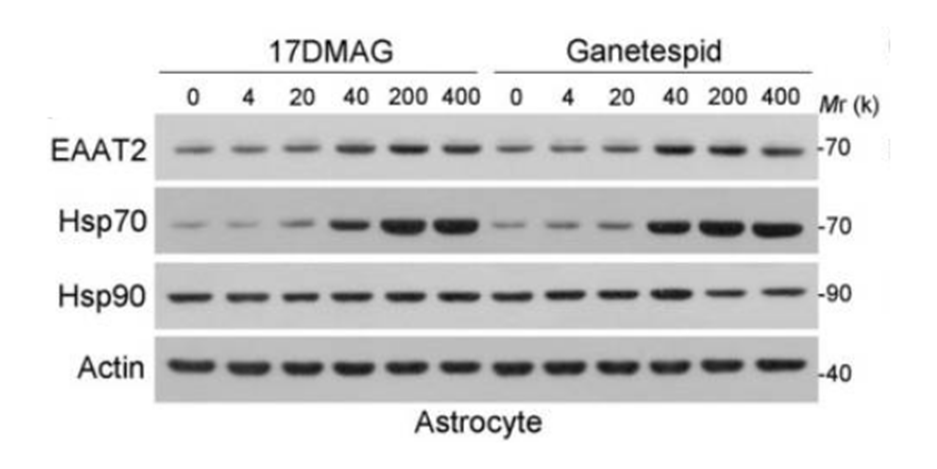
Alvespimycin purchased from MedChemExpress. Usage Cited in: Theranostics. 2020 Jul 9;10(18):8415-8429. [Abstract]
Western blot analysis of three proteins of interest in astrocytes treated with the Alvespimycin (17DMAG) for 24 h. Alvespimycin treatment increases EAAT2 and Hsp70 levels in a dose-dependent manner.
-
Pharmacol Res
Destabilization of ROR1 enhances activity of Ibrutinib against chronic lymphocytic leukemia in vivo. [Abstract]2020 Jan;151:104512. PMID: 31726100 -
Cell Death Dis
RNA binding protein NKAP protects glioblastoma cells from ferroptosis by promoting SLC7A11 mRNA splicing in an m6A-dependent manner. [Abstract]2022 Jan 21;13(1):73. PMID: 35064112 -
NPJ Precis Oncol
2023 May 18;7(1):44. PMID: 37202469 -
Br J Pharmacol
Inhibition of heat shock protein (HSP) 90 reverses signal transducer and activator of transcription (STAT) 3-mediated muscle wasting in cancer cachexia mice. [Abstract]2021 Nov;178(22):4485-4500. PMID: 34265073 -
Drug Deliv Transl Res
Leveraging quantum chemical properties in transfer learning for predicting blood-brain barrier permeability of drugs. [Abstract]2025 Oct 29. PMID: 41160380 -
ACS Biomater Sci Eng
2021 Nov 8;7(11):5154-5164. PMID: 34636537 -
Front Pharmacol
Targeting HSP90 Inhibits Proliferation and Induces Apoptosis Through AKT1/ERK Pathway in Lung Cancer. [Abstract]2022 Jan 14:12:724192. PMID: 35095481 -
Sci Rep
Functional characterization of a loss-of-function mutant I324M of arginine vasopressin receptor 2 in X-linked nephrogenic diabetes insipidus. [Abstract]2021 May 26;11(1):11057. PMID: 34040143 -
Biochim Biophys Acta Mol Cell Res
Microbial imidazole propionate affects glomerular filtration rate in patients with diabetic nephropathy through association with HSP90α. [Abstract]2024 Apr;1871(4):119703. PMID: 38453032 -
Exp Ther Med
2022 Apr;23(4):273. PMID: 35251339 -
-
-
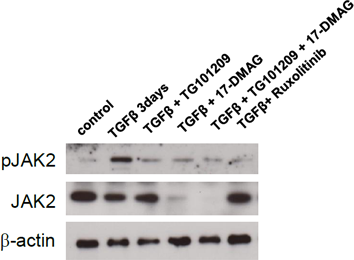
Alvespimycin purchased from MedChemExpress. Usage Cited in: Friedrich-Alexander University Erlangen-Nuremberg. 2016 Sep 14.
pJAK2 and JAK2 expression upon TGFβ stimulation and JAK inhibitors incubation. pJAK2 and JAK2 expression in healthy human fibroblasts after stimulation with TGFβ for 3 days and incubation with TG101209, 17-DMAG or Ruxolitinib.


Solvent & Solubility
DMSO : 100 mg/mL (162.14 mM; Need ultrasonic; Hygroscopic DMSO has a significant impact on the solubility of product, please use newly opened DMSO)
Please refer to the solubility information to select the appropriate solvent. Once prepared, please aliquot and store the solution to prevent product inactivation from repeated freeze-thaw cycles.
Storage method and period of stock solution: -80°C, 6 months; -20°C, 1 month. When stored at -80°C, please use it within 6 months. When stored at -20°C, please use it within 1 month.
Please refer to the solubility information to select the appropriate solvent. Once prepared, please aliquot and store the solution to prevent product inactivation from repeated freeze-thaw cycles.
Storage method and period of stock solution: -80°C, 6 months; -20°C, 1 month. When stored at -80°C, please use it within 6 months. When stored at -20°C, please use it within 1 month.
Concentration (start) × Volume (start) = Concentration (final) × Volume (final)
Select the appropriate dissolution method based on your experimental animal and administration route.
- For the following dissolution methods, please ensure to first prepare a clear stock solution using an In Vitro approach and then sequentially add co-solvents:
- To ensure reliable experimental results, the clarified stock solution can be appropriately stored based on storage conditions. As for the working solution for In Vivo experiments, it is recommended to prepare freshly and use it on the same day.
- The percentages shown for the solvents indicate their volumetric ratio in the final prepared solution. If precipitation or phase separation occurs during preparation, heat and/or sonication can be used to aid dissolution.
Add each solvent one by one: 10% DMSO 40% PEG300 5% Tween-80 45% Saline
Solubility: ≥ 2.5 mg/mL (4.05 mM); Clear solution
This protocol yields a clear solution of ≥ 2.5 mg/mL (saturation unknown).
Taking 1 mL working solution as an example, add 100 μL DMSO stock solution (25.0 mg/mL) to 400 μL PEG300, and mix evenly; then add 50 μL Tween-80 and mix evenly; then add 450 μL Saline to adjust the volume to 1 mL.
Preparation of Saline: Dissolve 0.9 g sodium chloride in ddH₂O and dilute to 100 mL to obtain a clear Saline solution.
Please enter the basic information of animal experiments:
-
-
-
-
Recommended: Prepare an additional quantity of animals to account for potential losses during experiments.
Please enter your animal formula composition:
-
%DMSO +
Recommended: Keep the proportion of DMSO in working solution below 2% if your animal is weak.
-
%+
-
+%Tween-80 + +
-
%Saline +
The co-solvents required include: DMSO, . All of co-solvents are available by MedChemExpress (MCE). , Tween 80. All of co-solvents are available by MedChemExpress (MCE).
Working solution concentration: 0.22 mg/mL
Method for preparing stock solution: mg drug dissolved in μL DMSO. Stock solution concentration: mg/mL.
1. Take μL DMSO stock solution;
2. Add μL .
μL , mix evenly;
3. Then add μL Tween 80, mix evenly;
4. Then add μL
Please ensure that the stock solution in the first step is dissolved to a clear state, and add co-solvents in sequence. You can use ultrasonic heating (ultrasonic cleaner, recommended frequency 20-40 kHz), vortexing, etc. to assist dissolution.

Protocol
MTT assays are performed to determine cytotoxicity. A total of 1×10⁶ CD19-selected B cells from CLL patients are incubated for 24 or 48 hours in Alvespimycin, 17-AAG, or vehicle. MTT reagent is then added, and plates are incubated for an additional 24 hours before spectrophotometric measurement. Apoptosis is determined by staining with annexin V-fluorescein isothiocyanate and propidium iodide (PI). After exposure to drugs, cells are washed with phosphate-buffered saline and stained in 1 time binding buffer. Cell death is assessed by flow cytometry. Data are analyzed with the System II software package. A total of 10000 cells are counted for each sample. Mitochondrial membrane potential changes are assessed by staining with the lipophilic cationic dye JC-1 and analysis by flow cytometry[2].
MedChemExpress (MCE) has not independently confirmed the accuracy of these methods. They are for reference only.
Mice[3]
Young male CB-17/IcrHsd-Prkdc-SCID mice are used. Recombinant xenografts are made by mixing 1×10⁵ BPH1 cells and 2.5×10⁵ CAF per graft in collagen solution, allowed to gel, covered with medium and cultured overnight. Tumors are allowed to form over eight weeks, and then treated for four weeks with three different doses of dipalmitoyl-radicicol (50, 100 and 200 mg/kg) and Alvespimycin (5, 10 and 20 mg/kg) via intraperitoneal injections of compounds in sesame oil every four days. After 12 weeks in total, the mice are sacrificed, their kidneys resected, grafts cut in half and photographed before processing for histology. Graft dimensions are measured and the resultant tumour volume is calculated using the formula; volume=width × length × depth × π/6. This formula represents a conservative approach to evaluate tumour volumes, as it understates the volume of large, invasive tumours compared with smaller, non-invasive tumours. Resected grafts are fixed in 10% formalin, embedded in paraffin and processed for immunohistochemistry.
MedChemExpress (MCE) has not independently confirmed the accuracy of these methods. They are for reference only.


Purity & Documentation
-
Data Sheet (281 KB)
-
SDS (393 KB)
- English - EN (393 KB)
- Français - FR (393 KB)
- Deutsch - DE (393 KB)
- Norwegian - NO (393 KB)
- Español - ES (393 KB)
- Swedish - SV (393 KB)
- Italian - IT (393 KB)
- Portuguese - PT (393 KB)
-
Handling Instructions (2659 KB)
References
[1]. Ge J, et al. Design, synthesis, and biological evaluation of hydroquinone derivatives of 17-amino-17-demethoxygeldanamycin as potent, water-soluble inhibitors of Hsp90. J Med Chem. 2006 Jul 27;49(15):4606-15. [Content Brief]
[2]. Hertlein E, et al. 17-DMAG targets the nuclear factor-kappaB family of proteins to induce apoptosis in chronic lymphocytic leukemia: clinical implications of HSP90 inhibition. Blood. 2010 Jul 8;116(1):45-53. [Content Brief]
[3]. Henke A, et al. Reduced Contractility and Motility of Prostatic Cancer-Associated Fibroblasts after Inhibition of Heat Shock Protein 90. Cancers (Basel). 2016 Aug 24;8(9). pii: E77. [Content Brief]


Complete Stock Solution Preparation Table
Please refer to the solubility information to select the appropriate solvent. Once prepared, please aliquot and store the solution to prevent product inactivation from repeated freeze-thaw cycles.
Storage method and period of stock solution: -80°C, 6 months; -20°C, 1 month. When stored at -80°C, please use it within 6 months. When stored at -20°C, please use it within 1 month.
| Optional Solvent | Concentration Solvent Mass | 1 mg | 5 mg | 10 mg | 25 mg |
|---|---|---|---|---|---|
| DMSO | 1 mM | 1.6214 mL | 8.1070 mL | 16.2140 mL | 40.5351 mL |
| 5 mM | 0.3243 mL | 1.6214 mL | 3.2428 mL | 8.1070 mL | |
| 10 mM | 0.1621 mL | 0.8107 mL | 1.6214 mL | 4.0535 mL | |
| 15 mM | 0.1081 mL | 0.5405 mL | 1.0809 mL | 2.7023 mL | |
| 20 mM | 0.0811 mL | 0.4054 mL | 0.8107 mL | 2.0268 mL | |
| 25 mM | 0.0649 mL | 0.3243 mL | 0.6486 mL | 1.6214 mL | |
| 30 mM | 0.0540 mL | 0.2702 mL | 0.5405 mL | 1.3512 mL | |
| 40 mM | 0.0405 mL | 0.2027 mL | 0.4054 mL | 1.0134 mL | |
| 50 mM | 0.0324 mL | 0.1621 mL | 0.3243 mL | 0.8107 mL | |
| 60 mM | 0.0270 mL | 0.1351 mL | 0.2702 mL | 0.6756 mL | |
| 80 mM | 0.0203 mL | 0.1013 mL | 0.2027 mL | 0.5067 mL | |
| 100 mM | 0.0162 mL | 0.0811 mL | 0.1621 mL | 0.4054 mL |


 Powered by Bioz