



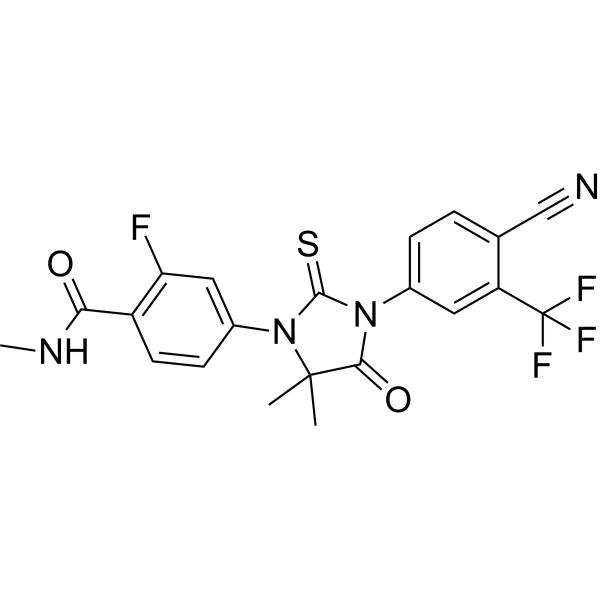
Enzalutamide
Based on 246 publication(s) in Google Scholar
Enzalutamide (MDV3100) is an androgen receptor (AR) antagonist with an IC50 of 36 nM in LNCaP prostate cells. Enzalutamide is an autophagy activator.
For research use only. We do not sell to patients.
- Purity : 99.97%
- CAS No.: 915087-33-1
- Formula: C21H16F4N4O2S
- Molecular Weight:464.44
-
Storage:Powder -20°C, 3 years , 4°C, 2 years ; In solvent -80°C, 2 years , -20°C, 1 year

To place orders, for customer services and technical support, please contact: MedChemExpress USA
Tel: 609-228-6898 E-mail: [email protected] [email protected]


-
 Biological Activity
-
Chemical Information
-
Solvent & Solubility
- Protocols
- Purity & Documentation
- References
-
 Help & FAQs


-
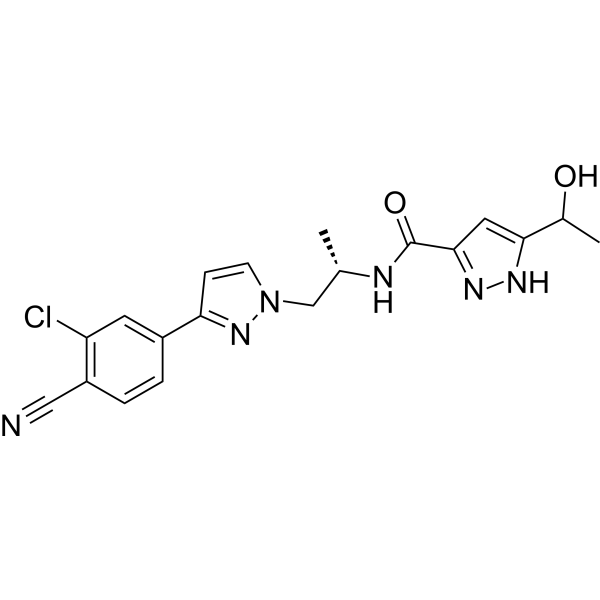
HY-16985
DarolutamideAndrogen Receptor Antagonist -
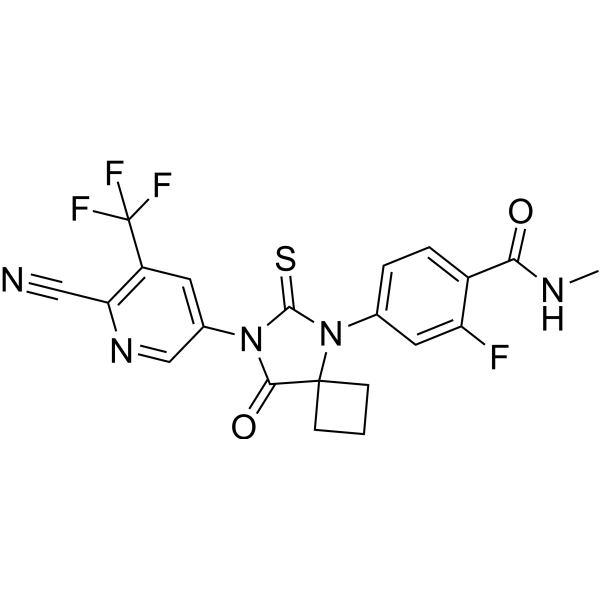
HY-16060
ApalutamideAR Antagonist -
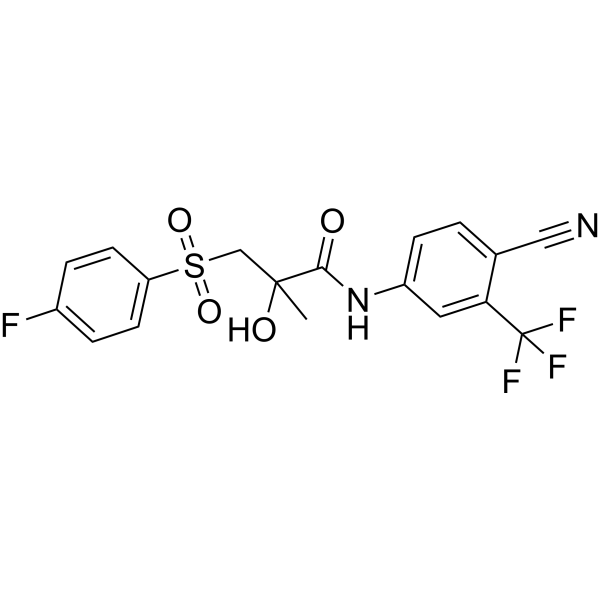
HY-14249
BicalutamideAndrogen Receptor Inhibitor -
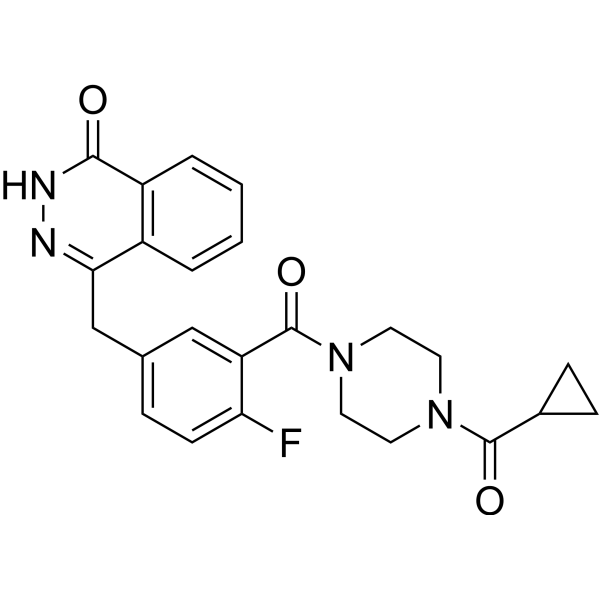
HY-10162
OlaparibPARP Inhibitor -
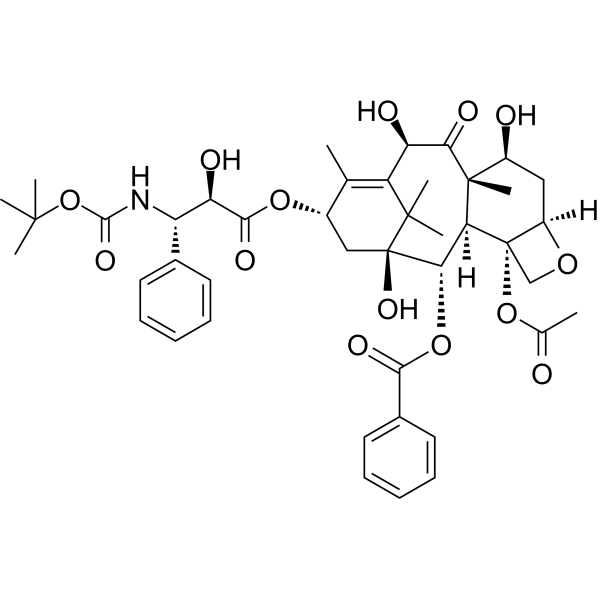
HY-B0011
DocetaxelTubulin Stabilizer -
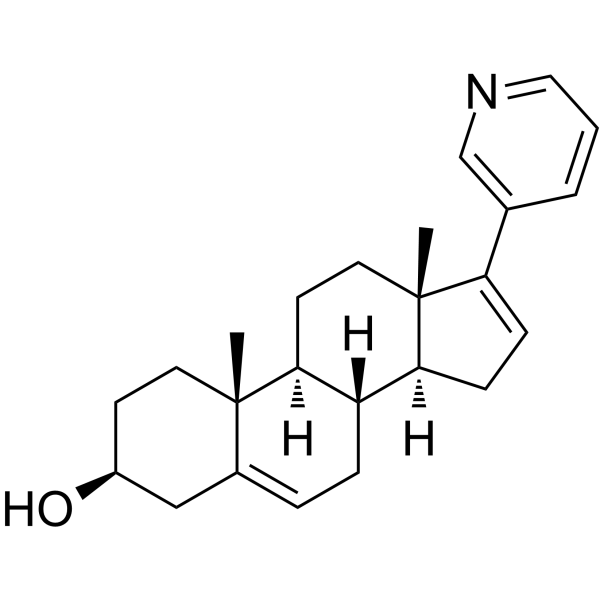
HY-70013
AbirateroneCYP17A1 Inhibitor -
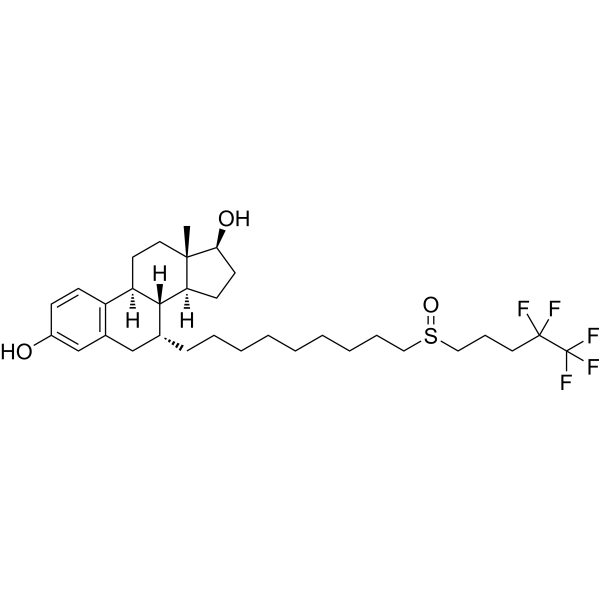
HY-13636
FulvestrantEstrogen Receptor Antagonist -
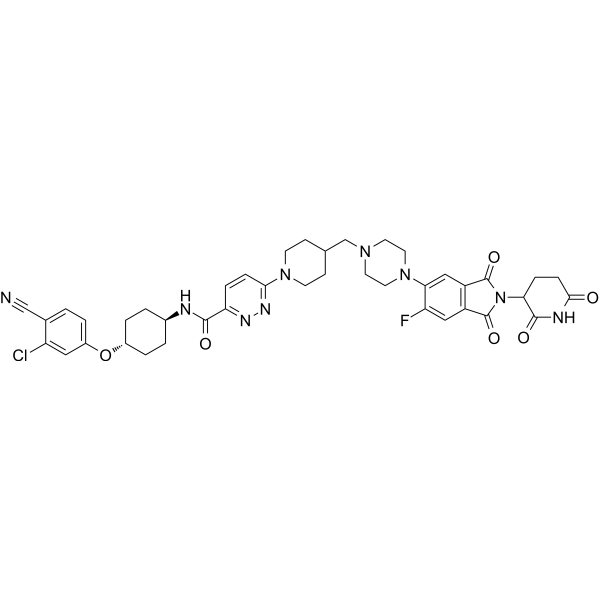
HY-138641
BavdegalutamideAR PROTAC Degrader -
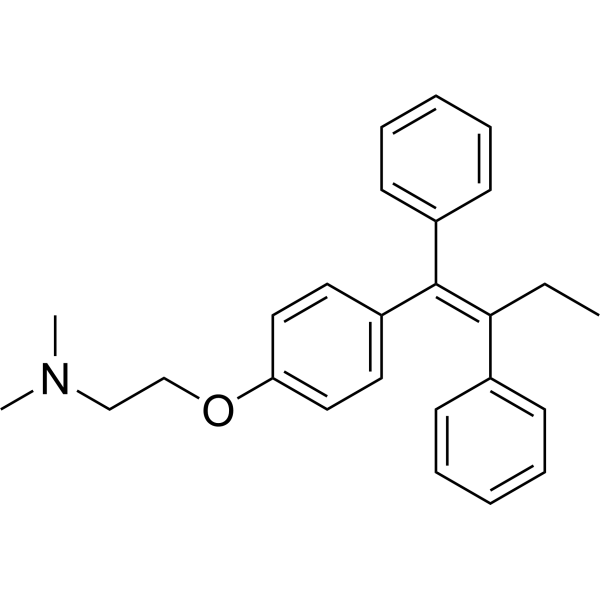
HY-13757A
TamoxifenEstrogen Receptor Modulator -
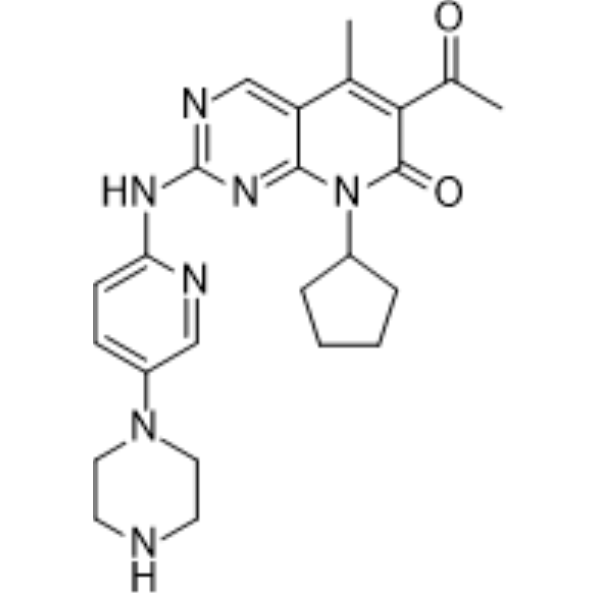
HY-50767
PalbociclibCDK4/6 Inhibitor -
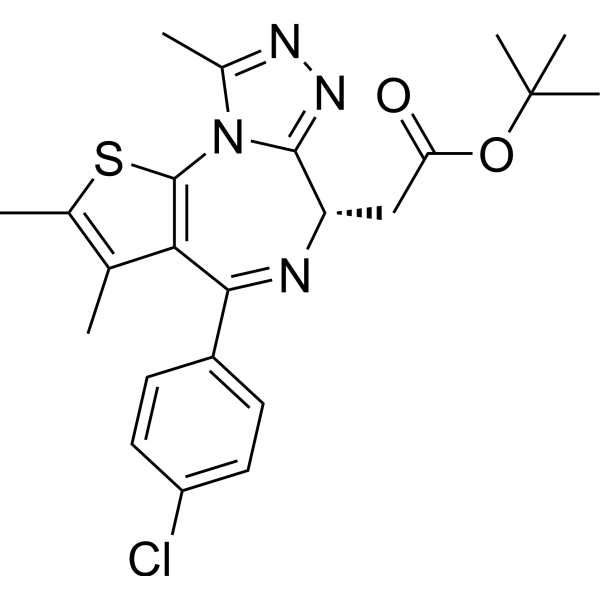
HY-13030
(+)-JQ-1BET Inhibitor -
HY-15431
CapivasertibAkt Inhibitor
Publications Citing Use of MedChemExpress (MCE) Enzalutamide
More- Nature. 2026 Apr;652(8110):763-773. [Abstract]
- Cancer Cell. 2025 Mar 18:S1535-6108(25)00079-0. [Abstract]
- Cell. 2023 Jun 22;186(13):2748-2764.e22. [Abstract]
- Cancer Discov. 2025 Dec 19. [Abstract]
- Cancer Discov. 2017 Jan;7(1):54-71. [Abstract]
- Cancer Res. 2026 Jan 13. [Abstract]
- Cancer Res. 2025 Aug 27. [Abstract]
- Cancer Res. 2025 Aug 8. [Abstract]
- Cancer Res. 2020 Jul 1;80(13):2927-2939. [Abstract]
- Cancer Res. 2018 May 15;78(10):2691-2704. [Abstract]
- Cancer Res. 2016 Nov 15;76(22):6701-6711. [Abstract]
- Cancer Res. 2013 Aug 15;73(16):5206-17. [Abstract]
- Nat Commun. 2026 May 21. [Abstract]
- Nat Commun. 2025 Jul 29;16(1):6964. [Abstract]
- Nat Commun. 2024 Aug 6;15(1):6672. [Abstract]
- Nat Commun. 2021 Nov 4;12(1):6377. [Abstract]
- Nat Commun. 2021 Sep 6;12(1):5307. [Abstract]
- Nat Commun. 2020 Jun 1;11(1):2689. [Abstract]
- Nat Commun. 2020 Apr 20;11(1):1884. [Abstract]
- Nat Commun. 2020 Jan 20;11(1):384. [Abstract]
- Nat Chem Biol. 2025 Aug;21(8):1226-1237. [Abstract]
- Theranostics. 2022 Jan 1;12(2):474-492. [Abstract]
- Theranostics. 2021 Jan 1;11(2):841-860. [Abstract]
- Acta Pharm Sin B. 2022 Nov;12(11):4165-4179. [Abstract]
- J Biomed Sci. 2021 Oct 8;28(1):68. [Abstract]
- J Clin Invest. 2026 Mar 17:e200260. [Abstract]
- J Clin Invest. 2024 Aug 15;134(18):e175023. [Abstract]
- J Exp Clin Cancer Res. 2024 May 15;43(1):144. [Abstract]
- J Exp Clin Cancer Res. 2022 May 19;41(1):178. [Abstract]
- J Exp Clin Cancer Res. 2022 Apr 5;41(1):125. [Abstract]
- J Clin Invest. 2020 Feb 3;130(2):699-714. [Abstract]
- Adv Sci (Weinh). 2026 Aug 11:e77110. [Abstract]
- Adv Sci (Weinh). 2026 Apr;13(19):e08588. [Abstract]
- Adv Sci (Weinh). 2026 Mar 2:e16411. [Abstract]
- Adv Sci (Weinh). 2025 Feb;12(8):e2411675. [Abstract]
- Adv Sci (Weinh). 2025 Jan;12(2):e2407662. [Abstract]
- Adv Sci (Weinh). 2024 Aug;11(30):e2401396. [Abstract]
- Adv Sci (Weinh). 2024 Mar;11(9):e2304939. [Abstract]
- Cell Rep Med. 2025 Jul 15;6(7):102215. [Abstract]
- Cell Rep Med. 2025 Apr 15;6(4):102053. [Abstract]
- Sci Adv. Sci Adv. 2025 Apr 25;11(17):eadu0847. [Abstract]
- Sci Adv. 2024 Feb 9;10(6):eadi4935. [Abstract]
- Sci Adv. 2022 Apr 29;8(17):eabh3635. [Abstract]
- Mol Biomed. 2026 Apr 8;7(1):47. [Abstract]
- Mol Biomed. 2025 Nov 17;6(1):112. [Abstract]
- Cell Death Dis. 2026 Aug 6.
- Cell Death Dis. 2024 Jul 18;15(7):513. [Abstract]
- Cell Death Dis. 2023 Jan 6;14(1):7. [Abstract]
- Cell Death Dis. 2022 Jul 19;13(7):626. [Abstract]
- Cell Death Dis. 2021 Jul 27;12(8):740. [Abstract]
- Cell Death Dis. 2014 Jul 17;5(7):e1338. [Abstract]
- Cancer Lett. 2018 Nov 28:437:35-43. [Abstract]
- Int J Biol Sci. 2024 Jul 1;20(9):3638-3655. [Abstract]
- Int J Biol Sci. 2019 Jan 1;15(3):522-532. [Abstract]
- Cell Commun Signal. 2024 Jun 19;22(1):339. [Abstract]
- Cell Commun Signal. 2020 Jan 24;18(1):11. [Abstract]
- Cell Commun Signal. 2019 May 15;17(1):44. [Abstract]
- EBioMedicine. 2019 Feb:40:504-516. [Abstract]
- Clin Cancer Res. 2017 Nov 15;23(22):6923-6933. [Abstract]
- Clin Cancer Res. 2015 Nov 1;21(21):4845-55. [Abstract]
- Clin Cancer Res. 2015 Apr 1;21(7):1675-87. [Abstract]
- Clin Cancer Res. 2014 Dec 15;20(24):6367-78. [Abstract]
- Cell Death Discov. 2022 Nov 29;8(1):471. [Abstract]
- NPJ Precis Oncol. 2025 Jul 7;9(1):223. [Abstract]
- NPJ Precis Oncol. 2025 May 27;9(1):156. [Abstract]
- J Transl Med. 2025 Mar 3;23(1):255. [Abstract]
- Sci China Life Sci. 2025 Jul 8. [Abstract]
- Proc Natl Acad Sci U S A. 2025 Oct 28;122(43):e2510386122. [Abstract]
- Proc Natl Acad Sci U S A. 2025 Mar 25;122(12):e2426107122. [Abstract]
- Oncogene. 2023 Mar;42(10):748-758. [Abstract]
- Oncogene. 2023 Feb;42(8):559-571. [Abstract]
- Oncogene. 2022 Jun;41(23):3239-3250. [Abstract]
- Oncogene. 2022 Mar;41(11):1536-1549. [Abstract]
- Oncogene. 2019 Nov;38(45):7060-7072. [Abstract]
- Oncogene. 2018 Apr;37(17):2313-2325. [Abstract]
- Oncogene. 2014 Jun 12;33(24):3140-50. [Abstract]
- Apoptosis. 2026 Mar 22;31(4):109. [Abstract]
- Apoptosis. 2024 Oct;29(9-10):1679-1695. [Abstract]
- Int J Biol Macromol. 2024 Oct;278(Pt 3):134844. [Abstract]
- NPJ Breast Cancer. 2026 Feb 24. [Abstract]
- EMBO J. 2023 Feb 15;42(4):e112184. [Abstract]
- Antioxidants (Basel). 2024 Nov 1;13(11):1340. [Abstract]
- Clin Transl Med. 2024 Jan;14(1):e1531. [Abstract]
- Clin Transl Med. 2021 Jun;11(6):e449. [Abstract]
- Br J Cancer. 2026 Jul 23.
- Br J Cancer. 2026 Jun;134(11):1671-1682. [Abstract]
- Br J Cancer. 2025 Dec 18. [Abstract]
- Br J Cancer. 2025 Apr;132(6):543-557. [Abstract]
- Br J Cancer. 2022 Sep;127(5):927-936. [Abstract]
- Cell Rep. 2026 May 12;45(5):117330. [Abstract]
- Cell Rep. 2023 Jan 30;42(2):112033. [Abstract]
- Eur J Nucl Med Mol Imaging. 2025 Sep 23. [Abstract]
- Chin Med. 2025 Mar 14;20(1):35. [Abstract]
- Int J Oncol. 2017 Jan;50(1):75-84. [Abstract]
- Sci Signal. 2025 Mar 18;18(878):eadi5174. [Abstract]
- Cancer Cell Int. 2019 Dec 10:19:332. [Abstract]
- Mol Cancer Ther. 2020 Jan;19(1):231-246. [Abstract]
- Mol Cancer Ther. 2017 Oct;16(10):2281-2291. [Abstract]
- Mol Cancer Ther. 2016 Sep;15(9):2107-18. [Abstract]
- Mol Cancer Ther. 2015 Mar;14(3):713-26. [Abstract]
- Mol Cancer Ther. 2013 May;12(5):567-76. [Abstract]
- Antioxid Redox Signal. 2025 Jun;42(16-18):954-972. [Abstract]
- JCI Insight. 2019 Sep 5;4(17):e122688. [Abstract]
- Eur J Med Chem. 2018 Sep 5:157:1164-1173. [Abstract]
- Ecotoxicol Environ Saf. 2026 Sep 1:322:120562.
- Cell Mol Life Sci. 2026 Feb 9;83(1):103. [Abstract]
- Cell Mol Life Sci. 2024 Apr 2;81(1):160. [Abstract]
- Cancer Gene Ther. 2026 Mar;33(3):277-288. [Abstract]
- Cancer Gene Ther. 2022 Dec;29(12):1988-2000. [Abstract]
- Biosensors (Basel). 2024 Apr 5;14(4):175. [Abstract]
- Oncogenesis. 2026 Aug 11.
- Mol Cancer Res. 2020 Jan;18(1):153-165. [Abstract]
- Mol Cancer Res. 2016 Jun;14(6):574-85. [Abstract]
- J Endocrinol. 2019 Jan;240(1):51-63. [Abstract]
- Int J Mol Sci. 2016 Sep 1;17(9):1458. [Abstract]
- Toxicology. 2023 Apr:488:153465. [Abstract]
- Nanoscale. 2017 Jul 13;9(27):9676-9684. [Abstract]
- Target Oncol. 2023 Mar;18(2):269-285. [Abstract]
- Sci Rep. 2025 Oct 21;15(1):36610. [Abstract]
- Am J Pathol. 2024 Dec;194(12):2326-2340. [Abstract]
- Mol Pharm. 2024 Nov 4;21(11):5749-5760. [Abstract]
- Cancer Sci. 2024 Aug;115(8):2630-2645. [Abstract]
- Sci Rep. 2023 Jun 3;13(1):9043. [Abstract]
- Int J Cancer. 2022 Oct 15;151(8):1405-1419. [Abstract]
- Transl Oncol. 2022 Oct:24:101495. [Abstract]
- Sci Rep. 2019 Sep 24;9(1):13786. [Abstract]
- Sci Rep. 2019 May 24;9(1):7826. [Abstract]
- Sci Rep. 2019 Mar 7;9(1):3823. [Abstract]
- Sci Rep. 2018 Nov 23;8(1):17307. [Abstract]
- Sci Rep. 2018 Oct 10;8(1):15063. [Abstract]
- Int J Cancer. 2018 Aug 1;143(3):645-656. [Abstract]
- Sci Rep. 2018 Jan 10;8(1):253. [Abstract]
- Sci Rep. 2017 Jun 8;7(1):3058. [Abstract]
- Sci Rep. 2017 Mar 15:7:44409. [Abstract]
- Sci Rep. 2016 Sep 28:6:33968. [Abstract]
- Neoplasia. 2026 Aug:78:101324. [Abstract]
- Comput Struct Biotechnol J. 2026 Apr 13;35(1):0038. [Abstract]
- Neoplasia. 2023 Feb:36:100875. [Abstract]
- Cancers (Basel). 2020 Nov 27;12(12):3540. [Abstract]
- Cancers (Basel). 2020 Jul 28;12(8):2092. [Abstract]
- Cancers (Basel). 2020 Mar 21;12(3):748. [Abstract]
- Cancers (Basel). 2020 Feb 12;12(2):428. [Abstract]
- Cell Signal. 2026 Oct:146:112690. [Abstract]
- J Cell Mol Med. 2024 Oct;28(20):e70186. [Abstract]
- Biomedicines. 2026 May;14(5):949.
- Eur Urol Open Sci. 2022 Jul 26:43:35-44. [Abstract]
- Front Physiol. 2018 Apr 16:9:312. [Abstract]
- Front Biosci (Landmark Ed). 2026 Jun 26;31(6):47325. [Abstract]
- J Biol Chem. 2023 Nov;299(11):105253. [Abstract]
- Lab Invest. 2023 Jul;103(7):100148. [Abstract]
- J Biol Chem. 2018 Sep 14;293(37):14328-14341. [Abstract]
- J Cell Commun Signal. 2025 Oct 3;19(4):e12032. [Abstract]
- J Immunol. 2023 Feb 15;210(4):496-503. [Abstract]
- J Pharm Sci. 2018 Sep;107(9):2479-2488. [Abstract]
- Endocrinology. 2025 Dec 5;167(1):bqaf168. [Abstract]
- Endocrinology. 2024 Aug 27;165(10):bqae114. [Abstract]
- Endocrinology. 2023 Mar 13;164(5):bqad033. [Abstract]
- EJNMMI Radiopharm Chem. 2026 May 20. [Abstract]
- Drug Metab Dispos. 2025 Dec 22.
- Drug Metab Dispos. 2025 Apr;53(4):100052. [Abstract]
- Arch Biochem Biophys. 2026 Nov:785:110976.
- J Radiat Res Appl Sci. 2025 Nov 25;18(4):102079.
- Arch Biochem Biophys. 2022 May 30;721:109194. [Abstract]
- Bioorg Med Chem. 2020 Oct 15;28(20):115712. [Abstract]
- Front Oncol. 2021 Feb 23;11:615568. [Abstract]
- J Cancer Res Clin Oncol. 2025 Mar 20;151(3):116. [Abstract]
- J Appl Toxicol. 2026 Feb 8. [Abstract]
- Genes (Basel). 2026 May 1;17(5):538. [Abstract]
- J Steroid Biochem Mol Biol. 2014 Oct:144 Pt B:436-44. [Abstract]
- Mol Biol Cell. 2020 Mar 15;31(6):478-490. [Abstract]
- Int J Urol. 2022 Sep;29(9):1085-1094. [Abstract]
- Medicina (Kaunas). 2020 Feb 23;56(2):90. [Abstract]
- Mol Cell Biol. 2024;44(12):529-542. [Abstract]
- J Assist Reprod Genet. 2024 Oct;41(10):2759-2770. [Abstract]
- Dig Dis Sci. 2017 Dec;62(12):3402-3414. [Abstract]
- PLoS One. 2016 Apr 5;11(4):e0152861. [Abstract]
- Prostate. 2025 Sep 19. [Abstract]
- Prostate. 2025 Sep;85(13):1196-1207. [Abstract]
- Prostate. 2023 Nov;83(15):1415-1429. [Abstract]
- Prostate. 2022 Jun;82(8):917-932. [Abstract]
- Prostate. 2019 Jan;79(1):44-53. [Abstract]
- EJNMMI Res. 2018 Oct 29;8(1):96. [Abstract]
- Prostate. 2017 Feb;77(3):309-320. [Abstract]
- Prostate. 2016 Sep;76(13):1192-202. [Abstract]
- Cancer Genomics Proteomics. 2025 Nov-Dec;22(6):953-970. [Abstract]
- J Anal Sci Technol. 13, 31 (2022).
- Int J Gen Med. 2026 Jul 10:19:615525.
- Mol Genet Genomics. 2026 Apr 16;301(1):97. [Abstract]
- Gene Expr Patterns. 2026 Aug 19:58:119414.
- Biomed Pharmacother. 2026 Sep 3:203:119891. [Abstract]
- Biomed Pharmacother. 2026 Sep:202:119803.
- University of Buenos Aires. 2026.
- Palacky University Olomouc. 2026.
- bioRxiv. 2026 Jul 1.
- University of Kentucky. 2026.
- University of Michigan. 2026.
- Res Sq. 2026 Jul 29.
- bioRxiv. 2026 Jul 15.
- Res Sq. 2026 May 20.
- bioRxiv. 2026 Mar 18.
- bioRxiv. 2026 Jan 19.
- bioRxiv. 2025 Nov 30.
- Res Sq. 2025 Nov 6.
- bioRxiv. 2025 Aug 31.
- SSRN. 2025 Aug 9.
- SSRN. 2025 Jul 10.
- bioRxiv. 2025 May 18:2025.05.14.653660. [Abstract]
- University of Minnesota. 2025.
- Université Laval. 2025.
- bioRxiv. 2025 Feb 17.
- bioRxiv. 2025 Mar 29:2025.03.26.645495. [Abstract]
- bioRxiv. 2025 March 17.
- University of Kentucky. 2024 Aug 1.
- Res Sq. 2024 Nov 15.
- Biomed Pharmacother. 2024 Nov:180:117485. [Abstract]
- Aging (Albany NY). 2024 Apr 19;16(8):7249-7266. [Abstract]
- bioRxiv. 2024 Jan 2.
- SSRN. 2023 Sep 18.
- University of Adelaide. 2023 Jan.
- Preprints. 2023 Jul 13.
- medRxiv. 2023 Feb 24:2023.02.24.23286403. [Abstract]
- Research Square Print. December 7th, 2022.
- Research Square Preprint. 2022 Jul.
- Research Square Preprint. 2022 Jun.
- bioRxiv. 2022 May 14.491739.
- bioRxiv. May 28, 2021.
- SSRN. 6 Jul 2021.
- Research Square Preprint. 2021 May.
- Aging (Albany NY). 2020 Sep 10;12(17):17694-17712. [Abstract]
- Biomed Pharmacother. 2019 Dec:120:109490. [Abstract]
- Patent. US20180305771A1.
- University of British Columbia. 2017 Dec.
- University of British Columbia. 2017 Dec.
- Oncotarget. 2017 Dec 7;8(70):115054-115067. [Abstract]
- J Oncol Res Ther. 2017 (03), ISSN: 2574-710X.
- Oncotarget. 2017 Nov 20;8(67):111084-111095. [Abstract]
- Oncotarget. 2017 Aug 12;8(45):78811-78824. [Abstract]
- Horm Cancer. 2017 Aug;8(4):243-256. [Abstract]
- University of British Columbia. 2017 Apr.
- Oncotarget. 2016 Sep 13;7(37):59781-59794. [Abstract]
- University of California. 2016 Aug.
- Oncotarget. 2016 Jun 28;7(26):40690-40703. [Abstract]
- Oncotarget. 2015 Aug 21;6(24):20474-84. [Abstract]
- Oncotarget. 2014 Oct 15;5(19):9007-21. [Abstract]
- Patent. US20140088178A1.
- Annual rept. 15 Sep 2012-14 Sep 2013
 Customer Validation & Images

-
Cell Proliferation/Viability Assay
-
WB
-
WB
-
WB
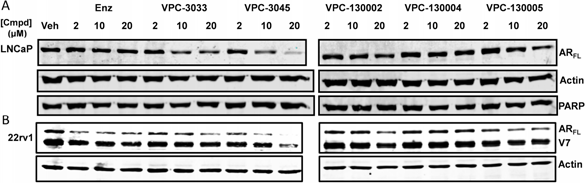
-
WB
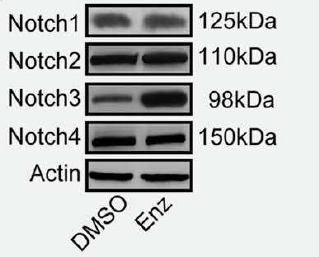


Biological Activity
Description
IC50 & Target
IC50: 36 nM (androgen-receptor, in LNCaP cells)[1]
Cellular Effect
|
Cell Line

|
Type | Value | Description | References |
|---|---|---|---|---|
| CWR22R | IC50 |
9.7 μM
Compound: 3, MDV3100
|
Inhibition of cell survival in human CWR22Rv1 cells after 144 hrs by TUNEL assay
Inhibition of cell survival in human CWR22Rv1 cells after 144 hrs by TUNEL assay
|
[PMID: 25121586] |
| CWR22R | GI50 |
3.34 μM
Compound: MDV3100
|
Growth inhibition of human CWR22Rv1 cells by MTT assay
Growth inhibition of human CWR22Rv1 cells by MTT assay
|
[PMID: 25634130] |
| CWR22R | IC50 |
31.76 μM
Compound: Enzalutamide
|
Antiproliferative activity against human 22Rv1 cells after 96 hrs by Oncotest monolayer assay
Antiproliferative activity against human 22Rv1 cells after 96 hrs by Oncotest monolayer assay
|
[PMID: 26965862] |
| CWR22R | IC50 |
31.76 μM
Compound: 5; MDV3100; Xtandi; Enzalutamide
|
Antiproliferative activity against human 22Rv1 cells after 96 hrs by propidium iodide staining based fluorescence 2D monolayer assay
Antiproliferative activity against human 22Rv1 cells after 96 hrs by propidium iodide staining based fluorescence 2D monolayer assay
|
[PMID: 27131065] |
| CWR22R | IC50 |
31.76 μM
Compound: 4
|
Antiproliferative activity against human 22Rv1 cells assessed as reduction in cell viability after 96 hrs by propidium iodide staining based fluorescence assay
Antiproliferative activity against human 22Rv1 cells assessed as reduction in cell viability after 96 hrs by propidium iodide staining based fluorescence assay
|
[PMID: 27301368] |
| CWR22R | IC50 |
36.66 μM
Compound: Enzalutamide
|
Antiproliferative activity against human 22Rv1 cells after 72 hrs by Cell-Titer Glo assay
Antiproliferative activity against human 22Rv1 cells after 72 hrs by Cell-Titer Glo assay
|
[PMID: 29448139] |
| CWR22R | IC50 |
36.66 μM
Compound: Enz
|
Antiproliferative activity against AR-positive human 22Rv1 cells assessed as reduction in cell viability incubated for 96 hrs by cell-titer glo assay
Antiproliferative activity against AR-positive human 22Rv1 cells assessed as reduction in cell viability incubated for 96 hrs by cell-titer glo assay
|
[PMID: 29566488] |
| CWR22R | IC50 |
36.66 μM
Compound: Enzalutamide
|
Antiproliferative activity against human 22Rv1 cells treated at 12 hrs post cell seeding measured at 72 to 144 hrs post cell seeding by Cell-Titer Glo assay
Antiproliferative activity against human 22Rv1 cells treated at 12 hrs post cell seeding measured at 72 to 144 hrs post cell seeding by Cell-Titer Glo assay
|
[PMID: 29758518] |
| CWR22R | IC50 |
24.77 μM
Compound: 2a
|
Antiproliferative activity against human 22Rv1 cells after 96 hrs by propidium iodide staining-based fluorescence assay
Antiproliferative activity against human 22Rv1 cells after 96 hrs by propidium iodide staining-based fluorescence assay
|
[PMID: 30108852] |
| CWR22R | IC50 |
>10 μM
Compound: 4
|
Cytotoxicity against AR-positive human 22Rv1 cells assessed as inhibition of cell growth incubated for 7 days in regular culture medium by WST-8 assay
Cytotoxicity against AR-positive human 22Rv1 cells assessed as inhibition of cell growth incubated for 7 days in regular culture medium by WST-8 assay
|
[PMID: 30629437] |
| CWR22R | IC50 |
>30 μM
Compound: Enza
|
Antiproliferative activity against human 22Rv1 cells assessed as reduction in cell viability incubated for 6 days by CCK8 assay
Antiproliferative activity against human 22Rv1 cells assessed as reduction in cell viability incubated for 6 days by CCK8 assay
|
[PMID: 30925341] |
| CWR22R | IC50 |
36.66 μM
Compound: Enzalutamide
|
Antiproliferative activity against human 22Rv1 cells measured after 96 hrs by celltiter-glo assay
Antiproliferative activity against human 22Rv1 cells measured after 96 hrs by celltiter-glo assay
|
[PMID: 30964293] |
| CWR22R | GI50 |
>40 μM
Compound: Enzalutamide
|
Antiproliferative activity against AR-positive human 22Rv1 cells harboring ARE14 construct assessed as growth inhibition after 72 hrs by resazurin dye based fluorescence assay
Antiproliferative activity against AR-positive human 22Rv1 cells harboring ARE14 construct assessed as growth inhibition after 72 hrs by resazurin dye based fluorescence assay
|
[PMID: 31271960] |
| CWR22R | IC50 |
31.8 μM
Compound: 2; MDV3100
|
Antiproliferative activity against human 22Rv1 cells assessed as reduction in cell growth incubated for 96 hrs by propidium iodide based 2D monolayer assay
Antiproliferative activity against human 22Rv1 cells assessed as reduction in cell growth incubated for 96 hrs by propidium iodide based 2D monolayer assay
|
[PMID: 31288149] |
| CWR22R | IC50 |
>30 μM
Compound: Enza
|
Antiproliferative activity against human 22Rv1 expressing AR assessed as reduction in cell viability incubated for 6 days by CCK-8 assay
Antiproliferative activity against human 22Rv1 expressing AR assessed as reduction in cell viability incubated for 6 days by CCK-8 assay
|
[PMID: 31437779] |
| CWR22R | IC50 |
31.76 μM
Compound: Enzalutamide
|
Antiproliferative activity against human 22Rv1 cells assessed as reduction in cell viability
Antiproliferative activity against human 22Rv1 cells assessed as reduction in cell viability
|
[PMID: 33513386] |
| CWR22R | IC50 |
42.3 μM
Compound: ENZ
|
Antiproliferative activity against AR-positive human 22RV1 cells assessed as reduction in cell viability incubated for 3 days by MTT assay
Antiproliferative activity against AR-positive human 22RV1 cells assessed as reduction in cell viability incubated for 3 days by MTT assay
|
[PMID: 33756125] |
| CWR22R | IC50 |
36.66 μM
Compound: Enzalutamide
|
Antiproliferative activity against human 22Rv1 cells assessed as cell viability incubated for 96 hrs by Cell-Titer Glo assay
Antiproliferative activity against human 22Rv1 cells assessed as cell viability incubated for 96 hrs by Cell-Titer Glo assay
|
[PMID: 34121397] |
| CWR22R | IC50 |
38 μM
Compound: Enz
|
Cytotoxicity against human 22Rv1 cells
Cytotoxicity against human 22Rv1 cells
|
[PMID: 34225450] |
| CWR22R | IC50 |
46.27 μM
Compound: ENZa
|
Antiproliferative activity against human 22Rv1 cells assessed as cell growth inhibition incubated for 72 hrs by MTT assay
Antiproliferative activity against human 22Rv1 cells assessed as cell growth inhibition incubated for 72 hrs by MTT assay
|
[PMID: 36031018] |
| CWR22R | IC50 |
36 μM
Compound: ENZ
|
Antiproliferative activity against AR-v7 positive human 22Rv1 cells measured after 3 days by celltiter-glo luminescence assay
Antiproliferative activity against AR-v7 positive human 22Rv1 cells measured after 3 days by celltiter-glo luminescence assay
|
[PMID: 36495632] |
| CWR22R | IC50 |
>1000 nM
Compound: Enzalutamide
|
Cytotoxicity against human 22Rv1 cells assessed as inhibition of cell growth incubated for 5 days in presence of AR agonist, R1881 by WST-1 assay
Cytotoxicity against human 22Rv1 cells assessed as inhibition of cell growth incubated for 5 days in presence of AR agonist, R1881 by WST-1 assay
|
[PMID: 36960664] |
| CWR22R | GI50 |
39.83 μM
Compound: Enzalutamide
|
Antiproliferative activity against human 22Rv1 cells assessed as growth inhibition incubated for 72 hrs by CCK8 assay
Antiproliferative activity against human 22Rv1 cells assessed as growth inhibition incubated for 72 hrs by CCK8 assay
|
[PMID: 38033250] |
| CWR22R | IC50 |
45.66 μM
Compound: ENZ
|
Cytotoxicity against human androgen-independent/androgen-responsive 22Rv1 cells assessed as cell viability incubated for 96 hrs by MTT assay
Cytotoxicity against human androgen-independent/androgen-responsive 22Rv1 cells assessed as cell viability incubated for 96 hrs by MTT assay
|
[PMID: 38153295] |
| CWR22R | IC50 |
36 μM
Compound: ENZ
|
Inhibition of cell viability in ARV7-positive human 22Rv1 cells by Steady-Glo luciferase assay
Inhibition of cell viability in ARV7-positive human 22Rv1 cells by Steady-Glo luciferase assay
|
[PMID: 38359754] |
| CWR22R | IC50 |
>1000 nM
Compound: Enzalutamide
|
Antiproliferative activity against human 22Rv1 cells assessed as cell growth inhibition incubated for 4 days by celtiter-glo luminescent assay
Antiproliferative activity against human 22Rv1 cells assessed as cell growth inhibition incubated for 4 days by celtiter-glo luminescent assay
|
[PMID: 38477974] |
| CWR22R | IC50 |
15.6 μM
Compound: Enzalutamide
|
Antiproliferative activity against AR/AR-V7 positive human 22Rv1 cells assessed as inhibition of cell growth incubated for 48 hrs by CCK-8 assay
Antiproliferative activity against AR/AR-V7 positive human 22Rv1 cells assessed as inhibition of cell growth incubated for 48 hrs by CCK-8 assay
|
[PMID: 38512060] |
| CWR22R | IC50 |
>1000 nM
Compound: Enzalutamide
|
Antiproliferative activity against AR positive human 22Rv1 cells assessed inhibition of cell growth measured after 4 days by CellTiter-Glo Luminescent cell viability assay
Antiproliferative activity against AR positive human 22Rv1 cells assessed inhibition of cell growth measured after 4 days by CellTiter-Glo Luminescent cell viability assay
|
[PMID: 38530938] |
| DU-145 | IC50 |
32.27 μM
Compound: 5; MDV3100; Xtandi; Enzalutamide
|
Antiproliferative activity against human DU145 cells after 96 hrs by propidium iodide staining based fluorescence 2D monolayer assay
Antiproliferative activity against human DU145 cells after 96 hrs by propidium iodide staining based fluorescence 2D monolayer assay
|
[PMID: 27131065] |
| DU-145 | IC50 |
32.27 μM
Compound: 4
|
Antiproliferative activity against human DU145 cells assessed as reduction in cell viability after 96 hrs by propidium iodide staining based fluorescence assay
Antiproliferative activity against human DU145 cells assessed as reduction in cell viability after 96 hrs by propidium iodide staining based fluorescence assay
|
[PMID: 27301368] |
| DU-145 | IC50 |
46.1 μM
Compound: Enzalutamide
|
Antiproliferative activity against AR negative human DU145 cells after 3 days by MTT assay
Antiproliferative activity against AR negative human DU145 cells after 3 days by MTT assay
|
[PMID: 27810589] |
| DU-145 | IC50 |
46.1 μM
Compound: Enzalutamide
|
Antiproliferative activity against human DU145 cells after 3 days by MTT assay
Antiproliferative activity against human DU145 cells after 3 days by MTT assay
|
[PMID: 29117897] |
| DU-145 | IC50 |
44.55 μM
Compound: 2a
|
Antiproliferative activity against human DU145 cells after 96 hrs by propidium iodide staining-based fluorescence assay
Antiproliferative activity against human DU145 cells after 96 hrs by propidium iodide staining-based fluorescence assay
|
[PMID: 30108852] |
| DU-145 | IC50 |
44.7 μM
Compound: Enzalutamide
|
Antiproliferative activity against human DU145 cells measured after 72 hrs by celltiter-glo assay
Antiproliferative activity against human DU145 cells measured after 72 hrs by celltiter-glo assay
|
[PMID: 30964293] |
| DU-145 | IC50 |
32.3 μM
Compound: 2; MDV3100
|
Antiproliferative activity against human DU145 cells assessed as reduction in cell growth incubated for 96 hrs by propidium iodide based 2D monolayer assay
Antiproliferative activity against human DU145 cells assessed as reduction in cell growth incubated for 96 hrs by propidium iodide based 2D monolayer assay
|
[PMID: 31288149] |
| DU-145 | IC50 |
49.3 μM
Compound: MDV3100
|
Antiproliferative activity against human DU-145 cells assessed as reduction in cel viability after 72 hrs by MTT assay
Antiproliferative activity against human DU-145 cells assessed as reduction in cel viability after 72 hrs by MTT assay
|
[PMID: 32169785] |
| DU-145 | IC50 |
32.27 μM
Compound: Enzalutamide
|
Antiproliferative activity against human DU-145 cells assessed as reduction in cell viability
Antiproliferative activity against human DU-145 cells assessed as reduction in cell viability
|
[PMID: 33513386] |
| DU-145 | IC50 |
45.3 μM
Compound: ENZ
|
Antiproliferative activity against AR-negative human DU145 cells assessed as reduction in cell viability incubated for 3 days by MTT assay
Antiproliferative activity against AR-negative human DU145 cells assessed as reduction in cell viability incubated for 3 days by MTT assay
|
[PMID: 33756125] |
| DU-145 | GI50 |
>10 μM
Compound: enzalutamide
|
Antiproliferative activity against human DU-145 cells assessed as cell growth inhibition incubated for 48 hrs by MTT assay
Antiproliferative activity against human DU-145 cells assessed as cell growth inhibition incubated for 48 hrs by MTT assay
|
[PMID: 34908406] |
| DU-145 | GI50 |
>31 μM
Compound: Enzalutamide
|
Growth inhibition of human DU-145 cells measured after 24 to 72 hrs by SRB method
Growth inhibition of human DU-145 cells measured after 24 to 72 hrs by SRB method
|
[PMID: 37163949] |
| DU-145 | IC50 |
>50 μM
Compound: 5; Enz
|
Cytotoxicity against androgen receptor independent human DU-145 cells assessed as inhibition of cell growth incubated for 72 hrs by MTT assay
Cytotoxicity against androgen receptor independent human DU-145 cells assessed as inhibition of cell growth incubated for 72 hrs by MTT assay
|
[PMID: 37209451] |
| DU-145 | GI50 |
54.78 μM
Compound: Enzalutamide
|
Antiproliferative activity against human DU-145 cells assessed as growth inhibition incubated for 72 hrs by CCK8 assay
Antiproliferative activity against human DU-145 cells assessed as growth inhibition incubated for 72 hrs by CCK8 assay
|
[PMID: 38033250] |
| DU-145 | IC50 |
121.01 μM
Compound: ENZ
|
Cytotoxicity against human DU-145 cells assessed as cell viability incubated for 96 hrs by MTT assay
Cytotoxicity against human DU-145 cells assessed as cell viability incubated for 96 hrs by MTT assay
|
[PMID: 38153295] |
| DU-145 | IC50 |
44.6 μM
Compound: Enzalutamide
|
Antiproliferative activity against AR-negative human DU-145 cells assessed as inhibition of cell growth incubated for 48 hrs by CCK-8 assay
Antiproliferative activity against AR-negative human DU-145 cells assessed as inhibition of cell growth incubated for 48 hrs by CCK-8 assay
|
[PMID: 38512060] |
| GES1 | IC50 |
96.89 μM
Compound: Enz
|
Cytotoxicity against human GES1 cells assessed as inhibition of cell proliferation by MTT assay
Cytotoxicity against human GES1 cells assessed as inhibition of cell proliferation by MTT assay
|
[PMID: 36154033] |
| HEK293 | IC50 |
0.216 μM
Compound: 5
|
Antagonist activity at human androgen receptor expressed in HEK293 cells assessed as inhibition of R1881-induced receptor transactivation after 24 hrs by luciferase reporter gene assay
Antagonist activity at human androgen receptor expressed in HEK293 cells assessed as inhibition of R1881-induced receptor transactivation after 24 hrs by luciferase reporter gene assay
|
[PMID: 30525603] |
| L02 | IC50 |
17.1 μM
Compound: Enza
|
Antiproliferative activity against human L02 cells assessed as reduction in cell viability incubated for 6 days by CCK8 assay
Antiproliferative activity against human L02 cells assessed as reduction in cell viability incubated for 6 days by CCK8 assay
|
[PMID: 30925341] |
| L02 | IC50 |
17.1 μM
Compound: Enza
|
Cytotoxicity against human L02 assessed as reduction in cell viability incubated for 6 days by CCK-8 assay
Cytotoxicity against human L02 assessed as reduction in cell viability incubated for 6 days by CCK-8 assay
|
[PMID: 31437779] |
| LNCaP | IC50 |
>100 μM
Compound: Enzalutamide
|
Inhibition of BF3 site of androgen receptor in enzalutamide-resistant human LNCAP cells assessed as reduction in PSA level after 3 days
Inhibition of BF3 site of androgen receptor in enzalutamide-resistant human LNCAP cells assessed as reduction in PSA level after 3 days
|
[PMID: 23301637] |
| LNCaP | EC50 |
915 nM
Compound: 6, MDV3100
|
Displacement of [3H]R1881 from AR in human LNCaP cells after 2 hrs by scintillation counting analysis
Displacement of [3H]R1881 from AR in human LNCaP cells after 2 hrs by scintillation counting analysis
|
[PMID: 23713567] |
| LNCaP | GI50 |
5.12 μM
Compound: 6, MDV3100
|
Cytotoxicity against human LNCAP cells after 7 days by MTT assay
Cytotoxicity against human LNCAP cells after 7 days by MTT assay
|
[PMID: 23713567] |
| LNCaP | GI50 |
2.88 μM
Compound: MDV3100
|
Growth inhibition of human LNCAP cells by MTT assay
Growth inhibition of human LNCAP cells by MTT assay
|
[PMID: 25634130] |
| LNCaP | IC50 |
127.1 nM
Compound: 4
|
Antiproliferative activity against human LNCAP cells after 3 days
Antiproliferative activity against human LNCAP cells after 3 days
|
[PMID: 26046313] |
| LNCaP | IC50 |
11.47 μM
Compound: 5; MDV3100; Xtandi; Enzalutamide
|
Antiproliferative activity against human LNCAP cells after 96 hrs by propidium iodide staining based fluorescence 2D monolayer assay
Antiproliferative activity against human LNCAP cells after 96 hrs by propidium iodide staining based fluorescence 2D monolayer assay
|
[PMID: 27131065] |
| LNCaP | IC50 |
11.47 μM
Compound: 4
|
Antiproliferative activity against human LNCAP cells assessed as reduction in cell viability after 96 hrs by propidium iodide staining based fluorescence assay
Antiproliferative activity against human LNCAP cells assessed as reduction in cell viability after 96 hrs by propidium iodide staining based fluorescence assay
|
[PMID: 27301368] |
| LNCaP | EC50 |
180 nM
Compound: 4
|
Inhibition of DHT-induced androgen receptor transactivation in human LNCaP cells after 24 hrs by luciferase reporter gene assay relative to control
Inhibition of DHT-induced androgen receptor transactivation in human LNCaP cells after 24 hrs by luciferase reporter gene assay relative to control
|
[PMID: 27437082] |
| LNCaP | IC50 |
4.85 μM
Compound: 4
|
Antiproliferative activity against human LNCAP cells after 7 days by MTT assay
Antiproliferative activity against human LNCAP cells after 7 days by MTT assay
|
[PMID: 27437082] |
| LNCaP | IC50 |
12.5 μM
Compound: Enzalutamide
|
Antiproliferative activity against human LNCAP cells after 3 days by MTT assay
Antiproliferative activity against human LNCAP cells after 3 days by MTT assay
|
[PMID: 29117897] |
| LNCaP | IC50 |
33.84 μM
Compound: Enzalutamide
|
Antiproliferative activity against human LNCAP cells after 72 hrs by Cell-Titer Glo assay
Antiproliferative activity against human LNCAP cells after 72 hrs by Cell-Titer Glo assay
|
[PMID: 29448139] |
| LNCaP | IC50 |
33.84 μM
Compound: Enz
|
Antiproliferative activity against AR-positive human LNCAP cells assessed as reduction in cell viability incubated for 96 hrs by cell-titer glo assay
Antiproliferative activity against AR-positive human LNCAP cells assessed as reduction in cell viability incubated for 96 hrs by cell-titer glo assay
|
[PMID: 29566488] |
| LNCaP | IC50 |
42.37 μM
Compound: Enzalutamide
|
Antiproliferative activity against human LNCAP cells treated at 12 hrs post cell seeding measured at 72 to 144 hrs post cell seeding by Cell-Titer Glo assay
Antiproliferative activity against human LNCAP cells treated at 12 hrs post cell seeding measured at 72 to 144 hrs post cell seeding by Cell-Titer Glo assay
|
[PMID: 29758518] |
| LNCaP | IC50 |
20.9 μM
Compound: 2a
|
Antiproliferative activity against human LNCAP cells after 96 hrs by propidium iodide staining-based fluorescence assay
Antiproliferative activity against human LNCAP cells after 96 hrs by propidium iodide staining-based fluorescence assay
|
[PMID: 30108852] |
| LNCaP | IC50 |
25 nM
Compound: 4
|
Cytotoxicity against AR-positive human LNCaP cells assessed as inhibition of cell growth incubated for 7 days in presence of AR agonist, R1881 in charcoal stripped medium by WST-8 assay
Cytotoxicity against AR-positive human LNCaP cells assessed as inhibition of cell growth incubated for 7 days in presence of AR agonist, R1881 in charcoal stripped medium by WST-8 assay
|
[PMID: 30629437] |
| LNCaP | IC50 |
7.9 μM
Compound: ENZa
|
Antiproliferative activity against human LNCAP cells assessed as reduction in cell growth incubated for 72 hrs by MTT assay
Antiproliferative activity against human LNCAP cells assessed as reduction in cell growth incubated for 72 hrs by MTT assay
|
[PMID: 30711833] |
| LNCaP | IC50 |
1.31 μM
Compound: Enzal
|
Antiproliferative activity against human LNCAP cells assessed as reduction in cell viability after 96 hrs by MTT assay
Antiproliferative activity against human LNCAP cells assessed as reduction in cell viability after 96 hrs by MTT assay
|
[PMID: 30743097] |
| LNCaP | IC50 |
5336 nM
Compound: Enza
|
Competitive displacement of [3H]R1881 from human AR-LBD expressed in LNCaP cells incubated for 24 hrs by scintillation counting method based radioligand competitive binding assay
Competitive displacement of [3H]R1881 from human AR-LBD expressed in LNCaP cells incubated for 24 hrs by scintillation counting method based radioligand competitive binding assay
|
[PMID: 30925341] |
| LNCaP | IC50 |
42.37 μM
Compound: Enzalutamide
|
Antiproliferative activity against human LNCAP cells measured after 96 hrs by celltiter-glo assay
Antiproliferative activity against human LNCAP cells measured after 96 hrs by celltiter-glo assay
|
[PMID: 30964293] |
| LNCaP | IC50 |
11.5 μM
Compound: 2; MDV3100
|
Antiproliferative activity against human LNCAP cells assessed as reduction in cell growth incubated for 96 hrs by propidium iodide based 2D monolayer assay
Antiproliferative activity against human LNCAP cells assessed as reduction in cell growth incubated for 96 hrs by propidium iodide based 2D monolayer assay
|
[PMID: 31288149] |
| LNCaP | IC50 |
0.19 μM
Compound: Enza
|
Antiproliferative activity against human LNCAP expressing AR assessed as reduction in cell viability incubated for 6 days by CCK-8 assay
Antiproliferative activity against human LNCAP expressing AR assessed as reduction in cell viability incubated for 6 days by CCK-8 assay
|
[PMID: 31437779] |
| LNCaP | IC50 |
150.8 nM
Compound: Enzalutamide
|
Antiproliferative activity against AR-positive human LNCAP cells incubated for 7 days in presence of AR agonist, R1881 by WST-8 assay
Antiproliferative activity against AR-positive human LNCAP cells incubated for 7 days in presence of AR agonist, R1881 by WST-8 assay
|
[PMID: 31804827] |
| LNCaP | IC50 |
16.5 μM
Compound: MDV3100
|
Antiproliferative activity against human LNCaP cells assessed as reduction in cel viability after 72 hrs by MTT assay
Antiproliferative activity against human LNCaP cells assessed as reduction in cel viability after 72 hrs by MTT assay
|
[PMID: 32169785] |
| LNCaP | IC50 |
1.9 μM
Compound: Enzalutamide
|
Antiproliferative activity against hormone sensitive human LNCaP cells assessed as reduction in cell proliferation measured after 6 days by CellTiter-Glo assay
Antiproliferative activity against hormone sensitive human LNCaP cells assessed as reduction in cell proliferation measured after 6 days by CellTiter-Glo assay
|
[PMID: 33388655] |
| LNCaP | IC50 |
11.47 μM
Compound: Enzalutamide
|
Antiproliferative activity against human LNCaP cells assessed as reduction in cell viability
Antiproliferative activity against human LNCaP cells assessed as reduction in cell viability
|
[PMID: 33513386] |
| LNCaP | IC50 |
17.6 μM
Compound: ENZ
|
Antiproliferative activity against AR-positive human LNCaP cells assessed as reduction in cell viability incubated for 3 days by MTT assay
Antiproliferative activity against AR-positive human LNCaP cells assessed as reduction in cell viability incubated for 3 days by MTT assay
|
[PMID: 33756125] |
| LNCaP | IC50 |
42.37 μM
Compound: Enzalutamide
|
Antiproliferative activity against human LNCaP cells assessed as cell viability incubated for 96 hrs by Cell-Titer Glo assay
Antiproliferative activity against human LNCaP cells assessed as cell viability incubated for 96 hrs by Cell-Titer Glo assay
|
[PMID: 34121397] |
| LNCaP | IC50 |
133 nM
Compound: 2
|
Growth inhibition of human LNCaP cells assessed as cell viability measured after 4 days in presence of R1881 by WST-8 assay
Growth inhibition of human LNCaP cells assessed as cell viability measured after 4 days in presence of R1881 by WST-8 assay
|
[PMID: 34431670] |
| LNCaP | IC50 |
133 nM
Compound: Enzalutamide
|
Growth inhibition of human LNCaP cells carrying AR T878A mutant assessed as cell viability by WST-8 assay
Growth inhibition of human LNCaP cells carrying AR T878A mutant assessed as cell viability by WST-8 assay
|
[PMID: 34473519] |
| LNCaP | IC50 |
0.1 μM
Compound: ENZ
|
Inhibition of prostate specific antigen expression in human LNCaP cells expressing ARR2PB-eGFP by immunoassay
Inhibition of prostate specific antigen expression in human LNCaP cells expressing ARR2PB-eGFP by immunoassay
|
[PMID: 35077161] |
| LNCaP | IC50 |
36 nM
Compound: 68
|
Antiproliferative activity against human LNCaP cells
Antiproliferative activity against human LNCaP cells
|
[PMID: 35786895] |
| LNCaP | IC50 |
437 nM
Compound: 1
|
Antiproliferative activity against human LNCAP cells assessed as reduction in cell viability measured after 6 days by CellTiter-Glo assay
Antiproliferative activity against human LNCAP cells assessed as reduction in cell viability measured after 6 days by CellTiter-Glo assay
|
[PMID: 36070471] |
| LNCaP | IC50 |
0.48 μM
Compound: Enz
|
Inhibition of PSA secretion in human LNCaP ARR2PB-eGFP cells measured after 3 days by immuno assay
Inhibition of PSA secretion in human LNCaP ARR2PB-eGFP cells measured after 3 days by immuno assay
|
[PMID: 36154033] |
| LNCaP | IC50 |
26.32 μM
Compound: Enz
|
Cytotoxicity against human LNCAP cells assessed as inhibition of cell proliferation by MTT assay
Cytotoxicity against human LNCAP cells assessed as inhibition of cell proliferation by MTT assay
|
[PMID: 36154033] |
| LNCaP | IC50 |
52 nM
Compound: Enzalutamide
|
Cytotoxicity against AR-positive human LNCaP cells assessed as inhibition of cell growth incubated for 5 days in presence of AR agonist, R1881 in charcoal stripped serum by WST-1 assay
Cytotoxicity against AR-positive human LNCaP cells assessed as inhibition of cell growth incubated for 5 days in presence of AR agonist, R1881 in charcoal stripped serum by WST-1 assay
|
[PMID: 36960664] |
| LNCaP | IC50 |
13.9 μM
Compound: 5; Enz
|
Cytotoxicity against androgen receptor dependent human LNCaP cells assessed as inhibition of cell growth incubated for 72 hrs by MTT assay
Cytotoxicity against androgen receptor dependent human LNCaP cells assessed as inhibition of cell growth incubated for 72 hrs by MTT assay
|
[PMID: 37209451] |
| LNCaP | IC50 |
349.8 nM
Compound: 2; ENZ
|
Antiproliferative activity against human LNCaP cells incubated for 6 days by CellTiter-Glo assay
Antiproliferative activity against human LNCaP cells incubated for 6 days by CellTiter-Glo assay
|
[PMID: 37458396] |
| LNCaP | IC50 |
213 nM
Compound: Enzalutamide
|
Growth inhibition in human LNCaP cells assessed as reduction in cell viability
Growth inhibition in human LNCaP cells assessed as reduction in cell viability
|
[PMID: 37683104] |
| LNCaP | IC50 |
3.33 μM
Compound: ENZ
|
Cytotoxicity against human AR-dependent LNCaP cells assessed as cell viability incubated for 96 hrs by MTT assay
Cytotoxicity against human AR-dependent LNCaP cells assessed as cell viability incubated for 96 hrs by MTT assay
|
[PMID: 38153295] |
| LNCaP | IC50 |
8000 nM
Compound: Enzalutamide
|
Antiproliferative activity against human LNCaP cells assessed as cell growth inhibition incubated for 4 days by celtiter-glo luminescent assay
Antiproliferative activity against human LNCaP cells assessed as cell growth inhibition incubated for 4 days by celtiter-glo luminescent assay
|
[PMID: 38477974] |
| LNCaP | IC50 |
8000 nM
Compound: Enzalutamide
|
Antiproliferative activity against AR positive human LNCaP cells assessed inhibition of cell growth measured after 4 days by CellTiter-Glo Luminescent cell viability assay
Antiproliferative activity against AR positive human LNCaP cells assessed inhibition of cell growth measured after 4 days by CellTiter-Glo Luminescent cell viability assay
|
[PMID: 38530938] |
| LNCaP C4-2 | GI50 |
>40 μM
Compound: Enzalutamide
|
Antiproliferative activity against AR-positive human C4-2 cells assessed as growth inhibition after 72 hrs by resazurin dye based fluorescence assay
Antiproliferative activity against AR-positive human C4-2 cells assessed as growth inhibition after 72 hrs by resazurin dye based fluorescence assay
|
[PMID: 31271960] |
| LNCaP C4-2B | IC50 |
17.96 μM
Compound: Enz
|
Antiproliferative activity against AR-positive human C4-2B cells assessed as reduction in cell viability incubated for 96 hrs by cell-titer glo assay
Antiproliferative activity against AR-positive human C4-2B cells assessed as reduction in cell viability incubated for 96 hrs by cell-titer glo assay
|
[PMID: 29566488] |
| LNCaP C4-2B | IC50 |
20.77 μM
Compound: Enzalutamide
|
Antiproliferative activity against human C4-2B cells treated at 12 hrs post cell seeding measured at 72 to 144 hrs post cell seeding by Cell-Titer Glo assay
Antiproliferative activity against human C4-2B cells treated at 12 hrs post cell seeding measured at 72 to 144 hrs post cell seeding by Cell-Titer Glo assay
|
[PMID: 29758518] |
| LNCaP C4-2B | IC50 |
23.56 μM
Compound: Enzalutamide
|
Antiproliferative activity against human C4-2B cells measured after 96 hrs by celltiter-glo assay
Antiproliferative activity against human C4-2B cells measured after 96 hrs by celltiter-glo assay
|
[PMID: 30964293] |
| LNCaP C4-2B | IC50 |
23.56 μM
Compound: Enzalutamide
|
Antiproliferative activity against human LNCaP C4-2B cells assessed as cell viability incubated for 96 hrs by Cell-Titer Glo assay
Antiproliferative activity against human LNCaP C4-2B cells assessed as cell viability incubated for 96 hrs by Cell-Titer Glo assay
|
[PMID: 34121397] |
| LNCaP C4-2B | IC50 |
18 μM
Compound: Enz
|
Cytotoxicity against human C42B cells
Cytotoxicity against human C42B cells
|
[PMID: 34225450] |
| LNCaP C4-2B | IC50 |
22.17 μM
Compound: 1
|
Antitumor activity against enzalutamide-resisitant human C4-2B cells administered for 3 months
Antitumor activity against enzalutamide-resisitant human C4-2B cells administered for 3 months
|
[PMID: 36070471] |
| LNCaP C4-2B | IC50 |
22.17 μM
Compound: 2; ENZ
|
Cytotoxicity against human LNCaP C4-2B cells measured after 3 months
Cytotoxicity against human LNCaP C4-2B cells measured after 3 months
|
[PMID: 37458396] |
| PC-3 | GI50 |
9.15 μM
Compound: MDV3100
|
Growth inhibition of human PC3 cells by MTT assay
Growth inhibition of human PC3 cells by MTT assay
|
[PMID: 25634130] |
| PC-3 | IC50 |
15.07 μM
Compound: Enzal
|
Antiproliferative activity against human PC3 cells assessed as reduction in cell viability after 96 hrs by MTT assay
Antiproliferative activity against human PC3 cells assessed as reduction in cell viability after 96 hrs by MTT assay
|
[PMID: 30743097] |
| PC-3 | IC50 |
>30 μM
Compound: Enza
|
Antiproliferative activity against human PC3 cells assessed as reduction in cell viability incubated for 6 days by CCK8 assay
Antiproliferative activity against human PC3 cells assessed as reduction in cell viability incubated for 6 days by CCK8 assay
|
[PMID: 30925341] |
| PC-3 | IC50 |
53.38 μM
Compound: Enzalutamide
|
Antiproliferative activity against human PC3 cells measured after 72 hrs by celltiter-glo assay
Antiproliferative activity against human PC3 cells measured after 72 hrs by celltiter-glo assay
|
[PMID: 30964293] |
| PC-3 | GI50 |
>40 μM
Compound: Enzalutamide
|
Antiproliferative activity against AR-negative human PC3 cells assessed as growth inhibition after 72 hrs by resazurin dye based fluorescence assay
Antiproliferative activity against AR-negative human PC3 cells assessed as growth inhibition after 72 hrs by resazurin dye based fluorescence assay
|
[PMID: 31271960] |
| PC-3 | IC50 |
>30 μM
Compound: Enza
|
Cytotoxicity against human PC3 assessed as reduction in cell viability incubated for 6 days by CCK-8 assay
Cytotoxicity against human PC3 assessed as reduction in cell viability incubated for 6 days by CCK-8 assay
|
[PMID: 31437779] |
| PC-3 | GI50 |
>10 μM
Compound: enzalutamide
|
Antiproliferative activity against human PC-3 cells assessed as cell growth inhibition incubated for 48 hrs by MTT assay
Antiproliferative activity against human PC-3 cells assessed as cell growth inhibition incubated for 48 hrs by MTT assay
|
[PMID: 34908406] |
| PC-3 | IC50 |
24.63 μM
Compound: Enzalutamide
|
Antiproliferative activity against human PC-3 cells assessed as inhibition of cell growth incubated for 72 hrs by MTT assay
Antiproliferative activity against human PC-3 cells assessed as inhibition of cell growth incubated for 72 hrs by MTT assay
|
[PMID: 35259487] |
| PC-3 | IC50 |
42 μM
Compound: ENZ
|
Antiproliferative activity against human PC-3 cells measured after 3 days by celltiter-glo luminescence assay
Antiproliferative activity against human PC-3 cells measured after 3 days by celltiter-glo luminescence assay
|
[PMID: 36495632] |
| PC-3 | GI50 |
22 μM
Compound: Enzalutamide
|
Growth inhibition of human PC-3 cells measured after 24 to 72 hrs by SRB method
Growth inhibition of human PC-3 cells measured after 24 to 72 hrs by SRB method
|
[PMID: 37163949] |
| PC-3 | GI50 |
73.08 μM
Compound: Enzalutamide
|
Antiproliferative activity against human PC-3 cells assessed as growth inhibition incubated for 72 hrs by CCK8 assay
Antiproliferative activity against human PC-3 cells assessed as growth inhibition incubated for 72 hrs by CCK8 assay
|
[PMID: 38033250] |
| PC-3 | IC50 |
72.71 μM
Compound: ENZ
|
Cytotoxicity against human PC-3 cells assessed as cell viability incubated for 96 hrs by MTT assay
Cytotoxicity against human PC-3 cells assessed as cell viability incubated for 96 hrs by MTT assay
|
[PMID: 38153295] |
| PC-3 | IC50 |
42 μM
Compound: ENZ
|
Inhibition of cell viability in AR-independent human PC-3 cells by Steady-Glo luciferase assay
Inhibition of cell viability in AR-independent human PC-3 cells by Steady-Glo luciferase assay
|
[PMID: 38359754] |
| RWPE-1 | IC50 |
>40 μM
Compound: Enz
|
Cytotoxicity against human RWPE-1 cells
Cytotoxicity against human RWPE-1 cells
|
[PMID: 34225450] |
| VCaP | GI50 |
0.61 μM
Compound: 3, MDV3100
|
Growth inhibition of human VCaP cells after 144 hrs by SRB assay
Growth inhibition of human VCaP cells after 144 hrs by SRB assay
|
[PMID: 25121586] |
| VCaP | IC50 |
53.04 μM
Compound: 5; MDV3100; Xtandi; Enzalutamide
|
Antiproliferative activity against human VCaP cells after 96 hrs by propidium iodide staining based fluorescence 2D monolayer assay
Antiproliferative activity against human VCaP cells after 96 hrs by propidium iodide staining based fluorescence 2D monolayer assay
|
[PMID: 27131065] |
| VCaP | IC50 |
53.04 μM
Compound: 4
|
Antiproliferative activity against human VCaP cells assessed as reduction in cell viability after 96 hrs by propidium iodide staining based fluorescence assay
Antiproliferative activity against human VCaP cells assessed as reduction in cell viability after 96 hrs by propidium iodide staining based fluorescence assay
|
[PMID: 27301368] |
| VCaP | IC50 |
>30 μM
Compound: Enzalutamide
|
Antiproliferative activity against human VCaP cells treated at 12 hrs post cell seeding measured at 72 to 144 hrs post cell seeding by Cell-Titer Glo assay
Antiproliferative activity against human VCaP cells treated at 12 hrs post cell seeding measured at 72 to 144 hrs post cell seeding by Cell-Titer Glo assay
|
[PMID: 29758518] |
| VCaP | IC50 |
24.47 μM
Compound: 2a
|
Antiproliferative activity against human VCaP cells after 96 hrs by propidium iodide staining-based fluorescence assay
Antiproliferative activity against human VCaP cells after 96 hrs by propidium iodide staining-based fluorescence assay
|
[PMID: 30108852] |
| VCaP | IC50 |
87.4 nM
Compound: 4
|
Cytotoxicity against AR-positive human VCaP cells assessed as inhibition of cell growth incubated for 7 days in presence of AR agonist, R1881 in charcoal stripped medium by WST-8 assay
Cytotoxicity against AR-positive human VCaP cells assessed as inhibition of cell growth incubated for 7 days in presence of AR agonist, R1881 in charcoal stripped medium by WST-8 assay
|
[PMID: 30629437] |
| VCaP | IC50 |
3.66 μM
Compound: Enzal
|
Antiproliferative activity against human VCaP cells assessed as reduction in cell viability after 96 hrs by MTS assay
Antiproliferative activity against human VCaP cells assessed as reduction in cell viability after 96 hrs by MTS assay
|
[PMID: 30743097] |
| VCaP | GI50 |
>40 μM
Compound: Enzalutamide
|
Antiproliferative activity against AR-positive human VCaP cells assessed as growth inhibition after 72 hrs by resazurin dye based fluorescence assay
Antiproliferative activity against AR-positive human VCaP cells assessed as growth inhibition after 72 hrs by resazurin dye based fluorescence assay
|
[PMID: 31271960] |
| VCaP | IC50 |
53 μM
Compound: 2; MDV3100
|
Antiproliferative activity against human VCaP cells assessed as reduction in cell growth incubated for 96 hrs by propidium iodide based 2D monolayer assay
Antiproliferative activity against human VCaP cells assessed as reduction in cell growth incubated for 96 hrs by propidium iodide based 2D monolayer assay
|
[PMID: 31288149] |
| VCaP | IC50 |
364 nM
Compound: Enzalutamide
|
Antiproliferative activity against AR- positive human VCaP cells incubated for 7 days in presence of AR agonist, R1881 by WST-8 assay
Antiproliferative activity against AR- positive human VCaP cells incubated for 7 days in presence of AR agonist, R1881 by WST-8 assay
|
[PMID: 31804827] |
| VCaP | IC50 |
149 nM
Compound: 1; MDV-3100
|
Antiproliferative activity against human VCaP cells expressing wild-type androgen receptor assessed as reduction in cell viability incubated for 5 days in presence of R1881 by CellTiter-glo assay
Antiproliferative activity against human VCaP cells expressing wild-type androgen receptor assessed as reduction in cell viability incubated for 5 days in presence of R1881 by CellTiter-glo assay
|
[PMID: 33470111] |
| VCaP | IC50 |
53.04 μM
Compound: Enzalutamide
|
Antiproliferative activity against human VCaP cells assessed as reduction in cell viability
Antiproliferative activity against human VCaP cells assessed as reduction in cell viability
|
[PMID: 33513386] |
| VCaP | IC50 |
149 nM
Compound: 1; MDV-3100
|
Antiproliferative activity against human VCaP cells expressing wild type AR assessed as reduction in R1881-stimulated cell proliferation measured after 5 days by Celltiter-Glo luminescence assay
Antiproliferative activity against human VCaP cells expressing wild type AR assessed as reduction in R1881-stimulated cell proliferation measured after 5 days by Celltiter-Glo luminescence assay
|
[PMID: 34422225] |
| VCaP | IC50 |
394 nM
Compound: 2
|
Growth inhibition of human VCaP cells assessed as cell viability measured after 4 days in presence of R1881 by WST-8 assay
Growth inhibition of human VCaP cells assessed as cell viability measured after 4 days in presence of R1881 by WST-8 assay
|
[PMID: 34431670] |
| VCaP | IC50 |
393 nM
Compound: Enzalutamide
|
Growth inhibition of human VCaP cells assessed as cell viability by WST-8 assay
Growth inhibition of human VCaP cells assessed as cell viability by WST-8 assay
|
[PMID: 34473519] |
| VCaP | IC50 |
>1000 nM
Compound: Enzalutamide
|
Antiproliferative activity against human VCaP cells assessed as cell growth inhibition incubated for 4 days by celtiter-glo luminescent assay
Antiproliferative activity against human VCaP cells assessed as cell growth inhibition incubated for 4 days by celtiter-glo luminescent assay
|
[PMID: 38477974] |
| VCaP | IC50 |
9500 nM
Compound: Enzalutamide
|
Antiproliferative activity against AR positive human VCaP cells assessed inhibition of cell growth measured after 4 days by CellTiter-Glo Luminescent cell viability assay
Antiproliferative activity against AR positive human VCaP cells assessed inhibition of cell growth measured after 4 days by CellTiter-Glo Luminescent cell viability assay
|
[PMID: 38530938] |
In Vitro
Enzalutamide (MDV3100) has greater affinity to AR than ICI 176334 does in a competition assay with 16β-[18F]fluoro-5α-DHT (18-FDHT) in castration-resistant LNCaP/AR cells (AR-overexpressing). While Enzalutamide shows no agonism in LNCaP/AR prostate cells. Enzalutamide antagonizes induction of prostate-specific antigen (PSA) and transmembrane serine protease 2 (TMPRSS2), combination with the synthetic androgen R1881 in parental LNCaP cells. Enzalutamide inhibits the transcriptional activity of a mutant AR protein (W741C, mutation of Trp741 to Cys)[1].
Enzalutamide also prevents nuclear translocation and co-activator recruitment of the ligand-receptor complex[2].
MedChemExpress (MCE) has not independently confirmed the accuracy of these methods. They are for reference only.
In Vivo
Enzalutamide shows dose-independent pharmacokinetics at intravenous and oral doses of 0.5-5 mg/kg[4].
MedChemExpress (MCE) has not independently confirmed the accuracy of these methods. They are for reference only.
Clinical Trial
| NCT Number | Sponsor | Condition | Start Date |
Phase
|
|---|---|---|---|---|
| NCT01329991 | Plexxikon| | 2011-05 | PHASE1 |


Chemical Information
-
CAS No. 915087-33-1
-
Appearance Solid
-
Molecular Weight 464.44
-
Formula C21H16F4N4O2S
-
Color White to off-white
-
SMILES
S=C(N(C(C1(C)C)=O)C2=CC=C(C#N)C(C(F)(F)F)=C2)N1C3=CC(F)=C(C(NC)=O)C=C3
-
Synonyms
MDV3100
-
Shipping
Room temperature in continental US; may vary elsewhere.
-
Storage
Powder -20°C 3 years 4°C 2 years In solvent -80°C 2 years -20°C 1 year


Publications (246)
-
Journal Impact Factor
-
Most Recent
-
Nature
2026 Apr;652(8110):763-773. PMID: 41882358 -
Cancer Cell
2025 Mar 18:S1535-6108(25)00079-0. PMID: 40118049 -
Cell
Ferroptosis surveillance independent of GPX4 and differentially regulated by sex hormones. [Abstract]2023 Jun 22;186(13):2748-2764.e22. PMID: 37267948
Enzalutamide purchased from MedChemExpress. Usage Cited in: Cell. 2023 Jun 22;186(13):2748-2764.e22. [Abstract]
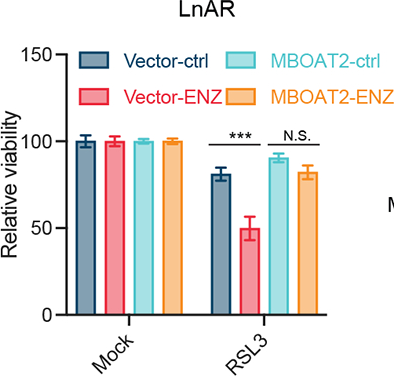
Viability analysis of LnAR cells harboring vector or MBOAT2 overexpression. Cells were pretreated with DMSO (ctrl) or 5 μM ENZ (Enzalutamide) for 48 h, followed by 1 μM RSL3 for 24 h.
Enzalutamide purchased from MedChemExpress. Usage Cited in: Cell. 2023 Jun 22;186(13):2748-2764.e22. [Abstract]
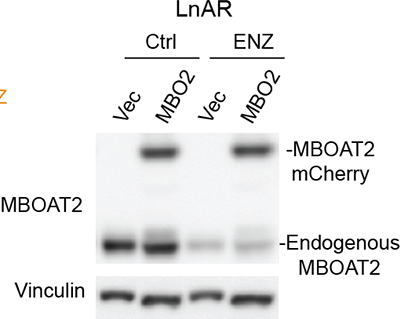
Western blot showing expression of endogenous and ectopic MBOAT2 in LnAR cells harboring either vector control or MBOAT2-mCherry. Cells were treated with 5 μM ENZ (Enzalutamide) as indicated for 48 h.
-
Cancer Discov
Serotonin modulates lineage plasticity in neuroendocrine prostate cancer via epigenetic reprogramming. [Abstract]2025 Dec 19. PMID: 41416996 -
Cancer Discov
The Master Neural Transcription Factor BRN2 Is an Androgen Receptor-Suppressed Driver of Neuroendocrine Differentiation in Prostate Cancer. [Abstract]2017 Jan;7(1):54-71. PMID: 27784708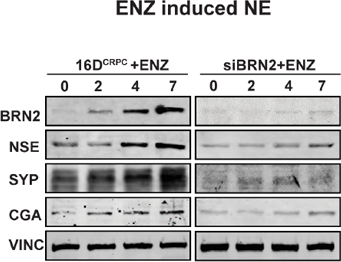
Enzalutamide purchased from MedChemExpress. Usage Cited in: Cancer Discov. 2017 Jan;7(1):54-71. [Abstract]
BRN2 expression inversely correlates with PSA in human PCa and is induced by ENZ. Protein and relative mRNA expression of BRN2, SYP, NSE, CGA, and VINC in siScr and 796 siBRN2 16DCRPC cells treated -/+ 10 μM ENZ for 2, 4 or 7 days.
-
Cancer Res
2026 Jan 13. PMID: 41529070 -
Cancer Res
Malonyl-CoA Promotes Prostate Cancer Progression and Castration Resistance by Enhancing Lipogenesis and Ran Activation. [Abstract]2025 Aug 27. PMID: 40865048 -
Cancer Res
Caloric Restriction Enhances the Efficacy of Anti-Androgen Therapy in Prostate Cancer by Inhibiting Androgen Receptor Translation. [Abstract]2025 Aug 8. PMID: 40779415 -
Cancer Res
Loss of a Negative Feedback Loop between IRF8 and AR Promotes Prostate Cancer Growth and Enzalutamide Resistance. [Abstract]2020 Jul 1;80(13):2927-2939. PMID: 32341037 -
Cancer Res
Heterochromatin Protein 1α Mediates Development and Aggressiveness of Neuroendocrine Prostate Cancer. [Abstract]2018 May 15;78(10):2691-2704. PMID: 29487201 -
Cancer Res
UGT2B17 Expedites Progression of Castration-Resistant Prostate Cancers by Promoting Ligand-Independent AR Signaling. [Abstract]2016 Nov 15;76(22):6701-6711. PMID: 27659047 -
Cancer Res
Cotargeting Androgen Receptor and Clusterin Delays Castrate-Resistant Prostate Cancer Progression by Inhibiting Adaptive Stress Response and AR Stability. [Abstract]2013 Aug 15;73(16):5206-17. PMID: 23786771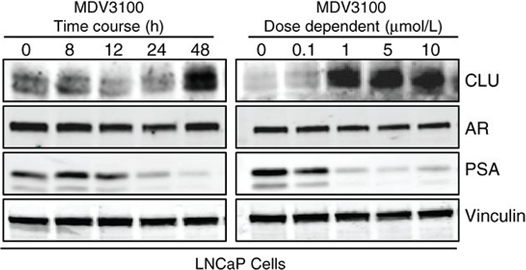
Enzalutamide purchased from MedChemExpress. Usage Cited in: Cancer Res. 2013 Aug 15;73(16):5206-17. [Abstract]
CLU is induced by MDV3100 in time- and dose-dependent manner. LNCaP cells are treated with MDV3100 at indicated time (left) or concentration (right) and Western blot analysis is conducted with CLU, AR, and PSA antibodies.
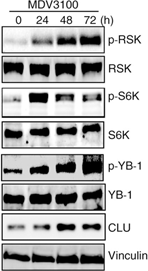
Enzalutamide purchased from MedChemExpress. Usage Cited in: Cancer Res. 2013 Aug 15;73(16):5206-17. [Abstract]
MDV3100-induced CLU is mediated via p90Rsk-YB-1 signaling pathway. MDV3100 activates AKT and MAPK pathways. LNCaP cells are treated with 10 μM MDV3100 for indicated times and Western blotted using CLU, p-Rsk/R/Rsk, p-S6K/S6K, and pYB-1/YB-1. Vinculin is used as a loading control.
-
Nat Commun
C2orf74 orchestrates germ-Leydig crosstalk to inhibit white adipose tissue browning in male mice. [Abstract]2026 May 21. PMID: 42168221 -
Nat Commun
AR+TREM2+ macrophage induced pathogenic immunosuppression promotes prostate cancer progression. [Abstract]2025 Jul 29;16(1):6964. PMID: 40730555 -
Nat Commun
Epigenome-wide impact of MAT2A sustains the androgen-indifferent state and confers synthetic vulnerability in ERG fusion-positive prostate cancer. [Abstract]2024 Aug 6;15(1):6672. PMID: 39107274 -
Nat Commun
Opposing transcriptional programs of KLF5 and AR emerge during therapy for advanced prostate cancer. [Abstract]2021 Nov 4;12(1):6377. PMID: 34737261 -
Nat Commun
Single-cell ATAC and RNA sequencing reveal pre-existing and persistent cells associated with prostate cancer relapse. [Abstract]2021 Sep 6;12(1):5307. PMID: 34489465 -
Nat Commun
The MAO inhibitors phenelzine and clorgyline revert enzalutamide resistance in castration resistant prostate cancer. [Abstract]2020 Jun 1;11(1):2689. PMID: 32483206 -
Nat Commun
Genetic characterization of a unique neuroendocrine transdifferentiation prostate circulating tumor cell-derived eXplant model. [Abstract]2020 Apr 20;11(1):1884. PMID: 32313004 -
Nat Commun
Androgen deprivation upregulates SPINK1 expression and potentiates cellular plasticity in prostate cancer. [Abstract]2020 Jan 20;11(1):384. PMID: 31959826 -
Nat Chem Biol
2025 Aug;21(8):1226-1237. PMID: 39870764 -
Theranostics
A transcriptional biosensor to monitor single cancer cell therapeutic responses by bioluminescence microscopy. [Abstract]2022 Jan 1;12(2):474-492. PMID: 34976196 -
Theranostics
ACSS3 represses prostate cancer progression through downregulating lipid droplet-associated protein PLIN3. [Abstract]2021 Jan 1;11(2):841-860. PMID: 33391508 -
Acta Pharm Sin B
A novel inhibitor of ARfl and ARv7 induces protein degradation to overcome enzalutamide resistance in advanced prostate cancer. [Abstract]2022 Nov;12(11):4165-4179. PMID: 36386477 -
J Biomed Sci
Reciprocal deregulation of NKX3.1 and AURKA axis in castration-resistant prostate cancer and NEPC models. [Abstract]2021 Oct 8;28(1):68. PMID: 34625072 -
J Clin Invest
Targeting Wnt/β-Catenin and circadian regulator restores PRC2/EZH2 controlled chromatin bivalency and suppresses cell state diversity. [Abstract]2026 Mar 17:e200260. PMID: 41842971 -
J Clin Invest
2024 Aug 15;134(18):e175023. PMID: 39146021 -
J Exp Clin Cancer Res
PAX6 promotes neuroendocrine phenotypes of prostate cancer via enhancing MET/STAT5A-mediated chromatin accessibility. [Abstract]2024 May 15;43(1):144. PMID: 38745318 -
J Exp Clin Cancer Res
The DNA/RNA helicase DHX9 contributes to the transcriptional program of the androgen receptor in prostate cancer. [Abstract]2022 May 19;41(1):178. PMID: 35590370 -
J Exp Clin Cancer Res
PPFIA4 promotes castration-resistant prostate cancer by enhancing mitochondrial metabolism through MTHFD2. [Abstract]2022 Apr 5;41(1):125. PMID: 35382861 -
J Clin Invest
Ivermectin inhibits HSP27 and potentiates efficacy of oncogene targeting in tumor models. [Abstract]2020 Feb 3;130(2):699-714. PMID: 31845908 -
Adv Sci (Weinh)
EP300-Mediated MTF1-K218 Lactylation Buffers AR-Driven Copper Overload to Suppress Cuproptosis in Castration-Resistant Prostate Cancer. [Abstract]2026 Aug 11:e77110. PMID: 42579622 -
Adv Sci (Weinh)
Cancer Cell-Intrinsic Cholesterol Induces Lipid-Associated Macrophage Differentiation via SP1 Palmitoylation to Promote Prostate Cancer Progression. [Abstract]2026 Apr;13(19):e08588. PMID: 41603134 -
Adv Sci (Weinh)
GNL3 Orchestrates AR Transcriptional Programs to Drive Castration-Resistant Prostate Cancer and Immune Evasion. [Abstract]2026 Mar 2:e16411. PMID: 41772945 -
Adv Sci (Weinh)
Primary Cilia Formation Mediated by Hsa_Circ_0005185/OTUB1/RAB8A Complex Inhibits Prostate Cancer Progression by Suppressing Hedgehog Signaling Pathway. [Abstract]2025 Feb;12(8):e2411675. PMID: 39785769 -
Adv Sci (Weinh)
Osteoblast-Derived ECM1 Promotes Anti-Androgen Resistance in Bone Metastatic Prostate Cancer. [Abstract]2025 Jan;12(2):e2407662. PMID: 39563492 -
Adv Sci (Weinh)
Enzalutamide Sensitizes Castration-Resistant Prostate Cancer to Copper-Mediated Cell Death. [Abstract]2024 Aug;11(30):e2401396. PMID: 38859590 -
Adv Sci (Weinh)
Identification of PRDX5 as A Target for The Treatment of Castration-Resistant Prostate Cancer. [Abstract]2024 Mar;11(9):e2304939. PMID: 38115765 -
Cell Rep Med
Epigenetic profiling identifies markers of endocrine resistance and therapeutic options for metastatic castration-resistant prostate cancer. [Abstract]2025 Jul 15;6(7):102215. PMID: 40609538 -
Cell Rep Med
CAN-Scan: A multi-omic phenotype-driven precision oncology platform identifies prognostic biomarkers of therapy response for colorectal cancer. [Abstract]2025 Apr 15;6(4):102053. PMID: 40187357 -
Sci Adv
Acute BRCAness induction and AR pathway blockage through CDK12/7/9 degradation enhances PARP inhibitor sensitivity in prostate cancer. [Abstract]Sci Adv. 2025 Apr 25;11(17):eadu0847. PMID: 40267193 -
Sci Adv
2024 Feb 9;10(6):eadi4935. PMID: 38335292 -
Sci Adv
A MYC inhibitor selectively alters the MYC and MAX cistromes and modulates the epigenomic landscape to regulate target gene expression. [Abstract]2022 Apr 29;8(17):eabh3635. PMID: 35476451 -
Mol Biomed
Targeting the RNA-binding motif protein 15 suppresses prostate cancer progression and hormone therapy resistance by promoting androgen receptor degradation. [Abstract]2026 Apr 8;7(1):47. PMID: 41949706 -
Mol Biomed
Histone methyltransferase KMT2D targets the SPOP-G3BP1 axis to enhance AR stability and drive castration-resistant prostate cancer progression. [Abstract]2025 Nov 17;6(1):112. PMID: 41247636 -
-
Cell Death Dis
2024 Jul 18;15(7):513. PMID: 39025852 -
Cell Death Dis
A potassium-chloride co-transporter promotes tumor progression and castration resistance of prostate cancer through m6A reader YTHDC1. [Abstract]2023 Jan 6;14(1):7. PMID: 36609444 -
Cell Death Dis
N-glycosylation of GDF15 abolishes its inhibitory effect on EGFR in AR inhibitor-resistant prostate cancer cells. [Abstract]2022 Jul 19;13(7):626. PMID: 35853851 -
Cell Death Dis
2021 Jul 27;12(8):740. PMID: 34315855 -
Cell Death Dis
2014 Jul 17;5(7):e1338. PMID: 25032861 -
Cancer Lett
Selectively targeting the dimerization interface of human androgen receptor with small-molecules to treat castration-resistant prostate cancer. [Abstract]2018 Nov 28:437:35-43. PMID: 30165195 -
Int J Biol Sci
PiRNA-4447944 promotes castration-resistant growth and metastasis of prostate cancer by inhibiting NEFH expression through forming the piRNA-4447944-PIWIL2-NEFH complex. [Abstract]2024 Jul 1;20(9):3638-3655. PMID: 38993562 -
Int J Biol Sci
Combined Androgen receptor blockade overcomes the resistance of breast cancer cells to palbociclib. [Abstract]2019 Jan 1;15(3):522-532. PMID: 30745839 -
Cell Commun Signal
Reciprocal regulation between RACGAP1 and AR contributes to endocrine therapy resistance in prostate cancer. [Abstract]2024 Jun 19;22(1):339. PMID: 38898473 -
Cell Commun Signal
Cancer-associated fibroblasts promote prostate tumor growth and progression through upregulation of cholesterol and steroid biosynthesis. [Abstract]2020 Jan 24;18(1):11. PMID: 31980029 -
Cell Commun Signal
MIIP inhibits the growth of prostate cancer via interaction with PP1α and negative modulation of AKT signaling. [Abstract]2019 May 15;17(1):44. PMID: 31092266 -
EBioMedicine
Preclinical study using androgen receptor (AR) degradation enhancer to increase radiotherapy efficacy via targeting radiation-increased AR to better suppress prostate cancer progression. [Abstract]2019 Feb:40:504-516. PMID: 30692044 -
Clin Cancer Res
2017 Nov 15;23(22):6923-6933. PMID: 28899970 -
Clin Cancer Res
siRNA Lipid Nanoparticle Potently Silences Clusterin and Delays Progression When Combined with Androgen Receptor Cotargeting in Enzalutamide-Resistant Prostate Cancer. [Abstract]2015 Nov 1;21(21):4845-55. PMID: 26106075 -
Clin Cancer Res
Generation 2.5 antisense oligonucleotides targeting the androgen receptor and its splice variants suppress enzalutamide-resistant prostate cancer cell growth. [Abstract]2015 Apr 1;21(7):1675-87. PMID: 25634993 -
Clin Cancer Res
Applications of immunoPET: using 124I-anti-PSCA A11 minibody for imaging disease progression and response to therapy in mouse xenograft models of prostate cancer. [Abstract]2014 Dec 15;20(24):6367-78. PMID: 25326233 -
Cell Death Discov
Tautomycin and enzalutamide combination yields synergistic effects on castration-resistant prostate cancer. [Abstract]2022 Nov 29;8(1):471. PMID: 36446767 -
NPJ Precis Oncol
Transcriptional profiling clarifies a program of enzalutamide extreme non-response in lethal prostate cancer. [Abstract]2025 Jul 7;9(1):223. PMID: 40624104 -
NPJ Precis Oncol
Optimized culturing yields high success rates and preserves molecular heterogeneity, enabling personalized screening for high-grade gliomas. [Abstract]2025 May 27;9(1):156. PMID: 40425813 -
J Transl Med
A novel lncRNA FLJ promotes castration resistance in prostate cancer through AR mediated autophagy. [Abstract]2025 Mar 3;23(1):255. PMID: 40033417 -
Sci China Life Sci
Androgen induces 3'UTR shortening of de novo lipogenesis genes by alternative polyadenylation in prostate cancer cells. [Abstract]2025 Jul 8. PMID: 40643802 -
Proc Natl Acad Sci U S A
A PHF19-YTHDC1 condensate switches EZH2-mediated gene suppression to activation for prostate cancer progression. [Abstract]2025 Oct 28;122(43):e2510386122. PMID: 41129231 -
Proc Natl Acad Sci U S A
Androgen receptors in corticotropin-releasing hormone neurons mediate the sexual dimorphism in restraint-induced thymic atrophy. [Abstract]2025 Mar 25;122(12):e2426107122. PMID: 40106355 -
Oncogene
Chaperone-mediated autophagy promotes PCa survival during ARPI through selective proteome remodeling. [Abstract]2023 Mar;42(10):748-758. PMID: 36611121 -
Oncogene
TRIM59 is suppressed by androgen receptor and acts to promote lineage plasticity and treatment-induced neuroendocrine differentiation in prostate cancer. [Abstract]2023 Feb;42(8):559-571. PMID: 36544044 -
Oncogene
RUVBL1 promotes enzalutamide resistance of prostate tumors through the PLXNA1-CRAF-MAPK pathway. [Abstract]2022 Jun;41(23):3239-3250. PMID: 35508542 -
Oncogene
Targeting a splicing-mediated drug resistance mechanism in prostate cancer by inhibiting transcriptional regulation by PKCβ1. [Abstract]2022 Mar;41(11):1536-1549. PMID: 35087237 -
Oncogene
Circular RNAs add diversity to androgen receptor isoform repertoire in castration-resistant prostate cancer. [Abstract]2019 Nov;38(45):7060-7072. PMID: 31409897 -
Oncogene
Non-canonical activation of hedgehog in prostate cancer cells mediated by the interaction of transcriptionally active androgen receptor proteins with Gli3. [Abstract]2018 Apr;37(17):2313-2325. PMID: 29429990 -
Oncogene
2014 Jun 12;33(24):3140-50. PMID: 23851510 -
Apoptosis
Insulin-like growth factor binding protein-3 serves as a biomarker for resistance to enzalutamide in prostate cancer. [Abstract]2026 Mar 22;31(4):109. PMID: 41866645 -
Apoptosis
Loss of AR-regulated AFF3 contributes to prostate cancer progression and reduces ferroptosis sensitivity by downregulating ACSL4 based on single-cell sequencing analysis. [Abstract]2024 Oct;29(9-10):1679-1695. PMID: 38478171 -
Int J Biol Macromol
Prebiotic stachyose inhibits PRDX5 activity and castration-resistant prostate cancer development. [Abstract]2024 Oct;278(Pt 3):134844. PMID: 39168191 -
NPJ Breast Cancer
Transcriptomic analysis to uncover the mechanism of radiosensitization of AR-positive triple-negative breast cancers with AR inhibition. [Abstract]2026 Feb 24. PMID: 41735341 -
EMBO J
2023 Feb 15;42(4):e112184. PMID: 36588499 -
Antioxidants (Basel)
Characterization of the Peroxisomal Proteome and Redox Balance in Human Prostate Cancer Cell Lines. [Abstract]2024 Nov 1;13(11):1340. PMID: 39594482 -
Clin Transl Med
Androgen-repressed lncRNA LINC01126 drives castration-resistant prostate cancer by regulating the switch between O-GlcNAcylation and phosphorylation of androgen receptor. [Abstract]2024 Jan;14(1):e1531. PMID: 38214432 -
Clin Transl Med
Melatonin inhibits lipid accumulation to repress prostate cancer progression by mediating the epigenetic modification of CES1. [Abstract]2021 Jun;11(6):e449. PMID: 34185414 -
-
Br J Cancer
Nuclear FGF2, androgen receptor and Wnt pathway activation define a targetable subset of antiprogestin-resistant luminal breast cancer. [Abstract]2026 Jun;134(11):1671-1682. PMID: 41935240 -
Br J Cancer
Senescence-related gene signature predicts prostate cancer progression and identifies PCNA as a therapeutic target via multi-omics machine learning integration. [Abstract]2025 Dec 18. PMID: 41407876 -
Br J Cancer
Elevated serum levels of GPX4, NDUFS4, PRDX5, and TXNRD2 as predictive biomarkers for castration resistance in prostate cancer patients: an exploratory study. [Abstract]2025 Apr;132(6):543-557. PMID: 39900986 -
Br J Cancer
Androgen and oestrogen receptor co-expression determines the efficacy of hormone receptor-mediated radiosensitisation in breast cancer. [Abstract]2022 Sep;127(5):927-936. PMID: 35618789 -
Cell Rep
HOXD11-NMDAR signaling drives neuroendocrine prostate cancer and enables potential therapeutic intervention as a target of memantine. [Abstract]2026 May 12;45(5):117330. PMID: 42126948 -
Cell Rep
Numb/Parkin-directed mitochondrial fitness governs cancer cell fate via metabolic regulation of histone lactylation. [Abstract]2023 Jan 30;42(2):112033. PMID: 36724072 -
Eur J Nucl Med Mol Imaging
Preclinical and first-in-human evaluation of novel androgen receptor-targeted PET imaging in prostate cancer. [Abstract]2025 Sep 23. PMID: 40986091 -
Chin Med
Atractylenolide I ameliorated the growth and enzalutamide resistance of castration-resistant prostate cancer by targeting KIF15. [Abstract]2025 Mar 14;20(1):35. PMID: 40087774 -
Int J Oncol
Enzalutamide inhibits proliferation of gemcitabine-resistant bladder cancer cells with increased androgen receptor expression. [Abstract]2017 Jan;50(1):75-84. PMID: 27909718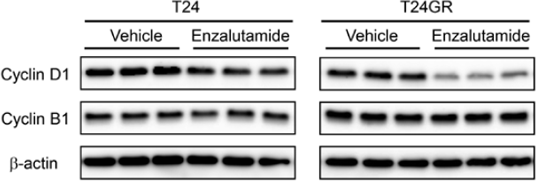
Enzalutamide purchased from MedChemExpress. Usage Cited in: Int J Oncol. 2017 Jan;50(1):75-84. [Abstract]
Effects of culture in CSS and treatment with Enzalutamide on cell cycle of T24GR cells. T24 and T24GR cells (5x10⁵) are seeded in a 6-well plate and cultured for 24 h. The culture medium is changed to that containing 50 μM Enzalutamide or vehicle (DMSO). Seventy-two hours later, cell lysates are harvested and subjected to western blot analysis for cyclin B1, D1 and β-actin.
-
Sci Signal
The kinase PLK1 promotes Hedgehog signaling-dependent resistance to the antiandrogen enzalutamide in metastatic prostate cancer. [Abstract]2025 Mar 18;18(878):eadi5174. PMID: 40100956 -
Cancer Cell Int
Abiraterone and MDV3100 inhibits the proliferation and promotes the apoptosis of prostate cancer cells through mitophagy. [Abstract]2019 Dec 10:19:332. PMID: 31827406 -
Mol Cancer Ther
Enzalutamide-Induced Feed-Forward Signaling Loop Promotes Therapy-Resistant Prostate Cancer Growth Providing an Exploitable Molecular Target for Jak2 Inhibitors. [Abstract]2020 Jan;19(1):231-246. PMID: 31548294 -
Mol Cancer Ther
Bypassing Drug Resistance Mechanisms of Prostate Cancer with Small Molecules that Target Androgen Receptor-Chromatin Interactions. [Abstract]2017 Oct;16(10):2281-2291. PMID: 28775145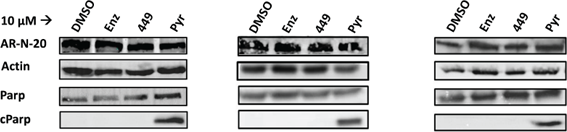
Enzalutamide purchased from MedChemExpress. Usage Cited in: Mol Cancer Ther. 2017 Oct;16(10):2281-2291. [Abstract]
Top-Cells (RPMI+CSS) are co-transfected with ARR3tk-Luc and Renilla-Luc plasmids (48 hrs). With the exception of 22Rv1, 0.1 nM R1881 is used to stimulate the AR, followed by compound treatment (24 hrs). 100% refers to normalized luminescence without compound (DMSO vehicle). Curves are fitted to a sigmoid dose-response with variable slope equation (GraphPad).
-
Mol Cancer Ther
2016 Sep;15(9):2107-18. PMID: 27390342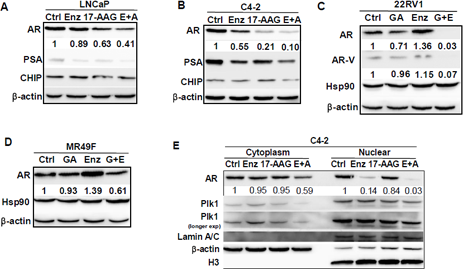
Enzalutamide purchased from MedChemExpress. Usage Cited in: Mol Cancer Ther. 2016 Sep;15(9):2107-18. [Abstract]
Combination of Enzalutamide and 17-AAG lead to decreased AR protein level and transcriptional activity. (A&B) LNCaP (A) and C4-2 (B) cells are treated as indicated for 24 hr, followed by IB against AR, PSA and CHIP. (C&D) 22RV1 (C) and MR49F (D) cells are treated as indicated for 24 hr, followed by IB against AR and HSP90. (E) C4-2 cells are treated as indicated for 24 hr, fractionated into cytoplasm and nuclear, followed by IB against AR and Plk1.
-
Mol Cancer Ther
Inhibition of Stat5a/b Enhances Proteasomal Degradation of Androgen Receptor Liganded by Antiandrogens in Prostate Cancer. [Abstract]2015 Mar;14(3):713-26. PMID: 25552366 -
Mol Cancer Ther
A novel antiandrogen, Compound 30, suppresses castration-resistant and MDV3100-resistant prostate cancer growth in vitro and in vivo. [Abstract]2013 May;12(5):567-76. PMID: 23493310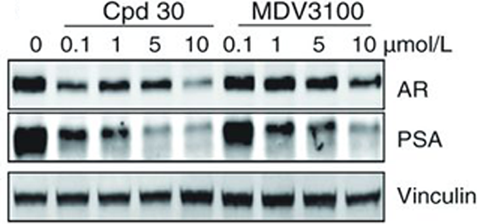
Enzalutamide purchased from MedChemExpress. Usage Cited in: Mol Cancer Ther. 2013 May;12(5):567-76. [Abstract]
LNCaP cells are treated with Compound 30 or MDV3100 for 24 hours; AR and PSA are analyzed by Western blot analysis; Vinculin is used as a loading control.
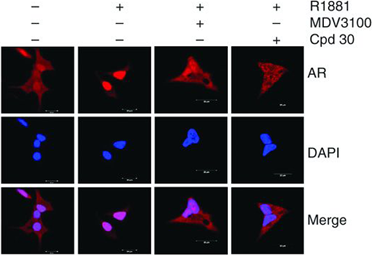
Enzalutamide purchased from MedChemExpress. Usage Cited in: Mol Cancer Ther. 2013 May;12(5):567-76. [Abstract]
LNCaP cells are maintained in androgen-deprived conditions for 24 hours and treated with 10 μM Compound 30 or MDV3100 for 2 hours followed by addition of 1 nM of R1881. After 15 minutes incubation, cells are fixed and AR localization is assessed by immunofluorescence imaging.
-
Antioxid Redox Signal
Androgen Receptor Mediates Dopamine Agonist Resistance by Regulating Intracellular Reactive Oxygen Species in Prolactin-Secreting Pituitary Adenoma. [Abstract]2025 Jun;42(16-18):954-972. PMID: 39360800 -
JCI Insight
Targeting castration-resistant prostate cancer with androgen receptor antisense oligonucleotide therapy. [Abstract]2019 Sep 5;4(17):e122688. PMID: 31484823 -
Eur J Med Chem
Small molecule-induced degradation of the full length and V7 truncated variant forms of human androgen receptor. [Abstract]2018 Sep 5:157:1164-1173. PMID: 30193215
Enzalutamide purchased from MedChemExpress. Usage Cited in: Eur J Med Chem. 2018 Sep 5:157:1164-1173. [Abstract]
Dose-response curves of active degraders and Enzalutamide on AR transcriptional activity as measured in LNCaP-eGFP cells following 0.1 nM R1881 for 72 hours in RPMI+CSS media (3 replicates per point). (B) PSA inhibition curves against transcriptional activity of AR as measured from the media of LNCaP-eGFP cells with active degraders and enzalutamide under the same conditions as A.
-
-
Cell Mol Life Sci
ZNF711 promotes enzalutamide resistance through transcriptional and epigenetic modification of the androgen receptor signaling pathway. [Abstract]2026 Feb 9;83(1):103. PMID: 41656388 -
Cell Mol Life Sci
EP300/CREBBP acetyltransferase inhibition limits steroid receptor and FOXA1 signaling in prostate cancer cells. [Abstract]2024 Apr 2;81(1):160. PMID: 38564048 -
Cancer Gene Ther
WTAP stabilized by USP7 contributes to enzalutamide resistance in prostate cancer via mediating AKT m6A-modification. [Abstract]2026 Mar;33(3):277-288. PMID: 41981278 -
Cancer Gene Ther
Targeting the androgen receptor to enhance NK cell killing efficacy in bladder cancer by modulating ADAR2/circ_0001005/PD-L1 signaling. [Abstract]2022 Dec;29(12):1988-2000. PMID: 35915245 -
Biosensors (Basel)
An Extracellular Matrix Overlay Model for Bioluminescence Microscopy to Measure Single-Cell Heterogeneous Responses to Antiandrogens in Prostate Cancer Cells. [Abstract]2024 Apr 5;14(4):175. PMID: 38667168 -
-
Mol Cancer Res
IL8 Expression Is Associated with Prostate Cancer Aggressiveness and Androgen Receptor Loss in Primary and Metastatic Prostate Cancer. [Abstract]2020 Jan;18(1):153-165. PMID: 31604846 -
Mol Cancer Res
SOCS3 Modulates the Response to Enzalutamide and Is Regulated by Androgen Receptor Signaling and CpG Methylation in Prostate Cancer Cells. [Abstract]2016 Jun;14(6):574-85. PMID: 27053681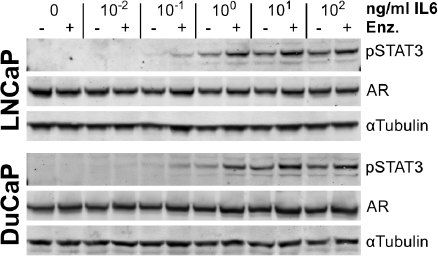
Enzalutamide purchased from MedChemExpress. Usage Cited in: Mol Cancer Res. 2016 Jun;14(6):574-85. [Abstract]
LNCaP and DuCaP cells are 1 treated for 72 hours with 1 or 10 μM Enzalutamide in the presence of increasing IL6 concentrations. The effect on JAK/STAT3 signaling is measured by determining STAT3 Tyr705-phosphorylation via Western blot and calculation of dose response curves.
-
J Endocrinol
2019 Jan;240(1):51-63. PMID: 30400038
Enzalutamide purchased from MedChemExpress. Usage Cited in: J Endocrinol. 2019 Jan;240(1):51-63. [Abstract]
At the protein level, CORT-induced FKBP5 content in both WAT and liver is attenuated with AR antagonism.
-
Int J Mol Sci
Cancer-Associated Fibroblasts Modify the Response of Prostate Cancer Cells to Androgen and Anti-Androgens in Three-Dimensional Spheroid Culture. [Abstract]2016 Sep 1;17(9):1458. PMID: 27598125 -
Toxicology
In silico, In vitro and in vivo studies: Dibutyl phthalate promotes prostate cancer cell proliferation by activating Forkhead Box M1 and remission after Natura-α pretreatment. [Abstract]2023 Apr:488:153465. PMID: 36828243 -
Nanoscale
2017 Jul 13;9(27):9676-9684. PMID: 28675222 -
Target Oncol
FT-6876, a Potent and Selective Inhibitor of CBP/p300, is Active in Preclinical Models of Androgen Receptor-Positive Breast Cancer. [Abstract]2023 Mar;18(2):269-285. PMID: 36826464 -
Sci Rep
2025 Oct 21;15(1):36610. PMID: 41120564 -
Am J Pathol
Testosterone-Induced H3K27 Deacetylation Participates in Granulosa Cell Proliferation Suppression and Pathogenesis of Polycystic Ovary Syndrome. [Abstract]2024 Dec;194(12):2326-2340. PMID: 39243944 -
Mol Pharm
Targeted Delivery of AR-V7 siRNA with Bivalent PSMA Aptamers Effectively Suppresses the Growth of Enzalutamide-Resistant Prostate Cancer. [Abstract]2024 Nov 4;21(11):5749-5760. PMID: 39388218 -
Cancer Sci
SYT4 binds to SNAP25 to facilitate exosomal secretion and prostate cancer enzalutamide resistance. [Abstract]2024 Aug;115(8):2630-2645. PMID: 38889208 -
Sci Rep
Investigation of enzalutamide, docetaxel, and cabazitaxel resistance in the castration resistant prostate cancer cell line C4 using genome-wide CRISPR/Cas9 screening. [Abstract]2023 Jun 3;13(1):9043. PMID: 37270558 -
Int J Cancer
Proteome profiling of enzalutamide-resistant cell lines and serum analysis identified ALCAM as marker of resistance in castration-resistant prostate cancer. [Abstract]2022 Oct 15;151(8):1405-1419. PMID: 35689436 -
Transl Oncol
The STAT3 inhibitor GPB730 enhances the sensitivity to enzalutamide in prostate cancer cells. [Abstract]2022 Oct:24:101495. PMID: 35917644 -
Sci Rep
2019 Sep 24;9(1):13786. PMID: 31551480 -
Sci Rep
2019 May 24;9(1):7826. PMID: 31127190 -
Sci Rep
Maintenance of MYC expression promotes de novo resistance to BET bromodomain inhibition in castration-resistant prostate cancer. [Abstract]2019 Mar 7;9(1):3823. PMID: 30846826 -
Sci Rep
Galiellalactone inhibits the STAT3/AR signaling axis and suppresses Enzalutamide-resistant Prostate Cancer. [Abstract]2018 Nov 23;8(1):17307. PMID: 30470788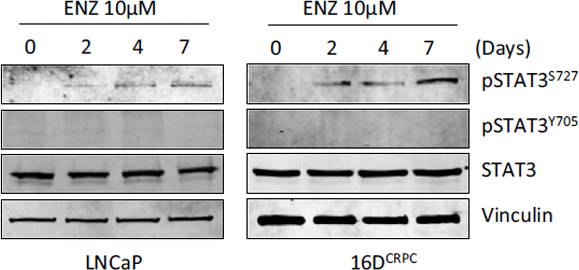
Enzalutamide purchased from MedChemExpress. Usage Cited in: Sci Rep. 2018 Nov 23;8(1):17307. [Abstract]
Western analysis of protein expression in LNCaP and 16D CRPC cells treated with 10 μM ENZ for indicated days.
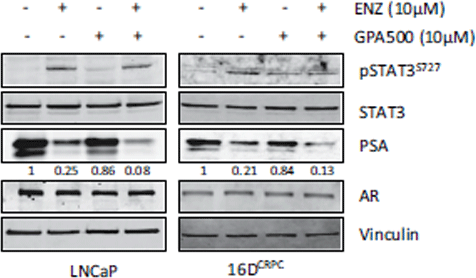
Enzalutamide purchased from MedChemExpress. Usage Cited in: Sci Rep. 2018 Nov 23;8(1):17307. [Abstract]
Protein expression analysis of p-STAT3S727, STAT3, PSA, AR and Vinculin in the treatment of ENZ and GPA500.
-
Sci Rep
Glucocorticoids Induce Stress Oncoproteins Associated with Therapy-Resistance in African American and European American Prostate Cancer Cells. [Abstract]2018 Oct 10;8(1):15063. PMID: 30305646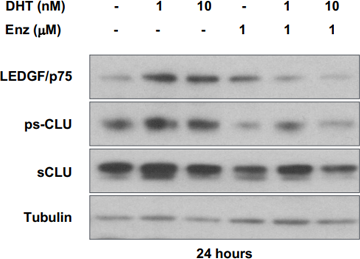
Enzalutamide purchased from MedChemExpress. Usage Cited in: Sci Rep. 2018 Oct 10;8(1):15063. [Abstract]
The increased protein levels of both LEDGF/p75 and CLU are observed in cells treated with either 1 nM or 10 nM DHT, which is attenuated by exposure to 1 μM Enz.
-
Int J Cancer
Pharmacological inhibition of the Notch pathway enhances the efficacy of androgen deprivation therapy for prostate cancer. [Abstract]2018 Aug 1;143(3):645-656. PMID: 29488214
Enzalutamide purchased from MedChemExpress. Usage Cited in: Int J Cancer. 2018 Aug 1;143(3):645-656. [Abstract]
Evaluation of protein expression change of Notch receptors response to the treatment of 10 μM Enzalutamide as an androgen receptor (AR) antagonist.
-
Sci Rep
The Microwell-mesh: A high-throughput 3D prostate cancer spheroid and drug-testing platform. [Abstract]2018 Jan 10;8(1):253. PMID: 29321576 -
Sci Rep
Inhibition of androgen receptor promotes CXC-chemokine receptor 7-mediated prostate cancer cell survival. [Abstract]2017 Jun 8;7(1):3058. PMID: 28596572 -
Sci Rep
2017 Mar 15:7:44409. PMID: 28294122 -
Sci Rep
Bioluminescence Microscopy as a Method to Measure Single Cell Androgen Receptor Activity Heterogeneous Responses to Antiandrogens. [Abstract]2016 Sep 28:6:33968. PMID: 27678181 -
Neoplasia
Targeting the ELF1/EGFR/ERK positive feedback loop overcomes resistance to androgen receptor inhibition in AR-Vs positive prostate cancer. [Abstract]2026 Aug:78:101324. PMID: 42263596 -
Comput Struct Biotechnol J
Identification of a Novel Trifluoromethyl-Bearing Flavonoid as a Promising Androgen Receptor Antagonist: Structure-Based Virtual Screening and In Vitro Study. [Abstract]2026 Apr 13;35(1):0038. PMID: 41993879 -
Neoplasia
A trio of tumor suppressor miRNA downregulates CREB5 dependent transcription to modulate neoadjuvant hormonal therapy sensitivity. [Abstract]2023 Feb:36:100875. PMID: 36603462 -
Cancers (Basel)
Inhibition of Serum Response Factor Improves Response to Enzalutamide in Prostate Cancer. [Abstract]2020 Nov 27;12(12):3540. PMID: 33260953 -
Cancers (Basel)
Dual Inhibitory Action of a Novel AKR1C3 Inhibitor on Both Full-Length AR and the Variant AR-V7 in Enzalutamide Resistant Metastatic Castration Resistant Prostate Cancer. [Abstract]2020 Jul 28;12(8):2092. PMID: 32731472 -
Cancers (Basel)
KLF5 Is Crucial for Androgen-AR Signaling to Transactivate Genes and Promote Cell Proliferation in Prostate Cancer Cells. [Abstract]2020 Mar 21;12(3):748. PMID: 32245249 -
Cancers (Basel)
2020 Feb 12;12(2):428. PMID: 32059441 -
Cell Signal
NUSAP1 mediates enzalutamide resistance in prostate cancer via Wnt/β-catenin signalling-dependent regulation of AR and AR-V7. [Abstract]2026 Oct:146:112690. PMID: 42331201 -
J Cell Mol Med
GOLM1 promotes prostate cancer progression via interaction with PSMD1 and enhancing AR-driven transcriptional activation. [Abstract]2024 Oct;28(20):e70186. PMID: 39470578 -
-
Eur Urol Open Sci
2022 Jul 26:43:35-44. PMID: 36246841 -
Front Physiol
Transcriptional Repression and Protein Degradation of the Ca2+-Activated K+ Channel KCa1.1 by Androgen Receptor Inhibition in Human Breast Cancer Cells. [Abstract]2018 Apr 16:9:312. PMID: 29713287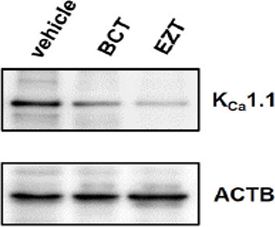
Enzalutamide purchased from MedChemExpress. Usage Cited in: Front Physiol. 2018 Apr 16:9:312. [Abstract]
Protein lysates of vehicle-, 1 μM BCT-, and 1 μM EZT-treated MDA-MB-453 cells are probed by immunoblotting with anti-KCa1.1 (upper panel) and anti-ACTB (lower panel) antibodies on the same filter.
-
Front Biosci (Landmark Ed)
Icariin Attenuates Neuroinflammation and Dopaminergic Degeneration in a Rodent Model of Parkinson's Disease by Promoting the Expansion of Regulatory T Cells. [Abstract]2026 Jun 26;31(6):47325. PMID: 42411473 -
J Biol Chem
The kinesin-14 family motor protein KIFC2 promotes prostate cancer progression by regulating p65. [Abstract]2023 Nov;299(11):105253. PMID: 37716704 -
Lab Invest
Androgen receptor transcriptionally inhibits programmed death ligand-1 (PD-L1) expression and influences immune escape in bladder cancer. [Abstract]2023 Jul;103(7):100148. PMID: 37059268 -
J Biol Chem
Inhibition of cholesterol biosynthesis overcomes enzalutamide resistance in castration-resistant prostate cancer (CRPC). [Abstract]2018 Sep 14;293(37):14328-14341. PMID: 30089652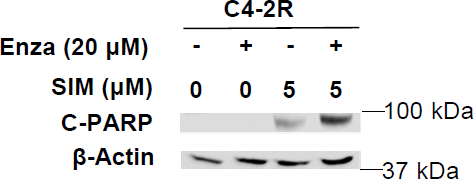
Enzalutamide purchased from MedChemExpress. Usage Cited in: J Biol Chem. 2018 Sep 14;293(37):14328-14341. [Abstract]
C4-2R cells are treated with MK 733, Enzalutamide or combination of the two drugs at the indicated concentrations for 48 hours, followed by Immunoblotting (IB) against cleaved PARP.
-
J Cell Commun Signal
Emerging role of HIC1 in prostate cancer progression and therapeutic response: A novel perspective. [Abstract]2025 Oct 3;19(4):e12032. PMID: 41050263 -
J Immunol
2023 Feb 15;210(4):496-503. PMID: 36548468 -
J Pharm Sci
Characterization of CYP2C Induction in Cryopreserved Human Hepatocytes and Its Application in the Prediction of the Clinical Consequences of the Induction. [Abstract]2018 Sep;107(9):2479-2488. PMID: 29802934 -
Endocrinology
Androgen Receptors Promote Oxidative Phosphorylation and Resistance to Palmitate Lipotoxicity in ER-Mutant Breast Cancer. [Abstract]2025 Dec 5;167(1):bqaf168. PMID: 41216931 -
Endocrinology
MED12 and CDK8/19 Modulate Androgen Receptor Activity and Enzalutamide Response in Prostate Cancer. [Abstract]2024 Aug 27;165(10):bqae114. PMID: 39253786 -
Endocrinology
2023 Mar 13;164(5):bqad033. PMID: 36799021 -
EJNMMI Radiopharm Chem
Radiochemistry and comparative in vitro assessment of PSMA-617 labeled with lead-212 (212Pb), actinium-225 (225Ac), and lutetium-177 (177Lu). [Abstract]2026 May 20. PMID: 42159963 -
-
Drug Metab Dispos
Quantitative clinical risk assessment of CYP2C, UDP-glucuronosyltransferase, P-glycoprotein induction, and complex drug-drug interactions using TruVivo human hepatocyte triculture platform. [Abstract]2025 Apr;53(4):100052. PMID: 40133023 -
-
-
Arch Biochem Biophys
Chemical degrader enhances the treatment of androgen receptor-positive triple-negative breast cancer. [Abstract]2022 May 30;721:109194. PMID: 35337811 -
Bioorg Med Chem
2020 Oct 15;28(20):115712. PMID: 33069070 -
Front Oncol
2021 Feb 23;11:615568. PMID: 33708629 -
J Cancer Res Clin Oncol
Elevated VRK1 levels after androgen deprivation therapy promote prostate cancer progression by upregulating YAP1 expression. [Abstract]2025 Mar 20;151(3):116. PMID: 40111564 -
J Appl Toxicol
Biocompatibility and Toxicity Evaluation of an Elastin-Based Nanogel Carrier for Enzalutamide: Comprehensive Characterization, Controlled Release and Assessment in Zebrafish Embryos. [Abstract]2026 Feb 8. PMID: 41655981 -
Genes (Basel)
DHT-Induced lncRNA AC092718.4 Promotes Prostate Cancer Cell Proliferation via ceRNA Mechanism. [Abstract]2026 May 1;17(5):538. PMID: 42194995 -
J Steroid Biochem Mol Biol
Next-generation steroidogenesis inhibitors, dutasteride and abiraterone, attenuate but still do not eliminate androgen biosynthesis in 22RV1 cells in vitro. [Abstract]2014 Oct:144 Pt B:436-44. PMID: 25201454 -
Mol Biol Cell
SPOP is essential for DNA-protein cross-link repair in prostate cancer cells: SPOP-dependent removal of topoisomerase 2A from the topoisomerase 2A-DNA cleavage complex. [Abstract]2020 Mar 15;31(6):478-490. PMID: 31967940 -
Int J Urol
TP53 loss-of-function causes vulnerability to autophagy inhibition in aggressive prostate cancer. [Abstract]2022 Sep;29(9):1085-1094. PMID: 35975690 -
Medicina (Kaunas)
Stevia eupatoria and Stevia pilosa Extracts Inhibit the Proliferation and Migration of Prostate Cancer Cells. [Abstract]2020 Feb 23;56(2):90. PMID: 32102219 -
Mol Cell Biol
A Genome Wide CRISPR Screen Reveals That HOXA9 Promotes Enzalutamide Resistance in Prostate Cancer. [Abstract]2024;44(12):529-542. PMID: 39300912 -
J Assist Reprod Genet
SIRT5 suppresses the trophoblast cell proliferation, invasion, and migration to promote preeclampsia via desuccinylating HOXB3. [Abstract]2024 Oct;41(10):2759-2770. PMID: 39145876 -
Dig Dis Sci
2017 Dec;62(12):3402-3414. PMID: 29052817 -
PLoS One
Combined AKT and MEK Pathway Blockade in Pre-Clinical Models of Enzalutamide-Resistant Prostate Cancer. [Abstract]2016 Apr 5;11(4):e0152861. PMID: 27046225 -
Prostate
MIF Facilitates Resistance to Androgen Deprivation Therapy by Regulating AMPD2 Expression in Prostate Cancer Cells. [Abstract]2025 Sep 19. PMID: 40968720 -
Prostate
PRMT5:MEP50 Are Mediators of Treatment-Induced Neuroendocrine Differentiation in Prostate Cancer. [Abstract]2025 Sep;85(13):1196-1207. PMID: 40677010 -
Prostate
Androgen receptor and MYC transcriptomes are equilibrated in multilayer regulatory circuitries in prostate cancer. [Abstract]2023 Nov;83(15):1415-1429. PMID: 37565264 -
Prostate
Diptoindonesin G antagonizes AR signaling and enhances the efficacy of antiandrogen therapy in prostate cancer. [Abstract]2022 Jun;82(8):917-932. PMID: 35322879 -
Prostate
NPRL2 enhances autophagy and the resistance to Everolimus in castration-resistant prostate cancer. [Abstract]2019 Jan;79(1):44-53. PMID: 30178500 -
EJNMMI Res
Preclinical evaluation of PSMA expression in response to androgen receptor blockade for theranostics in prostate cancer. [Abstract]2018 Oct 29;8(1):96. PMID: 30374743 -
Prostate
Suppression of LIM and SH3 Domain Protein 1 (LASP1) Negatively Regulated by Androgen Receptor Delays Castration Resistant Prostate Cancer Progression. [Abstract]2017 Feb;77(3):309-320. PMID: 27775154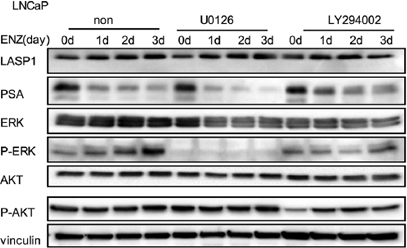
Enzalutamide purchased from MedChemExpress. Usage Cited in: Prostate. 2017 Feb;77(3):309-320. [Abstract]
LNCaP cell are treated with 20 mM LY294002 or 10 mM U0126 for 1 hr before 10 mM of ENZ. Whole-cell extracts are subjected to SDS–PAGE, followed by western blot analysis for the indicated proteins.
-
Prostate
2016 Sep;76(13):1192-202. PMID: 27225803 -
Cancer Genomics Proteomics
SCAMP3 and EPS8 Cooperatively Regulate EGFR Signaling to Promote Enzalutamide Resistance and Metastatic Potential in Prostate Cancer. [Abstract]2025 Nov-Dec;22(6):953-970. PMID: 41151858 -
-
-
Mol Genet Genomics
SND1 regulates the androgen signaling axis by stabilizing EIF3B mRNA to facilitate the deterioration of prostate cancer. [Abstract]2026 Apr 16;301(1):97. PMID: 41986545 -
-
Biomed Pharmacother
2026 Sep 3:203:119891. PMID: 42691574 -
-
-
-
-
-
-
-
-
-
-
-
-
-
-
-
-
bioRxiv
Longitudinal single-cell analysis reveals RUNX1T1 as an early driver in treatment-induced neuroendocrine transdifferentiation. [Abstract]2025 May 18:2025.05.14.653660. PMID: 40463134 -
-
-
-
bioRxiv
Androgen Deprivation-Induced TET2 Activation Fuels Prostate Cancer Progression via Epigenetic Priming and Slow-Cycling Cancer Cells. [Abstract]2025 Mar 29:2025.03.26.645495. PMID: 40196510 -
-
-
-
Biomed Pharmacother
Design, synthesis and biological evaluation of dual inhibitors targeting AR/AR-Vs and PARP1 in castration resistant prostate cancer therapy. [Abstract]2024 Nov:180:117485. PMID: 39326103 -
Aging (Albany NY)
AAT resistance-related AC007405.2 and AL354989.1 as novel diagnostic and prognostic markers in prostate cancer. [Abstract]2024 Apr 19;16(8):7249-7266. PMID: 38643469 -
-
-
-
-
medRxiv
Enhancer profiling identifies epigenetic markers of endocrine resistance and reveals therapeutic options for metastatic castration-resistant prostate cancer patients. [Abstract]2023 Feb 24:2023.02.24.23286403. PMID: 36865297 -
-
-
-
-
-
-
-
Aging (Albany NY)
Preclinical studies show using enzalutamide is less effective in docetaxel-pretreated than in docetaxel-naïve prostate cancer cells. [Abstract]2020 Sep 10;12(17):17694-17712. PMID: 32920545 -
Biomed Pharmacother
Inhibition of autophagy enhances the anticancer effect of enzalutamide on bladder cancer. [Abstract]2019 Dec:120:109490. PMID: 31574376 -
-
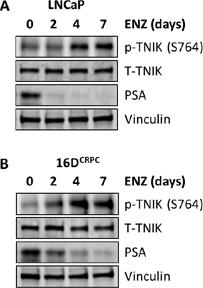
Enzalutamide purchased from MedChemExpress. Usage Cited in: University of British Columbia. 2017 Dec.
p-TNIK (S764), T-TNIK, and PSA protein expression are assessed in (A) LNCaP and 16DCRPC cells that are treated with 10 μM Enzalutamide (ENZ) in media containing 10% FBS for 2, 4, and 7 days by western blot. Vinculin is used as loading control.
-
-
Oncotarget
YAP1 regulates prostate cancer stem cell-like characteristics to promote castration resistant growth. [Abstract]2017 Dec 7;8(70):115054-115067. PMID: 29383141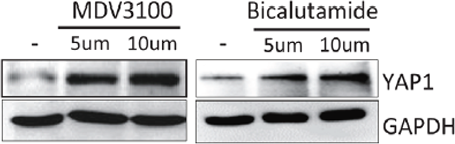
Enzalutamide purchased from MedChemExpress. Usage Cited in: Oncotarget. 2017 Dec 7;8(70):115054-115067. [Abstract]
The levels of YAP1 protein are measured in LNCaP cells treated for 24 h with the AR antagonist MDV3100 (Enzalutamide, 100 nM) and ICI 176334 (10 mM).
-
-
Oncotarget
Integrative molecular network analysis identifies emergent enzalutamide resistance mechanisms in prostate cancer. [Abstract]2017 Nov 20;8(67):111084-111095. PMID: 29340039 -
Oncotarget
Beta-catenin represses protein kinase D1 gene expression by non-canonical pathway through MYC/MAX transcription complex in prostate cancer. [Abstract]2017 Aug 12;8(45):78811-78824. PMID: 29108267 -
Horm Cancer
Role of 20-Hydroxyeicosatetraenoic Acid (20-HETE) in Androgen-Mediated Cell Viability in Prostate Cancer Cells. [Abstract]2017 Aug;8(4):243-256. PMID: 28639228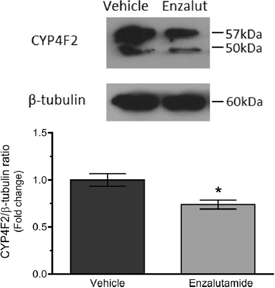
Enzalutamide purchased from MedChemExpress. Usage Cited in: Horm Cancer. 2017 Aug;8(4):243-256. [Abstract]
LNCaP cells are grown in complete media for 24 h in the presence of vehicle (control) or Enzalutamide, 10 μM, and protein expression normalized to β-tubulin.
-
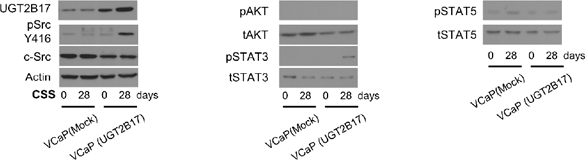
Enzalutamide purchased from MedChemExpress. Usage Cited in: University of British Columbia. 2017 Apr.
VCaP (mock) and VCaP (UGT2B17) cells are cultured in the RPMI1640 medium plus 5% CSS. Cells are treated with vehicle, 10 nM of R1881 or 10 μM of Enzalutamide (ENZ) for 0 or 28 days. Protein levels of UGT2B17, pSrc, tSrc, pAKT, total AKT, pSTAT3, total STAT3, pSTAT5, total STAT5 and β-actin are determined by immunoblotting.
-
Oncotarget
Critical role of androgen receptor level in prostate cancer cell resistance to new generation antiandrogen enzalutamide. [Abstract]2016 Sep 13;7(37):59781-59794. PMID: 27486973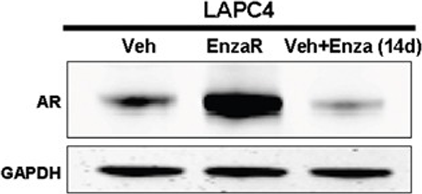
Enzalutamide purchased from MedChemExpress. Usage Cited in: Oncotarget. 2016 Sep 13;7(37):59781-59794. [Abstract]
Short term treatment (14 days) of LAPC4 vehicle cells with 8μM Enzalutamide clearly demonstrates that AR overexpression is not a short term effect of drug treatment but develops as a long term adaptation during acquisition of resistance. It has been suggested that presence of a truncated AR variant (AR-V7) is associated with resistance to Enzalutamide.
-
-
Oncotarget
Cellular androgen content influences enzalutamide agonism of F877L mutant androgen receptor. [Abstract]2016 Jun 28;7(26):40690-40703. PMID: 27276681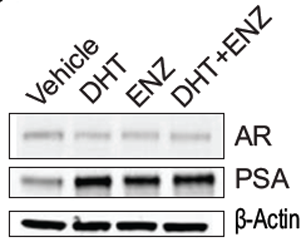
Enzalutamide purchased from MedChemExpress. Usage Cited in: Oncotarget. 2016 Jun 28;7(26):40690-40703. [Abstract]
DHT alone, Enzalutamide alone, or the combination in androgen-depleted conditions also increase expression of canonical AR targets: KLK3, TMPRSS2, and NKX3.1 and increase protein levels of PSA encoded by the KLK3 gene.
-
Oncotarget
Catalytic inhibitors of DNA topoisomerase II suppress the androgen receptor signaling and prostate cancer progression. [Abstract]2015 Aug 21;6(24):20474-84. PMID: 26009876
Enzalutamide purchased from MedChemExpress. Usage Cited in: Oncotarget. 2015 Aug 21;6(24):20474-84. [Abstract]
LNCaP cells are cultured in RPMI1640 medium containing 5% CSS and treated with vehicle, 1 μM of ICRF187 or 1 μM of ICRF193 in addition to vehicle, 10 nM of R1881 or 10 μM of ENZ treatment for 2 hours. Three independent ChIP experiments are performed using the AR antibody. AR protein levels under 2 and 24 hour treatment are detected by Western blotting.
-
Oncotarget
A novel calcium-dependent mechanism of acquired resistance to IGF-1 receptor inhibition in prostate cancer cells. [Abstract]2014 Oct 15;5(19):9007-21. PMID: 25344862 -
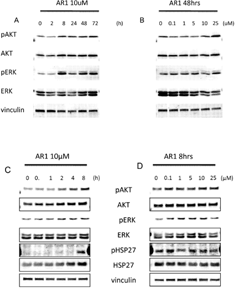
Enzalutamide purchased from MedChemExpress. Usage Cited in: Patent. US20140088178A1.
Effect of AR1 (MDV-3100) administration on AKT and ERK phosphorylation and protein levels in LNCaP cells. (A), 10 μM AR1. (B), after 48 hours of AR1 treatment at indicated concentrations. (C), Dose dependent change of expression level of AKT or ERK after treatment with AR1. (D), Dose dependent change of expression level of AKT or ERK after treatment with AR1.
-


Solvent & Solubility
In Vitro:
DMSO : ≥ 50 mg/mL (107.66 mM; Hygroscopic DMSO has a significant impact on the solubility of product, please use newly opened DMSO)
* "≥" means soluble, but saturation unknown.
Please refer to the solubility information to select the appropriate solvent. Once prepared, please aliquot and store the solution to prevent product inactivation from repeated freeze-thaw cycles.
Storage method and period of stock solution: -80°C, 2 years; -20°C, 1 year. When stored at -80°C, please use it within 2 years. When stored at -20°C, please use it within 1 year.
Please refer to the solubility information to select the appropriate solvent. Once prepared, please aliquot and store the solution to prevent product inactivation from repeated freeze-thaw cycles.
Storage method and period of stock solution: -80°C, 2 years; -20°C, 1 year. When stored at -80°C, please use it within 2 years. When stored at -20°C, please use it within 1 year.
Concentration (start) × Volume (start) = Concentration (final) × Volume (final)
In Vivo:
Select the appropriate dissolution method based on your experimental animal and administration route.
- For the following dissolution methods, please ensure to first prepare a clear stock solution using an In Vitro approach and then sequentially add co-solvents:
- To ensure reliable experimental results, the clarified stock solution can be appropriately stored based on storage conditions. As for the working solution for In Vivo experiments, it is recommended to prepare freshly and use it on the same day.
- The percentages shown for the solvents indicate their volumetric ratio in the final prepared solution. If precipitation or phase separation occurs during preparation, heat and/or sonication can be used to aid dissolution.
Add each solvent one by one: 10% DMSO 40% PEG300 5% Tween-80 45% Saline
Solubility: ≥ 2.5 mg/mL (5.38 mM); Clear solution
This protocol yields a clear solution of ≥ 2.5 mg/mL (saturation unknown).
Taking 1 mL working solution as an example, add 100 μL DMSO stock solution (25.0 mg/mL) to 400 μL PEG300, and mix evenly; then add 50 μL Tween-80 and mix evenly; then add 450 μL Saline to adjust the volume to 1 mL.
Preparation of Saline: Dissolve 0.9 g sodium chloride in ddH₂O and dilute to 100 mL to obtain a clear Saline solution.
For the following dissolution methods, please prepare the working solution directly:
It is recommended to prepare fresh solutions and use them promptly within a short period of time.
The percentages shown for the solvents indicate their volumetric ratio in the final prepared solution. If precipitation or phase separation occurs during preparation, heat and/or sonication can be used to aid dissolution.
Add each solvent one by one: 1% Tween-80 in PBS
Solubility: 10 mg/mL (21.53 mM); Suspended solution; Need ultrasonic and warming and heat to 60°C
In Vivo Dissolution Calculator
Please enter the basic information of animal experiments:
-
-
-
-
Recommended: Prepare an additional quantity of animals to account for potential losses during experiments.
Please enter your animal formula composition:
-
%DMSO +
Recommended: Keep the proportion of DMSO in working solution below 2% if your animal is weak.
-
%+
-
+%Tween-80 + +
-
%Saline +
The co-solvents required include: DMSO, . All of co-solvents are available by MedChemExpress (MCE). , Tween 80. All of co-solvents are available by MedChemExpress (MCE).
Working solution concentration: 0.22 mg/mL
Method for preparing stock solution: mg drug dissolved in μL DMSO. Stock solution concentration: mg/mL.
1. Take μL DMSO stock solution;
2. Add μL .
μL , mix evenly;
3. Then add μL Tween 80, mix evenly;
4. Then add μL
Please ensure that the stock solution in the first step is dissolved to a clear state, and add co-solvents in sequence. You can use ultrasonic heating (ultrasonic cleaner, recommended frequency 20-40 kHz), vortexing, etc. to assist dissolution.


Purity & Documentation
-
Data Sheet (282 KB)
-
SDS (394 KB)
- English - EN (394 KB)
- Français - FR (394 KB)
- Deutsch - DE (394 KB)
- Norwegian - NO (394 KB)
- Español - ES (394 KB)
- Swedish - SV (394 KB)
- Italian - IT (394 KB)
- Korean - KR (394 KB)
- Portuguese - PT (394 KB)
-
Handling Instructions (2659 KB)
References
[1]. Tran C, et al. Development of a second-generation antiandrogen for treatment of advanced prostate cancer. Science, 2009, 324 (5928), 787-790. [Content Brief]
[2]. Scher HI, et al. Antitumour activity of MDV3100 in castration-resistant prostate cancer: a phase 1-2 study. Lancet, 2010, 375(9724), 1437-1446. [Content Brief]
[3]. Guerrero J, et al. Enzalutamide, an androgen receptor signaling inhibitor, induces tumor regression in a mouse model of castration-resistant prostate cancer. Prostate. 2013 Sep;73(12):1291-305. [Content Brief]
[4]. Kim TH, et al. Pharmacokinetics of enzalutamide, an anti-prostate cancer drug, in rats. Arch Pharm Res. 2015 Nov;38(11):2076-82. [Content Brief]


Complete Stock Solution Preparation Table
Please refer to the solubility information to select the appropriate solvent. Once prepared, please aliquot and store the solution to prevent product inactivation from repeated freeze-thaw cycles.
Storage method and period of stock solution: -80°C, 2 years; -20°C, 1 year. When stored at -80°C, please use it within 2 years. When stored at -20°C, please use it within 1 year.
| Optional Solvent | Concentration Solvent Mass | 1 mg | 5 mg | 10 mg | 25 mg |
|---|---|---|---|---|---|
| DMSO | 1 mM | 2.1531 mL | 10.7657 mL | 21.5313 mL | 53.8283 mL |
| 5 mM | 0.4306 mL | 2.1531 mL | 4.3063 mL | 10.7657 mL | |
| 10 mM | 0.2153 mL | 1.0766 mL | 2.1531 mL | 5.3828 mL | |
| 15 mM | 0.1435 mL | 0.7177 mL | 1.4354 mL | 3.5886 mL | |
| 20 mM | 0.1077 mL | 0.5383 mL | 1.0766 mL | 2.6914 mL | |
| 25 mM | 0.0861 mL | 0.4306 mL | 0.8613 mL | 2.1531 mL | |
| 30 mM | 0.0718 mL | 0.3589 mL | 0.7177 mL | 1.7943 mL | |
| 40 mM | 0.0538 mL | 0.2691 mL | 0.5383 mL | 1.3457 mL | |
| 50 mM | 0.0431 mL | 0.2153 mL | 0.4306 mL | 1.0766 mL | |
| 60 mM | 0.0359 mL | 0.1794 mL | 0.3589 mL | 0.8971 mL | |
| 80 mM | 0.0269 mL | 0.1346 mL | 0.2691 mL | 0.6729 mL | |
| 100 mM | 0.0215 mL | 0.1077 mL | 0.2153 mL | 0.5383 mL |


Enzalutamide Related Classifications
HY-70002 Related Classifications
 Powered by Bioz