



Murepavadin
Based on 3 publication(s) in Google Scholar
Murepavadin (POL7080), a 14-amino-acid cyclic peptide, is a highly potent, specific antibiotic. Murepavadin exhibits a potent antimicrobial activity for P. aeruginosa with both MIC50 and MIC90 values of 0.12 mg/L. Murepavadin also can target the lipopolysaccharide transport portin D. Murepavadin can be used for the research of bacterial resistance.
商品は「研究用試薬」です。人や動物の医療用・臨床診断用・食品用の製品ではありません。
研究用途以外に使用した場合、当社は一切の責任を負いかねます。
- CAS 番号: 944252-63-5
- 分子式: C73H112N22O16
- 分子量:1553.81
-
保管条件:
Please store the product under the recommended conditions in the Certificate of Analysis.

To place orders, for customer services and technical support, please contact: MedChemExpress USA
Tel: 609-228-6898 E-mail: [email protected] [email protected]


-
 生物活性
生物活性
-
化学情報
-
溶剤 & 溶解度
- 純度とドキュメンテーション
- 参考文献
-
 Help & FAQs


MedChemExpress(MCE)の使用を引用している文献 Murepavadin
MoreAntibiotic アイソフォーム固有の製品をすべて表示
More

生物活性
MIC50: 0.12 mg/L(P. aeruginosa)[2] MIC90: 0.12 mg/L(P. aeruginosa)[2] IC50: 5.84 μM (gentamicin)[2]
Murepavadin has activity against P. aeruginosa with MIC50 and MIC90 values both of 0.12 mg/L[2].
Murepavadin inhibits megalin-mediated uptake of gentamicin in vitro with an IC50 value of 5.84 μM[2].
MedChemExpress (MCE) has not independently confirmed the accuracy of these methods. They are for reference only.
MedChemExpress (MCE) has not independently confirmed the accuracy of these methods. They are for reference only.
-
Animal Model:murine models of P. aeruginosa infection[2]
-
Dosage:0-100 mg/kg
-
Administration:Subcutaneous, q24h or q12h
-
Result:Resulted in an increase in survival rate to 100% and showed significantly lower CFU levels both in the blood and in the peritoneal fluid at 2 and 10 mg/kg 1 h post-infection.
-
Animal Model:Mouse, rat, rabbit, and monkey[2]
-
Dosage:0-5 mg/kg
-
Administration:Intraperitoneal or subcutaneous, single
-
Result:Followed a two-compartment model following intravenous administration and decline of plasma concentrations.
Distributed into the aqueous phase of the body, and systemic plasma clearance (CL) values were similar to the species-specific glomerular filtration rates (GFRs) .
Had high bioavailability (67.79%) after subcutaneous (s.c.) administration in rats but had low oral bioavailability (<0.01%).
Had a linear relationship between ELF AUC and unbound plasma AUC in mouse.
Did not readily cross the blood/brain barrier.


化学情報
-
CAS 番号 944252-63-5
-
分子量 1553.81
-
分子式 C73H112N22O16
-
別名
POL7080
-
配列
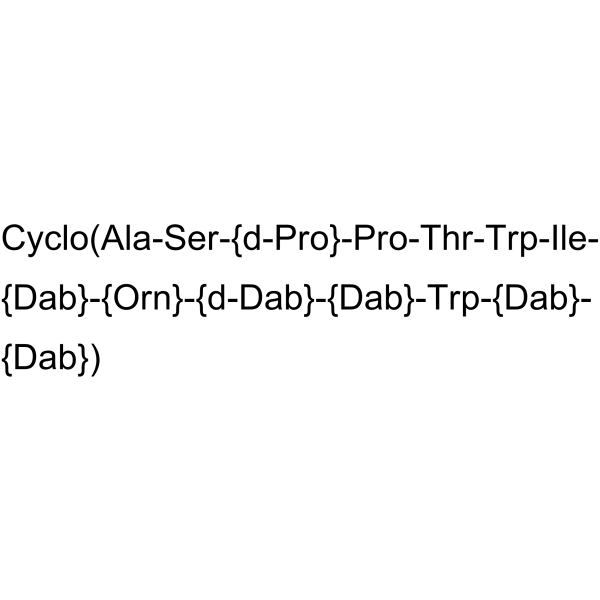
Cyclo(Ala-Ser-{d-Pro}-Pro-Thr-Trp-Ile-{Dab}-{Orn}-{d-Dab}-{Dab}-Trp-{Dab}-{Dab})
-
シーケンスの短縮
Cyclo(AS-{d-Pro}-PTWI-{Dab}-{Orn}-{d-Dab}-{Dab}-W-{Dab}-{Dab})
-
輸送条件
Room temperature in continental US; may vary elsewhere.
-
保管条件
Please store the product under the recommended conditions in the Certificate of Analysis.


Publications (3)
-
Journal Impact Factor
-
Most Recent
-
Front Immunol
Murepavadin, a Small Molecule Host Defense Peptide Mimetic, Activates Mast Cells via MRGPRX2 and MrgprB2. [Abstract]2021 Jun 23:12:689410. PMID: 34248979 -
Microbiol Spectr
Murepavadin induces envelope stress response and enhances the killing efficacies of β-lactam antibiotics by impairing the outer membrane integrity of Pseudomonas aeruginosa. [Abstract]2023 Sep 5;11(5):e0125723. PMID: 37668398 -
J Microbiol Methods
Comparison of agar-based and checkerboard methods to assess phage-antimicrobial synergy in Pseudomonas aeruginosa. [Abstract]2026 Feb 25:107441. PMID: 41759663


溶剤 & 溶解度
H2O
Peptide Solubility and Storage Guidelines:
1. Calculate the length of the peptide.
2. Calculate the overall charge of the entire peptide according to the following table:
| Contents | Assign value | |
|---|---|---|
| Acidic amino acid | Asp (D), Glu (E), and the C-terminal -COOH. | -1 |
| Basic amino acid | Arg (R), Lys (K), His (H), and the N-terminal -NH2 | +1 |
| Neutral amino acid | Gly (G), Ala (A), Leu (L), Ile (I), Val (V), Cys (C), Met (M), Thr (T), Ser (S), Phe (F), Tyr (Y), Trp (W), Pro (P), Asn (N), Gln (Q) | 0 |
3. Recommended solution:
| Overall charge of peptide | Details |
|---|---|
| Negative (<0) |
1. Try to dissolve the peptide in water first. 2. If water fails, add NH4OH (<50 μL). 3. If the peptide still does not dissolve, add DMSO (50-100 μL) to solubilize the peptide. |
| Positive (>0) |
1. Try to dissolve the peptide in water first. 2. If water fails, try dissolving the peptide in a 10%-30% acetic acid solution. 3. If the peptide still does not dissolve, try dissolving the peptide in a small amount of DMSO. |
| Zero (=0) |
1. Try to dissolve the peptide in organic solvent (acetonitrile, methanol, etc.) first. 2. For very hydrophobic peptides, try dissolving the peptide in a small amount of DMSO, and then dilute the solution with water to the desired concentration. |


純度とドキュメンテーション
参考文献

Calculators
濃度 (開始) × 体積 (開始) = 濃度 (終了) × 体積 (終了)


Murepavadin 関連分類
HY-P1674 関連分類
 Powered by Bioz