



Kirromycin
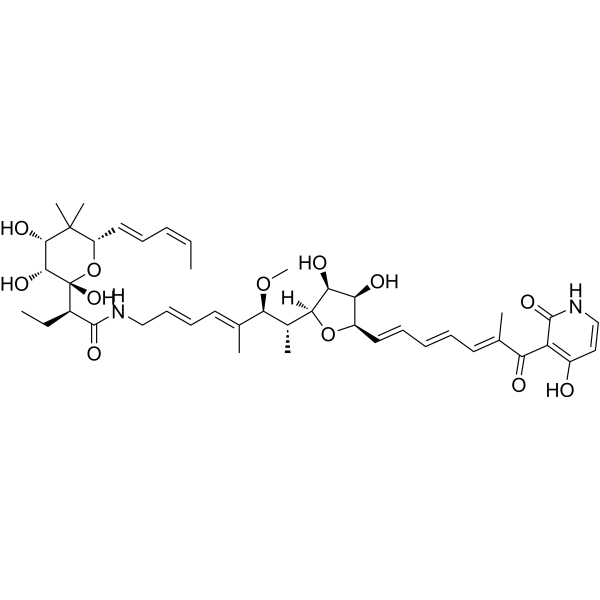
Kirromycin (Mocimycin; Delvomycin) is an elongation factor Tu (EF-Tu) inhibitor targeting protein biosynthesis. As an antibiotic, Kirromycin exerts antibacterial activity against Gram-negative bacteria by acting on EF-Tu to interfere with the peptidyl transfer reaction. Kirromycin is applicable to studies on bacterial infections.
Nur für Forschungszwecke. Wir verkaufen nicht an Patienten.
- CAS. Nr.: 50935-71-2
- Formel: C43H60N2O12
- Molecular Weight:796.94
-
Speicherung:
Please store the product under the recommended conditions in the Certificate of Analysis.

To place orders, for customer services and technical support, please contact: MedChemExpress USA
Tel: 609-228-6898 E-mail: [email protected] [email protected]


-
 Biologische Aktivität
-
Chemical Information
- Protokoll
- Reinheit & Dokumentation
- Verweise
-
 Help & FAQs


Alle Antibiotic Isoform-spezifische Produkte anzeigen
More

Biologische Aktivität
Beschreibung
In Vitro
Kirromycin (5 min) potently inhibits poly (U)-directed polyphenylalanine synthesis in an *E. coli* cell-free translation system, with an IC50 of 5 × 10⁻⁷ M[1].
Kirromycin (5 min) doubles the EF-T-dependent GTP hydrolysis activity, strongly inhibits EF-T-dependent peptide bond formation, and does not alter EF-T-mediated binding of Phe-tRNAPhe to ribosomes in the *Escherichia coli* ribosome assay system[1].
When incubated with EF-T and GTP for 5 min, kirromycin increases the binding amount of [3H]GTP to *Escherichia coli* EF-T to more than three times the original level[1].
Kirromycin (500 pmol; 10 min) induces Escherichia coli EF-T-dependent GTP hydrolysis in the absence of ribosomes or aminoacyl-tRNA; this activity is specifically activated only in the presence of Phe-tRNAPhe (but not uncharged tRNAPhe or Ac-Phe-tRNAPhe); it significantly enhances this activity in the presence of ribosomes; its GTP Km is 2 × 10⁻⁷ M, which is consistent with the GTP Km of ribosome- and Phe-tRNAPhe-dependent EF-T GTPase in the absence of antibiotics[1].
Kirromycin (1 nmol; 5 min) enables EF-T-dependent binding of Phe-tRNAPhe to poly (U)-ribosome complexes in *E. coli* in the absence of GTP, with the amount of [14C]Phe-tRNAPhe bound to ribosomes reaching 3.5 pmol[1].
At 4°C, kirromycin reduces the affinity of *E. coli* EF-Tu-GTP for aa-tRNA by approximately 3 orders of magnitude, resulting in a Kd of 2 μM; it also equalizes the affinity of *E. coli* EF-Tu-GDP for aa-tRNA to a Kd of 7 μM at 4°C, thereby eliminating the significant difference in affinity between EF-Tu-GTP and EF-Tu-GDP for aa-tRNA observed in the absence of this antibiotic[3].
Kirromycin (0.4-26 μM) binds to EF-Tu-GDP (as well as EF-Tu-GTP) from *E. coli* at a 1:1 molar ratio to form a complex, induces conformational changes that increase the net negative charge and electrophoretic mobility of EF-Tu, and exhibits an extremely low dissociation rate[3].
MedChemExpress (MCE) has not independently confirmed the accuracy of these methods. They are for reference only.


Chemical Information
-
CAS. Nr. 50935-71-2
-
Molecular Weight 796.94
-
Formel C43H60N2O12
-
SMILES
O=C(NC/C=C/C=C(C)/[C@@H](OC)[C@H]([C@]([C@H]([C@H]1O)O)([H])O[C@@H]1/C=C/C=C/C=C(C)/C(C(C2=O)=C(C=CN2)O)=O)C)[C@H]([C@@](O[C@H](C(C)3C)/C=C/C=C\C)([C@@H]([C@@H]3O)O)O)CC
-
Synonyms
Mocimycin; Delvomycin
-
Structure Classification
-
Initial Source
Streptomyces collinus Tue 365
-
Versand
Room temperature in continental US; may vary elsewhere.
-
Speicherung
Please store the product under the recommended conditions in the Certificate of Analysis.


Reinheit & Dokumentation
Verweise
[1]. Wolf H, et al. Kirromycin, an inhibitor of protein biosynthesis that acts on elongation factor Tu. Proc Natl Acad Sci U S A. 1974;71(12):4910-4914. [Content Brief]
[2]. Olsthoorn-Tieleman LN, et al. Elongation factor Tu3 (EF-Tu3) from the kirromycin producer Streptomyces ramocissimus Is resistant to three classes of EF-Tu-specific inhibitors. J Bacteriol. 2007;189(9):3581-3590. [Content Brief]
[3]. Abrahams JP, et al. Kirromycin drastically reduces the affinity of Escherichia coli elongation factor Tu for aminoacyl-tRNA. Biochemistry. 1991;30(27):6705-6710. [Content Brief]

Calculators
Konzentration (Stammlösung) × Volumen (Stammlösung) = Konzentration (Ziellösung) × Volumen (Ziellösung)


Kirromycin Related Classifications
HY-122386 Related Classifications
 Powered by Bioz