



Lard oil
Based on 1 publication(s) in Google Scholar
Lard oil is an orally active biochemical reagent. Lard oil upregulates PERK, eIF2a, CHOP, OPN, TLR2, TLR4, TNF-α, and downregulates GRP78 and IRE1a. Lard oil induces responses such as body fat accumulation, elevated serum insulin levels, increased HOMA-IR, hepatic ectopic lipid deposition, hepatic endoplasmic reticulum stress, and hepatic inflammation. Lard oil can be used in studies related to diet-induced obesity, insulin resistance, and non-alcoholic fatty liver disease.
For research use only. We do not sell to patients.
- CAS No.: 8016-28-2
-
Storage:
Please store the product under the recommended conditions in the Certificate of Analysis.

To place orders, for customer services and technical support, please contact: MedChemExpress USA
Tel: 609-228-6898 E-mail: [email protected] [email protected]


-
 Biological Activity
-
Chemical Information
- Protocols
- Purity & Documentation
- References
-
 Help & FAQs


Publications Citing Use of MedChemExpress (MCE) Lard oil
More

Biological Activity
Description
IC50 & Target
[1]|
TLR2 |
TLR4 |
TNF-α |
eIF2-α |
IRE1α |
Cellular Effect
|
Cell Line

|
Type | Value | Description | References |
|---|---|---|---|---|
| CEM-SS | CC50 |
>100 μM
Compound: 9
|
Cytotoxic concentration to inhibit HIV replication in TK CEM-SS cell line and the value is represented as CC50
Cytotoxic concentration to inhibit HIV replication in TK CEM-SS cell line and the value is represented as CC50
|
[PMID: 11425558] |
| CEM-SS | EC50 |
5.2 μM
Compound: 9
|
Effective concentration to inhibit HIV replication in TK CEM-SS cell line and the value is represented as EC50
Effective concentration to inhibit HIV replication in TK CEM-SS cell line and the value is represented as EC50
|
[PMID: 11425558] |
In Vivo
MedChemExpress (MCE) has not independently confirmed the accuracy of these methods. They are for reference only.
-
Animal Model:Sprague-Dawley (male, 120-130 g initial weight, diet-induced obesity model)[1]
-
Dosage:Component of high-fat diet
-
Administration:p.o.; ad libitum daily; 18 weeks (HL/HL group); p.o.; ad libitum daily; 10 weeks followed by low-fat diet for 8 weeks (HL/LF group)
-
Result:Exhibited markedly increased abdominal fat accumulation, body fat ratio, serum insulin and HOMA-IR in the HL/HL group relative to low-fat control and soybean oil-based high-fat diet groups.
Showed the maximal hepatic fat vacuolation and triglyceride levels in the HL/HL group among all experimental groups.
Elevated hepatic inflammatory gene and protein expression of TLR4, TLR2, TNF-α and OPN in the HL/HL group, which were significantly higher than those in soybean oil-treated rats.
Increased multiple endoplasmic reticulum stress and lipogenic markers in the HL/HL group, while significantly downregulating GRP78 protein expression.
Reduced fat deposition, serum insulin level and insulin resistance index in the HL/LF group compared with the HL/HL group.
Decreased hepatic lipid accumulation in the HL/LF group relative to the HL/HL group.
Lowered hepatic inflammatory expression levels in the HL/LF group when compared with the HL/HL group.
Attenuated hepatic endoplasmic reticulum stress and lipogenic activation in the HL/LF group versus the HL/HL group.
-
Animal Model:Wistar Crl(WI)BR rats (male, ~180 g upon arrival, acclimated 1 week until body weight >100% of pre-surgery weight, carotid artery and jugular vein catheter implanted with 4-5 days recovery)[2]
-
Dosage:70 μl/min per kg
-
Administration:i.v.; 4-hour infusion
-
Result:Elevated plasma free fatty acids and major saturated and monounsaturated fatty acid levels compared with control rats.
Enhanced hepatic UPR, IKKβ phosphorylation, inflammatory gene expression, and MIP1α and Mmp12 protein levels relative to control and soybean oil groups.
Augmented adipose UPR activation, IKKβ phosphorylation, inflammatory expression, and MCP1 and haptoglobin protein levels compared with control and soybean oil groups.
Exhibited no significant changes in plasma glucose and insulin levels versus controls.


Chemical Information
-
CAS No. 8016-28-2
-
SMILES
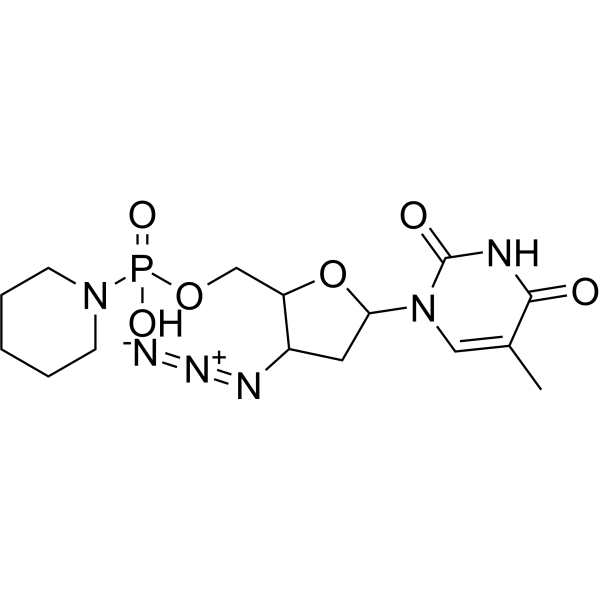
[Lard oil]
-
Shipping
Room temperature in continental US; may vary elsewhere.
-
Storage
Please store the product under the recommended conditions in the Certificate of Analysis.


Publications (1)
-
Journal Impact Factor
-
Most Recent
-
J Ethnopharmacol
Baicalin alleviates pathological changes in Alzheimer's disease comorbid with type 2 diabetes: Targeting metabolic dysregulation and neuroinflammation. [Abstract]2025 Aug 5;353(Pt A):120352. PMID: 40759295


Purity & Documentation
-
Data Sheet (273 KB)
-
SDS (252 KB)
- Français - FR (252 KB)
- Deutsch - DE (252 KB)
- Norwegian - NO (252 KB)
- Español - ES (252 KB)
- Swedish - SV (252 KB)
- Italian - IT (252 KB)
- Korean - KR (252 KB)
- Portuguese - PT (252 KB)
-
Handling Instructions (2659 KB)
References
[1]. Zhao M, et al. Differential responses of hepatic endoplasmic reticulum stress and inflammation in diet-induced obese rats with high-fat diet rich in lard oil or soybean oil. PloS one. 2013;8(11):e78620. [Content Brief]
[2]. Nivala AM, et al. Fatty acid-mediated endoplasmic reticulum stress in vivo: differential response to the infusion of Soybean and Lard Oil in rats. Metabolism: clinical and experimental. 2013 May;62(5):753-60. [Content Brief]

Calculators
Concentration (start) × Volume (start) = Concentration (final) × Volume (final)


Lard oil Related Classifications
HY-W127601 Related Classifications
 Powered by Bioz