



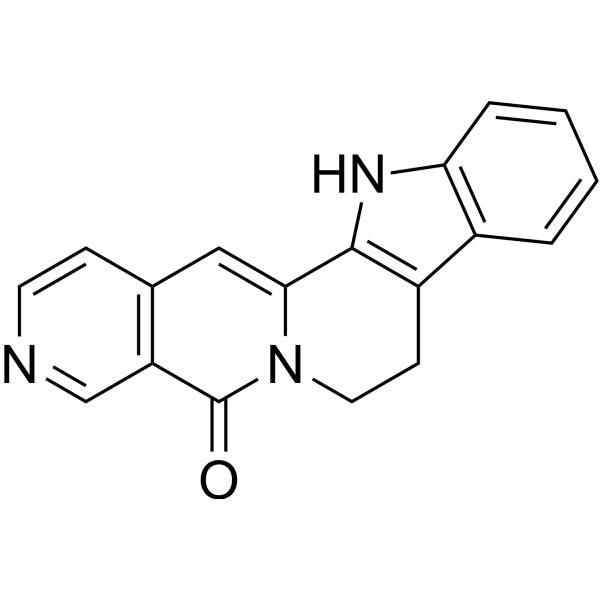
Nauclefine

Based on 1 Customer Validation
Nauclefine is an indole alkaloid isolated from Nauclea officinalis. Nauclefine acts as a PDE3A modulator to induce cancer cell apoptosis through a PDE3A-SLFN12-dependent death pathway.
For research use only. We do not sell to patients.
- Purity : 99.65%
- CAS No.: 57103-51-2
- Formula: C18H13N3O
- Molecular Weight:287.32
-
Storage:Powder -20°C, 3 years ; In solvent -80°C, 6 months , -20°C, 1 month

To place orders, for customer services and technical support, please contact: MedChemExpress USA
Tel: 609-228-6898 E-mail: [email protected] [email protected]


-
 Biological Activity
-
Chemical Information
-
Solvent & Solubility
- Protocols
- Purity & Documentation
- References
-
 Help & FAQs




Biological Activity
Description
In Vitro
Nauclefine (250?nM, 48 h) can inhibit the viability of HeLa cells and induce apoptosis, resulting in cell death dependent on PDE3A and SLFN12. Nauclefine can bind PDE3A, but does not inhibit its phosphodiesterase activity, can promote the interaction between PDE3A and SLFN12, and promote cell death by increasing the stability of SLFN12[1].
MedChemExpress (MCE) has not independently confirmed the accuracy of these methods. They are for reference only.
In Vivo
MedChemExpress (MCE) has not independently confirmed the accuracy of these methods. They are for reference only.


Chemical Information
-
CAS No. 57103-51-2
-
Appearance Solid
-
Molecular Weight 287.32
-
Formula C18H13N3O
-
Color Yellow to orange
-
SMILES
O=C1C2=C(C=C3C4=C(CCN13)C5=C(C=CC=C5)N4)C=CN=C2
-
Structure Classification
-
Shipping
Room temperature in continental US; may vary elsewhere.
-
Storage
Powder -20°C 3 years In solvent -80°C 6 months -20°C 1 month


Solvent & Solubility
In Vitro:
DMSO : 20 mg/mL (69.61 mM; Need ultrasonic and warming; Hygroscopic DMSO has a significant impact on the solubility of product, please use newly opened DMSO)
Please refer to the solubility information to select the appropriate solvent. Once prepared, please aliquot and store the solution to prevent product inactivation from repeated freeze-thaw cycles.
Storage method and period of stock solution: -80°C, 6 months; -20°C, 1 month. When stored at -80°C, please use it within 6 months. When stored at -20°C, please use it within 1 month.
Please refer to the solubility information to select the appropriate solvent. Once prepared, please aliquot and store the solution to prevent product inactivation from repeated freeze-thaw cycles.
Storage method and period of stock solution: -80°C, 6 months; -20°C, 1 month. When stored at -80°C, please use it within 6 months. When stored at -20°C, please use it within 1 month.
Concentration (start) × Volume (start) = Concentration (final) × Volume (final)


Purity & Documentation
-
Data Sheet (274 KB)
-
SDS (393 KB)
- English - EN (393 KB)
- Français - FR (393 KB)
- Deutsch - DE (393 KB)
- Norwegian - NO (393 KB)
- Español - ES (393 KB)
- Swedish - SV (393 KB)
- Italian - IT (393 KB)
- Korean - KR (393 KB)
- Portuguese - PT (393 KB)
-
Handling Instructions (2659 KB)
References


Complete Stock Solution Preparation Table
Please refer to the solubility information to select the appropriate solvent. Once prepared, please aliquot and store the solution to prevent product inactivation from repeated freeze-thaw cycles.
Storage method and period of stock solution: -80°C, 6 months; -20°C, 1 month. When stored at -80°C, please use it within 6 months. When stored at -20°C, please use it within 1 month.
| Optional Solvent | Concentration Solvent Mass | 1 mg | 5 mg | 10 mg | 25 mg |
|---|---|---|---|---|---|
| DMSO | 1 mM | 3.4804 mL | 17.4022 mL | 34.8044 mL | 87.0110 mL |
| 5 mM | 0.6961 mL | 3.4804 mL | 6.9609 mL | 17.4022 mL | |
| 10 mM | 0.3480 mL | 1.7402 mL | 3.4804 mL | 8.7011 mL | |
| 15 mM | 0.2320 mL | 1.1601 mL | 2.3203 mL | 5.8007 mL | |
| 20 mM | 0.1740 mL | 0.8701 mL | 1.7402 mL | 4.3505 mL | |
| 25 mM | 0.1392 mL | 0.6961 mL | 1.3922 mL | 3.4804 mL | |
| 30 mM | 0.1160 mL | 0.5801 mL | 1.1601 mL | 2.9004 mL | |
| 40 mM | 0.0870 mL | 0.4351 mL | 0.8701 mL | 2.1753 mL | |
| 50 mM | 0.0696 mL | 0.3480 mL | 0.6961 mL | 1.7402 mL | |
| 60 mM | 0.0580 mL | 0.2900 mL | 0.5801 mL | 1.4502 mL |


Nauclefine Related Classifications
HY-N10149 Related Classifications
 Powered by Bioz