



Pentacosafluorotridecanoic Acid

Based on 1 Customer Validation
Pentacosafluorotridecanoic Acid (PFTrDA) is a long-chain perfluoroalkyl carboxylic acid with strong endocrine-disrupting activity. Pentacosafluorotridecanoic Acid exhibits estrogenic effects and disrupts vtg1 transcription as well as sex hormone homeostasis in male Danio rerio. Pentacosafluorotridecanoic Acid disturbs steroidogenesis and HPG axis function in a sex-dependent pattern. Pentacosafluorotridecanoic Acid inhibits CYP17A and CYP11A1 to reduce testosterone and increase E2/T ratio in H295R cells. Pentacosafluorotridecanoic Acid triggers gender-specific immunomodulation after prenatal exposure. Pentacosafluorotridecanoic Acid correlates with lower eczema risk in female infants. Pentacosafluorotridecanoic Acid can be used for the research of endocrine disruption and eczema.
For research use only. We do not sell to patients.
- Purity : 95.0%
- CAS No.: 72629-94-8
- Formula: C₁₃HF₂₅O₂
- Molecular Weight:664.11
-
Storage:Powder -20°C, 3 years , 4°C, 2 years ; In solvent -80°C, 6 months , -20°C, 1 month


To place orders, for customer services and technical support, please contact: MedChemExpress USA
Tel: 609-228-6898 E-mail: [email protected] [email protected]


-
 Biological Activity
-
Chemical Information
-
Solvent & Solubility
- Protocols
- Purity & Documentation
- References
-
 Help & FAQs


-

HY-W679754R
Pentacosafluorotridecanoic Acid (Standard) -
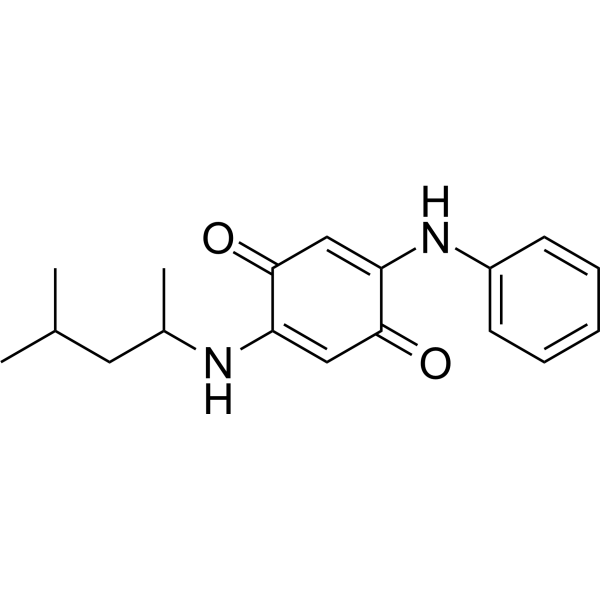
HY-153169
6PPD-QCNR2 Receptor Agonist -
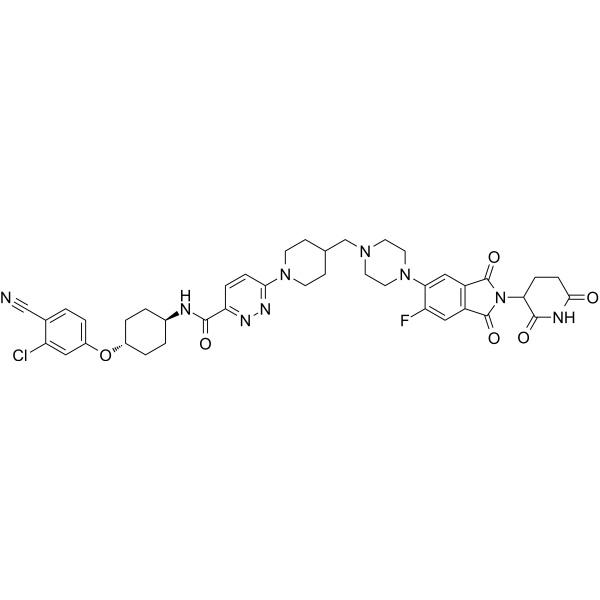
HY-138641
BavdegalutamideAR PROTAC Degrader -

HY-W203683
Perfluorononanoic acidPPARα Activator -

HY-W081067
Perfluoro(2-methyl-3-oxahexanoic) acidPPARα Activator -
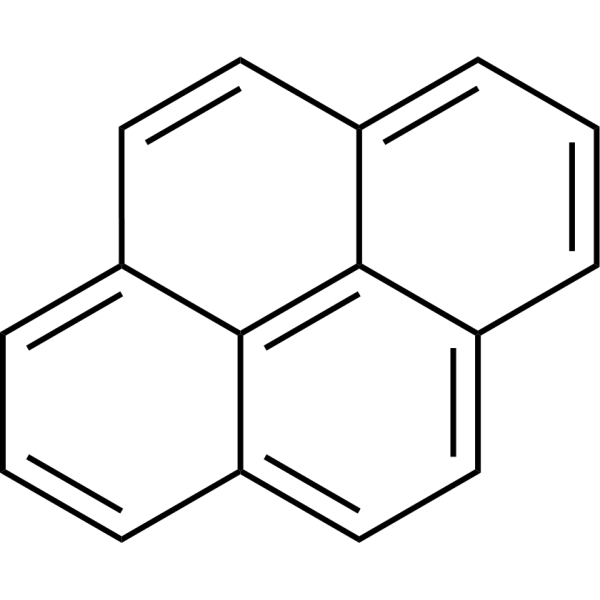
HY-103609
PyreneBiochemical Assay Reagent -

HY-W142432
Perfluoroundecanoic acidOxidative Stress Inducer -

HY-21197
Perfluoroenanthic acidPollutant -

HY-W762011
BDE 47JNK Activator -

HY-21194
Perfluorohexanoic acid -
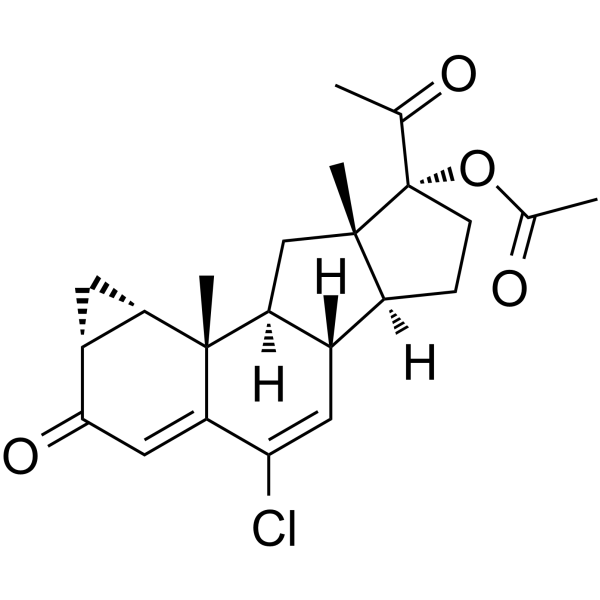
HY-13604
Cyproterone acetateAndrogen Receptor Antagonist -
HY-121106
9-Deazaguanine


Biological Activity
Description
IC50 & Target
[1]|
CYP17 |
CYP11A1 |
In Vitro
Pentacosafluorotridecanoic Acid (0.05-50 mg/L; 48 h) alters steroid hormone balance and down-regulates key steroidogenic genes in H295R human adrenocortical carcinoma cells[1].
MedChemExpress (MCE) has not independently confirmed the accuracy of these methods. They are for reference only. Further protocols information, click here.
In Vivo
MedChemExpress (MCE) has not independently confirmed the accuracy of these methods. They are for reference only.
-
Animal Model:neonates (< 24 h old)[1]
-
Dosage:0.78 μg/L, 3.13 μg/L, 12.5 μg/L, 50 μg/L, 200 μg/L (chronic exposure); 1 mg/L, 10 mg/L, 100 mg/L (acute exposure)
-
Administration:waterborne; continuous; 21 days (chronic exposure); waterborne; continuous; 48 hours (acute exposure)
-
Result:Determined 48-hour EC50 for immobilization as 8.23 mg/L.
Identified NOEC for immobilization as 1 mg/L and LOEC as 10 mg/L for 48-hour acute exposure.
Established survival NOEC as 0.0125 mg/L for 21-day chronic exposure.
Significantly delayed the time required for reproduction of the first brood at 0.2 mg/L exposure.
Decreased population growth rate in a dose-dependent manner during 21-day chronic exposure.
-
Animal Model:Danio rerio (> 3 month old adults, fertilized eggs/larvae/juveniles)[1]
-
Dosage:0.01 mg/L, 0.1 mg/L, 1 mg/L, 10 mg/L
-
Administration:waterborne; continuous; from fertilization through 120 dpf
-
Result:Identified NOEC for survival as 0.01 mg/L across larvae, juvenile, and adult stages, reduced adult survival to 40.63% at 0.1-10 mg/L, and increased condition factor of adult fish at 0.1 mg/L.
Elevated 17β-estradiol (E2) in male fish at 0.01 mg/L, decreased testosterone (T) and 11-ketotestosterone (11-KT) at 0.1 mg/L, and increased E2/T and E2/11-KT ratios at ≥ 0.01 mg/L.
Upregulated GnRHR2, GnRHR4, and ERα mRNA in male brain, GnRHR2 mRNA in female brain, HMGRB, 3βHSD, and CYP11A mRNA in female gonad.
Downregulated VTG1 mRNA in female liver concentration-dependently and up-regulated CYP19A and VTG1 mRNA in male gonad/liver at 0.1 mg/L.
-
Animal Model:Danio rerio (mixed sex, starting as fertilized eggs, raised to adult stage (120 day post fertilization))[2]
-
Dosage:0.01 mg/L; 0.1 mg/L; 1 mg/L; 10 mg/L
-
Administration:waterborne; continuous; 120 days
-
Result:Elevated 17β-estradiol (E2), E2/T ratio, E2/11-KT ratio and gnrhr4 mRNA in male zebrafish at 0.01 mg/L.
Down-regulated vtg1 mRNA concentration-dependently and up-regulated hmgrb mRNA in female zebrafish at 0.01 mg/L.
Reduced zebrafish survival dose-dependently with stage-specific NOECs and increased condition factor in 120 dpf adults.


Chemical Information
-
CAS No. 72629-94-8
-
Appearance Solid
-
Molecular Weight 664.11
-
Formula C₁₃HF₂₅O₂
-
Color White to off-white
-
SMILES
OC(=O)C(F)(F)C(F)(F)C(F)(F)C(F)(F)C(F)(F)C(F)(F)C(F)(F)C(F)(F)C(F)(F)C(F)(F)C(F)(F)C(F)(F)F
-
Synonyms
PFTrDA
-
Shipping
Room temperature in continental US; may vary elsewhere.
-
Storage
Powder -20°C 3 years 4°C 2 years In solvent -80°C 6 months -20°C 1 month


Solvent & Solubility
In Vitro:
Acetone : ≥ 10 mg/mL (15.06 mM)
* "≥" means soluble, but saturation unknown.
Please refer to the solubility information to select the appropriate solvent. Once prepared, please aliquot and store the solution to prevent product inactivation from repeated freeze-thaw cycles.
Storage method and period of stock solution: -80°C, 6 months; -20°C, 1 month. When stored at -80°C, please use it within 6 months. When stored at -20°C, please use it within 1 month.
Please refer to the solubility information to select the appropriate solvent. Once prepared, please aliquot and store the solution to prevent product inactivation from repeated freeze-thaw cycles.
Storage method and period of stock solution: -80°C, 6 months; -20°C, 1 month. When stored at -80°C, please use it within 6 months. When stored at -20°C, please use it within 1 month.
Concentration (start) × Volume (start) = Concentration (final) × Volume (final)

Protocols
-
Research Protocol for Endocrine Diseases
Endocrine diseases often arise from disrupted hormone production, hormone signaling, or target-tissue responsiveness; for diabetes-focused endocrine disease models, insulin signaling regulates glucose uptake, hepatic glucose output, lipid metabolism, and β-cell compensation. Type 2 diabetes develops through interacting defects in insulin resistance, β-cell dysfunction, adipose inflammation, hepatic glucose overproduction, altered incretin signaling, and ectopic lipid metabolism. A major unresolved question is whether endocrine dysfunction is driven primarily by target-tissue insulin resistance, intrinsic β-cell failure, immune/inflammatory stress, or combined multi-organ failure that differs by disease stage.


Purity & Documentation
-
Data Sheet (277 KB)
-
SDS (722 KB)
- English - EN (722 KB)
- Français - FR (722 KB)
- Deutsch - DE (722 KB)
- Norwegian - NO (722 KB)
- Español - ES (722 KB)
- Swedish - SV (722 KB)
- Italian - IT (722 KB)
- Korean - KR (722 KB)
- Portuguese - PT (722 KB)
-
Handling Instructions (2659 KB)
References
[1]. Jo A, et al. Endocrine disruption effects of long-term exposure to perfluorodecanoic acid (PFDA) and perfluorotridecanoic acid (PFTrDA) in zebrafish (Danio rerio) and related mechanisms. Chemosphere. 2014;108:360-366. [Content Brief]
[2]. Okada E, et al. Prenatal exposure to perfluoroalkyl acids and allergic diseases in early childhood. Environ Int. 2014;65:127-134. [Content Brief]


Complete Stock Solution Preparation Table
Please refer to the solubility information to select the appropriate solvent. Once prepared, please aliquot and store the solution to prevent product inactivation from repeated freeze-thaw cycles.
Storage method and period of stock solution: -80°C, 6 months; -20°C, 1 month. When stored at -80°C, please use it within 6 months. When stored at -20°C, please use it within 1 month.
| Optional Solvent | Concentration Solvent Mass | 1 mg | 5 mg | 10 mg | 25 mg |
|---|---|---|---|---|---|
| Acetone | 1 mM | 1.5058 mL | 7.5289 mL | 15.0577 mL | 37.6444 mL |
| 5 mM | 0.3012 mL | 1.5058 mL | 3.0115 mL | 7.5289 mL | |
| 10 mM | 0.1506 mL | 0.7529 mL | 1.5058 mL | 3.7644 mL | |
| 15 mM | 0.1004 mL | 0.5019 mL | 1.0038 mL | 2.5096 mL |


Pentacosafluorotridecanoic Acid Related Classifications
HY-W679754 Related Classifications
 Powered by Bioz