



Perfluoroenanthic acid

Based on 1 Customer Validation
Perfluoroenanthic acid (Perfluoroheptanoic acid) is a kind of perfluoroalkyl carboxylic acid organic pollutant. Perfluoroenanthic acid has environmental persistence and bioaccumulation, and exposure can occur via oral, dermal and other routes. Perfluoroenanthic acid exhibits reproductive toxicity, neurotoxicity, hepatotoxicity, immunotoxicity and endocrine-disrupting effects. Perfluoroenanthic acid exerts definite adverse effects on development, spermatogenesis, neuronal activity and liver tissue.
For research use only. We do not sell to patients.
- Purity : 98.0%
- CAS No.: 375-85-9
- Formula: C7HF13O2
- Molecular Weight:364.06
-
Storage:Pure form -20°C, 3 years , 4°C, 2 years ; In solvent -80°C, 6 months , -20°C, 1 month


To place orders, for customer services and technical support, please contact: MedChemExpress USA
Tel: 609-228-6898 E-mail: [email protected] [email protected]


-
 Biological Activity
-
Chemical Information
-
Solvent & Solubility
- Protocols
- Purity & Documentation
- References
-
 Help & FAQs


-

HY-W203683
Perfluorononanoic acidPPARα Activator -

HY-W142432
Perfluoroundecanoic acidOxidative Stress Inducer -

HY-21193
Perfluoropentanoic acidPerfluorinated Compound -

HY-21194
Perfluorohexanoic acid -

HY-21200
Perfluoroheptanesulfonic acidPerfluoroalkyl Compounds -

HY-109540
PerfluorohexaneHIFU Enhancer -

HY-W008600R
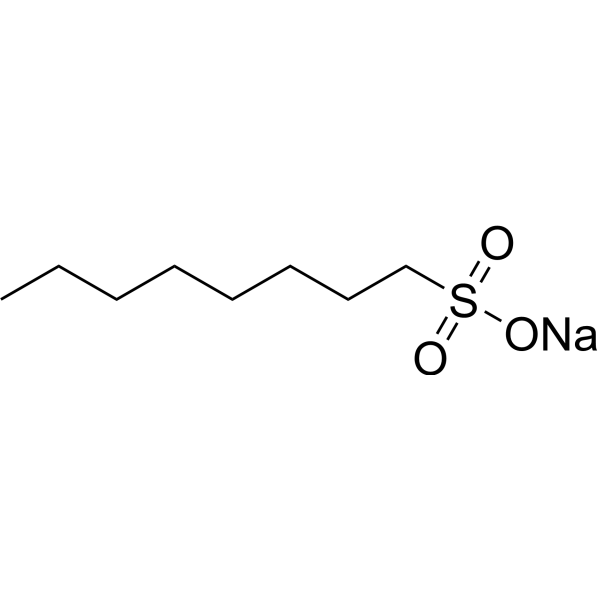
Sodium octane-1-sulfonate (Standard)Biochemical Assay Reagents -
HY-W008600
Sodium octane-1-sulfonateBiochemical Assay Reagents -

HY-21193R
Perfluoropentanoic acid (Standard)Standard of Perfluoropentanoic acid -
HY-B0176A
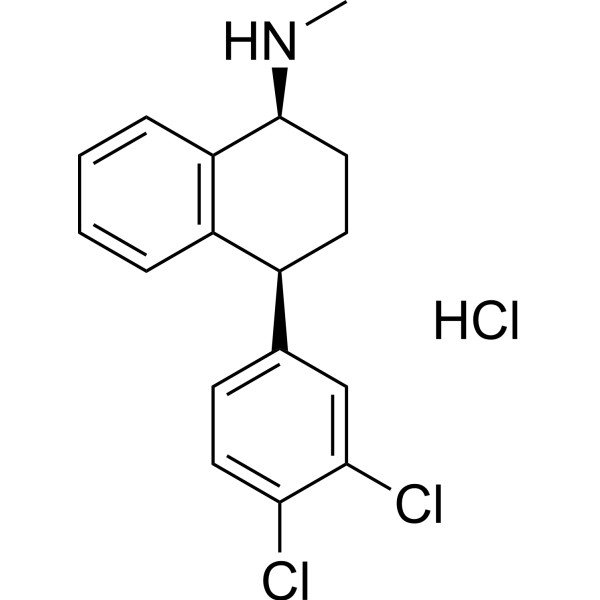
Sertraline hydrochlorideSSRI


Biological Activity
Description
In Vivo
Perfluoroenanthic acid (1.25-5% (v/v); percutaneous administration; once daily; for 28 consecutive days) induces systemic toxicity in female B6C3F1 mice in a subchronic 28-day skin exposure model, including increased liver weight, altered immune cell phenotypes, hepatocyte hypertrophy, and dysregulated gene expression associated with the PPAR pathway[3].
MedChemExpress (MCE) has not independently confirmed the accuracy of these methods. They are for reference only.
-
Animal Model:C57BL/6 mice (female: 7 weeks old at breeding; male offspring: sacrificed at 7 weeks old; prenatal exposure reproductive toxicity model)[1]
-
Dosage:0.0015 mg/kg bw/d; 0.015 mg/kg bw/d; 0.15 mg/kg bw/d
-
Administration:i.g.; daily; 16 days (GD1-GD16)
-
Result:Reduced sperm count and concentration.
Increased sperm progressive cells’ head area significantly in the 0.015 mg/kg bw/d group.
Caused slightly enlarged seminiferous tubule lumens in the 0.0015 mg/kg bw/d group.
Caused disordered seminiferous epithelium arrangement, reduced spermatogenic cell numbers, and enlarged tubule lumens in the 0.015 mg/kg bw/d group.
Caused severely disordered seminiferous epithelium, reduced spermatogenic cell layers, and shrunken seminiferous tubules in the 0.15 mg/kg bw/d group.
Decreased absolute m6A levels in testicular tissue.
Decreased Mettl3 and Mettl5 expression, and increased Mettl14 expression.
Decreased Pcif1 and Wtap expression, and increased Hnrnpa2b1 expression.


Chemical Information
-
CAS No. 375-85-9
-
Appearance <30°C Solid,>30°C Liquid
-
Molecular Weight 364.06
-
Formula C7HF13O2
-
Color Colorless to off-white
-
SMILES
O=C(O)C(F)(F)C(F)(F)C(F)(F)C(F)(F)C(F)(F)C(F)(F)F
-
Synonyms
Perfluoroheptanoic acid; Tridecafluoroheptanoic acid; PFHpA
-
Shipping
Room temperature in continental US; may vary elsewhere.
-
Storage
Pure form -20°C 3 years 4°C 2 years In solvent -80°C 6 months -20°C 1 month


Solvent & Solubility
In Vitro:
DMSO : 100 mg/mL (274.68 mM; Need ultrasonic; Hygroscopic DMSO has a significant impact on the solubility of product, please use newly opened DMSO)
Please refer to the solubility information to select the appropriate solvent. Once prepared, please aliquot and store the solution to prevent product inactivation from repeated freeze-thaw cycles.
Storage method and period of stock solution: -80°C, 6 months; -20°C, 1 month. When stored at -80°C, please use it within 6 months. When stored at -20°C, please use it within 1 month.
Please refer to the solubility information to select the appropriate solvent. Once prepared, please aliquot and store the solution to prevent product inactivation from repeated freeze-thaw cycles.
Storage method and period of stock solution: -80°C, 6 months; -20°C, 1 month. When stored at -80°C, please use it within 6 months. When stored at -20°C, please use it within 1 month.
Concentration (start) × Volume (start) = Concentration (final) × Volume (final)
In Vivo:
Select the appropriate dissolution method based on your experimental animal and administration route.
- For the following dissolution methods, please ensure to first prepare a clear stock solution using an In Vitro approach and then sequentially add co-solvents:
- To ensure reliable experimental results, the clarified stock solution can be appropriately stored based on storage conditions. As for the working solution for In Vivo experiments, it is recommended to prepare freshly and use it on the same day.
- The percentages shown for the solvents indicate their volumetric ratio in the final prepared solution. If precipitation or phase separation occurs during preparation, heat and/or sonication can be used to aid dissolution.
Add each solvent one by one: 10% DMSO 40% PEG300 5% Tween-80 45% Saline
Solubility: ≥ 5 mg/mL (13.73 mM); Clear solution
This protocol yields a clear solution of ≥ 5 mg/mL (saturation unknown).
Taking 1 mL working solution as an example, add 100 μL DMSO stock solution (50.0 mg/mL) to 400 μL PEG300, and mix evenly; then add 50 μL Tween-80 and mix evenly; then add 450 μL Saline to adjust the volume to 1 mL.
Preparation of Saline: Dissolve 0.9 g sodium chloride in ddH₂O and dilute to 100 mL to obtain a clear Saline solution.
Add each solvent one by one: 10% DMSO 90% (20% SBE-β-CD in Saline)
Solubility: ≥ 5 mg/mL (13.73 mM); Clear solution
This protocol yields a clear solution of ≥ 5 mg/mL (saturation unknown).
Taking 1 mL working solution as an example, add 100 μL DMSO stock solution (50.0 mg/mL) to 900 μL 20% SBE-β-CD in Saline, and mix evenly.
Preparation of 20% SBE-β-CD in Saline (4°C, storage for one week): 2 g SBE-β-CD powder is dissolved in 10 mL Saline, completely dissolve until clear.
In Vivo Dissolution Calculator
Please enter the basic information of animal experiments:
-
-
-
-
Recommended: Prepare an additional quantity of animals to account for potential losses during experiments.
Please enter your animal formula composition:
-
%DMSO +
Recommended: Keep the proportion of DMSO in working solution below 2% if your animal is weak.
-
%+
-
+%Tween-80 + +
-
%Saline +
The co-solvents required include: DMSO, . All of co-solvents are available by MedChemExpress (MCE). , Tween 80. All of co-solvents are available by MedChemExpress (MCE).
Working solution concentration: 0.22 mg/mL
Method for preparing stock solution: mg drug dissolved in μL DMSO. Stock solution concentration: mg/mL.
1. Take μL DMSO stock solution;
2. Add μL .
μL , mix evenly;
3. Then add μL Tween 80, mix evenly;
4. Then add μL
Please ensure that the stock solution in the first step is dissolved to a clear state, and add co-solvents in sequence. You can use ultrasonic heating (ultrasonic cleaner, recommended frequency 20-40 kHz), vortexing, etc. to assist dissolution.


Purity & Documentation
-
Data Sheet (273 KB)
-
SDS (477 KB)
- English - EN (477 KB)
- Français - FR (477 KB)
- Deutsch - DE (477 KB)
- Norwegian - NO (477 KB)
- Español - ES (477 KB)
- Swedish - SV (477 KB)
- Italian - IT (477 KB)
- Korean - KR (477 KB)
- Portuguese - PT (477 KB)
-
Handling Instructions (2659 KB)
References
[1]. Zhou Y, et al. Effect of prenatal perfluoroheptanoic acid exposure on spermatogenesis in offspring mice. Ecotoxicol Environ Saf. 2023;260:115072. [Content Brief]
[2]. Ko MY, et al. Differential regulations of neural activity and survival in primary cortical neurons by PFOA or PFHpA. Chemosphere. 2024;352:141379. [Content Brief]
[3]. Weatherly LM, et al. Systemic toxicity induced by topical application of perfluoroheptanoic acid (PFHpA), perfluorohexanoic acid (PFHxA), and perfluoropentanoic acid (PFPeA) in a murine model. Food Chem Toxicol. 2023;171:113515. [Content Brief]


Complete Stock Solution Preparation Table
Please refer to the solubility information to select the appropriate solvent. Once prepared, please aliquot and store the solution to prevent product inactivation from repeated freeze-thaw cycles.
Storage method and period of stock solution: -80°C, 6 months; -20°C, 1 month. When stored at -80°C, please use it within 6 months. When stored at -20°C, please use it within 1 month.
| Optional Solvent | Concentration Solvent Mass | 1 mg | 5 mg | 10 mg | 25 mg |
|---|---|---|---|---|---|
| DMSO | 1 mM | 2.7468 mL | 13.7340 mL | 27.4680 mL | 68.6700 mL |
| 5 mM | 0.5494 mL | 2.7468 mL | 5.4936 mL | 13.7340 mL | |
| 10 mM | 0.2747 mL | 1.3734 mL | 2.7468 mL | 6.8670 mL | |
| 15 mM | 0.1831 mL | 0.9156 mL | 1.8312 mL | 4.5780 mL | |
| 20 mM | 0.1373 mL | 0.6867 mL | 1.3734 mL | 3.4335 mL | |
| 25 mM | 0.1099 mL | 0.5494 mL | 1.0987 mL | 2.7468 mL | |
| 30 mM | 0.0916 mL | 0.4578 mL | 0.9156 mL | 2.2890 mL | |
| 40 mM | 0.0687 mL | 0.3433 mL | 0.6867 mL | 1.7167 mL | |
| 50 mM | 0.0549 mL | 0.2747 mL | 0.5494 mL | 1.3734 mL | |
| 60 mM | 0.0458 mL | 0.2289 mL | 0.4578 mL | 1.1445 mL | |
| 80 mM | 0.0343 mL | 0.1717 mL | 0.3433 mL | 0.8584 mL | |
| 100 mM | 0.0275 mL | 0.1373 mL | 0.2747 mL | 0.6867 mL |


Perfluoroenanthic acid Related Classifications
HY-21197 Related Classifications
 Powered by Bioz
Keywords
- Perfluoroenanthic acid
- 375-85-9
- Perfluoroheptanoic acid
- Tridecafluoroheptanoic acid
- PFHpA
- PPAR
- reproductive toxicity
- PPAR family receptors
- m6A methyltransferases
- C57BL/6 mice
- cAMP/cGMP signaling
- testicular tissue damage
- m6A RNA methylation
- B6C3F1 mice
- environmental endocrine disruptor
- m6A binding proteins
- Inhibitor
- inhibitor
- inhibit