



PSMα3 TFA
PSMα3 TFA is an inhibitor of NF-κB p65 and p38 MAPK. PSMα3 TFA forms membrane pores and binds to residues of human insulin B chain to inhibit insulin aggregation. PSMα3 TFA forms α-type amyloid-like fibrils to exert cytotoxic effects, and acts as a functional amyloid virulence determinant of Staphylococcus aureus. PSMα3 TFA is applicable to research related to spondyloarthritis, rheumatoid arthritis, insulin-derived amyloidosis, and Staphylococcus aureus infection.
For research use only. We do not sell to patients.
- Formula: C130H193F3N28O32S
- Molecular Weight:2749.15
-
Storage:
Please store the product under the recommended conditions in the Certificate of Analysis.

To place orders, for customer services and technical support, please contact: MedChemExpress USA
Tel: 609-228-6898 E-mail: [email protected] [email protected]


-
 Biological Activity
-
Chemical Information
-
Solvent & Solubility
- Purity & Documentation
- References
-
 Help & FAQs




Biological Activity
Description
In Vitro
PSMα3 TFA (10 μM; 6-24 h) alters surface molecule expression in TLR4-stimulated human moDCs, enhancing early HLA-DR expression and reducing CD40 and CD80 expression at 6 and 24 h, respectively, while showing a trend to reduce PD-L1 upregulation at 24 h[1].
PSMα3 TFA (10 μM; 6-24 h) significantly impairs pro- and anti-inflammatory cytokine secretion by TLR4-stimulated human moDCs, reducing TNF, IL-12, and IL-10 production at 6 and 24 h, respectively[1].
PSMα3 TFA (10 μM; 1 h) reduces NF-κB and p38 phosphorylation in a non-significant trend in TLR4-stimulated human moDCs after 1 h of treatment[1].
PSMα3 TFA (10 μM; 24 h) significantly reduces OVA uptake by immature human moDCs after 24 h of treatment, and shows a non-significant trend to further reduce OVA uptake in TLR2- or TLR4-stimulated moDCs[1].
PSMα3 TFA (2.5-10 μM; 10 min) induces concentration-dependent transient pore formation in human moDCs after 10 min of treatment, as measured by LDH release, without reducing cell viability[1].
PSMα3 TFA (10 μM; 24 h moDC pretreatment) in combination with TLR2/TLR4 ligands reduces the frequency of T-bet+ Th1 cells and IFN-γ secretion in co-cultured human naïve CD4+ T cells, while increasing IL-13 secretion when used to pretreat moDCs[1].
PSMα3 TFA (10 μM; 1-2 d) significantly increases IDO production by TLR4-stimulated human moDCs after 1 and 2 d of treatment[1].
Synthetic PSMα3 TFA (0.0625-10 mg/mL; up to 7 days) maintains a stable α-helical conformation in aqueous solution and does not form amyloid fibrils after incubation for up to 7 days at 37 °C, with only minor oligomer formation observed under specific non-standard pre-treatment and incubation conditions[2].
PSMα3 TFA forms a unique cross-α amyloid-like fibril structure, solved at 1.45 Å resolution, with amphipathic α-helices stacked perpendicular to the fibril axis into tight self-associating sheets[3].
MedChemExpress (MCE) has not independently confirmed the accuracy of these methods. They are for reference only.


Chemical Information
-
Molecular Weight 2749.15
-
Formula C130H193F3N28O32S
-
Sequence
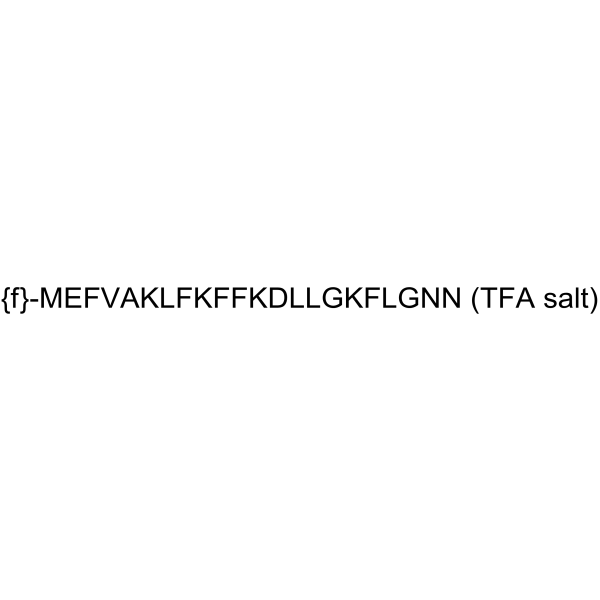
{f}-Met-Glu-Phe-Val-Ala-Lys-Leu-Phe-Lys-Phe-Phe-Lys-Asp-Leu-Leu-Gly-Lys-Phe-Leu-Gly-Asn-Asn
-
Sequence Shortening
{f}-MEFVAKLFKFFKDLLGKFLGNN
-
Shipping
Room temperature in continental US; may vary elsewhere.
-
Storage
Please store the product under the recommended conditions in the Certificate of Analysis.


Solvent & Solubility
In Vitro
H2O
Peptide Solubility and Storage Guidelines:
1. Calculate the length of the peptide.
2. Calculate the overall charge of the entire peptide according to the following table:
| Contents | Assign value | |
|---|---|---|
| Acidic amino acid | Asp (D), Glu (E), and the C-terminal -COOH. | -1 |
| Basic amino acid | Arg (R), Lys (K), His (H), and the N-terminal -NH2 | +1 |
| Neutral amino acid | Gly (G), Ala (A), Leu (L), Ile (I), Val (V), Cys (C), Met (M), Thr (T), Ser (S), Phe (F), Tyr (Y), Trp (W), Pro (P), Asn (N), Gln (Q) | 0 |
3. Recommended solution:
| Overall charge of peptide | Details |
|---|---|
| Negative (<0) |
1. Try to dissolve the peptide in water first. 2. If water fails, add NH4OH (<50 μL). 3. If the peptide still does not dissolve, add DMSO (50-100 μL) to solubilize the peptide. |
| Positive (>0) |
1. Try to dissolve the peptide in water first. 2. If water fails, try dissolving the peptide in a 10%-30% acetic acid solution. 3. If the peptide still does not dissolve, try dissolving the peptide in a small amount of DMSO. |
| Zero (=0) |
1. Try to dissolve the peptide in organic solvent (acetonitrile, methanol, etc.) first. 2. For very hydrophobic peptides, try dissolving the peptide in a small amount of DMSO, and then dilute the solution with water to the desired concentration. |


Purity & Documentation
References
[1]. Richardson JR, et, al. Staphylococcus aureus PSM Peptides Modulate Human Monocyte-Derived Dendritic Cells to Prime Regulatory T Cells. Front Immunol. 2018 Nov 13;9:2603. [Content Brief]
[2]. Kalitnik A, et al. Cytotoxic Staphylococcus aureus PSMα3 inhibits the aggregation of human insulin in vitro. Phys Chem Chem Phys. 2024 May 29;26(21):15587-15599. [Content Brief]
[3]. Tayeb-Fligelman E, et, al. The cytotoxic Staphylococcus aureus PSMα3 reveals a cross-α amyloid-like fibril. Science. 2017 Feb 24;355(6327):831-833. [Content Brief]

Calculators
Concentration (start) × Volume (start) = Concentration (final) × Volume (final)


PSMα3 TFA Related Classifications
HY-P2358A Related Classifications
 Powered by Bioz