15 Results for "

HCC cell lines

" in MedChemExpress (MCE) Product Catalog:
Products (15)

15 Results for "HCC cell lines" in MCE Product Catalog:

Cat. No.: HY-153360
CAS No.: 2873460-70-7
Purity:  98.99%
Research Areas:  

Cancer

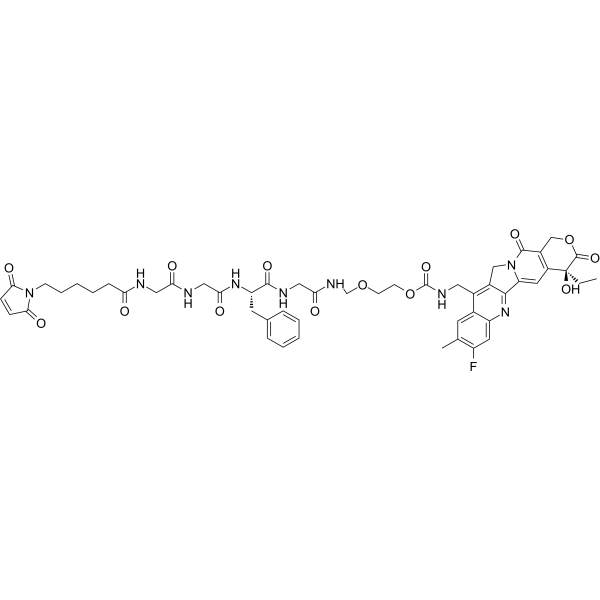
MC-GGFG-AM-(10Me-11F-Camptothecin) is a linker-payload conjugate used to synthesize ZW251. ZW251 an antibody-drug conjugate (ADC) targeting human GPC3. ZW251 consists of a humanized IgG1 antibody conjugated to a novel camptothecin-based topoisomerase 1 inhibitor, ZD06519, via a linker. The linker is the maleimide anchor and a glycyl glycyl phenylalanyl glycine (GGFG)-aminomethyl (AM) cleavable linker. ZW251 has high affinity with human and cynomolgus monkey GPC3. ZW251 displays rapid internalization in GPC3-expressing HCC cell lines, and bystander-mediated killing of GPC3 negative cancer cells .
loading...
    loading...
Cat. No.: HY-113081R
CAS No.: 15763-06-1
1-Methyladenosine (Standard) is the analytical standard of 1-Methyladenosine. This product is intended for research and analytical applications. 1-Methyladenosine is an RNA modification that can serve as a tumor marker, with elevated levels in the body associated with cancer development. Following 1-methyladenosine methylation, upregulation of PPARδ expression regulates cholesterol metabolism and activates Hedgehog signaling pathway, driving liver tumorigenesis . In Vitro:Compared to surrounding tumor tissues, 1-methyladenosine methylation in RNA is aberrantly elevated in hepatocellular carcinoma (HCC) cell lines and liver cancer stem cells (CSCs). Methylated 1-methyladenosine can promote cholesterol synthesis and activate the Hedgehog signaling pathway by enhancing the translation of PPARδ in liver CSCs, ultimately driving the self-renewal and tumorigenesis of liver cancer stem cells .
loading...
    loading...
Cat. No.: HY-W599279
CAS No.: 2761170-84-5
ABS-752 is an orally active prodrug targeting CRBN-modulating molecular glue with selectivity in protein degradation. ABS-752 preferentially degrades GSPT1 and induces cytotoxicity through this degradation, while it also degrades NEK7, SALL4 and CK1α, with weaker degradation potency against CK1α. As a prodrug, ABS-752 requires metabolic activation to ABT-002 to form the active complex; VAP-1 mediates its conversion to an aldehyde intermediate. ABS-752 induces cell death, reduces cell viability, and exhibits antitumor activity, leading to regression and inhibition of tumor growth. ABS-752 shows no cytotoxicity in primary human hepatocytes. ABS-752 can be used in the research of hepatocellular carcinoma .
loading...
    loading...
Cat. No.: HY-172957
Target:  

JAK

Research Areas:  

Cancer

JNN-5 is a potent and selective JAK2 inhibitor with an IC50 of 0.41 nM. JNN-5 shows strong antiproliferative activities in the TNBC cell lines (MDA-MB-468, MDA-MB-213, HCC70, MDA-MB-157) .
loading...
    loading...
Cat. No.: HY-119833
CAS No.: 73694-15-2
Purity:  99.1%
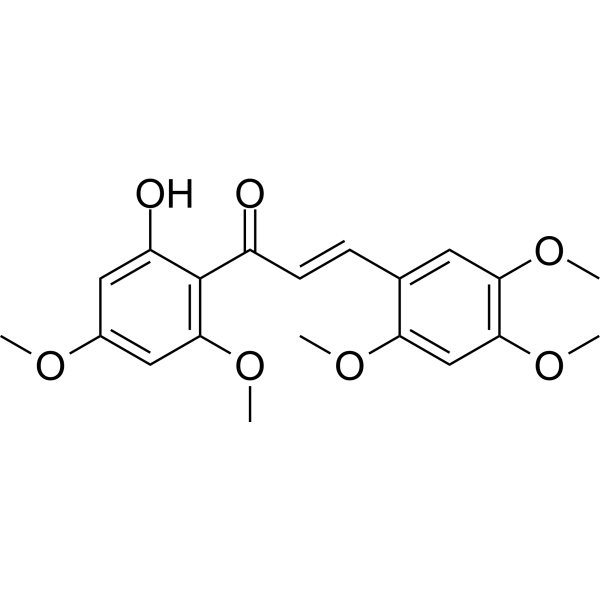
Rubone, a chalcone analog, is a modulator of miR-34a. Rubone upregulates miR-34a expression in a p53 dependent manner, downregulates the downstream target Bcl-2 and Cyclin D1 expression, and suppresses hepatocellular carcinoma (HCC) growth in vivo. Rubone enhances the anticancer effect of Paclitaxel (PTX; HY-B0015) in PTX-resistant prostate cancer cell lines by reversing the expression of miR-34a downstream targets .
loading...
    loading...
Cat. No.: HY-120766
CAS No.: 1239468-48-4
Purity:  ≥97.0%
Target:  

Histone Demethylase

Research Areas:  

Cancer

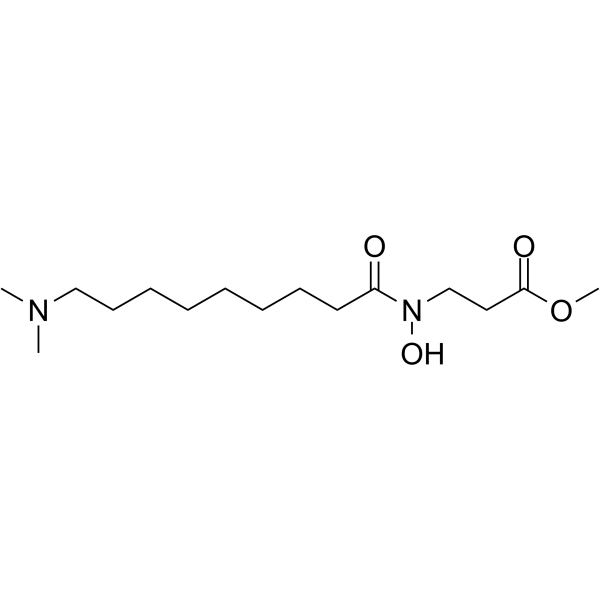
NCDM-32B is a potent and selective KDM4 inhibitor, with IC50 values of 3.0 μM for KDM4A and 1.0 μM for KDM4C in in vitro enzyme assays. NCDM-32B specifically increases global H3K9me3/me2 levels in basal breast cancer cells. NCDM-32B impairs the viability of KDM4C-amplified basal breast cancer cell lines (HCC1954 and Colo824). NCDM-32B can be used for the study of breast cancer .
loading...
    loading...
Cat. No.: HY-176198
CAS No.: 2341740-85-8
Target:  

PROTACs FAK

Research Areas:  

Cancer

BI-0319 is a potent and selective PTK2 PROTAC degrader with an IC50 of 19 nM and a DC50 of 243 nM (in A549 cells). By bridging PTK2 and VHL E3 ubiquitin ligase, BI-0319 induces polyubiquitination of PTK2, leading to its targeted degradation via the ubiquitin-proteasome system. BI-0319 can be used in research related to liver cancer and non-small cell lung cancer .
loading...
    loading...
Cat. No.: HY-175553
Target:  

VEGFR Apoptosis

Research Areas:  

Cancer

VEGFR-2-IN-72 is a selective VEGFR-2 inhibitor with an IC50 of 22.2 nM. VEGFR-2-IN-72 exhibits anticancer activity against HepG2 and Hep3B human HCC cell lines with IC50s of 15.7 and 2.4 μM. VEGFR-2-IN-72 can cause a mild blockage of the cell cycle and induce cell aopoptosis. VEGFR-2-IN-72 can used for the study of hepatocellular carcinoma (HCC) .
loading...
    loading...
Cat. No.: HY-W717425
CAS No.: 1421677-31-7
SC-60 is a derivative of Sorafenib (HY-10201). SC-60 exerts its anti-tumor effect by activating the phosphatase activity of SHP-1, thereby inhibiting the STAT3 signaling pathway. SC-60 exhibits strong proliferation inhibitory activity in various hepatocellular carcinoma (HCC) cell lines. SC-60 downregulates the expression of downstream anti-apoptotic proteins (such as Bcl-2, Cyclin D1, Survivin), ultimately inducing caspase-dependent apoptosis. SC-60 significantly inhibits tumor growth in xenograft tumor models. SC-60 can be used for the study of HCC .
loading...
    loading...
Cat. No.: HY-172881
Target:  

Pyruvate Kinase

Research Areas:  

Cancer

PKM2-IN-10 (Compound 16) is a PKM2 inhibitor. PKM2-IN-10 inhibits the proliferation of A549 and HCC1833 cell lines with IC50 of 3.36 μM and 9.20 μM, respectively. PKM2-IN-10 exhibits antitumor activity in human non-small cell lung cancer (NSCLC) and mouse lung adenocarcinoma models. PKM2-IN-10 can be used in lung cancer research .
loading...
    loading...
Cat. No.: HY-147793
CAS No.: 2423992-63-4
Target:  

FGFR

Research Areas:  

Cancer

FGFR4-IN-12 (Compound A34) is a potent inhibitor of FGFR4. FGFR4-IN-12 exhibits improved FGFR4 inhibitory capability and selectivity and excellent anti-proliferative activities against FGFR4-dependent HCC cell lines. FGFR4-IN-12 has the potential for the research of cancer diseases . FGFR4-IN-12 is a click chemistry reagent, it contains an Alkyne group and can undergo copper-catalyzed azide-alkyne cycloaddition (CuAAc) with molecules containing Azide groups.
loading...
    loading...
Cat. No.: HY-168337
CAS No.: 3052985-32-4
Target:  

JNK Pyruvate Kinase

SET-171 is a JNK (c-Jun N-terminal kinase) inhibitor that exhibits significant anticancer activity and lipid metabolism regulation by inhibiting liver pyruvate kinase (PKL) expression. In anticancer studies, SET-171 shows IC50 values of 8.82 μM and 2.97 μM against HepG2 and Huh7 cell lines, respectively, indicating high cytotoxicity. Additionally, in non-alcoholic fatty liver disease (NAFLD)-related studies, SET-171 significantly reduces triacylglycerol (TAG) levels and inhibits the expression of steatosis-related proteins. SET-171 holds promise for research on hepatocellular carcinoma (HCC) and NAFLD .
loading...
    loading...
Cat. No.: HY-170549
CAS No.: 3116929-46-2
Target:  

VEGFR

Research Areas:  

Cancer

VEGFR-2-IN-60 (compound 5c) is a potent VEGFR-2 inhibitor with an IC50 of 1.07 nM. VEGFR-2-IN-60 exhibits cytotoxic activity against HCC1806, Hela, and A549 cell lines .
loading...
    loading...
Cat. No.: HY-W998347
CAS No.: 2922884-90-8
ABS-752 hydrochloride is an orally active prodrug targeting CRBN-modulating molecular glue with selectivity in protein degradation. ABS-752 hydrochloride preferentially degrades GSPT1 and induces cytotoxicity through this degradation, while it also degrades NEK7, SALL4 and CK1α, with weaker degradation potency against CK1α. As a prodrug, ABS-752 hydrochloride requires metabolic activation to ABT-002 to form the active complex; VAP-1 mediates its conversion to an aldehyde intermediate. ABS-752 hydrochloride induces cell death, reduces cell viability, and exhibits antitumor activity, leading to regression and inhibition of tumor growth. ABS-752 hydrochloride shows no cytotoxicity in primary human hepatocytes. ABS-752 hydrochloride can be used in the research of hepatocellular carcinoma .
loading...
    loading...
Cat. No.: HY-179430
Target:  

Mps1

Research Areas:  

Cancer

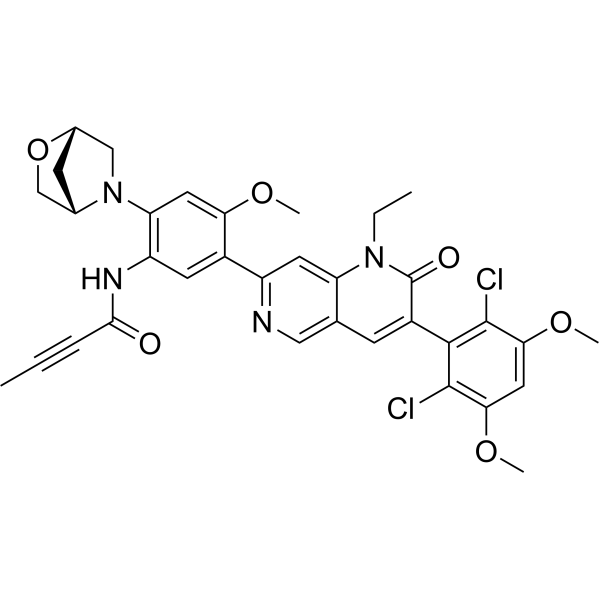
TTK-IN-5 is an orally active covalent threonine tyrosine kinase (TTK) inhibitor with selectivity (IC50 = 8.918 nM). TTK-IN-5 exhibits anti-proliferative potencies against MDA-MB-231, A2780, HCT116, HCC1569 and MKN1 cell lines (IC50 values of 0.113 μM, 0.476 μM, 3.136 μM, 3.649 μM, and 1.856 μM, respectively). TTK-IN-5 potently suppresses tumor growth without notable toxicity in A2780 and MDA-MB-231 xenograft mouse models. TTK-IN-5 can be used for the research of cancer such as breast cancer and ovarian cancer .
loading...
    loading...
  • 1

