
4 Results for "

LB broth

" in MedChemExpress (MCE) Product Catalog:
Products (4)

4 Results for "LB broth" in MCE Product Catalog:

Cat. No.: HY-156263
Synonyms: Luria-Bertani Base
LB Broth Base, powder (Luria-Bertani Base) is generally used to maintain the growth of E. coli. The composition of 1 liter of LB medium is: 10 g peptone, 5 g yeast extract and 10 g NaCl .
loading...
    loading...
Cat. No.: HY-157346A
LB Agar is a nutrient-rich bacterial medium prepared by adding Agar to lysogeny broth (LB). LB Agar supports the growth of Enterobacteriaceae, Escherichia coli, related intestinal species, and various facultative microorganisms. LB Agar is used for Escherichia coli plaque assays .
loading...
    loading...
Cat. No.: HY-W127393
CAS No.: 177158-21-3
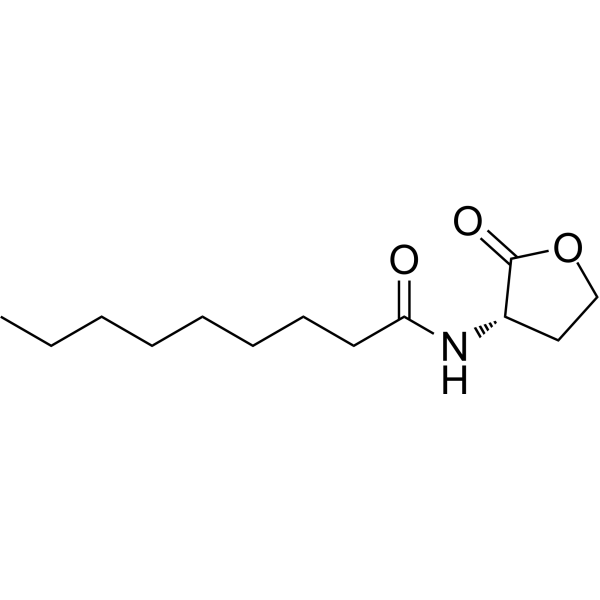
Quorum sensing is a regulatory system used by bacteria to control gene expression in response to increased cell density. This regulatory process manifests itself in a variety of phenotypes, including biofilm formation and virulence factor production. Coordinated gene expression is achieved through the production, release and detection of small diffusible signaling molecules called autoinducers. N-acylated homoserine lactones (AHLs) comprise a class of such autoinducers, each of which generally consists of a fatty acid coupled to a homoserine lactone (HSL). Modulation of bacterial quorum-sensing signaling systems to suppress pathogenesis represents a new approach to antimicrobial research for infectious diseases. AHLs differ in acyl length (C4-C18), C3 substitution (hydrogen, hydroxyl, or oxo group), and the presence or absence of one or more carbon-carbon double bonds in the fatty acid chain. These differences confer signaling specificity through the affinity of the LuxR family of transcriptional regulators. C9-HSL is a rare odd-numbered acyl carbon chain produced by wild-type Erwinia carotovora strain SCC 3193 grown in nutrient-rich Luria-Bertani broth (LB) medium.
loading...
    loading...
Cat. No.: HY-W001968
CAS No.: 498-62-4
Synonyms: 3-TC
Target:  

Drug Intermediate

Research Areas:  

Others

3-Thiophenecarboxaldehyde is a thiophene derivative substrate for biocatalytic reduction to 3-thiophenemethanol, and can be processed by Pseudomonas putida S12 cells. 3-Thiophenecarboxaldehyde functions as an intermediate compound. 3-Thiophenecarboxaldehyde exhibits toxicity toward Pseudomonas putida S12 cells at elevated concentrations, reducing specific growth rate and final biomass yield .
loading...
    loading...

