7 Results for "

Lipid bilayer disruption

" in MedChemExpress (MCE) Product Catalog:
Products (7)

7 Results for "Lipid bilayer disruption" in MCE Product Catalog:

1
1 Cited Publications
Cat. No.: HY-P5712
CAS No.: 113-73-5
Synonyms: Gramicidin soviet
Research Areas:  

Infection

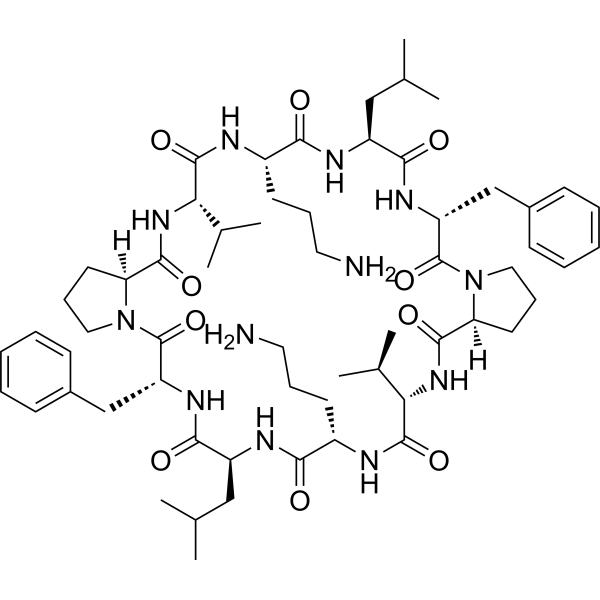
Gramicidin S (Gramicidin soviet) is a cationic cyclic peptide antibiotic that selectively targets bacterial cell membranes and has anticancer activity. Gramicidin S also exerts antibacterial activity by destroying membrane integrity and interfering with membrane protein function. Gramicidin S inserts into the phospholipid bilayer through hydrophobic amino acid residues, specifically binds to negatively charged membrane lipids and disrupts membrane structure, thereby inhibiting cell division and cell wall synthesis, and ultimately causing bacterial death. Gramicidin S also inhibits ion channels, with IC50s of 41 μM, 24 μM, and 3 μM for Na +/K +-ATPase, tobacco leaf plasma membrane Mg 2+/K +-ATPase, and rat heart plasma membrane Ca 2+-ATPase, respectively .
loading...
    loading...
Cat. No.: HY-P10233A
Target:  

Bacterial

Research Areas:  

Infection

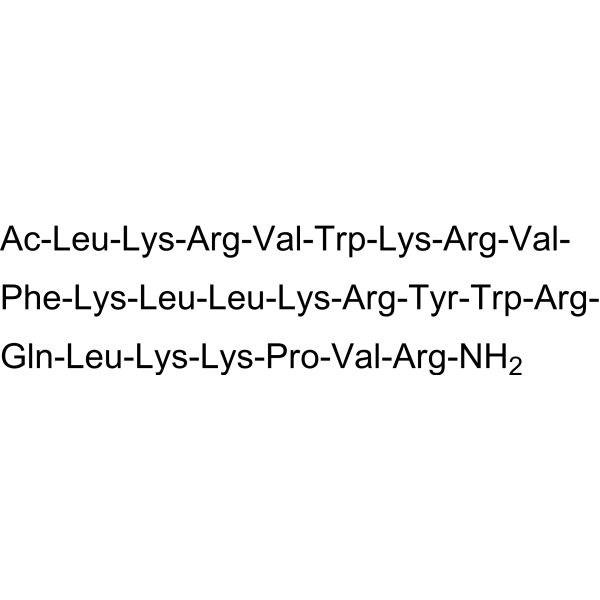
SAAP 148 TFA is a synthetic antimicrobial peptide (bacteria) that interacts with and disrupts the lipid bilayer of bacterial cytoplasmic membranes, thereby inducing changes in membrane permeability and bacterial death. SAAP 148 TFA kills drug-resistant, multidrug-resistant and persister bacterial strains, inhibits biofilm formation, eliminates established biofilms, and blocks bacterial colonization on implant surfaces. SAAP 148 TFA retains its activity after modification or immobilization, exhibits variable cytotoxicity in different human cell models, and shows reduced efficacy in protein-rich environments. SAAP 148 TFA can be used in infection-related research .
loading...
    loading...
Cat. No.: HY-108569
CAS No.: 118414-59-8
Purity:  ≥98.0%
Target:  

Antibiotic Bacterial PPAR

Research Areas:  

Infection

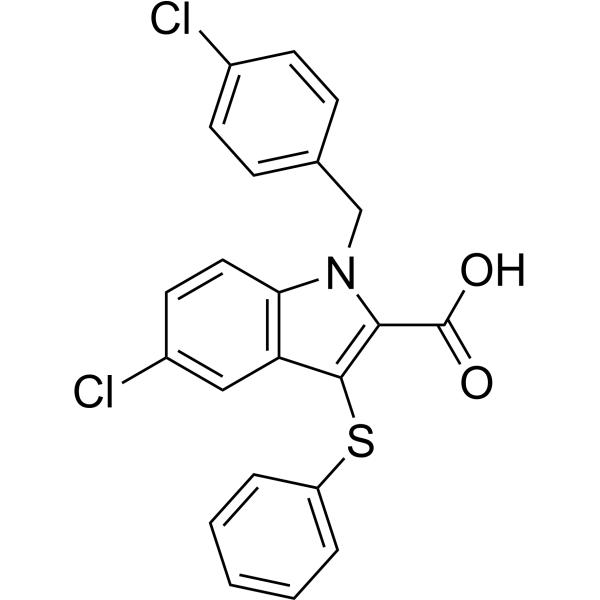
nTZDpa is an antibiotic. nTZDpa is a PPARG partial agonist. nTZDpa has antibacterial activity. nTZDpa is effective against growing and persistent Staphylococcus aureus by lipid bilayer disruption .
loading...
    loading...
Cat. No.: HY-P10233
Target:  

Bacterial

Research Areas:  

Infection

SAAP 148 is a synthetic antimicrobial peptide (bacteria) that interacts with and disrupts the lipid bilayer of bacterial cytoplasmic membranes, thereby inducing changes in membrane permeability and bacterial death. SAAP 148 kills drug-resistant, multidrug-resistant and persister bacterial strains, inhibits biofilm formation, eliminates established biofilms, and blocks bacterial colonization on implant surfaces. SAAP 148 retains its activity after modification or immobilization, exhibits variable cytotoxicity in different human cell models, and shows reduced efficacy in protein-rich environments. SAAP 148 can be used in infection-related research .
loading...
    loading...
Cat. No.: HY-P10536
CAS No.: 1802175-40-1
Target:  

Bacterial

Research Areas:  

Infection

Temporin SHF is a broad-spectrum antimicrobial peptide that is active against Gram-positive and Gram-negative bacteria and yeasts, but does not have hemolytic activity. Temporin SHF disrupts the acyl chain stacking of anionic lipid bilayers, leading to cracks and disintegration of microbial membranes. Temporin SHF can be used in the development of antimicrobial drugs .
loading...
    loading...
Cat. No.: HY-P11220
Research Areas:  

Infection

Hs02 is a cationic amphiphilic antibacterial peptide derived from human proteins, and it is the membrane-active module of the core chimeric peptide Chim2. Hs02 exhibits broad-spectrum and potent antibacterial activity against various human pathogenic bacteria with the MIC for Staphylococcus aureus and Escherichia coli of as low as 2 μM, and the MBC is 2-4 μM. Hs02 primarily kills bacteria by disrupting the integrity of the bacterial cell membrane, and it has a relatively low selectivity for eukaryotic cell membranes. Hs02 induces the release of IL-12 but does not induce the release of IL-6, indicating its potential for pro-inflammatory or immune activation. Hs02 can be used in antibacterial and immunomodulatory research .
loading...
    loading...
Cat. No.: HY-P5423C
Target:  

Peptides

Research Areas:  

Others

GALA-Cys is a chemically modified GALA peptide (HY-P5423) that retains GALA functions while acquiring strong covalent conjugation capability. GALA-Cys undergoes pH-driven reversible secondary structure transition, rearranges into an amphipathic α-helix, self-oligomerizes, penetrates lipid membranes to form pores, and disrupts lipid bilayers, thereby enabling endosomal escape and cytosolic cargo delivery. GALA-Cys can be conjugated with lipid DPTE for integration into liposomes, self-assembles into a tilted monolayer on gold surfaces, and serves as a pH-responsive coating for particle surface functionalization. GALA-Cys is applicable to studies related to targeted cargo delivery .
loading...
    loading...

