1. Search Result
Search Result
Results for "

Phytosphingosine

" in MedChemExpress (MCE) Product Catalog:

16

Inhibitors & Agonists

1

Biochemical Assay Reagents

5

Natural
Products

3

Isotope-Labeled Compounds

Cat. No. Product Name Target Research Areas Chemical Structure
  • HY-W011303
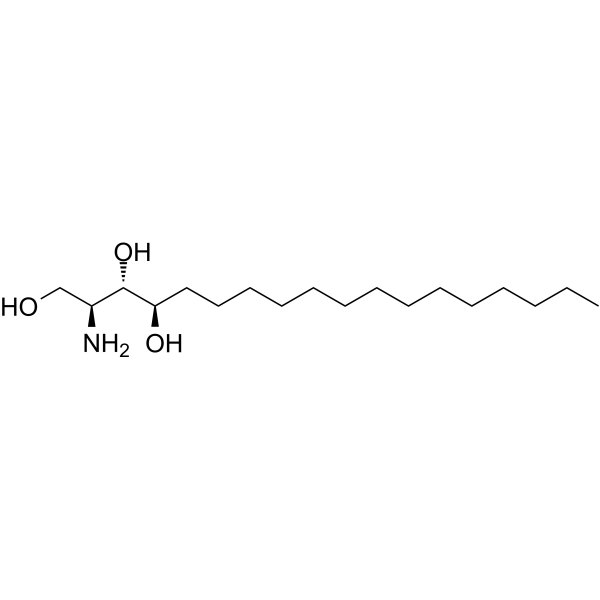
    Phytosphingosine
    4 Publications Verification

    4-Hydroxysphinganine

    Apoptosis Endogenous Metabolite Fungal Free Fatty Acid Receptor Infection Metabolic Disease Inflammation/Immunology Cancer
    Phytosphingosine is a phospholipid with anti-inflammatory, antibacterial, and anti-cancer activities, which can induce apoptosis. Phytosphingosine is an immune regulator and can be used in the study of inflammatory skin diseases. Phytosphingosine is also an activator of GPR120 with an IC50 value of 33.4 μM and can be used in the study of type II diabetes .
    Phytosphingosine
  • HY-141582

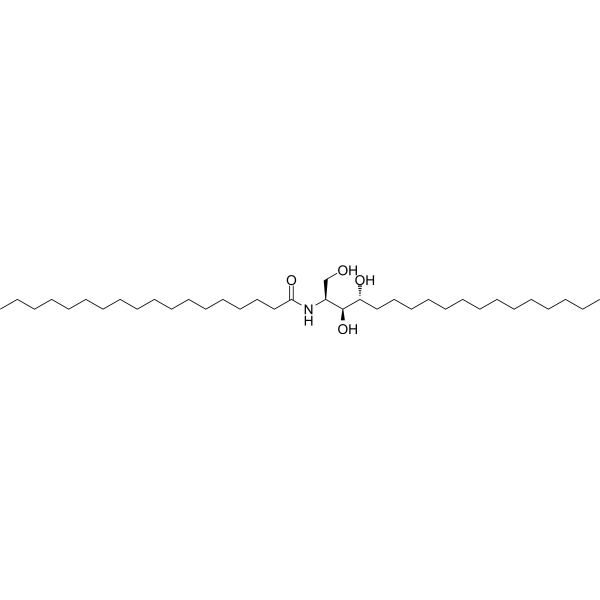
    N-Stearoyl Phytosphingosine

    JNK NF-κB Interleukin Related TNF Receptor Inflammation/Immunology
    Ceramide 3 (N-Stearoyl phytosphingosine) is an orally active major component of intercellular lipids in the stratum corneum of the skin, and belongs to the ceramide family. Ceramide 3 inhibits c-jun and NF-κB activation induced by Histamine (HY-B1204), and suppresses the expression of IL-4 and TNF-α. Ceramide 3 inhibits scratching behavior and vascular permeability in mice, and exhibits antihistamine effects in guinea pig ileum. Ceramide 3 improves skin barrier function, reduces transepidermal water loss, erythema and the number of circulating epidermal cells, and accelerates barrier repair of irritated or dysfunctional skin .
    Ceramide 3
  • HY-N7814
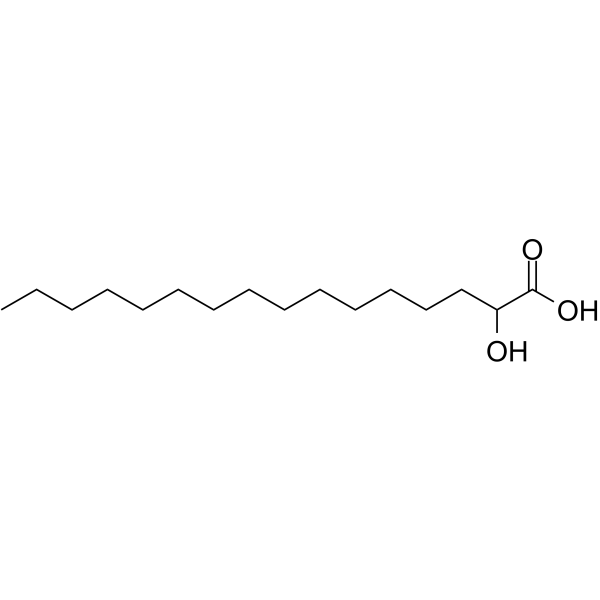
    2-Hydroxypalmitic acid
    1 Publications Verification

    Endogenous Metabolite Drug Intermediate Infection
    2-Hydroxypalmitic acid is an intermediate in the phytosphingosine metabolic pathway. 2-Hydroxypalmitic acid is exclusively incorporated into sphingolipids and not used for other lipids. 2-Hydroxypalmitic acid promotes the production of odd-carbon phosphatidylcholine species. 2-Hydroxypalmitic acid is applicable to studies of Saccharomyces cerevisiae infection .
    2-Hydroxypalmitic acid
  • HY-138875

    p38 MAPK Apoptosis Cardiovascular Disease Cancer
    Tetraacetylphytosphingosine is a sphingolipid metabolite produced by phytosphingosine acetylation. Tetraacetylphytosphingosine exerts its inhibitory action on angiogenesis through the inhibition of MAPK activation and intracellular calcium increase . Tetraacetylphytosphingosine induces apoptosis in HaCaT cells .
    Tetraacetylphytosphingosine
  • HY-141582S

    N-Stearoyl Phytosphingosine-d3

    Isotope-Labeled Compounds Interleukin Related TNF Receptor NF-κB JNK Inflammation/Immunology
    Ceramide 3-d3 (N-Stearoyl phytosphingosine-d3) is deuterium labeled Ceramide 3. Ceramide 3 is an orally active major component of intercellular lipids in the stratum corneum of the skin, and belongs to the ceramide family. Ceramide 3 inhibits c-jun and NF-κB activation induced by Histamine (HY-B1204), and suppresses the expression of IL-4 and TNF-α. Ceramide 3 inhibits scratching behavior and vascular permeability in mice, and exhibits antihistamine effects in guinea pig ileum. Ceramide 3 improves skin barrier function, reduces transepidermal water loss, erythema and the number of circulating epidermal cells, and accelerates barrier repair of irritated or dysfunctional skin.
    Ceramide 3-d3
  • HY-W011303R

    4-Hydroxysphinganine (Standard)

    Reference Standards Apoptosis Endogenous Metabolite Fungal Free Fatty Acid Receptor Infection Metabolic Disease Inflammation/Immunology Cancer
    Phytosphingosine (Standard) is the analytical standard of Phytosphingosine. This product is intended for research and analytical applications. Phytosphingosine is a phospholipid with anti-inflammatory, antibacterial, and anti-cancer activities, which can induce apoptosis. Phytosphingosine is an immune regulator and can be used in the study of inflammatory skin diseases. Phytosphingosine is also an activator of GPR120 with an IC50 value of 33.4 μM and can be used in the study of type II diabetes[1][2][3][4].
    Phytosphingosine (Standard)
  • HY-115708

    Cer(t18:0/22:0); Ceramide (t18:0/22:0); C22 Phytosphingosine (t18:0/22:0)

    Endogenous Metabolite Metabolic Disease
    C22 Phytoceramide is a sphingolipid that has been found in Moro blood orange (C. sinensis) peels. It has also been found in primary human astrocytes.
    C22 Phytoceramide (t18:0/22:0)
  • HY-166066

    Biochemical Assay Reagents Metabolic Disease
    N-Tetracosanoyl-phytosphingosine is an ester product.
    N-Tetracosanoyl-phytosphingosine
  • HY-W011303S

    4-Hydroxysphinganine-d7

    Isotope-Labeled Compounds Fungal Free Fatty Acid Receptor Apoptosis Endogenous Metabolite Infection Metabolic Disease Inflammation/Immunology Cancer
    Phytosphingosine-d7 (4-Hydroxysphinganine-d7) is deuterium labeled Phytosphingosine. Phytosphingosine is a phospholipid with anti-inflammatory, antibacterial, and anti-cancer activities, which can induce apoptosis. Phytosphingosine is an immune regulator and can be used in the study of inflammatory skin diseases. Phytosphingosine is also an activator of GPR120 with an IC50 value of 33.4 μM and can be used in the study of type II diabetes .
    Phytosphingosine-d7
  • HY-W414697

    D-Ribo-Phytosphingosine (C17 base)

    Bacterial Others
    4-Hydroxysphinganine C17 base (D-Ribo-phytosphingosine C17 base), also known as D-ribo-phytosphingosine or PHS, is a crucial compound present in the membranes of fungi, plants, bacteria, marine organisms, and mammalian tissues. It plays a vital role in preserving the structural integrity of membranes, regulating cellular growth, and mediating the heat stress response in yeast. Additionally, PHS serves as a precursor for the synthesis of important lipid mediators such as PHS 1-phosphate, inositol phosphorylceramide, and KRN7000 (the α-anomer of galactosylceramide). Furthermore, this phospholipid promotes keratinocyte differentiation, making it a valuable active ingredient in cosmetic formulations.
    4-Hydroxysphinganine (C17 base)
  • HY-175088

    C48:2 EOP (t18:0/30:0w18:2 (9Z,12Z)); N-(30-Linoleoyloxy-triacontanoyl)-Phytosphingosine

    Drug Derivative Others
    EOP (t18:0/30:0/18:2) (C48:2 EOP (t18:0/30:0w18:2 (9Z,12Z)); N-(30-Linoleoyloxy-triacontanoyl)-phytosphingosine) is a plant ceramide-based EOS analog. EOP (t18:0/30:0/18:2) is formed by esterifying an ω-hydroxy very long chain ceramide (C28-36) with the essential fatty acid linoleic acid. EOP (t18:0/30:0/18:2) has been used as a component of a model stratum corneum lipid mixture .
    EOP (t18:0/30:0/18:2)
  • HY-N7814R

    Reference Standards Endogenous Metabolite Others
    Pheniramine (maleate) (Standard) is the analytical standard of Pheniramine (maleate). This product is intended for research and analytical applications. Pheniramine (Prophenpyridamine; Tripoton) maleate is a first-generation histamine H1 receptor antagonist, acts on the central nervous system (CNS) with sedative and hypnotic effect. Pheniramine maleate displays antitumor effect and induces leukemia cells apoptosis. Pheniramine maleate is also a safe and effective local agent that can suppress or relieve pain, with antipruritic effects .
    2-Hydroxypalmitic acid (Standard)
  • HY-N7814S

    2-Hydroxyhexadecanoic acid-d30

    Isotope-Labeled Compounds Endogenous Metabolite Others
    2-Hydroxypalmitic acid-d30 (2-Hydroxyhexadecanoic acid-d30) is deuterium labeled 2-Hydroxypalmitic acid. 2-Hydroxypalmitic acid is an intermediate in phytosphingosine metabolism .
    2-Hydroxypalmitic acid-d30
  • HY-W590572

    Biochemical Assay Reagents Others
    N-Butyroyl Phytosphingosine is a lipid molecule featuring an amide, a primary alcohol, two secondary alcohols and a C18 chain.
    N-Butyroyl Phytosphingosine
  • HY-158951

    N-24:0 (2S-OH) Phytosphingosine

    Biochemical Assay Reagents
    C24 (2'(S)-Hydroxy) phytoceramide (t18:0/24:0) is a ceramide.
    C24 (2'(S)-Hydroxy) phytoceramide (t18:0/24:0)
  • HY-175055

    C12 NBD Phytosphingosine (t18:0/12:0); NBD cer (t18:0/12:0); NBD ceramide (t18:0/12:0)

    Fluorescent Dye Drug Derivative Others
    C12 NBD Phytoceramide (t18:0/12:0) is a ceramide analogue composed of a phytoceramide and green fluorescent C12 NBD. C12 NBD Phytoceramide (t18:0/12:0) is a fluorescent substrate (Ex=485 nM, Em=525 nM) and can be used to detect ceramidase (such as diacylglycerol acyltransfereases Lro1p) activity .
    C12 NBD phytoceramide (t18:0/12:0)

Inquiry Online

Your information is safe with us. * Required Fields.

Salutation


Country or Region *

Applicant Name *


Organization Name *

Department *


Email Address *


Product Name *

Cat. No.


Requested quantity *

Phone Number *


Remarks

Inquiry Online

Inquiry Information

Product Name:
Cat. No.:
Quantity:
MCE Japan Authorized Agent:

