14 Results for "

Qi

" in MedChemExpress (MCE) Product Catalog:
Products (14)

14 Results for "Qi" in MCE Product Catalog:

Cat. No.: HY-13836
CAS No.: 1354745-52-0
Purity:  ≥98.0%
Target:  

Parasite

Research Areas:  

Infection

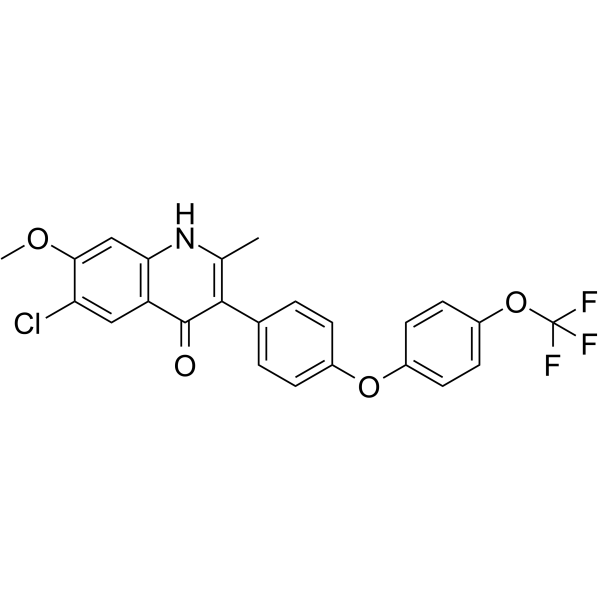
ELQ-300 is a potent and orally bioavailable antimalarial agent, acts as an inhibitor of the reductive (Qi) site of the cytochrome bc1 complex (cyt bc1). ELQ-300 inhibits growth of P. falciparum Dd2, Tm90-C2B, and D1 with IC50 values of 6.6, 4.6 and 160 nM, respectively. ELQ-300 can be used for the research of antimalarial .
loading...
    loading...
Cat. No.: HY-162066
CAS No.: 2868298-43-3
Target:  

Parasite

Research Areas:  

Infection

DNDI-6174 is an orally active Leishmania cytochrome b (Qi site of cytochrome bc1 complex/complex III) inhibitor. DNDI-6174 binds to the Qi site of Leishmania cytochrome b, inhibits cytochrome bc1 complex activity in the parasite's electron transport chain across promastigote and axenic amastigote stages. DNDI-6174 reduces parasite burden in rodent models, inhibits growth of various Leishmania species, drug-resistant clinical isolates, and Trypanosoma cruzi, with marginal activity against Trypanosoma brucei. DNDI-6174 can be used for the research of visceral leishmaniasis, cutaneous leishmaniasis .
loading...
    loading...
Cat. No.: HY-159934
CAS No.: 3093894-38-0
Target:  

FAP

Research Areas:  

Cancer

QI-18 is a fibroblast activation protein (FAP) inhibitor with the IC50 of 0.50 nM, which is a 6.5-fold increase in potency over that of UAMC-1110 (HY-100684,IC50 of 3.25 nM). QI-18 can be used to synthesize high tumor selectivity and high dose radiotracers for the diagnosis and study of tumors .
loading...
    loading...
Cat. No.: HY-122298
CAS No.: 517875-34-2
Synonyms: XDE 777
Target:  

Antibiotic Fungal

Research Areas:  

Infection

Fenpicoxamid is a new fungicide. Fenpicoxamid inhibits the growth of the fungus Z. tritici with an EC50 value of 0.051 mg/L .
loading...
    loading...
Cat. No.: HY-N17727
CAS No.: 331433-08-0
Divaricatol is an orally ative chromone natural product and an active component in Saposhnikovia divaricata. Divaricatol reduces the release of pro-inflammatory cytokines and restores immune homeostasis by stably binding to 5KIR (a target of the TNF/IL-17 pathway). Divaricatol exerts analgesic effects in mouse models. Divaricatol can be used in the research of pain, diarrhea-predominant irritable bowel syndrome (IBS-D) and qi deficiency syndrome .
loading...
    loading...
Cat. No.: HY-184395
Target:  

Parasite

Research Areas:  

Infection

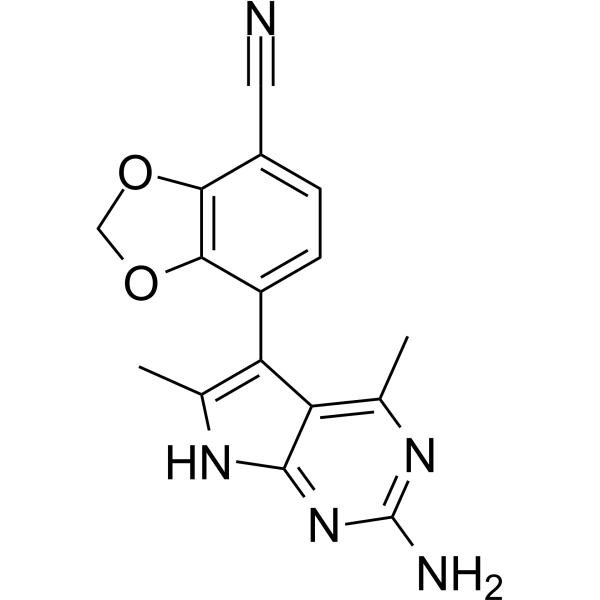
HLQ-102 is an orally active parasite cytochrome bc1 complex Qi site binder. HLQ-102 inhibits the growth of Plasmodium. HLQ-102 exhibits antimalarial activity against Plasmodium in mice. HLQ-102 can be used in malaria-related research .
loading...
    loading...
Cat. No.: HY-N17289
CAS No.: 1420217-16-8
Schisphenin A is a natural product that can be found in Chang Sheng Qi.
loading...
    loading...
Cat. No.: HY-182711
CAS No.: 1379615-30-1
Target:  

Bacterial Parasite

Research Areas:  

Infection

SCR0911 is an inhibitor of mycobacterial cytochrome bcc oxidase and Plasmodium falciparum cytochrome bc1. SCR0911 disrupts oxidative phosphorylation by binding to mycobacterial cytochrome bcc, binds to the Qi site of Plasmodium falciparum cytochrome bc1, inhibits mycobacterial cell growth and ATP synthesis, and exhibits broad-spectrum anti-mycobacterial and anti-malarial activities. SCR0911 can be used in research related to tuberculosis, malaria, and isolated persistent hypermethioninemia (iph) .
loading...
    loading...
Cat. No.: HY-N18671
Category:  

Extract

Target:  

Others

Codonopsis Pilosula Extract has the effect of invigorating the middle and nourishing qi, invigorating the spleen and lungs.
loading...
    loading...
Cat. No.: HY-N17485
CAS No.: 194235-18-2
3-Oxooleana-1,12-dien-28-oic acid is a natural product that can be found in Qi Dun Guo.
loading...
    loading...
Cat. No.: HY-N17327
CAS No.: 189116-23-2
(2α,3β)-Dihydroxy-23-norolean-4(24),12(13)-dien-28-oic acid is a natural product that can be found in Qi Dun Guo.
loading...
    loading...
Cat. No.: HY-N18292
CAS No.: 1802143-09-4
Qinanone G is a 2-(2-phenylethyl)chromone (HY-N8220) derivative found in the high quality Chinese agarwood 'Qi-Nan' from Aquilaria sinensis (Lour.) Glig. Qinanone G shows no inhibitory activity against AChE and cancer cells .
loading...
    loading...
Cat. No.: HY-L224
2,467 compounds

Diarrhea is a disease symptom, and the pathophysiologic basis of diarrhea is a disturbance in intestinal water and electrolyte balance, which may be due to increased secretion of osmotically active electrolytes (secretory diarrhea) or increased intake of osmotically active substances (osmotic diarrhea). Food poisoning, pathogenic bacterial infections, and intestinal-related diseases can all contribute to the development of diarrhea. Traditional Chinese Medicine (TCM) considers diarrhea to be a symptom of an imbalance in the body's systems, particularly related to the functions of the spleen and stomach. Spleen qi deficiency, dampness-heat, liver and spleen disharmony are closely related to diarrhea. Many types of Chinese herbs regulate the function of diarrhea, such as: Dysosmae Verspiellis Rhixoma Et Radix, Ginkgo Semen, Forsythiae Fructus, and Campsis Flos.

MCE can provide 2,467 active monomers that can be obtained from TCM herbs with diarrhea-regulating functions, which can be applied to drug development and disease mechanism research.

Cat. No.: HY-L246
1,040 compounds

Tonifying traditional Chinese medicines occupy a central position in the traditional medical system, with their core value lying in the regulation of the body's functional state. Modern pharmacological studies have confirmed that these medicinal materials and their monomeric components possess multiple biological activities, including bidirectional immune regulation, anti-aging and lifespan extension, neuroprotection and cognitive enhancement, as well as hematopoietic and metabolic regulation. According to the traditional Chinese medicine theory of “strengthening the body’s resistance and consolidating the foundation”, tonifying medicines are mainly classified into four major categories: Qi-tonifying, Blood-tonifying, Yin-tonifying, and Yang-tonifying. This compound library strictly follows this classification system for compound collection.

Monomeric compounds derived from traditional Chinese medicines demonstrate excellent drug-like properties. They naturally possess structural diversity and clearly defined pharmacological activities, which help improve screening success rates and make them ideal tools for studying multi-target synergistic effects. This library contains 1,040 compounds, providing a material basis for investigating synergistic interactions among compounds (network pharmacology) and facilitating the development of multi-target therapeutic strategies for complex diseases such as cancer, neurodegenerative disorders, and metabolic syndrome.

  • 1

