1. Search Result
Search Result
Isoforms Recommended: USP14
Results for "

USP14

" in MedChemExpress (MCE) Product Catalog:

14

Inhibitors & Agonists

1

Fluorescent Dyes

2

Recombinant Proteins

2

Antibodies

3

Oligonucleotides

Cat. No. Product Name Target Research Areas Chemical Structure
  • HY-13817
    IU1
    Maximum Cited Publications
    25 Publications Verification

    Deubiquitinase Autophagy Apoptosis Cardiovascular Disease Neurological Disease Endocrinology Cancer
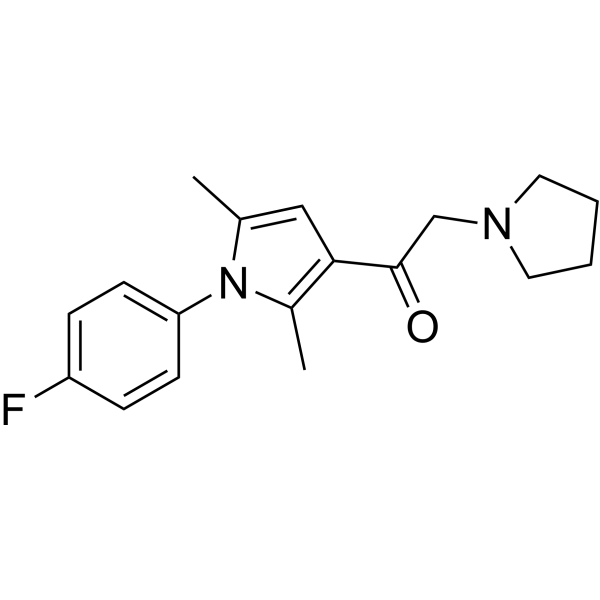
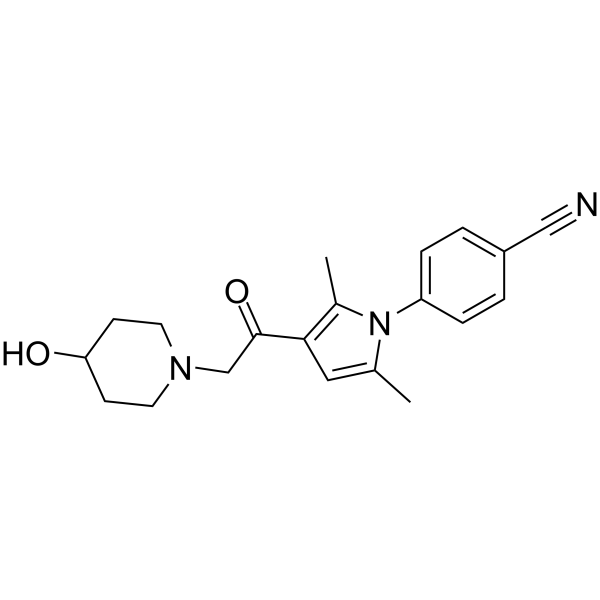
    IU1 is a selective, reversible USP14 inhibitor with an IC50 of 4-5 μM. IU1 binds USP14’s catalytic cleft to block deubiquitinase activity. IU1 induces calpain-dependent Tau cleavage, causes ATP deficits, reduces E1~Ub thioester levels and 26S proteasome assembly. IU1 enhances 26S proteasome chymotrypsin-like activity, modulates LC3B-dependent autophagy flux, reduces cancer cell proliferation and migration, and blocks G0/G1 to S phase cell cycle transition in follicular thyroid cancer cells. IU1 activates autophagy-lysosomal and ubiquitin-proteasome pathways, triggers apoptosis, and reduces cervical cancer cell growth. IU1 enhances degradation of proteasome substrates linked to neurodegenerative disease, accelerates oxidized protein degradation, and increases oxidative stress resistance. IU1 can be used for the research of Alzheimer’s disease, follicular thyroid cancer, ischemic stroke, cervical cancer, and neurodegenerative disease .
    IU1
  • HY-13264
    Degrasyn
    15+ Cited Publications

    WP1130

    Deubiquitinase Bcr-Abl Autophagy Apoptosis Cancer
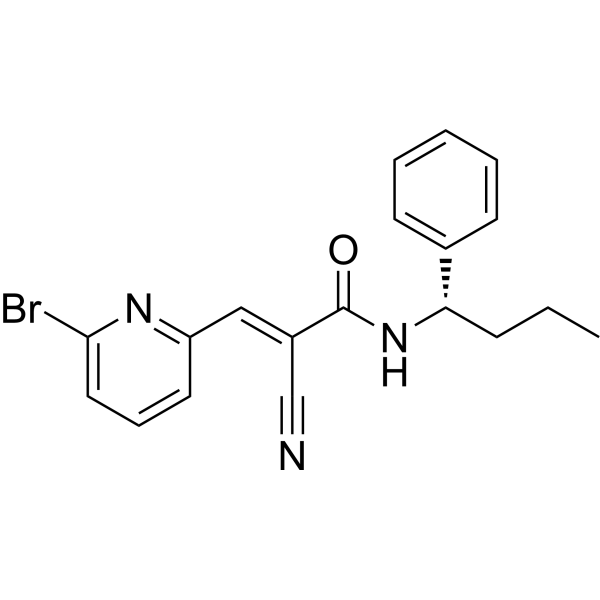
    Degrasyn (WP1130) is a cell-permeable deubiquitinase (DUB) inhibitor, directly inhibiting DUB activity of USP9x, USP5, USP14, and UCH37. Degrasyn has been shown to downregulate the antiapoptotic proteins Bcr-Abl and JAK2.
    Degrasyn
  • HY-13989
    b-AP15
    10+ Cited Publications

    NSC 687852

    Deubiquitinase Apoptosis Cancer
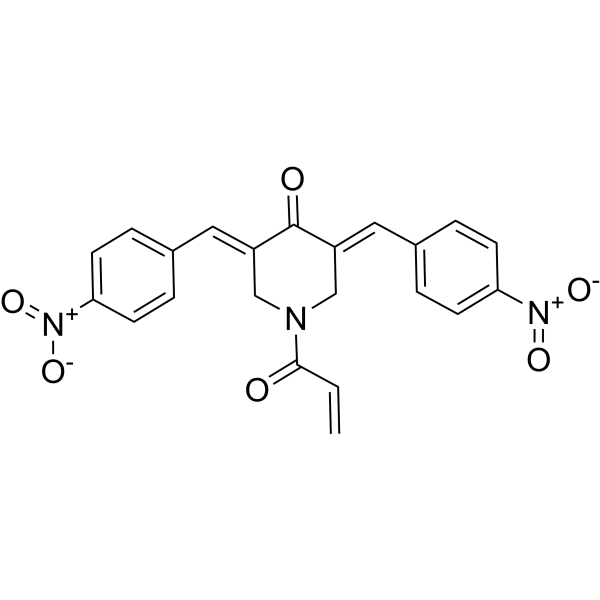
    b-AP15 is a specific inhibitor of the deubiquitinating enzymes UCHL5 and Usp14.
    b-AP15
  • HY-122243
    IU1-47
    3 Publications Verification

    Deubiquitinase Neurological Disease
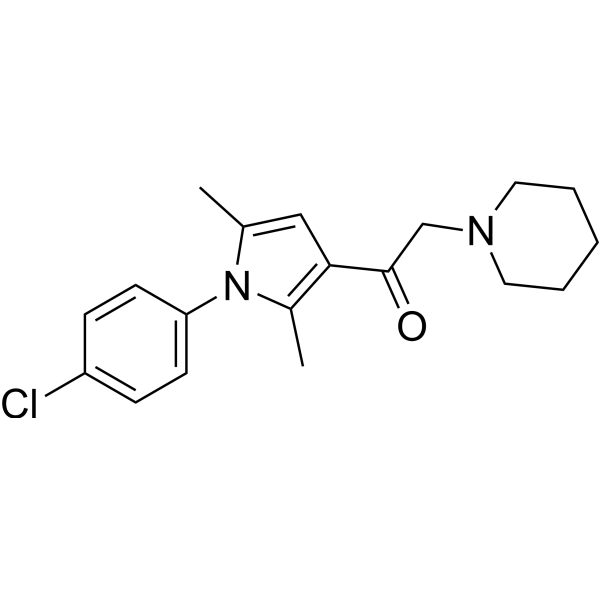
    IU1-47 is a potent and specific USP14 inhibitor with an IC50 of 0.6 μM. IU1-47 inhibits IsoT/USP5 with an IC50 of 20 μM. IU1-47 induces tau elimination in cultured neurons .
    IU1-47
  • HY-122885
    IU1-248
    1 Publications Verification

    Deubiquitinase Cancer
    IU1-248, a derivative of IU1, is a potent and selective USP14 inhibitor with an IC50 of 0.83 μM.
    IU1-248
  • HY-RS15525

    Small Interfering RNA (siRNA) Others

    USP14 Human Pre-designed siRNA Set A contains three designed siRNAs for USP14 gene (Human), as well as a negative control, a positive control, and a FAM-labeled negative control.

    USP14 Human Pre-designed siRNA Set A
    USP14 Human Pre-designed siRNA Set A
  • HY-RS23069

    Small Interfering RNA (siRNA) Others

    Usp14 Rat Pre-designed siRNA Set A contains three designed siRNAs for Usp14 gene (Rat), as well as a negative control, a positive control, and a FAM-labeled negative control.

    Usp14 Rat Pre-designed siRNA Set A
    Usp14 Rat Pre-designed siRNA Set A
  • HY-RS16634

    Small Interfering RNA (siRNA) Others

    Usp14 Mouse Pre-designed siRNA Set A contains three designed siRNAs for Usp14 gene (Mouse), as well as a negative control, a positive control, and a FAM-labeled negative control.

    Usp14 Mouse Pre-designed siRNA Set A
    Usp14 Mouse Pre-designed siRNA Set A
  • HY-176207

    ByeTAC HDAC Cancer
    HDAC6 degrader-6 (compound 10c) is a ByeTAC protein degrader targeting HDAC6, with IC50 values of 0.034 μM, 0.166 μM, 0.703 μM, and 0.293 μM for HDAC6, HDAC1, HDAC2, and HDAC3, respectively. HDAC6 degrader-6 induces cell apoptosis and can be used for the study of multiple myeloma(Blue: USP14 ligand HY-159808; Pink: HDAC ligand HY-176209; Black: linker HY-W016871)
    HDAC degrader-1
  • HY-15432

    (E/Z)-b-AP15

    Deubiquitinase Cancer
    (E/Z)-NSC-687852 is a isomer of NSC-687852 (HY-13989). NSC687852 (b-AP15) is a specific inhibitor of the deubiquitinating enzymes UCHL5 and Usp14 .
    (E/Z)-NSC-687852
  • HY-135779

    Deubiquitinase Neurological Disease
    IU2-6 is a USP14 deubiquitinase inhibitor. IU2-6 inhibits deubiquitinating activity of proteasome-associated USP14, blocks substrate rescue from degradation, and enhances proteasomal activity. IU2-6 can be used for the research of neurodegeneration .
    IU2-6
  • HY-164689

    Proteasome Cancer
    Cadmium pyrithione is a metal compound that inhibits protein deubiquitinase activity. Cadmium pyrithione treatment results in significant accumulation of ubiquitinated proteins in cancer cells and primary leukemia cells. Cadmium pyrithione strongly inhibits the activity of proteasome deubiquitinase (such as USP14 and UCHL5), but has a smaller inhibitory effect on 20S proteasome activity. The anticancer activity of Cadmium pyrithione is associated with the induction of apoptosis through caspase activation. Furthermore, Cadmium pyrithione inhibition inhibited proteasome function and suppressed tumor growth in animal xenograft models .
    Cadmium pyrithione
  • HY-D1236

    Parasite Deubiquitinase PARP Cancer
    Fluorescent brightener 71 (FB71) is an inhibitor targeting deubiquitinases UCHL5 and USP14, as well as a CD40 ligand. Fluorescent brightener 71 blocks enzymatic activity, induces apoptosis, inhibits cell growth and triggers reactive oxygen species production. Meanwhile, Fluorescent brightener 71 upregulates the expression of oxidative stress-related genes gpx-4 and sod-4, and reversibly increases the protein levels of UCHL5 and USP14 through a feedback response. Fluorescent brightener 71 inhibits the growth, movement and reproductive capacity of Caenorhabditis elegans, and also exhibits concentration-dependent toxic effects. Fluorescent brightener 71 can be applied to scientific research in related fields such as breast cancer .
    Fluorescent brightener 71
  • HY-181495

    Proteasome Cap Targeting Chimeras PROTACs Proteasome Epigenetic Reader Domain Cancer
    RAJQ14 is a BRD4 PROTAC-like CAP-TAC (Proteasome Cap Targeting Chimeras) degrader. RAJQ14 binds to 19S proteasome cap subunits RPN1, RPN10, RPN13, and USP14 to recruit target proteins to the proteasome for ubiquitination-independent, proteasome-dependent degradation. RAJQ14 can be used for the research of cancer (Pink: BRD4 Ligand (HY-181496); Blue: Proteasome Ligand (HY-128978); Black: Linker).
    RAJQ14

Inquiry Online

Your information is safe with us. * Required Fields.

Salutation


Country or Region *

Applicant Name *


Organization Name *

Department *


Email Address *


Product Name *

Cat. No.


Requested quantity *

Phone Number *


Remarks

Inquiry Online

Inquiry Information

Product Name:
Cat. No.:
Quantity:
MCE Japan Authorized Agent:

