
1. Search Result
Search Result
Results for "

Wilson disease

" in MedChemExpress (MCE) Product Catalog:

10

Inhibitors & Agonists

3

Fluorescent Dyes

1

Biochemical Assay Reagents

3

Natural
Products

1

Isotope-Labeled Compounds

Cat. No. Product Name Target Research Areas Chemical Structure
  • HY-B0300
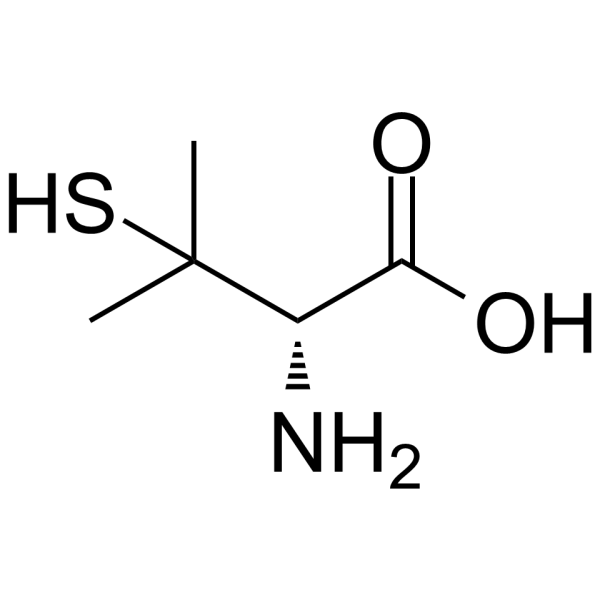
    Penicillamine
    3 Publications Verification

    D-(-)-Penicillamine

    Cuproptosis Drug Metabolite Inflammation/Immunology Cancer
    Penicillamine (D-(-)-Penicillamine) is a penicillin metabolic degradation product, can be used as a heavy metal chelator. Penicillamine increases free copper and increases oxidative stress. Penicillamine has effect of seizures through nitric oxide/NMDA pathways. Penicillamine is a potential immune modulator. Penicillamine can be used for the research of Wilson disease, rheumatoid arthritis, and cystinuria .
    Penicillamine
  • HY-B0658A

    Zinc(II) acetate dihydrate, ACS, 98%

    Biochemical Assay Reagents Others
    Zinc acetate dihydrate, ACS, 98% (Zinc (II) acetate dihydrate, ACS, 98%) acts as a metal chelator and an intestinal metallothionein inducer. Zinc acetate dihydrate, ACS, 98% induces intestinal metallothionein synthesis and shortens the course of the common cold. Zinc acetate dihydrate, ACS, 98% is applicable to the research of copper metabolism disorder-related diseases, the common cold and Wilson's disease, as well as protein experiments .
    Zinc acetate dihydrate, ACS, 98%
  • HY-B2153

    Cuproptosis Bacterial Infection
    Tetraethylenepentamine pentahydrochloride is an orally active copper chelator and copper mobilizer. Tetraethylenepentamine pentahydrochloride exhibits growth inhibitory and hypolipidemic properties. Tetraethylenepentamine pentahydrochloride significantly increases urinary copper excretion and reduces renal copper accumulation in copper overload models, but does not significantly alter hepatic copper levels. Tetraethylenepentamine pentahydrochloride exerts growth inhibitory effects on Candida albicans and Fluconazole (HY-B0101)-resistant strains, and can be widely used in studies related to Wilson's disease and Candida infections .
    Tetraethylenepentamine pentahydrochloride
  • HY-B0300S

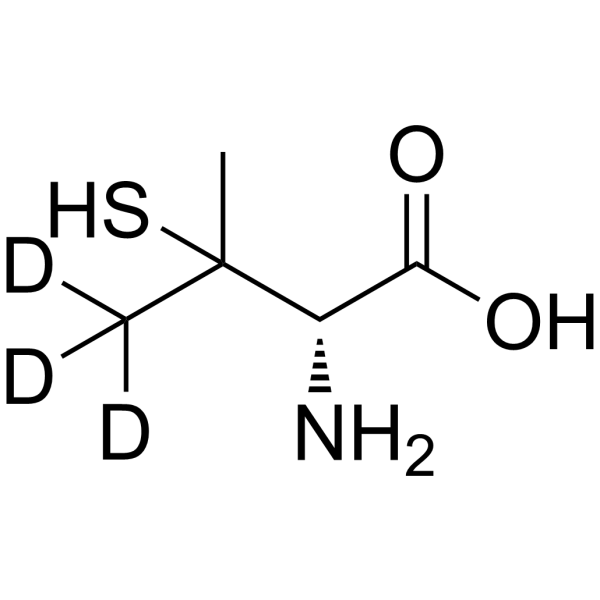
    D-(-)-Penicillamine-d3

    Drug Metabolite Isotope-Labeled Compounds Cuproptosis Inflammation/Immunology
    Penicillamine-d3 is the deuterium labeled Penicillamine. Penicillamine (D-(-)-Penicillamine) is the most characteristic degradation product of the penicillin antibiotics. It is used as an antirheumatic and as a chelating agent in Wilson's disease.
    Penicillamine-d3
  • HY-157735

    Endogenous Metabolite Metabolic Disease
    2-Myristyl dipalmitin (PMP) is a triglyceride of palmitic acid. 2-Myristyldipalmitin has potential as a lipid marker for Wilson's disease (WD) .
    2-Myristyldipalmitin
  • HY-B0300R

    D-(-)-Penicillamine (Standard)

    Cuproptosis Reference Standards Drug Metabolite Inflammation/Immunology Cancer
    Penicillamine (Standard) is the analytical standard of Penicillamine. This product is intended for research and analytical applications. Penicillamine (D-(-)-Penicillamine) is a penicillin metabolic degradation product, can be used as a heavy metal chelator. Penicillamine increases free copper and increases oxidative stress. Penicillamine has effect of seizures through nitric oxide/NMDA pathways. Penicillamine is a potential immune modulator. Penicillamine can be used for the research of Wilson disease, rheumatoid arthritis, and cystinuria .
    Penicillamine (Standard)
  • HY-W783351

    Coppersensor 790 acetoxymethyl ester

    Fluorescent Dye Metabolic Disease
    CS790AM (Coppersensor 790 acetoxymethyl ester) is a cell-permeable, Cu +-targeted near-infrared fluorescent probe (λabs=760 nm, λem=790 nm) applicable to live cells. CS790AM can cross lipophilic cell membranes, and is converted into negatively charged CS790 under the action of intracellular esterases to be retained, thus enabling highly sensitive, reversible "turn-on" detection of labile Cu + pools in live cells and mice. CS790AM possesses excellent biocompatibility and selectivity, avoids interference from other metal ions, shows no obvious toxicity, and can be rapidly cleared. CS790AM allows long-term longitudinal monitoring of individual mice, visualizes copper levels in internal organs and isolated livers, and effectively evaluates abnormal copper accumulation in Wilson's disease models (Atp7b -/-) as well as dynamic changes after chelator treatment. CS790AM can be used for research on Wilson's disease and related copper metabolic disorders .
    CS790AM
  • HY-D3215

    Fluorescent Dye Neurological Disease
    Lyso-Cu (II) is a lysosome-targeted divalent copper ion probe. Lyso-Cu (II) is applicable to the research of Wilson's disease, Menkes disease and Alzheimer's disease .
    Lyso-Cu(II)
  • HY-D2969

    Fluorescent Dye Metabolic Disease
    CYDA is a colorimetric probe based on cyanine dyes, which enables highly sensitive and selective detection of Cu²⁺. CYDA can be used for urine copper detection in Wilson's disease .
    CYDA
  • HY-D3207

    Fluorescent Dye Neurological Disease
    DHUCu-1 is a lysosome-targeted NIR divalent copper ion probe with high water solubility. DHUCu-1 serves as a tool for investigating the physiological functions of Cu 2+ and related diseases, such as Menke syndrome, Wilson's disease, and Alzheimer's disease .
    DHUCu-1

Inquiry Online

Your information is safe with us. * Required Fields.

Salutation


Country or Region *

Applicant Name *


Organization Name *

Department *


Email Address *


Product Name *

Cat. No.


Requested quantity *

Phone Number *


Remarks

Inquiry Online

Inquiry Information

Product Name:
Cat. No.:
Quantity:
MCE Japan Authorized Agent:

