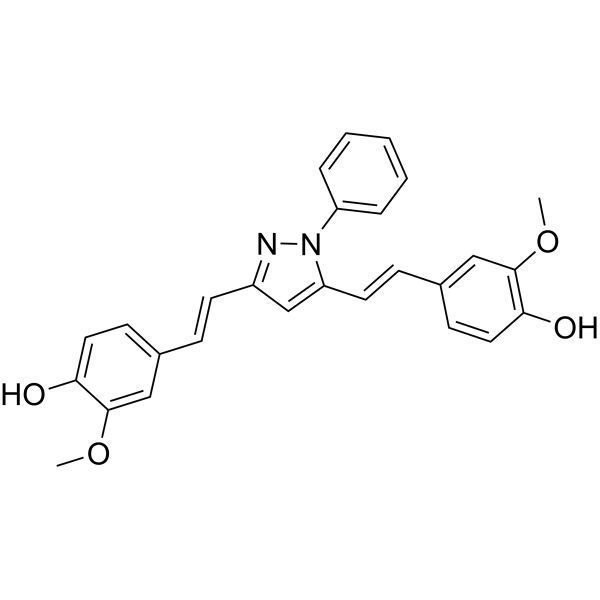
8 Results for "

amyloid uptake

" in MedChemExpress (MCE) Product Catalog:
Products (8)

8 Results for "amyloid uptake" in MCE Product Catalog:

Cat. No.: HY-W176557
CAS No.: 877459-36-4
Target:  

Aquaporin Amyloid-β

Research Areas:  

Neurological Disease

TGN-073 is an orally active, blood-brain barrier-permeable aquaporin 4 (AQP4) modulator. TGN-073 increases the uptake and distribution of brain MRI tracers in the brain parenchyma and reduces the levels of insoluble amyloid β-40 and β-42. TGN-073 can be used in research related to Alzheimer's disease, dementia, traumatic brain injury and pain .
loading...
    loading...
Cat. No.: HY-161723
CAS No.: 2358754-22-8
Research Areas:  

Neurological Disease

LH2-051, a lysosome-enhancing compound (LYEC), is a brain-penetrant dopamine transporter (DAT) inhibitor (Ki: 0.95 μM). LH2-051 inhibits DAT-mediated dopamine uptake with an IC50 of 3.0 μM. LH2-051 promotes nuclear translocation of TFEB and lysosome biogenesis. LH2-051 improves the memory of amyloid precursor protein (APP)/Presenilin 1 (PS1) mice. LH2-051 can be used for the study of Alzheimer’s disease .
loading...
    loading...
Cat. No.: HY-P1388F
Synonyms: FITC-Ahx-amyloid β-peptide (1-42) (rat/mouse) tris
Research Areas:  

Neurological Disease

FITC-Ahx-β-Amyloid (1-42), (rat/mouse) (tris) (FITC-Ahx-Amyloid β-peptide (1-42) (rat/mouse) (tris)) is a fluorescently labeled (FITC) form of β-Amyloid (1-42), (rat/mouse) (HY-P1388), which can be used in Alzheimer's disease-related research, such as aggregation, fiber formation, cellular uptake or imaging experiments. This product is provided in the form of Tris salt.
loading...
    loading...
Cat. No.: HY-158204
CAS No.: 1019110-87-2
CNB-001 is a potent and orally active 5-lipoxygenase (5-LOX) inhibitor. CNB-001 can decreases 5-LOX expression and increase proteasome activity. CNB-001 can inhibit accumulation of soluble Amyloid-β and ubiquitinated aggregated proteins. CNB-001 can inhibit apoptosis, ROS production and stabilize mitochondrial membrane potential. CNB-001 can reduce insulin resistance and increase glucose uptake. CNB-001 also exhibits anti-ischemic, anti-inflammatory effects. CNB-001 can be used for the researches of inflammation, neurological and metabolic disease, such as Alzheimer's disease, stroke and diabetes .
loading...
    loading...
Cat. No.: HY-183586
CAS No.: 946336-44-3
G721-0377 is a CHI3L1 modulator with a human Kd value of 45 μM. G721-0377 binds to CHI3L1 and modulates downstream signaling pathways. G721-0377 suppresses CHI3L1-induced NF-κB activation, decreases secretion of CHI3L1 and IL-6. G721-0377 can be used for the research of Alzheimer's disease .
loading...
    loading...
Cat. No.: HY-164641
CAS No.: 2459994-71-7
Target:  

Orphan GPCR

Research Areas:  

Neurological Disease

GPR34 agonist 1 is a G-protein coupled receptor 34 agonist that enhances fibrillar Aβ uptake in mouse primary microglia with an EC50 of 5 nM .GPR34 agonist 1 selectively activates Gi/o-coupled GPR34, reduces intracellular cyclic adenosine monophosphate levels, and requires functional TREM2 signaling .GPR34 agonist 1 induces microglial Aβ fibril phagocytosis and chemotaxis, enhances microglial uptake and clearance of amyloid β fibrils, and increases microglial Aβ fibril uptake in vivo and in human induced pluripotent stem cell-derived microglia .GPR34 agonist 1 can be used for the research of Alzheimer disease .
loading...
    loading...
Cat. No.: HY-184157
IB15C is an ILT3 (LILRB4) inhibitor with a human Kd of 0.92 μM. IB15C binds to a specific ILT3 pocket, disrupts ApoE interaction, and interferes with downstream inhibitory signaling pathways. IB15C reduces SHP1 and SHP2 phosphorylation, suppresses pro-inflammatory cytokine secretion, enhances amyloid uptake, and attenuates NF-κB activation. IB15C can be used for the research of alzheimer's disease .
loading...
    loading...
Cat. No.: HY-183593
CAS No.: 3027375-00-1
Research Areas:  

Neurological Disease

SHIP1-IN-1 is an orally active, blood-brain barrier-permeable SHIP1 ligand. SHIP1-IN-1 exhibits IC50 values of 384 μM and 177 μM against human SHIP1, and an IC50 value of 379 μM against murine SHIP1. SHIP1-IN-1 alters the binding state of SHIP1 to phosphatidylinositol membranes, and regulates phosphoinositide pools and phosphorylated AKT levels. SHIP1-IN-1 enhances the uptake of myelin/membrane fragments and amyloid proteins by microglia, alters gene expression and reduces IL-1β levels. SHIP1-IN-1 can be used in studies related to Alzheimer's disease .
loading...
    loading...

