
1. Search Result
Search Result
Results for "

fluorescence modulator

" in MedChemExpress (MCE) Product Catalog:

8

Inhibitors & Agonists

4

Fluorescent Dyes

2

Natural
Products

Cat. No. Nombre del producto Target Áreas de investigación Chemical Structure
  • HY-N2183
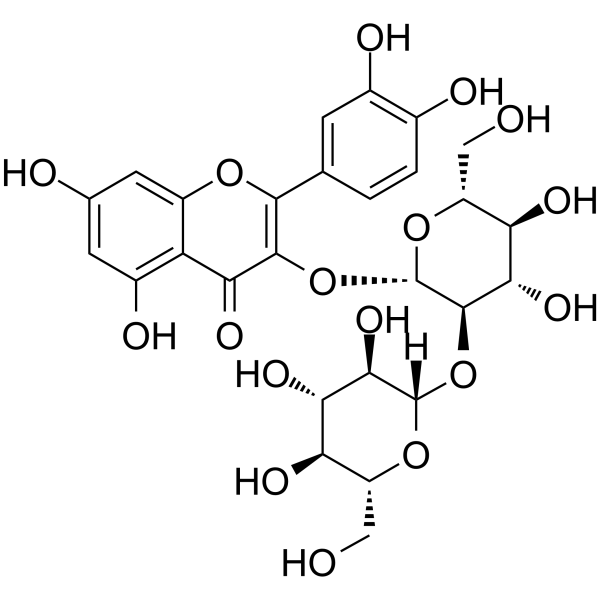
    Baimaside
    3 Publications Verification

    Quercetin 3-O-sophoroside

    SARS-CoV Infection Neurological Disease
    Baimaside (Quercetin 3-O-sophoroside) is a flavonoid cholinergic function modulator that binds to SARS-CoV-2-related targets. Baimaside regulates the expression of cholinergic system-related proteins and acetylcholine levels, improves scopolamine-induced learning and memory impairment, protects hippocampal neurons, inhibits pollen protein fluorescence, and protects pollen DNA. Its biosynthesis is regulated by multiple enzymes. Baimaside is completely absorbed in rats, undergoes phase Ⅱ metabolism and gut microbiota decomposition, and inhibits the invasion and proliferation of SARS-CoV-2 and its variants, making it suitable for research related to Alzheimer's disease and COVID-19 .
    Baimaside
  • HY-163385

    DNA Methyltransferase Cancer
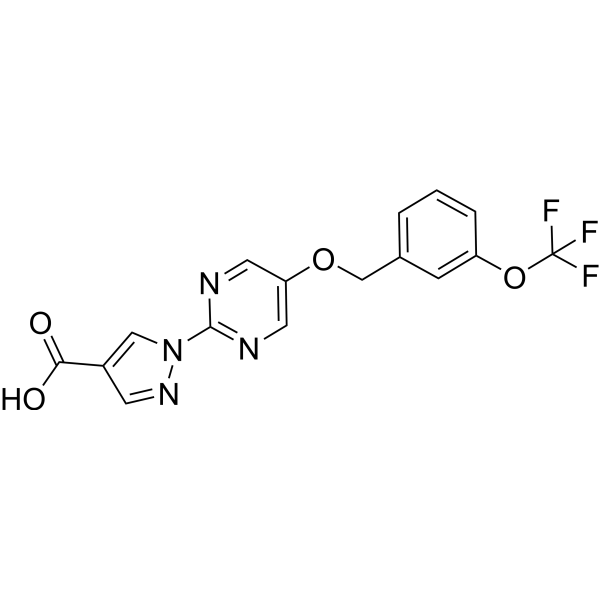
    ALKBH1-IN-1 (Compound 13h) is a selective ALKBH1 inhibitor, with an IC50 of 0.026 μM and 1.39 μM in the fluorescence polarization and enzyme activity assay, respectively. ALKBH1-IN-1 can modulate the level of DNA 6mA modifications. ALKBH1-IN-1 can be used to study the functions of ALKBH1 and DNA 6mA .
    ALKBH1-IN-1
  • HY-D1030

    Fluorescent Dye Others
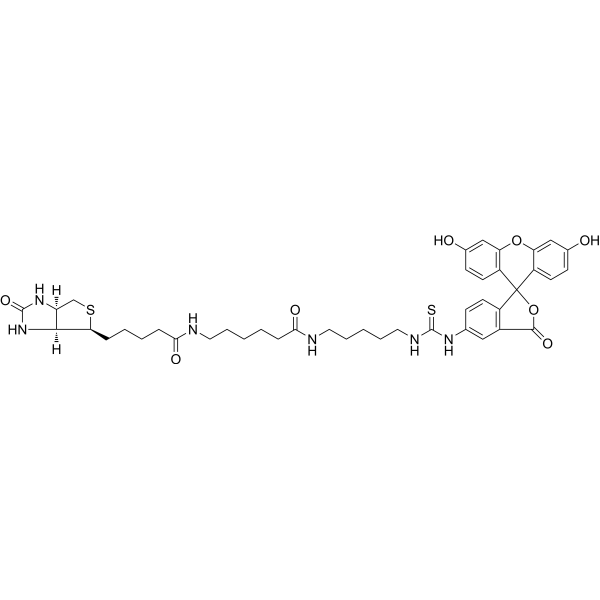
    Fluorescein Biotin is a fluorescent modulator with avidin and streptavidin binding activity. Fluorescein Biotin binds to the biotin-binding sites of avidin and streptavidin, and this binding induces significant fluorescence quenching .
    Fluorescein Biotin
  • HY-160250

    Fluorescent Dye UGT Metabolic Disease
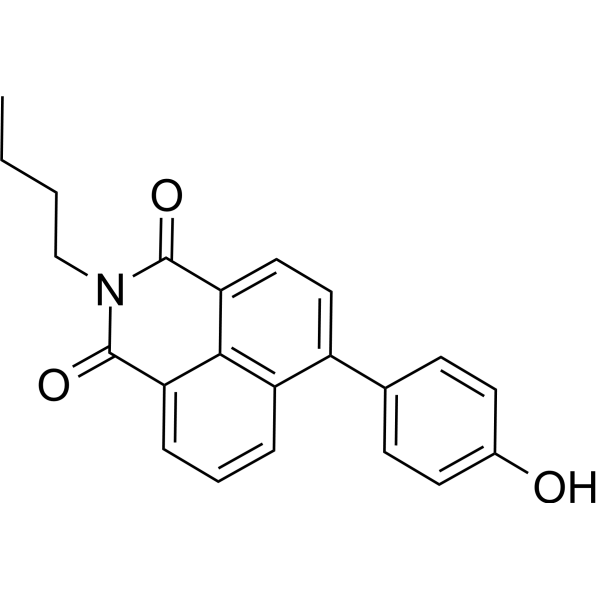
    UGT1A1-IN-1 is a UGT1A1 inhibitor and fluorescent probe (Ex=370 nm, Em=520 nm), with an IC50 of 1.33 μM and a Ki of 5.02 μM. UGT1A1-IN-1 is selectively glucuronidated by UGT1A1 at the bilirubin homologous binding site, and its PET effect is blocked along with this reaction, triggering fluorescence changes. UGT1A1-IN-1 can serve as a substitute for bilirubin to detect UGT1A1 activity and perform high-throughput screening of UGT1A1 modulators .
    UGT1A1-IN-1
  • HY-D2060

    Fluorescent Dye Others
    ATTO 740 is a near-infrared dye (Ex/Em: 740/764 nm). ATTO 740 can be conjugated with the Cetuximab antibody (HY-P9905) .
    ATTO 740
  • HY-N2183R

    Quercetin 3-O-sophoroside (Standard)

    Reference Standards SARS-CoV Others
    Baimaside (Standard) is the analytical standard of Baimaside. This product is intended for research and analytical applications. Baimaside (Quercetin 3-O-sophoroside) is a flavonoid cholinergic function modulator that binds to SARS-CoV-2-related targets. Baimaside regulates the expression of cholinergic system-related proteins and acetylcholine levels, improves scopolamine-induced learning and memory impairment, protects hippocampal neurons, inhibits pollen protein fluorescence, and protects pollen DNA. Its biosynthesis is regulated by multiple enzymes. Baimaside is completely absorbed in rats, undergoes phase Ⅱ metabolism and gut microbiota decomposition, and inhibits the invasion and proliferation of SARS-CoV-2 and its variants, making it suitable for research related to Alzheimer's disease and COVID-19 .
    Baimaside (Standard)
  • HY-D3243

    Fluorescent Dye Others
    Mn1 (M1) is a BODIPY-based Mn 2+-selective "turn-on" Fluorescent sensor and fluorescence modulator. In the absence of Mn 2+, Mn1 undergoes fluorescence quenching via photoinduced electron transfer; binding to Mn 2+ inhibits this mechanism, thereby generating a fluorescence "turn-on" response. Mn1 exhibits Mn 2+-specific cellular fluorescence response .
    Mn1
  • HY-D3404

    DNA Stain Others
    BODi-1 is a fluorescent modulator targeting dsDNA, which binds to dsDNA via a bis-intercalation mechanism (Ex=465 nm, Em=490 nm). BODi-1 exhibits a fluorescence enhancement effect upon binding to nucleic acids, but its fluorescence intensity, anisotropy and average lifetime decrease at higher dye/DNA ratios. When BODi-1 binds to DNA in liposome complexes, it also shows red-shifted emission spectra, along with reduced quantum yield and average lifetime. BODi-1 does not induce significant DNA conformational changes when the dye/DNA ratio is below 0.01. BODi-1 can be used as a fluorescent probe for the characterization of liposome complexes and FRET studies at this ratio .
    BODi-1

Consulta en línea

Your information is safe with us. * Required Fields.

Saludo


Country or Region *

Nombre del solicitante *


Nombre de la Organizaciòn *

Department *


Direcciòn del E-mail *


Nombre del producto *

Cat. No.


Requested quantity *

Número de teléfono *


Observaciones

Consulta en línea

Inquiry Information

Nombre del producto:
Cat. No.:
Cantidad:
MCE Japan Authorized Agent:

