
1. Search Result
Search Result
Pathways Recommended: Membrane Transporter/Ion Channel
Results for "

ion pump

" in MedChemExpress (MCE) Product Catalog:

11

Inhibitors & Agonists

1

Screening Libraries

1

Biochemical Assay Reagents

2

Natural
Products

1

Isotope-Labeled Compounds

Targets Recommended:
Cat. No. Product Name Target Research Areas Chemical Structure
  • HY-D0180

    18C6; 1,4,7,10,13,16-Hexaoxacyclooctadecane

    Bacterial Infection
    18-Crown-6-ether is a type of crown ether compound and a specific structure dissociating agent. 18-Crown-6-ether can compete with K + for binding to G-quadruplexes, disrupting their stable structure to regulate the functions of related systems. 18-Crown-6-ether combines with K + and other metal ions to achieve precise ion transmembrane transport. 18-Crown-6-ether can act as an "susceptibility substrate" for the multi-drug efflux pump EmrE (a bacterial multidrug resistance transporter), ultimately inhibiting bacterial growth. 18-Crown-6-ether can be used in microcapsule controlled release and the research on developing antibacterial enhancers .
    18-Crown-6-ether
  • HY-113410

    Na+/K+ ATPase Mitochondrial Metabolism Reactive Oxygen Species (ROS) Neurological Disease Metabolic Disease
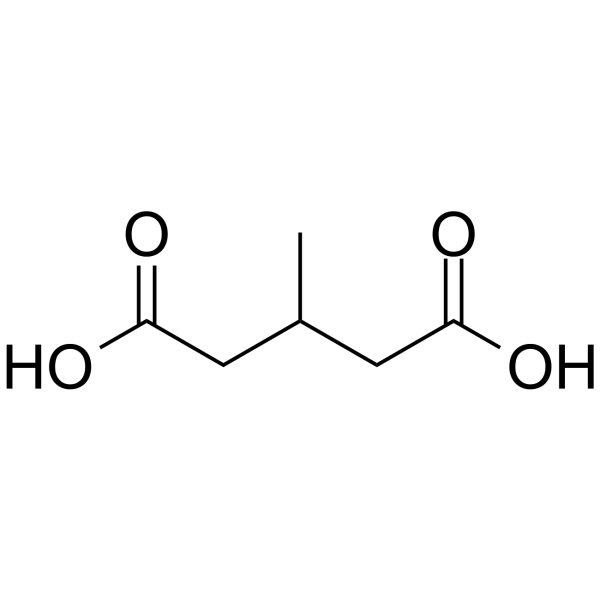
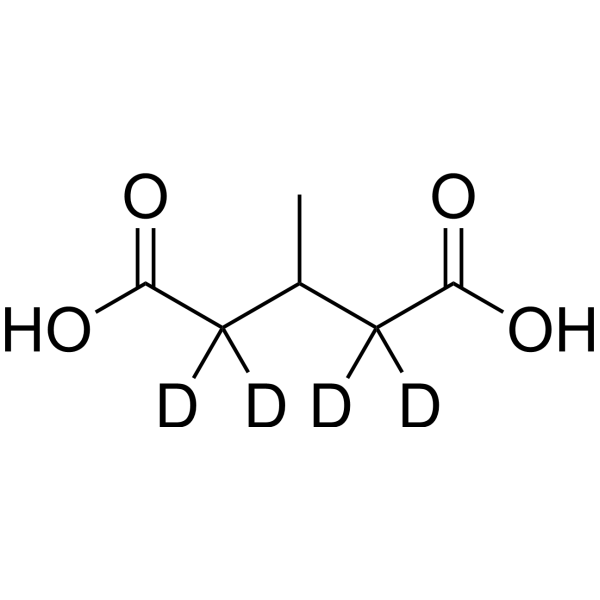
    3-Methylglutaric acid is a non-selective inhibitor of mitochondrial function and Na +, K +-ATPase, with an inhibition rate of 30% on rat cortical synaptosomal Na +, K +-ATPase. 3-Methylglutaric acid can induce reactive oxygen species (ROS) generation, thereby causing oxidative damage and inhibiting mitochondrial redox potential and ion pump function of cell membranes. 3-Methylglutaric acid can be used to study the neuropathological mechanisms of metabolic diseases and the role of oxidative stress-mediated neuronal damage in neurodegeneration .
    3-Methylglutaric acid
  • HY-W042301

    Anion Exchangers Carbonic Anhydrase Endothelin Receptor Cardiovascular Disease
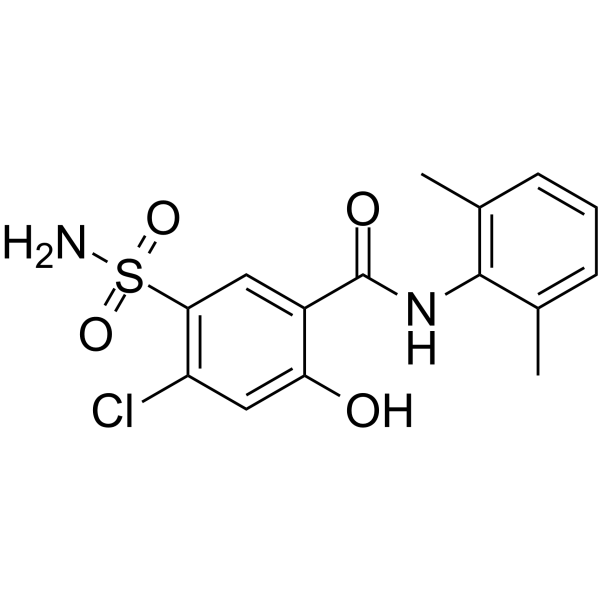
    Xipamide is an orally active carbonic anhydrase (CA) inhibitor and Na +/Cl --potassium transporter inhibitor with diuretic and antihypertensive effects. Xipamide reduces NaCl reabsorption by inhibiting the Cl -/NaCO3 - anion exchanger, and increases calcium reabsorption while promoting potassium and magnesium excretion. Xipamide is mainly cleared via the renal pathway and causes a temporary decrease in glomerular filtration rate under specific conditions. Xipamide does not affect Ca 2+ signaling induced by endothelin-1 and other factors, nor does it inhibit various ion cotransport or pump activities in red blood cells. Xipamide can be used in researches related to cardiovascular diseases, hypertension (especially with left ventricular hypertrophy), advanced renal failure, and liver cirrhosis with ascites .
    Xipamide
  • HY-13100

    Proton Pump Metabolic Disease
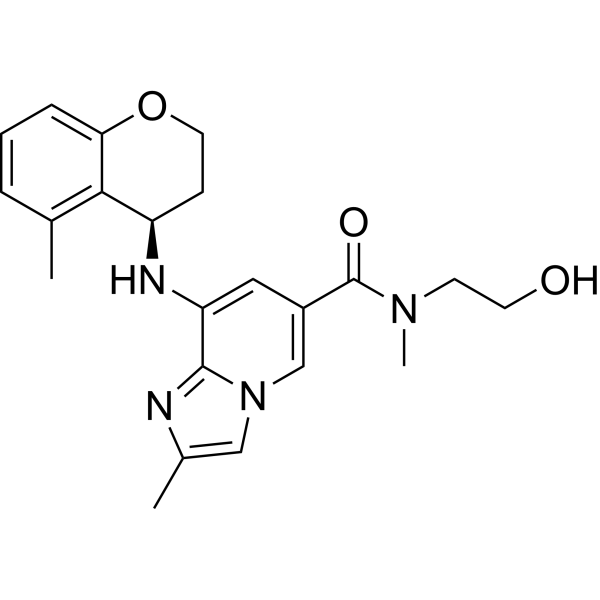
    PF 03716556 is a potent, selective, competitive and reversible acid pump (H +,K +-ATPase) antagonist with pIC50s of 6.026, 6.038 and 6.009 for porcine, canine, and human recombinant gastric H +,K +-ATPase, respectively. PF 03716556 is inactive against other receptors, ion channels, and enzymes. PF 03716556 has the potential for gastroesophageal reflux disease research .
    PF 03716556
  • HY-165569

    Potassium Channel Neurological Disease
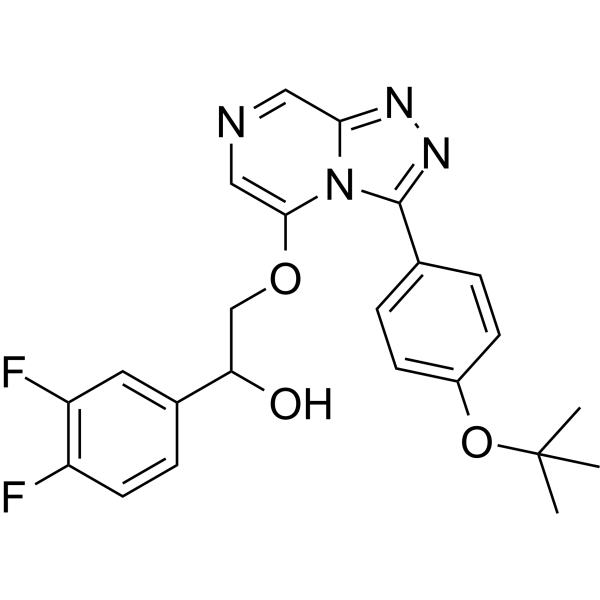
    AU-1421 is a potassium ion (K⁺) site-directed regulator that specifically acts on various cation transport ATPases. AU-1421 can distinguish between two different K⁺-sensitive phosphorylation intermediate (E2P) states: for non-K⁺ transport type ATPases (such as the sarcoplasmic reticulum Ca²⁺-ATPase), after binding to AU-1421, it mimics the agonistic effect of K⁺, significantly accelerating the hydrolysis (dephosphorylation) of E2P. For K⁺ transport type ATPases (such as the gastric mucosa H⁺/K⁺-ATPase and the renal Na⁺/K⁺-ATPase), after binding to AU-1421, it inhibits the hydrolysis of E2P, stabilizing the phosphorylated intermediate, thereby blocking the ion transport cycle. AU-1421 can be used to study the mechanism of the potassium ion pump .
    AU-1421
  • HY-145327

    Na+/K+ ATPase Parasite Infection
    Antimalarial agent 7 is a potent inhibitor of PfATP4. PfATP4 is an essential ion pump on the parasite surface. Antimalarial agent 7 has the potential for the research of human malaria parasite, Plasmodium falciparum .
    Antimalarial agent 7
  • HY-E70278

    Biochemical Assay Reagents Metabolic Disease
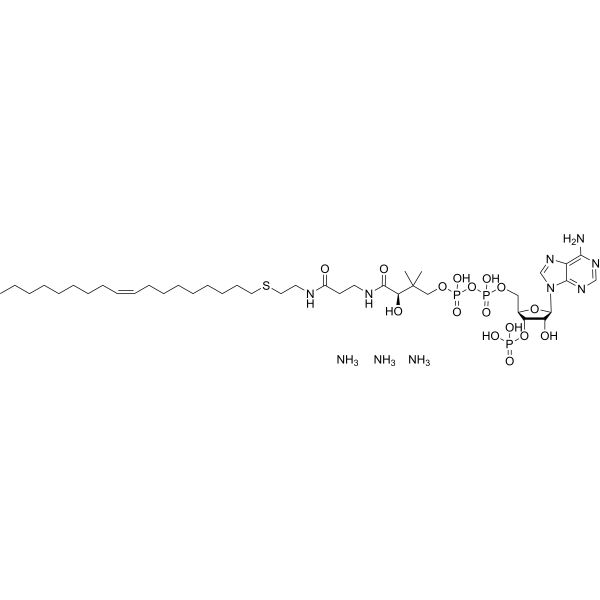
    (9Z-Octadecenyl)-CoA triammonium is a coenzyme. (9Z-Octadecenyl)-CoA triammonium is a long-chain acyl-CoA esters. Long-chain acyl-CoA esters are involved in regulation of fatty acid synthesis, enzyme systems, vesicle trafficking, ion channels and ion pumps .
    (9Z-Octadecenyl)-CoA triammonium
  • HY-118050

    L-420

    Sodium Channel Endogenous Metabolite Cardiovascular Disease
    L589420-0-2 (L-420) is a sodium pump inhibitor with inhibitory activity in human erythrocytes. L589420-0-2 can regulate the concentration of intracellular sodium ions, thereby affecting the electrophysiological properties of cells. L589420-0-2 may also play an important role in the inhibition of cardiovascular diseases .
    L589420-0-2
  • HY-113410S

    Isotope-Labeled Compounds Na+/K+ ATPase Mitochondrial Metabolism Reactive Oxygen Species (ROS) Neurological Disease Metabolic Disease
    3-Methylglutaric acid-d4 is the deuterium labeled 3-Methylglutaric acid (HY-113410). 3-Methylglutaric acid is a non-selective inhibitor of mitochondrial function and Na +, K +-ATPase, with an inhibition rate of 30% on rat cortical synaptosomal Na +, K +-ATPase. 3-Methylglutaric acid can induce reactive oxygen species (ROS) generation, thereby causing oxidative damage and inhibiting mitochondrial redox potential and ion pump function of cell membranes. 3-Methylglutaric acid can be used to study the neuropathological mechanisms of metabolic diseases and the role of oxidative stress-mediated neuronal damage in neurodegeneration .
    3-Methylglutaric acid-d4
  • HY-113410R

    Reference Standards Na+/K+ ATPase Mitochondrial Metabolism Reactive Oxygen Species (ROS) Neurological Disease Metabolic Disease
    3-Methylglutaric acid (Standard) is the analytical standard of 3-Methylglutaric acid (HY-113410). This product is intended for research and analytical applications. 3-Methylglutaric acid is a non-selective inhibitor of mitochondrial function and Na +, K +-ATPase, with an inhibition rate of 30% on rat cortical synaptosomal Na +, K +-ATPase. 3-Methylglutaric acid can induce reactive oxygen species (ROS) generation, thereby causing oxidative damage and inhibiting mitochondrial redox potential and ion pump function of cell membranes. 3-Methylglutaric acid can be used to study the neuropathological mechanisms of metabolic diseases and the role of oxidative stress-mediated neuronal damage in neurodegeneration .
    3-Methylglutaric acid (Standard)
  • HY-172577

    ion potassium green-4 (TMA)

    Fluorescent Dye Potassium Channel Others
    IPG-4 (Ion potassium green-4) TMA is an extracellular potassium ion fluorescence indicator with an Ex/Em ratio of 525/545 nm. IPG-4 TMA can be used for real-time monitoring and quantitative analysis of the transport of the biological electrochemical ion pump K⁺ .
    IPG-4 (TMA)

Inquiry Online

Your information is safe with us. * Required Fields.

Salutation


Country or Region *

Applicant Name *


Organization Name *

Department *


Email Address *


Product Name *

Cat. No.


Requested quantity *

Phone Number *


Remarks

Inquiry Online

Inquiry Information

Product Name:
Cat. No.:
Quantity:
MCE Japan Authorized Agent:

