1. Search Result
Search Result
Results for "

paralytic

" in MedChemExpress (MCE) Product Catalog:

8

Inhibitors & Agonists

1

Peptides

4

Natural
Products

Cat. No. Product Name Target Research Areas Chemical Structure
  • HY-135000

    DcSTX; DecarbamoylSTX

    Endogenous Metabolite Drug Metabolite Neurological Disease
    Decarbamoylsaxitoxin is a sodium channel inhibitor that blocks the influx of sodium ions through the membranes of excitable nerves and skeletal muscle cells, thereby preventing the formation of action potentials. Decarbamoylsaxitoxin is an acidic hydrolysis product of saxitoxin, and its toxic effects on mice are identical to those of saxitoxin. Decarbamoylsaxitoxin inhibits veratridine- and ouabain-induced swelling and lysis of mouse neuroblastoma cells by blocking Na + channels. Decarbamoylsaxitoxin can be used in studies related to paralytic shellfish poisoning .
    Decarbamoylsaxitoxin
  • HY-137252

    Ivermectin Impurity G

    Parasite Infection
    22,23-Dihydroavermectin B1a aglycon is an acid degradation product produced by hydrolysis of the disaccharide unit of ivermectin. It can inhibit nematode larval development, but does not cause paralytic activity.
    22,23-Dihydroavermectin B1a aglycon
  • HY-19605

    Sodium Channel Neurological Disease Cancer
    Gonyautoxin II is a paralytic shellfish poisoning toxin. Gonyautoxin II can block of the voltage-gated sodium channels at axonal level, impeding nerve impulse propagation. Gonyautoxin II has killing activity against mouse neuroblastoma cells. Gonyautoxin II can be used for the researches of cancer and neurological disease .
    Gonyautoxin II
  • HY-N6609

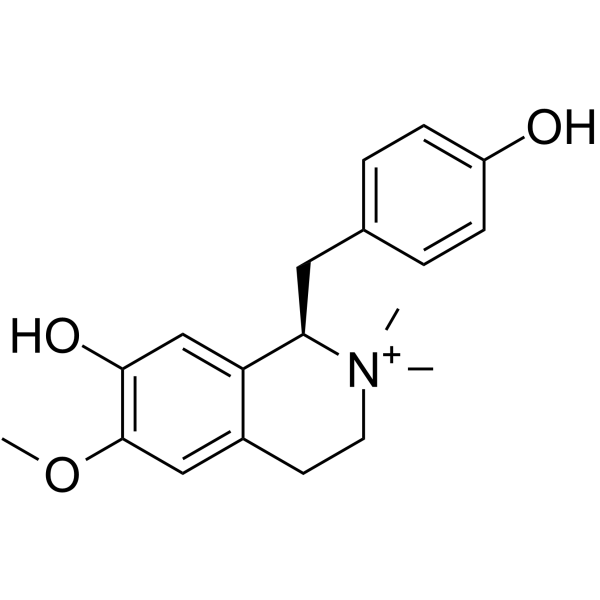
    nAChR Others
    Magnocurarine is a neuromuscular junction blocker that inhibits muscle contraction by functionally blocking signal transmission without directly damaging nerve or muscle tissues. In frog, mouse and rabbit models, Magnocurarine exerts a dose-dependent paralytic effect, which progresses gradually from limb weakness and loss of righting reflex to respiratory depression and even cardiac arrest. Although high doses cause complete cessation of movement, Magnocurarine does not affect the spinal multineuronal reflex in frogs. Magnocurarine exhibits biological activity similar to that of tubocurarine (HY-125901) in various animal models .
    Magnocurarine
  • HY-124874

    (rel)-Aspergillimide; (rel)-VM55598

    nAChR Neurological Disease
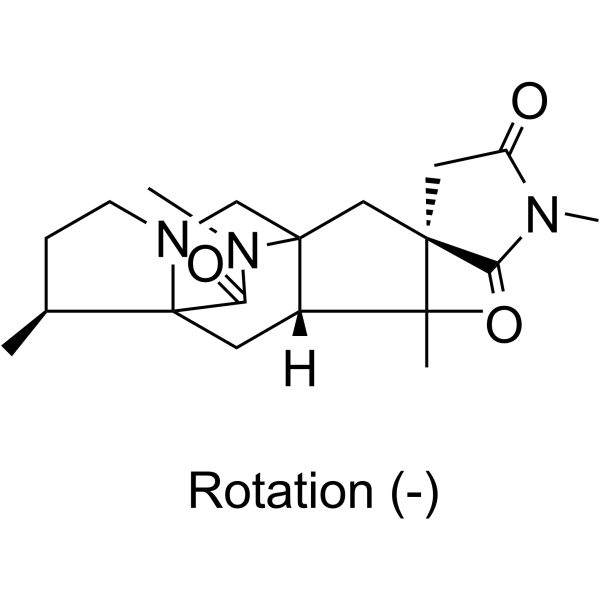
    (rel)-Asperparaline A ((rel)-Aspergillimide), an anthelmintic metabolite, is isolated from okara that has been fermented with Aspergillus japonicas JV-23. (rel)-Asperparaline A is also a potent and selective antagonist of nAChR. (rel)-Asperparaline A exhibits paralytic activity in silk worms .
    (rel)-Asperparaline A
  • HY-W343059

    GTX-III

    Sodium Channel Neurological Disease Cancer
    Gonyautoxin III (GTX-III) is a paralytic shellfish poisoning toxin. Gonyautoxin III can block of the voltage-gated sodium channels at axonal level with an IC50 of 14.9 nM, impeding nerve impulse propagation. Gonyautoxin III has killing activity against mouse neuroblastoma cells. Gonyautoxin III can be used for the researches of cancer and neurological disease .
    Gonyautoxin III
  • HY-179116

    BS2463

    Parasite Infection
    BL-1005 (BS2463), thiophen-2-yl pyrimidine (TTP), is a potent paralytic of Schistosoma mansoni with an EC50 of 37 nM. BL-1005 shows low cytotoxicity for HEK293, HeLa and HepG2 cell with CC50 >20 μM. BL-1005 can induce paralysis in both adult and juvenile S. mansoni. BL-1005 can be used for the research of infection .
    BL-1005
  • HY-N6609B

    nAChR Cardiovascular Disease
    Magnocurarine chloride is a neuromuscular junction blocker that inhibits muscle contraction by functionally blocking signal transmission without directly damaging nerve or muscle tissues. In frog, mouse and rabbit models, Magnocurarine chloride exerts a dose-dependent paralytic effect, which progresses gradually from limb weakness and loss of righting reflex to respiratory depression and even cardiac arrest. Although high doses cause complete cessation of movement, Magnocurarine chloride does not affect the spinal multineuronal reflex in frogs. Magnocurarine chloride exhibits biological activity similar to that of tubocurarine (HY-125901) in various animal models .
    Magnocurarine chloride

Inquiry Online

Your information is safe with us. * Required Fields.

Salutation


Country or Region *

Applicant Name *


Organization Name *

Department *


Email Address *


Product Name *

Cat. No.


Requested quantity *

Phone Number *


Remarks

Inquiry Online

Inquiry Information

Product Name:
Cat. No.:
Quantity:
MCE Japan Authorized Agent:

