
1. Search Result
Search Result
Results for "

parenchyma

" in MedChemExpress (MCE) Product Catalog:

9

Inhibitors & Agonists

2

Biochemical Assay Reagents

1

Inhibitory Antibodies

Cat. No. Product Name Target Research Areas Chemical Structure
  • HY-W176557

    Aquaporin Neurological Disease
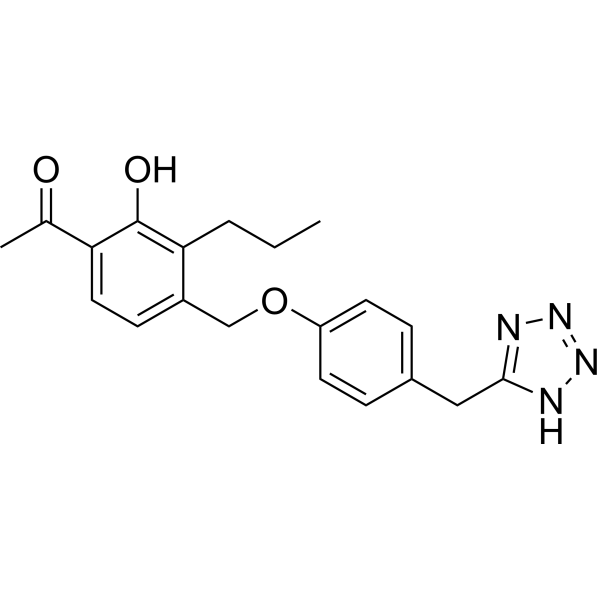
    TGN-073 is a aquaporin 4 (AQP4) modulator, as well as an orally available, blood-brain barrier-permeable agent. TGN-073 increases the uptake and distribution of brain MRI tracers in the brain parenchyma and reduces the levels of insoluble amyloid-β 40 and β 42. TGN-073 can be used in research related to Alzheimer's disease, dementia, traumatic brain injury and pain .
    TGN-073
  • HY-NP0204

    ELOVL Apoptosis NOD-like Receptor (NLR) Caspase Tau Protein Neurological Disease Inflammation/Immunology
    Mouse Serum Albumin is most abundant protein in plasma, which leaks into the brain parenchyma when the blood-brain barrier (BBB) is impaired. Mouse Serum Albumin induces astrocytes to A1 phenotype to remarkably increase levels of Elovl1. Mouse Serum Albumin promotes VLSFAs secretion and causes neuronal lippoapoptosis through endoplasmic reticulum stress response pathway. MSA-activated microglia triggeres remarkable tau phosphorylation at multiple sites (Ser202/Thr205) through NLRP3 inflammasome pathway. Mouse Serum Albumin decreases the spatial learning and memory abilities in mice. Mouse Serum Albumin can be used for the study of neurodegenerative diseases like Alzheimer’s disease (AD) and frontotemporal dementia (FTD) .
    Mouse Serum Albumin
  • HY-W133891

    Peptones, soybean

    Biochemical Assay Reagents Others
    Peptone from soy (peptones, soybean) is a peptone. Peptone from soy provides nitrogen and carbon sources, as well as other nutrients. Peptone from soy can stimulate/regulate the biosynthesis of cyclic eicosanoids. Peptone from soy induces dose-dependent contraction of guinea pig lung parenchyma. Peptone from soy can be used in microbial and cell culture .
    Peptone from soya
  • HY-113758

    Leukotriene Receptor Inflammation/Immunology
    LY 163443 is a selective antagonist of leukotrienes D4 (LTD4) and E4 (LTE4). LY 163443 can antagonize LTD4-induced contractions of guinea pig ileum, trachea, and lung parenchyma. LY 163443 also inhibits tracheal contractions to LTE4 .
    LY 163443
  • HY-100724

    Leukotriene Receptor Inflammation/Immunology
    YM-17690 is a LTD4 and LTE4 agonist, with a pKi value of 9.28 for [3H]LTD4. It induces dose-dependent contractions in guinea pig ileum, lung parenchyma, and trachea, with EC50 values of 16, 3.9, and 22 nM, respectively. YM-17690 can be used in research related to asthma and inflammation .
    YM-17690
  • HY-132246

    MAGL Neurological Disease
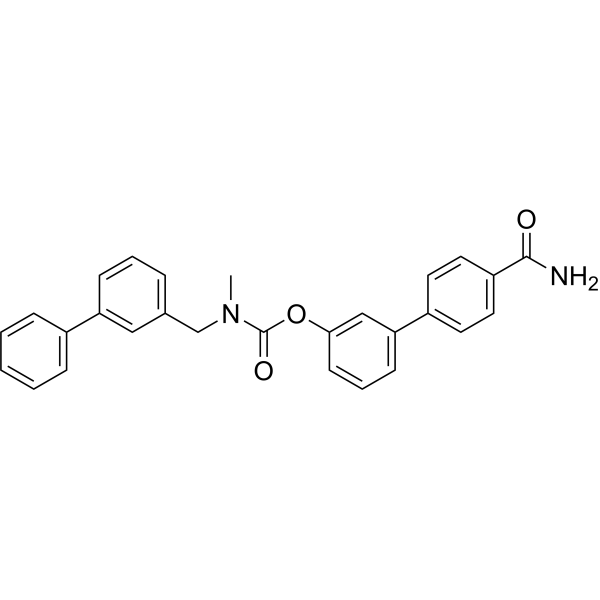
    WWL123 analogue-1 is an analogue of WWL123. WWL123 is a potent and selective ABHD6 inhibitor with an IC50 of 430 nM . WWL123 crosses the blood-brain-barrier and inhibits ABHD6 in brain parenchyma. ABHD6 blockade by WWL123 exerts an antiepileptic effect in Pentylenetetrazole (PTZ)-induced epileptiform seizures and spontaneous seizures in R6/2 mice .
    WWL123 analogue-1
  • HY-W747563

    11-trans LTD4

    Drug Isomer Others
    11-trans Leukotriene D4 (11-trans LTD4) is a C-11 double bond isomer of LTD4. LTD4 undergoes slow temperature-dependent isomerization to 11-trans LTD4 during storage. 11-trans LTD4 retains about 10-25 % of the potency for contraction of guinea pig ileum, trachea and parenchyma compared to LTD4. It exhibits an ED50 ranging between 12-60 nM for contraction of guinea pig trachea.
    11-trans Leukotriene D4
  • HY-P992048

    HIRMab; SHP-631; TAK-531

    Insulin Receptor Metabolic Disease
    AGT-182 (HIRMab; SHP-631; TAK-531) is a brain-penetrating anti-human insulin receptor antibody and iduronate-2-sulfatase conjugation. AGT-182 can be used for the research of mucopolysaccharidosis type II (MPS II, Hunter syndrome) .
    AGT-182
  • HY-182640

    Adrenergic Receptor Cardiovascular Disease Metabolic Disease Inflammation/Immunology
    SM-11044 is a β-adrenoceptor agonist with Ki values of 18.1 μM (β1), 4.1 μM (β2) and 1.3 μM (β3), showing higher binding selectivity for the β3-adrenoceptor. SM-11044 stimulates cAMP accumulation in cells expressing this receptor. SM-11044 mediates ileal relaxation, tracheal relaxation, pulmonary parenchymal relaxation, increased right atrial heart rate and adipocyte lipolysis .
    SM-11044

Inquiry Online

Your information is safe with us. * Required Fields.

Salutation


Country or Region *

Applicant Name *


Organization Name *

Department *


Email Address *


Product Name *

Cat. No.


Requested quantity *

Phone Number *


Remarks

Inquiry Online

Inquiry Information

Product Name:
Cat. No.:
Quantity:
MCE Japan Authorized Agent:

