

1. Search Result
Search Result
Results for "

peptide engineering

" in MedChemExpress (MCE) Product Catalog:

13

Inhibitors & Agonists

1

Screening Libraries

2

Biochemical Assay Reagents

15

Peptides

Cat. No. Product Name Target Research Areas Chemical Structure
  • HY-Y0623
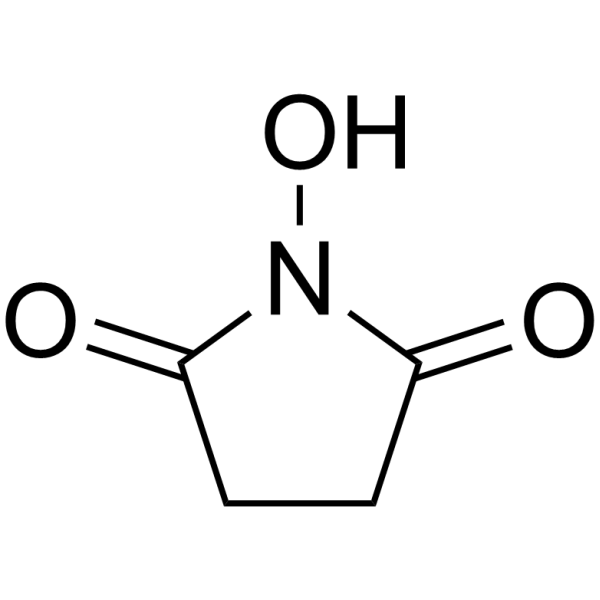
    N-Hydroxysuccinimide
    5+ Cited Publications

    HOSu; 1-Hydroxy-2,5-pyrrolidinedione

    Biochemical Assay Reagents Others
    N-Hydroxysuccinimide (HOSu; 1-Hydroxy-2,5-pyrrolidinedione) is a covalent crosslinker commonly used in bioconjugation technology with a primary amine group. N-Hydroxysuccinimide reacts with amino groups (-NH2) to form a stable amide bond, which can modify amino-containing biomolecules. N-Hydroxysuccinimide can be used, for example, for protein labeling with fluorescent dyes and enzymes, surface activation of chromatography supports, microbeads, nanoparticles and microarray slides, and chemical synthesis of peptides. N-Hydroxysuccinimide has a wide range of applications in biomaterial synthesis (such as collagen, chitosan crosslinking), drug delivery systems (such as hydrogel preparation) and tissue engineering .
    N-Hydroxysuccinimide
  • HY-P4198

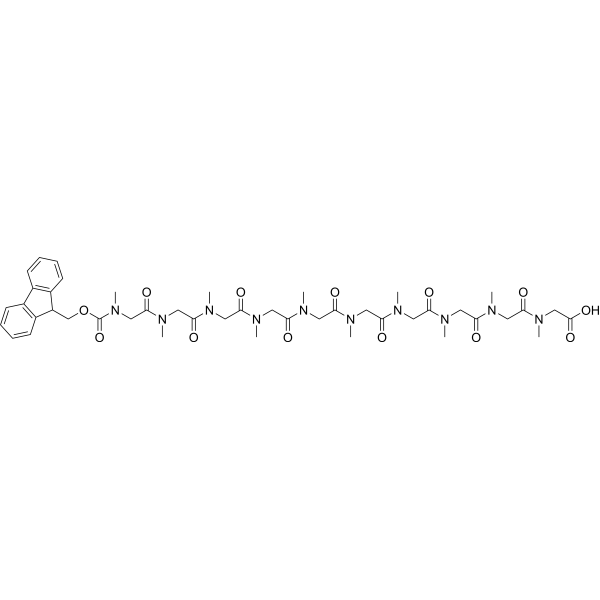
    Fmoc-Sar10

    Biochemical Assay Reagents Others
    Fmoc-N(Me)-Sar10 (Fmoc-Sar10) is an Fmoc-protected derivative of a methylated sarcosine decamer, which supports cell adhesion, proliferation, and maintenance of cell phenotype. Fmoc-N(Me)-Sar10 is primarily used in peptide synthesis to introduce enzymatically stable spacer sequences. By mimicking the extracellular matrix (ECM), Fmoc-N(Me)-Sar10 provides a 3D growth microenvironment for cells and is mainly used in tissue engineering and 3D cell culture, particularly suitable for in vitro culture studies of cells such as chondrocytes .
    Fmoc-N(Me)-Sar10
  • HY-P5558

    VEGFR Neurological Disease
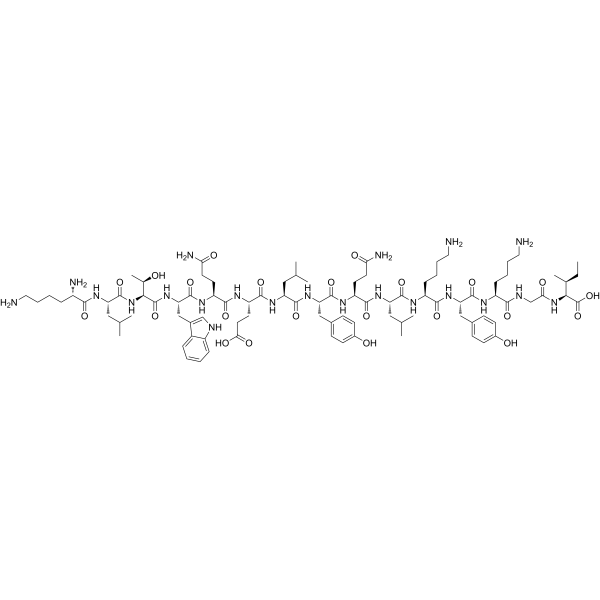
    KLTWQELYQLKYKGI is a VEGF mimetic peptide designed based on the VEGF helix sequence 17-25, with the ability to activate VEGF receptors and exert pro-angiogenic biological activity. KLTWQELYQLKYKGI effectively promotes the attachment, spreading and proliferation of human umbilical vein endothelial cells. KLTWQELYQLKYKGI enhances the proliferation, migration and osteogenic differentiation of bone marrow stromal cells (BMSCs). KLTWQELYQLKYKGI synergistically accelerates angiogenesis and bone regeneration in rat cranial defect models. KLTWQELYQLKYKGI can be used for the research of brain tissue engineering and traumatic brain injury repair and biomaterials for bone tissue engineering and bone repair .
    KLTWQELYQLKYKGI
  • HY-P11328

    Integrin Others
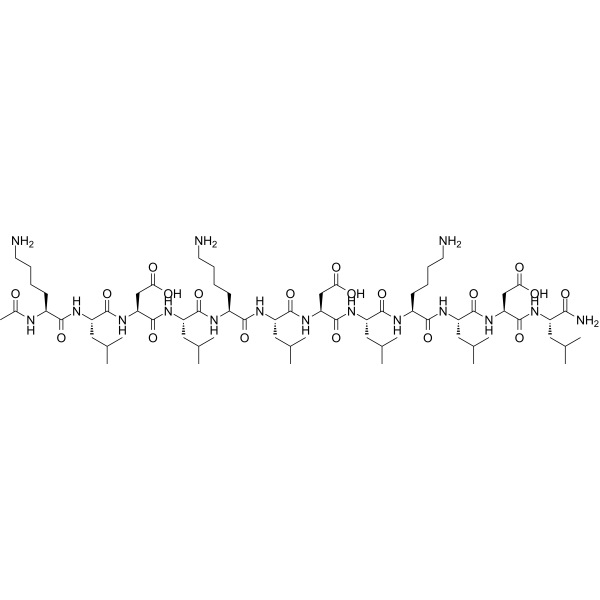
    GFOGER peptide is an artificially synthesized collagen-mimetic sequence. GFOGER peptide acts as a ligand for α2β1, α11β1 and α1β1 integrins, thereby supporting integrin-mediated cell adhesion to collagen. GFOGER peptide triggers signaling pathways mediated by the α2β1 integrin receptor and upregulates osteoblast differentiation. GFOGER peptide accelerates and enhances bone formation at sites of refractory femoral defects. GFOGER peptide can be passively adsorbed onto polymer scaffolds for cell-free/growth factor-free bone formation. GFOGER peptide is used in biomaterials such as hydrogels and 3D bioinks for tissue engineering research including bone formation .
    GFOGER peptide
  • HY-W835525

    Biochemical Assay Reagents Others
    N-(Biotinoyl)-N''-(iodoacetyl)ethylenediamine is a biotinylated biochemical assay reagent that forms a layer of biotin derivative on the surface of ORMOCER, and triggers the assembly of peptide nanostructured fibers. N-(Biotinoyl)-N''-(iodoacetyl)ethylenediamine can be used for 3D assembly of peptides in molecular electronics, biosensors, and tissue engineering .
    N-(Biotinoyl)-N''-(iodoacetyl)ethylenediamine
  • HY-W009033

    Biochemical Assay Reagents Amino Acid Derivatives Others
    Cbz-Lys(Boc)-OH is a protected amino acid, primarily utilized in peptide synthesis, protein engineering, and drug development, particularly in research involving lysine residues .
    Cbz-Lys(Boc)-OH
  • HY-P11246

    RXFP Receptor Metabolic Disease
    A13:B7-24-GG is an engineered analogue of insulin-like peptide 5 (INSL5), a selective RXFP4 agonist with a Ki value of 2.29 nM. A13:B7-24-GG has an extremely low binding affinity for RXFP3 (Ki = 602.56 nM) and an inhibitory effect on cAMP (EC50) of 1.17 nM. Activation of RXFP4 by A13:B7-24-GG leads to the recruitment of β-Arrestin2, with an EC50 of 22.39 nM. A13:B7-24-GG can be used for research on chronic constipation .
    A13:B7-24-GG
  • HY-P10499

    CaMK Others
    [Ala286]-Calmodulin-Dependent Protein Kinase II (281-302) is a modified fragment of calcium/calmodulin-dependent protein kinase II that contains the active domain of CaMKII and has an alanine substitution at position 286. [Ala286]-Calmodulin-Dependent Protein Kinase II (281-302) can be used to develop more potent CaMKII inhibitors .
    [Ala286]-Calmodulin-Dependent Protein Kinase II (281-302)
  • HY-164076

    Biochemical Assay Reagents Others
    mPEG-Epoxide is an activated polyethylene glycol (mPEG) derivative, which is achieved by converting the hydroxyl groups of mPEG into reactive epoxy groups. mPEG-Epoxide is a mild PEGylation reagent that reacts with amino groups in peptides and proteins to form stable secondary amine bonds. mPEG-Epoxide can be used in protein engineering and biomaterials research .
    mPEG-Epoxide
  • HY-P11275

    GLP Receptor GCGR Neuropeptide Y Receptor Metabolic Disease
    TC4 is a highly balanced single-molecule quadruple agonist that can respectively activate GIPR, GLP-1R, GcgR, and Y2R with IC50 values of 0.95, 31, 81, and 1100 nM respectively. TC4 exhibits extremely strong signal bias on GLP-1R and has very low recruitment efficacy for β-inhibitor protein 2 (βArr2) and this strong cAMP preference is believed to maximize metabolic benefits (such as weight loss and hypoglycemia) while possibly minimizing side effects mediated by β-inhibitor protein recruitment (such as receptor desensitization). TC4 can be used for research on obesity and diabetes .
    TC4
  • HY-P11279

    GLP Receptor GCGR Neuropeptide Y Receptor Metabolic Disease
    TC2 is an efficient GIPR-preferring monomeric quadruple agonist that can respectively activate GIPR, GLP-1R, GcgR, and Y2R with IC50 values of 0.47, 2.1, 30, and 55 nM respectively. TC2 exhibits a significant GLP-1R preference, with a significant reduction in β-inhibitory protein 2 (βArr2) recruitment, while maintaining a strong cAMP signal. TC2 can be used for research on obesity and diabetes .
    TC2
  • HY-P11259

    Urotensin Receptor Cardiovascular Disease Metabolic Disease Inflammation/Immunology Cancer
    UPG-111 is a peptide compound that acts as a negative allosteric modulator of the Urotensin II receptor (UTR). UPG-111 exhibits a dual inhibitory effect on the vasoconstriction induced by UTR agonists - it reduces both the maximum response intensity and the sensitivity of the agonist. UPG-111 does not induce calcium release or cause contraction of the endothelium-deprived rat aortic rings. UPG-111 can be used for the study of various diseases related to the angiotensinergic system .
    UPG-111
  • HY-P11258

    Urotensin Receptor Cardiovascular Disease Metabolic Disease Inflammation/Immunology Cancer
    UPG-108, a peptide compound, is a non-competitive allosteric modulator of Urotensin II receptors (UTR). UPG-108 significantly enhances the efficacy of UTR agonists but reduces the potency of UTR agonists. UPG-111 efficiently induces calcium release and does not cause contraction of rat aortic rings without endothelial denudation. UPG-111 can be used to study various diseases related to the angiotensinergic system .
    UPG-108

Inquiry Online

Your information is safe with us. * Required Fields.

Salutation


Country or Region *

Applicant Name *


Organization Name *

Department *


Email Address *


Product Name *

Cat. No.


Requested quantity *

Phone Number *


Remarks

Inquiry Online

Inquiry Information

Product Name:
Cat. No.:
Quantity:
MCE Japan Authorized Agent:

